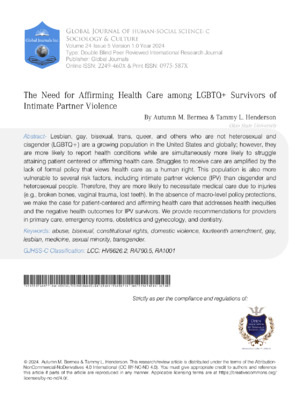
The Need for Affirming Health Care among LGBTQ+ Survivors of Intimate Partner Violence

Article ID

7E7PM

Accessible alt text highlighting LGBTQ+ health studies and research findings.

The Need for Affirming Health Care among LGBTQ+ Survivors of Intimate Partner Violence

Autumn M Bermea
Autumn M Bermea
Tammy L. Henderson
Tammy L. Henderson
DOI

Abstract

Lesbian, gay, bisexual, trans, queer, and others who are not heterosexual and cisgender (LGBTQ+) are a growing population in the United States and globally; however, they are more likely to report health conditions while are simultaneously more likely to struggle attaining patient centered or affirming health care. Struggles to receive care are amplified by the lack of formal policy that views health care as a human right. This population is also more vulnerable to several risk factors, including intimate partner violence (IPV) than cisgender and heterosexual people. Therefore, they are more likely to necessitate medical care due to injuries (e.g., broken bones, vaginal trauma, lost teeth). In the absence of macro-level policy protections, we make the case for patient-centered and affirming health care that addresses health inequities and the negative health outcomes for IPV survivors. We provide recommendations for providers in primary care, emergency rooms, obstetrics and gynecology, and dentistry.

The Need for Affirming Health Care among LGBTQ+ Survivors of Intimate Partner Violence

Lesbian, gay, bisexual, trans, queer, and others who are not heterosexual and cisgender (LGBTQ+) are a growing population in the United States and globally; however, they are more likely to report health conditions while are simultaneously more likely to struggle attaining patient centered or affirming health care. Struggles to receive care are amplified by the lack of formal policy that views health care as a human right. This population is also more vulnerable to several risk factors, including intimate partner violence (IPV) than cisgender and heterosexual people. Therefore, they are more likely to necessitate medical care due to injuries (e.g., broken bones, vaginal trauma, lost teeth). In the absence of macro-level policy protections, we make the case for patient-centered and affirming health care that addresses health inequities and the negative health outcomes for IPV survivors. We provide recommendations for providers in primary care, emergency rooms, obstetrics and gynecology, and dentistry.

Autumn M Bermea
Autumn M Bermea
Tammy L. Henderson
Tammy L. Henderson

No Figures found in article.

Autumn M Bermea. 2026. “. Unknown Journal GJHSS-C Volume 24 (GJHSS Volume 24 Issue C5): .

Download Citation

Journal Specifications
Issue Cover
GJHSS Volume 24 Issue C5
Pg. 33- 44
Classification
Not Found
Keywords
Article Matrices
Total Views: 880
Total Downloads: 27
2026 Trends
Research Identity (RIN)
Related Research
Our website is actively being updated, and changes may occur frequently. Please clear your browser cache if needed. For feedback or error reporting, please email [email protected]


Request Access

Please fill out the form below to request access to this research paper. Your request will be reviewed by the editorial or author team.
X

Quote and Order Details

Contact Person

Invoice Address

Notes or Comments

This is the heading

Lorem ipsum dolor sit amet, consectetur adipiscing elit. Ut elit tellus, luctus nec ullamcorper mattis, pulvinar dapibus leo.

High-quality academic research articles on global topics and journals.

The Need for Affirming Health Care among LGBTQ+ Survivors of Intimate Partner Violence

Autumn M Bermea
Autumn M Bermea
Tammy L. Henderson
Tammy L. Henderson

Research Journals