The article examines the nature of thermal radiation from the Universe, black holes as a baryonic matter factory and quasar disks as natural masers.
## I. INTRODUCTION
Despite all the successes of modern astrophysics, the cosmological theory of the birth and evolution of the Universe remains a territory of delusions, scientific speculations about inflationary theories and pseudoscientific opuses, like the "Universal Law of Antigravity" in the standard cosmological model $\Lambda$ CDM [1]. Martin Ries, the cosmologist and the astrophysicist, President of the Royal Society of London, believes that the birth of the universe will remain a mystery to us forever. He declares: "We do not understand the laws of the universe. And we'll never know how the universe appeared and what awaits it. The hypotheses about the Big Bang, which allegedly gave rise to the world around us, or that there may be many others in parallel with our Universe, or about the holographic nature of the world, will remain unproved assumptions." The authors of the new theory of the origin of the Universe are N. Anshordi, R. Mann and R. Purhasan suggested that our Universe could have arisen as the result of implosion (explosion inward) of a star from four-dimensional space predeecessor of the Universe [2]. The presence of in homogeneities of the background radiation was discovered as a result of astronomical observations and can serve as confirmation of the energetic connection of our Universe with the external enveloping Cosmos[2]. According to the latest data, interaction between parallel universes is possible through wormholes. Physicists divide wormholes into passable and impassable. Traversable wormholes can potentially connect different regions of space-time Fig.1
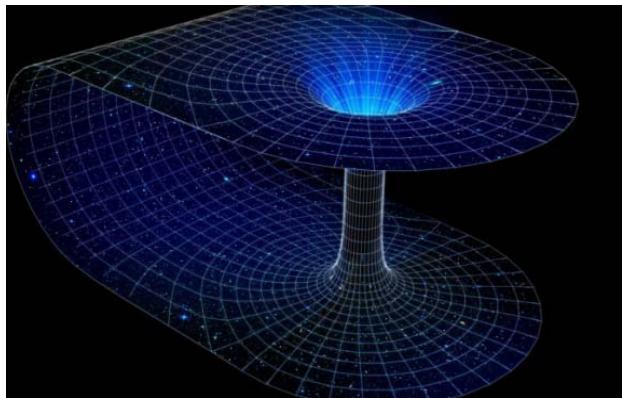 Figure 1: Wormhole (walkable)
In particular, a field flux created by objects on opposite sides of the hole can pass through such a hole, so the objects will feel each other long before they fall into the hole. Physicists from China and the United States have evaluated how objects on opposite sides of the wormhole interact. It turned out that due to the "glueing" of fields at the border of "our" and "alien" spaces, observers feel the electric, scalar and gravitational fields of objects from the opposite edge of the hole [3]. A clarification needs to be made here. Recently, astrophysicists discovered the shadow of a black hole's exit caused by gravitational lensing [4]. This fact suggests that physicists from China and the United States found the electric, scalar and gravitational fields of objects in your universe located on the other side of the black hole. Scientists from the Center for Astrophysical Research in the Fermi Laboratory (Fermilab) are now working on creating a Holometer device. With the help of the Golometer device, experts hope to prove or disprove the insane assumption that the three-dimensional Universe, as we know it, does not exist more than a kind of hologram. In other words, the surrounding reality is an illusion and nothing more. Until the illusory nature of our world is proven, scientists have hope to understand the laws of the universe. The new cosmological theory of Professor Valery Etkin on the local expansion and contraction of the Universe, based on the hypothesis of an uneven distribution of baryonic and non-baryonic matter in the Cosmos, is based on the energy-dynamic theory of the evolution of the Universe, which rejects the Big Bang as the beginning of all things [5].
## II. THE THEORY OF LOCAL EXPANSION AND CONTRACTION OF THE UNIVERSE
In the new cosmological model, the quantum vacuum is understood as a super fluid heterogeneous medium of dark matter and dark energy forming a galactic and intergalactic environment, which accounts for $95\%$ of the average density of matter in the Universe [6]. In this case, ordinary baryonic matter accounts for only about $5\%$. Possessing the property of gravity, super fluid dark matter forms a halo around galaxies, which, rotating together with them, forms apremionantly flat or nearly flat structure of the Universe [6]. Lawrence Livermore National Laboratory of the United States announced on 2022 about the sensational results. This laboratory has long-term observations and analysis with the Supercomputer. A space model of our entire Universe was created on the Supercomputer, and it turned out that our Universe has a flat structure, and all Galaxies about half a million light years in size are located at a distance of six billion light years from each other and lie in the same plane. This picture of our Universe does not correspond to the Big Bang model. Today, with the creation of the largest James Webb space telescope, astrophysicists have the opportunity to look into the depths of the Universe, 13 billion years old in the infrared, and there they did not see the expected picture of the Big Bang. Astrophysicists are in a panic. In July 2022, a large group of astrophysicists published an article called "Panic!" [7]. According to the latest astrophysical data, the number of small galaxies and their location in the depths of the Universe, aged 13 billion years, does not correspond to the expected picture of the Big Bang. Astrophysicists tend to think that the Universe has always existed and the Big Bang, like the singularity, is Einstein's unscientific fantasy. Based on the latest conclusions of astrophysicists, the nature of the background radiation discovered in 1965 by A. Penzias and R. Wilson cannot be a relic, which means that the hypothesis of cold nuclear fusion in the space environment acquires a scientific status. Nature offers humanity various options for atomic fusion: on the one hand, it is uncontrolled thermonuclear fusion realized in the depths of the sun and accompanied by coronary emissions that have a detrimental effect on all life on the planets: on the other hand, the thermal radiation of the universe realized in the form of cold nuclear fusion in the interstellar medium. The detected thermal background radiation of the Universe, discovered in 1965 by A. Penzias and Robert Wilson, in the microwave range from 10 GHz to 33 GHz received in astrophysics an insufficiently convincingly justified name "relict". This may be a process of cold nuclear fusion occurring in the space environment, with the release of energy sufficient to raise the temperature of the Universe to 2.7 K. The theory of local expansion and contraction of the infinite Universe does not need the Big Bang and the inflationary theory of the expansion of a point into the existing Universe 13 billion years from its birth [5]. This could be a process of cold nuclear fusion occurring in the cosmic environment, releasing enough energy to raise the temperature of the Universe to $2.7\mathrm{K}$. From the point of view of the unitary quantum theory (UQT) of Professor L. Sapogin, the motion of electrons in tunnel junctions can occur even very low temperatures [8]. This is confirmed by the experiments of American scientists who managed to establish tunnel effects near the absolute zero temperature (in liquid helium) [9]. Under normal conditions, a vacuum quantum behaves like a quasiparticle in a condensed state. In a state of excitation, a vacuum quantum loses its original state and passes into a new one - into the state neutron $\mathsf{n}^{\mathsf{o}}$ (1840;1;0), which then transforms into three particles, proton $\mathsf{p}^{\mathsf{o}}$ (1836;1;1), electron $\mathsf{e}^{-}(1;1; -1)$ and antineutrino $\gamma^{-}(1; -1;0)$ [10]. During the birth of a neutron, several types of elementary particles are released. They form the corresponding radiation, by the combination of which one can detect the processes of production of the proton, deuterium and tritium neutrons:
$\gamma$ -quanta $\gamma^{-}(0;1;0)$ and $\gamma^{+}(0;1;0)$ - form $\gamma$ -radiation;
neutrino ${}^{\mathrm{b}}\gamma^{-}(-1; - 1;0)$ and $\gamma^{+}(1;1;0)$ - neutrino radiation;
electrons and positrons $\mathrm{we}^{-}$ (-1; -1; -1) and $\mathrm{e}^{+}(1; 1; 1)$ - forms $\beta$ -radiation;
generated single neutrons $\mathsf{n}^0$ (1840;1;0) give neutron radiation;
neutrons grouped in pairs form $\alpha$ -radiation [10].
It is in this interstellar medium that cold nuclear fusion occurs, allowing the creation of thermal background radiation from the Universe in the microwave range from 10 GHz to 33 GHz. When a vacuum is irradiated by third-party $\gamma$ quanta, the vacuum must be transformed into matter, in which case the above five types of radiation will be present, and high energy and temperature will also be released [10]. However, there is one argument in favour of the existence of a big bang in the past. In the standard Big Bang model, the Big Bang problem is solved very well. At high density, immediately after the explosion, matter and radiation were a homogeneous mixture, and interacting with each other according to the laws of statistical physics, they reached an equilibrium distribution. When, after several hundred years, the radiation "broke away" from the substance that suddenly became transparent, the photons inherited the same pristine equilibrium distribution for the entire subsequent history, despite the progressive drop in temperature. An essential feature of the observed cosmological background is the frequency distribution of energy. In nature, blackbody radiation is recorded (with an effective temperature of 2.7 degrees Kelvin). The COBE satellite (Figure 2) measured the spectrum of cosmic background radiation; each square in this figure corresponds to a different dimension. The three curves shown show the dependence of the radiation intensity of a black body on the wavelength for three different
temperatures. Notice how closely COBE's measurements match the curve depicting blackbody radiation at 2.73 degrees. The Big Bang Theory predicts the exact shape of this curve.
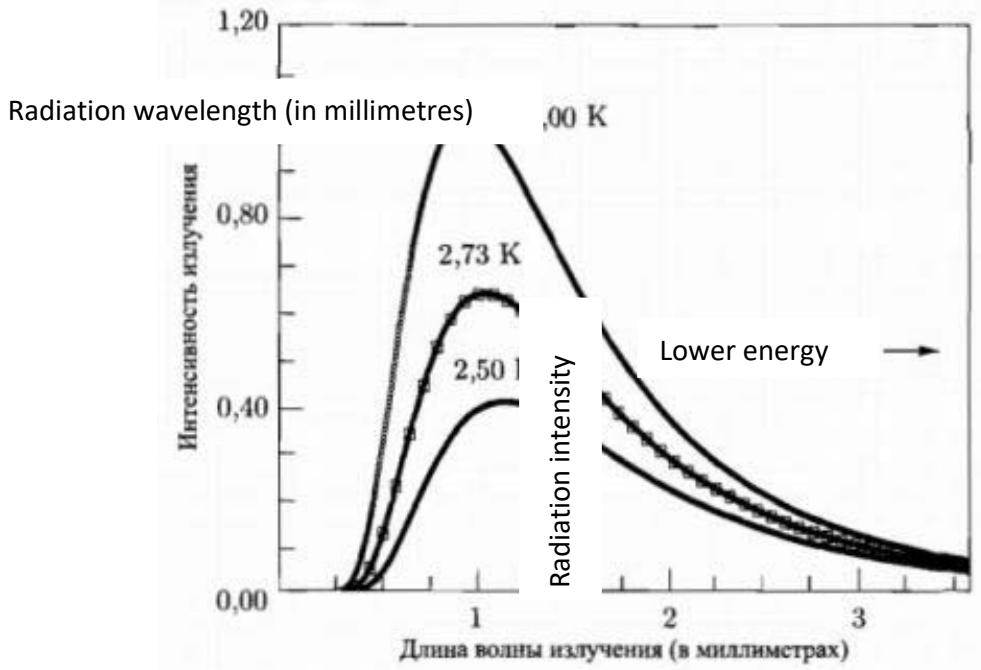 The middle dashed curve represents black body radiation at 2.73 degrees Solid curves are actual measurements made by COBE Figure 2: The cosmic microwave background spectrum measured by the FIRAS instrument on the COBE
Thus, in the new cosmological theory of the Universe by Professor Valery Etkin [5], it is possible to explain the nature of background radiation by cold nuclear fusion (CNS) occurring in the galactic and intergalactic medium at a temperature of 2.7 degrees Kelvin and high energy released when irradiating the vacuum by external $\gamma$ -quanta [10]. Until the 1970s, it was believed that the Big Bang gave birth to the Universe and all its contents, arising from some infinitesimal point - a singularity. However, in the late 70s, a new theory appeared - cosmological inflation. According to it, the early Universe expanded at an exponentially rate, and then, at the end of this period, continued to grow, but more slowly. The acceleration of this expansion due to dark energy began after the age of the Universe had already exceeded 7.7 billion years (5.4 billion years ago). The contributions to the theory were made by Soviet and American physicist Andrei Linde, Russian theoretical physicist Alexei Starobinsky and American physicist Alan Gut: in 2014 the three of them received the Kavli Prize for this theory. However, new astronomical observations and the creation of more advanced space telescopes have allowed astrophysicists to propose new cosmological theories of the development of the Universe. In them, black holes constantly replenish the Universe with both baryonic and non-baryonic matter and make it possible to abandon the Big Bang theory as a necessary condition for origin Universe. The Universe is eternal and infinite.
In September 2021, Professors Xavier Calmett and Folkert Kuipers from the Department of Physics and Astronomy at the University of Sussex published a report that the structure of black holes is more complex than previously thought; and quantum gravity can lead to pressure black holes on the quantum environment. Xavier Calmett said: "Our finding that Schwarzschild black holes have a pressure as well as a temperature is even more exciting given that it was a total surprise Hawking's famous intuition that black holes are not black, but have a spectrum of radiation very similar to that of a black body, makes black holes an ideal laboratory for studying the interactions between quantum mechanics, gravity and thermodynamics"[12]. At the edge of a black hole, the physical vacuum is in a conditionally stressed state, as a result of which it is po quantum polarized. Nothing of the kind follows from Einstein's General Theory of Relativity. Einstein's general relativity, in general, is incompatible with quantum concepts. Studying the behaviour of quantum fields near a black hole, Stephen Hawking predicted that a black hole necessarily radiates particles into outer space and thereby loses mass [13]. This effect is called Hawking radiation (evaporation). Polarization of the vacuum occurs under the influence of monstrous gravitational and magnetic fields, as a result of which the formation of not only virtual, but also real particle-antiparticle pairs is possible. According to Hawking, on the surface of the event horizon the direction of expansion of generated particles ceases to be random, i.e. becomes polarized, orthogonal to the surface of the black hole. [11]. The existence of stable Hawking radiation - the process of emission of various particles by a black hole - was first proved by specialists from the Israel Institute of Technology. The experiment, conducted by Israeli scientists, had to be repeated 97 thousand times over a period for 124 days. To create an analogue of a black hole 0.1 millimeters long, researchers needed 800 rubidium atoms. It is assumed that in the future specialists will be able to extract energy from black holes using a single reactor. According to the theory, the energy will be generated by Hawking radiation. Scientific material describing the creation of a sound-like black hole in the laboratory was published on February 19, 2021, on Phys.org. [14]. As a result, a considerable amount of matter is thrown into the surrounding space of the black hole. This matter a plasma of the most elementary particles of the universe. It is a huge and still very dense cloud of plasma, retaining the shape of a disk. Its rotation speed is close to the speed of light, and the direction of rotation coincides with the direction of rotation of the original black hole. The radial displacement of matter in the accretion disk is accompanied by the release of gravitational energy, part of which is converted into kinetic energy (acceleration of gas movement when approaching the star), and the other part is converted into heat and heats the disk matter. Therefore, the accretion disk emits thermal electromagnetic radiation. The kinetic energy of the gas upon collision with the star's surface is also transformed into thermal energy and radiated. The main property of the formation of such X-ray sources will be magnetic solid radiation. Its magnetic field and induction can reach several thousand Tesla, researchers from the LaPlaz Institute, National Research Nuclear University MEPhl and the CELIA laboratory of the University of Bordeaux note in their work [15]. The uniqueness of the experiment is that the parameters of the resulting plasma do not need to be scaled; they correspond to the actual parameters of the plasma in the vicinity of the black hole of close binary systems like Cygnus X-1 (Figure 3). Matter with a temperature of billions of degrees, a density of $10^{18}$ particles per $\mathrm{cm}^3$ and a frozen magnetic field of more than 2,000 Tesla. It is these parameters that can be detected in the plasma of the active region of X-ray sources. The volume of hot magnetized matter was sufficient to have the essential characteristics of its space prototype [15].
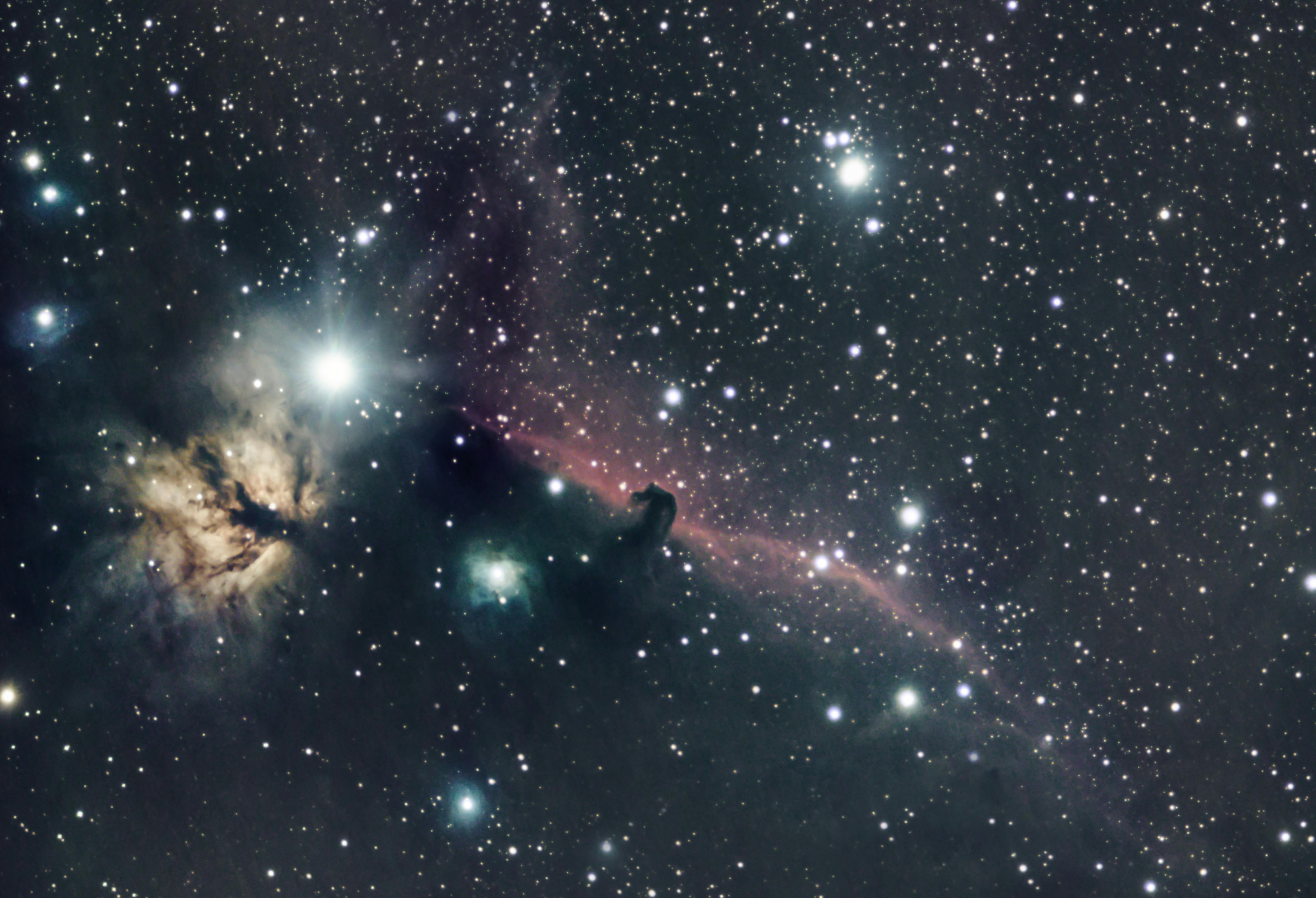
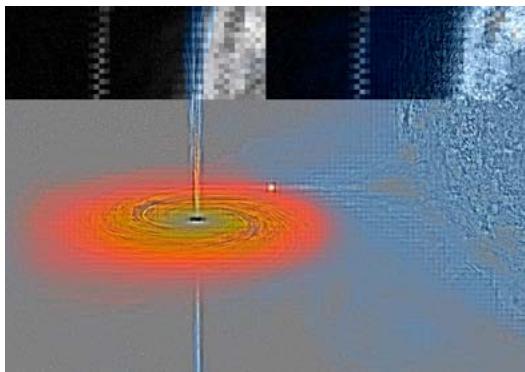 Figure 3: Black hole Swan X-1
The substance of a plasma disk formed by Hawking radiation hear a black hole is gradually stratified into electrons-positrons and neutrons. The mass appearance of neutrons on the outskirts of the plasma disk marks a fundamentally new stage in the life of the formation of the universe. From this moment, the assembly line for the production of chemical elements begins to work. Experimental physics has established for certain that a free neutron decays into a proton and an electron after about 15 minutes. Hydrogen atoms gradually accumulate around the rotating disk of protoplasm and envelop it in a reasonably dense layer. At some point, the density of the hydrogen blanket reaches a critical value, and the free escape of neutrons from the plasma disk becomes difficult. The next cycle of synthesis of atoms of matter begins. The next chemical element of the periodic table - helium.Similar processes of wrapping a neutron centrifuge in a gas cushion are repeated for each new chemical element. The further we move along the periodic table, the denser the outer nucleon layer becomes, and the fewer atoms of a new substance are formed at the output. Therefore, in our Universe, hydrogen makes up $70\%$ of the total mass of all chemical elements. The described process allows us to understand how the synthesis of all chemical components of the universe proceeds. Similar processes of wrapping a neutron centrifuge in a gas cushion are repeated for each new chemical element. Thanks to this, the most common substance in the universe, hydrogen, is born at the output. Professor Vladimir Strelnitsky's article "Masers, Lasers and the Interstellar Medium" discusses the results obtained in three areas of astrophysics: interstellar supersonic turbulence, circumstellar disks, and natural masers and lasers [16]. The masers in the hydrogen recombination lines detected by the Kuiper observatory originate in quasars surrounding massive black holes. They make it possible to study the kinematics and structure of the quasar disk. The lines of hydrogen recombination in the far infrared range turned out to be enhanced. They are the first known natural amplifiers of electromagnetic waves in the laser wavelength region. Analysis of their emissions as well as emissions in other recombination lineages provides a possible clue absence of optical lasers in the Universe. The role of Maxwell's demon, realizing the separation of excited positronium particles from unexcited in the vicinity of black holes, is played by inhomogeneous gravitational and magnetic fields. That is, the event horizon is a gate that Maxwell's Demon opens, deflecting unexcited particles towards a strong field and excited particles towards a weak field. This process is similar to the process implemented in the ammonia molecular generator (Basov's maser) – "Maxwell's Demon of the 20th century", considered in detail by Professor R. Poplavsky in [17]. The role of Maxwell's demon, which separates excited molecules from unexcited ones in the Basov maser, is played by an inhomogeneous electric field that deflects unexcited molecules towards a strong fiel, and excited molecules towards a weak field. If a sufficient number of excited molecules enter a resonator with a high quality factor per unit time, then the self-excitation conditions are met and the molecular generator will operate in a continuous mode. However, in a molecular generator based on ammonia, the negentropy of separation is far from being fully used: as a useful effect, it is only necessary to consider the energy stored in excited molecules at the frequency $\nu$ [17]. There is also a thermodynamically interesting method for directly converting thermal energy into coherent radiation. Without going into details of this (thermal) excitation method, described in detail in [17], we note that here, at first, an equilibrium distribution corresponding to the heater temperature is established at all three levels. Then, at the refrigerator temperature, the population inversion of the lower and middle levels is achieved due to the much shorter relaxation time between the upper and middle levels (at the idler frequency) than at the other two frequencies (signal and auxiliary). It was shown in [18] that the quantum efficiency $\eta_{\mathrm{i}}$ is greater than the efficiency $\eta_{\mathrm{r}}$ of the Carnot cycle. The specialists of the Israel Institute of Technology are right when they proposed extracting energy from black holes using a singular reactor based on Hawking radiation, similar to how it is implemented today in installations using coherent radiation from artificial masers and lasers. Considering the Maxwell demon in Leo Sapogin's Unitary Quantum Theory as a system of two potential barriers leads to the conclusion that the 1st and 2nd laws of thermodynamics are violated. This conclusion is confirmed by experimental data [19].
## III. CONCLUSION
The astrophysical observations and experiments presented in the article force physicists to take a critical approach to the standard cosmological model $\Lambda$ CDM (Λ-Cold Dark Matter). The Universe is a dynamic system that continuously generates baryon masses of matter and dark matter and regulates their density, expanding its boundaries. This circumstance leads to new, more general conservation laws inherent in the physics of open systems. In the article by Professor Valery Etkin "The Perpetuum Mobile of the Universe" the concept of the dynamic Universe is substantiated, according to which the field (continuum) and corpuscular phases of matter with their inherent forms of energy are circulated in it. In this circuit, gravity is a "perpetual motion machine" that allows the Universe to function in time and space indefinitely, bypassing the state of equilibrium [20].
Generating HTML Viewer...
References
20 Cites in Article
A Chernin (2013). Dark energy in the nearby Universe: HST data, nonlinear theory and computer simulation.
N Afiordi,R Mann,R Purhasan (2014). Black hole at the beginning of time.
Chang De,; Dai,Dejanstojkovic (2019). Physicists have evaluated the effects of "tunneling" fields through a wormhole.
Ramesh Narayan,Michael Johnson,Charles Gammie (2019). The Shadow of a Spherically Accreting Black Hole.
V Etkin (2021). Egodynamic theory of the evolution of the Universe.
S Konstantinov (2019). Dark Matter is an Extreme State of Dark Energy (Fifth Interaction).
Leonardo Ferreira,Nathan Adams,Christopher Conselice Panic! At the Disks: First Restframe Optical Observations of Galaxy Structure at.
Leo Sapogin,Victor Boichenko (2015). Commutation Relations, Relativistic Invariance and Deriving the Value of the Fine-Structure Constant from Unitary Quantum Theory.
K Liharev,T Klaeson (1992). Annual Index 1992.
A Kamaev,I Urmanov,A Sorokin,D Karmanov,S Korolev (2013). Images analysis for automatic volcano visibility estimation.
F Hoyle (1948). A new model for the expanding universe.
Xavier Calmet (2021). Quantum gravitational corrections to the entropy of a Schwarzschild black hole.
Stephen Hawking (1988). From the Big Bang to Black Holes.
Ingrid Fadelli (2021). Researchers observe stationary Hawking radiation in an analog black hole.
K Law,Y Abe,A Morace,Y Arikawa,S Sakata,S Lee,K Matsuo,H Morita,Y Ochiai,C Liu,A Yogo,K Okamoto,D Golovin,M Ehret,T Ozaki,M Nakai,Y Sentoku,J Santos,E Humières,Ph Korneev,S Fujioka (2020). Relativistic magnetic reconnection in laser laboratory for testing an emission mechanism of hard-state black hole system.
Vladimir Strelnitsky (1997). Masers, Lasers and the Interstellar Medium.
R Poplavsky (1979). Maxwell demon and the correspondence between information and entropy.
V Konyuχov,A Prokhorov (1976). Second Law of Thermodynamics and Quantum Generators with Thermal Excitation.
G Leo,Andrew Sapogin,Kostin (2021). Laws of Thermodynamics and Unitary Quantum Theory.
V Etkin (2022). Perpetual Movement of the Universe.
No ethics committee approval was required for this article type.
Data Availability
Not applicable for this article.
How to Cite This Article
Stanislav Konstantinov. 2026. \u201cThe nature of thermal radiation from the Universe, Hawking radiation and quasar disks as natural masers\u201d. Global Journal of Science Frontier Research - A: Physics & Space Science GJSFR-A Volume 24 (GJSFR Volume 24 Issue A4).
Explore published articles in an immersive Augmented Reality environment. Our platform converts research papers into interactive 3D books, allowing readers to view and interact with content using AR and VR compatible devices.
Your published article is automatically converted into a realistic 3D book. Flip through pages and read research papers in a more engaging and interactive format.
Our website is actively being updated, and changes may occur frequently. Please clear your browser cache if needed. For feedback or error reporting, please email [email protected]
Thank you for connecting with us. We will respond to you shortly.