Decolonial Indigenous Education: Contribution to Ethnic-Racial and Intercultural Education

Article ID

346X3

Decolonial Indigenous Education and Ethnic-Racial Intercultural Education for social inclusion.

Decolonial Indigenous Education: Contribution to Ethnic-Racial and Intercultural Education

Fabrício Cesar Da Costa Rodrigues
DOI

Abstract

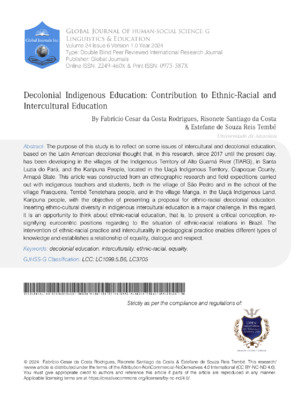
The purpose of this study is to reflect on some issues of intercultural and decolonial education, based on the Latin American decolonial thought that, in this research, since 2017 until the present day, has been developing in the villages of the Indigenous Territory of Alto Guamá River (TIARG), in Santa Luzia do Pará, and the Karipuna People, located in the Uaçá Indigenous Territory, Oiapoque County, Amapá State. This article was constructed from an ethnographic research and field expeditions carried out with indigenous teachers and students, both in the village of São Pedro and in the school of the village Frasqueira, Tembé Tenetehara people, and in the village Manga, in the Uaçá Indigenous Land, Karipuna people, with the objective of presenting a proposal for ethnic-racial decolonial education. Inserting ethnic-cultural diversity in indigenous intercultural education is a major challenge. In this regard, it is an opportunity to think about ethnic-racial education, that is, to present a critical conception, re-signifying eurocentric positions regarding to the situation of ethnic-racial relations in Brazil. The intervention of ethnic-racial practice and interculturality in pedagogical practice enables different types of knowledge and establishes a relationship of equality, dialogue and respect.

Decolonial Indigenous Education: Contribution to Ethnic-Racial and Intercultural Education

The purpose of this study is to reflect on some issues of intercultural and decolonial education, based on the Latin American decolonial thought that, in this research, since 2017 until the present day, has been developing in the villages of the Indigenous Territory of Alto Guamá River (TIARG), in Santa Luzia do Pará, and the Karipuna People, located in the Uaçá Indigenous Territory, Oiapoque County, Amapá State. This article was constructed from an ethnographic research and field expeditions carried out with indigenous teachers and students, both in the village of São Pedro and in the school of the village Frasqueira, Tembé Tenetehara people, and in the village Manga, in the Uaçá Indigenous Land, Karipuna people, with the objective of presenting a proposal for ethnic-racial decolonial education. Inserting ethnic-cultural diversity in indigenous intercultural education is a major challenge. In this regard, it is an opportunity to think about ethnic-racial education, that is, to present a critical conception, re-signifying eurocentric positions regarding to the situation of ethnic-racial relations in Brazil. The intervention of ethnic-racial practice and interculturality in pedagogical practice enables different types of knowledge and establishes a relationship of equality, dialogue and respect.

Fabrício Cesar Da Costa Rodrigues

No Figures found in article.

Fabrício Cesar Da Costa Rodrigues. 2026. “. Global Journal of Human-Social Science – G: Linguistics & Education GJHSS-G Volume 24 (GJHSS Volume 24 Issue G6): .

Download Citation

Journal Specifications

Crossref Journal DOI 10.17406/GJHSS

Print ISSN 0975-587X

e-ISSN 2249-460X

Issue Cover
GJHSS Volume 24 Issue G6
Pg. 13- 20
Classification
Not Found
Keywords
Article Matrices
Total Views: 994
Total Downloads: 18
2026 Trends
Research Identity (RIN)
Related Research
Our website is actively being updated, and changes may occur frequently. Please clear your browser cache if needed. For feedback or error reporting, please email [email protected]

Request Access

Please fill out the form below to request access to this research paper. Your request will be reviewed by the editorial or author team.
X

Quote and Order Details

Contact Person

Invoice Address

Notes or Comments

This is the heading

Lorem ipsum dolor sit amet, consectetur adipiscing elit. Ut elit tellus, luctus nec ullamcorper mattis, pulvinar dapibus leo.


High-quality academic research articles on global topics and journals.

Decolonial Indigenous Education: Contribution to Ethnic-Racial and Intercultural Education

Fabrício Cesar Da Costa Rodrigues

Research Journals