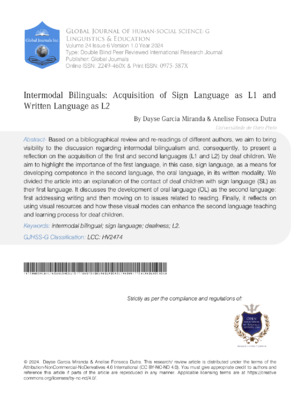
Intermodal Bilinguals: Acquisition of Sign Language as L1 and Written Language as L2

Article ID

S8T5A

Understanding how bilingual sign language acquisition affects language development in L1 and L2 children.

Intermodal Bilinguals: Acquisition of Sign Language as L1 and Written Language as L2

Dayse Garcia Miranda
Anelise Fonseca Dutra
DOI

Abstract

Based on a bibliographical review and re-readings of different authors, we aim to bring visibility to the discussion regarding intermodal bilingualism and, consequently, to present a reflection on the acquisition of the first and second languages (L1 and L2) by deaf children. We aim to highlight the importance of the first language, in this case, sign language, as a means for developing competence in the second language, the oral language, in its written modality. We divided the article into an explanation of the contact of deaf children with sign language (SL) as their first language. It discusses the development of oral language (OL) as the second language: first addressing writing and then moving on to issues related to reading. Finally, it reflects on using visual resources and how these visual modes can enhance the second language teaching and learning process for deaf children.

Intermodal Bilinguals: Acquisition of Sign Language as L1 and Written Language as L2

Based on a bibliographical review and re-readings of different authors, we aim to bring visibility to the discussion regarding intermodal bilingualism and, consequently, to present a reflection on the acquisition of the first and second languages (L1 and L2) by deaf children. We aim to highlight the importance of the first language, in this case, sign language, as a means for developing competence in the second language, the oral language, in its written modality. We divided the article into an explanation of the contact of deaf children with sign language (SL) as their first language. It discusses the development of oral language (OL) as the second language: first addressing writing and then moving on to issues related to reading. Finally, it reflects on using visual resources and how these visual modes can enhance the second language teaching and learning process for deaf children.

Dayse Garcia Miranda
Anelise Fonseca Dutra

No Figures found in article.

Dayse Garcia Miranda. 2026. “. Global Journal of Human-Social Science – G: Linguistics & Education GJHSS-G Volume 24 (GJHSS Volume 24 Issue G6): .

Download Citation

Journal Specifications

Crossref Journal DOI 10.17406/GJHSS

Print ISSN 0975-587X

e-ISSN 2249-460X

Issue Cover
GJHSS Volume 24 Issue G6
Pg. 25- 32
Classification
Not Found
Keywords
Article Matrices
Total Views: 978
Total Downloads: 24
2026 Trends
Research Identity (RIN)
Related Research
Our website is actively being updated, and changes may occur frequently. Please clear your browser cache if needed. For feedback or error reporting, please email [email protected]

Request Access

Please fill out the form below to request access to this research paper. Your request will be reviewed by the editorial or author team.
X

Quote and Order Details

Contact Person

Invoice Address

Notes or Comments

This is the heading

Lorem ipsum dolor sit amet, consectetur adipiscing elit. Ut elit tellus, luctus nec ullamcorper mattis, pulvinar dapibus leo.

High-quality academic research articles on global topics and journals.

Intermodal Bilinguals: Acquisition of Sign Language as L1 and Written Language as L2

Dayse Garcia Miranda
Anelise Fonseca Dutra

Research Journals