The article discusses the physical reasons for the discrepancies between the observed and calculated values of the perihelion displacement of the planet Mercury. Based on numerous data obtained by domestic and foreign authors, the reasons for such differences are indicated. The possibility of introducing into calculations of the dynamics of planets in the terrestrial system practical values of the gravitational constant related to the specific terrestrial systems under consideration is substantiated. The article is accompanied by valuable analytical and numerical estimates.
## I. INTRODUCTION
Mathematical models of physical objects always assume boundary conditions under which one or another mathematical statement is valid or the physical theory in question is applicable. Boundary conditions are also provided for in the general theory of relativity. Calculating the motion of Mercury's perihelion has long served as a "touchstone" for assessing the reliability of theories of gravity. In observational astronomy, it is known that due to its proximity to the Sun and the influence of gravity of other planets, Mercury moves along an ellipse, the semi-major axis of which rotates at an angular velocity of $575^{\circ}$ per century. Calculations based on Newton's theory gave a perihelion rotation of $532^{\circ}$, and A. In 1915, Einstein obtained the expected value of the correction $43^{\circ}$ based on the equations of the general theory of relativity [1]. This fact was one of the proofs of the validity of the general theory of relativity. A hundred years later, the Chinese academician Hua Di discovered an error in Einstein's calculations, indicating that instead of $43^{\circ}$, Einstein, according to his theory, should have received a correction value of $71.5^{\circ}$ [2]. It can be stated that Einstein's authority in modern science is so high that the authors of many articles and books continue to reproduce Einstein's erroneous calculations. The result obtained by Einstein requires an explanation. In 2018, Professor of the P. N. Lebedev Physical Institute N.
V. Kupryaev, by direct numerical modelling of the precession of the perihelion of the orbit of Mercury in the field of the spherical Sun, within the framework of the general theory of relativity, also received $71.63^{\circ}$, that is, 503. $5^{\circ}$ per century [3]. There as on for the error is related to the use of the General Theory of Relativity outside of its boundary conditions. Geometry, as the theory of invariants of one or another group of transformations, the space-time of special and general theories of relativity (flat Minkowski space) is a four-dimensional real affine space with a metric of a certain singularity. In other words, SRT is a theory of invariance of the laws of physics in isolated stationary systems concerning homogeneous motions. If we have in mind the symmetries that define uniform rectilinear motions, then we can share Feynman's point of view: "Symmetry relating to homogeneous rectilinear motions leads to a special principle of relativity." In other words, this principle takes place only in the case of rectilinear uniform motion of reference frames. In the case when the motion is accelerated, the special principle of relativity ceases to be valid. Einstein's attempts in the General Theory of Relativity to extend the principle of relativity to any kind of motion of matter were unsuccessful. The use by physicists of the General Theory of Relativity to describe irreversible processes in non-equilibrium systems leads to gross errors. Albert Einstein's General Theory of Relativity is reliable only when describing equilibrium systems when invariance and the principle of mass equivalence are fulfilled, from which a geometric approach to gravity follows. In this case, the influence on the system from the outside is insignificant. Still, as noted by the Nobel Prize Laureate Ilya Prigogine, in non-equilibrium systems, this influence becomes very noticeable. Based on the results of experiments, Professor I. Prigogine wrote: "In a steady state, the active influence from the outside on the system is insignificant, but it can become essential when the system goes into a non-equilibrium state, while the principle of equivalence is violated" [4]. At the same time, in real open systems, the influence of the environment is manifested. The interplanetary circumsolar plasma medium mainly includes the solar wind, interplanetary magnetic field, cosmic rays (high-energy charged particles), and neutral gas. Today, this list can be supplemented with a superfluid medium of dark matter, which has the property of gravity and forms halos around galaxies, stars and planets [5]. Professor S. Garbari from the University of Zurich estimates the density of dark matter in the vicinity of the Sun at 0.85 GeV/cm $^3$ $\sim 12\times 10^{-25}$ g/cm $^3$. At the same time, the density of baryonic matter is estimated to be 3.8 GeV/cm $^3$ $\sim 50\times 10^{-25}$ g/cm $^3$. For terrestrial planets rotating in stable, slightly disturbed orbits, Einstein's general relativity is applicable. Still, for Mercury, whose orbit is subject to strong disturbances, general relativity is inapplicable since the influence on Mercury from the outside leads to added (added) mass. For the planet Mercury, a significant part of whose orbit passes near the upper layers of the solar atmosphere in a plasma environment, one can apply the macroscopic approach in which the hydrodynamic addition of mass to spherical bodies of any nature in liquid and gas was stated by Stokes two centuries ago. This effect was experimentally verified in the plasma environment of super fluid $^3\mathrm{He}$ -B by Vladimir Shikin, an employee of the Institute of Solid State Physics of the Russian Academy of Sciences, in 2013. We are talking about a complex force $F(\omega)$ acting from a liquid on a sphere of radius $R$, performing periodic oscillations with a frequency $\omega$. Within small Reynolds numbers, we have \[6\]:
$$
F(\omega)=6\pi\eta R\left(1+\frac{R}{\delta(\omega)}\right)V(\omega)+3\pi R^{2}\sqrt{\frac{2\eta\rho}{\omega}}\left(1+\frac{2}{9}\frac{R}{\delta(\omega)}\right)i\omega V(\omega),\,(1)\quad\delta(\omega)=(2\eta/\rho\omega)^{1/2}
$$
where $\rho$ - fluid density, $\eta$ - viscosity, $V$ - velocity amplitude sphere, $\delta (\omega)$ - the so-called viscous penetration depth, which increases with an increase in viscosity and a decrease of the oscillation frequency.
The real part of the expression (1) is a known Stokes force derived from the movement of fluid in the sphere. The imaginary component (coefficient of $\mathrm{i}\omega V$ ) is naturally identified with the effective mass of the cluster added:
$$
\mathsf{Meff}(\omega R) = \frac{2\pi\rho R^3}{3} \left[1 + \frac{9}{2} \frac{\delta(\omega)}{R}\right]
$$
Origin added (attached) mass Meff $(\omega R)$, depending on the frequency $\omega$ and the radius $R$ of the sphere of the cluster associated with the excitation of the field around a moving cluster of hydrodynamic velocity $\nu_{i}$ (r) and the appearance in connection with this additional kinetic energy. In a superfluid liquid, the additional mass has two components: superfluid and typical. [6].
Disturbances in Mercury's orbital motion in the plasma environment of charged particles of ionized gases of the solar corona and dark matter halo as it periodically moves away from the Sun lead to a violation of the equivalence principle. At the same time, possible inequality about gravitational and inertial masses for the Earth and Mercury can read $\frac{mg}{m_i} \sim 10^{-2}$ [7]. Today, the Earth-Moon-Sun system is considered to be the best model in the Solar System for testing the strong form of PE. Lunar laser ranging (LLR) experiments involved the reflection of laser beams from an array of corner reflectors installed on the Moon by Apollo astronauts and Soviet lunar rovers. Recent experimental data have made it possible to establish that the possible inequality to gravitational and inertial masses for stable orbits of the Earth and the Moon has the value $\Delta (\mathrm{mg} / \mathrm{m}_{\mathrm{i}})\sim (0.8\pm 1.3)\bullet 10^{-13}$ [8].
As a result of the peculiarities in the movement of Mercury in its orbit around the Sun, the value of the gravitational constant for Mercury may differ from the value of the gravitational constant for terrestrial planets rotating in stable orbits. Einstein's geometric theory of general relativity does not allow this, and Newton's law can be modified for different values of the gravitational constant:
$$
F = G \frac {M m}{R ^ {2}} \tag {3}
$$
Where $G$ is the gravitational constant for each planet in the solar system;
M is the mass of the Sun;
m is the mass of the planet;
R is the distance from the center of the planet to the center of the Sun
At the same time, for several decades, the measurement of the gravitational constant for the planet Earth $G_0$ has not ceased to be a source of headache for experimental physicists. The current "official" value of the gravitational constant $G_0$ recommended by the US National Institute of Standards (NIST) is $(6.67384 \pm 0.00080) \cdot 10^{-11} \, \text{m}^3 \cdot \text{kg}^{-1} \cdot \text{s}^{-2}$. The relative error here is $0.012\%$, or $1.2 \times 10^{-4}$, or, in even more familiar notation for physicists, 120 ppm (millionths), and this is several orders of magnitude worse than the measurement accuracy of other equally critical fundamental quantities. A relative error of $10^{-4}$ was reached 30 years ago, and there has been no improvement since then. When four or five results at once, obtained by different groups, all differ by a dozen or two declared errors is unprecedented for physics [9]. It can be assumed that the reason for the discrepancy between the measured values of the gravitational constant in various experiments is not the peculiarities of the measurement methods and the quality of the equipment but the dependence of the gravitational constant on the frequency of oscillations of the Earth's gravitational field. Measurements of the instantaneous value of the acceleration of free fall using gravimeters show that when $\Delta g$ changes in the average value of the acceleration of gravity, the sign of $\Delta g$ is determined by the phase difference $\Theta$ of oscillations of the Earth's gravity acceleration and oscillations of the weighed oscillator. This leads to an increase or decrease in the values of the gravitational potential measured in the variable gravitational field of the Earth[10]. At the same time, in the theory and practice of interplanetary flights, the significance of the gravitational constant inherent in each planet is of particularly important. This is due to the experimentally fact that planets, when rotating in the cosmic environment, form gravitational funnels. [11]. A spacecraft speed jump (by tens of kilometres per second) upon entering the gravitational funnel of Mars or Venus is an experimentally confirmed physical effect [12] associated with the value of the gravitational constant of a given planet. The consequence of such a jump is the Doppler shift of the carrier frequency during radio communication with the spacecraft and a change in its trajectory. It was for this reason that some Soviet and American vehicles were lost during the first flights to Venus and Mars. For the correct calculation of interplanetary flight, the "true" speed of the device within the planetary gravitational funnel should be measured only in the planetocentric frame of reference, and in interplanetary space - only in the heliocentric frame of reference [12]. It turned out that in the case of Mercury it is necessary to turn to alternative theories of gravity, compared to Einstein's General Theory of Relativity. Within the framework of the theory, the intensity of gravitational interaction for Mercury depends on the additional magnetic dipole field of the Sun ( $\sim 50$ Tesla), which induces electric and torsion fields leading to electromagnetic and spin polarization of the vacuum. The solar wind originates in the upper layers of the Sun's atmosphere, and its main parameters determine the environment in which Mercury moves. The alternative theory of gravity in the planetary solar system does not contradict the observational mechanics of Kepler-Newton, born in the heliocentric Copernican system. Newton's law of universal gravitation is satisfied, provided that each planet has its gravitational constant value, depending on the nature of its motion in the cosmic environment. The scope of application of the alternative theory of gravity will be the entire Universe.
## II. CALCULATION OF THE VALUE OF THE GRAVITATIONAL CONSTANT GM FOR THE PLANET MERCURY BASED ON KEPLER-NEWTON OBSERVATIONAL ASTRONOMY
Johannes Kepler formulated his laws of celestial mechanics based on the analysis of many years of astronomical observations. Fifty years later, Isaac Newton analytically derived Kepler's third law as a consequence of the law of universal gravitation and the second law of dynamics, introducing the forces of gravity and inertia into the spatial model of the Universe. With the average velocity of the planet's orbital rotation $v = 2\pi R / T$, he obtained\[13\]:
$$
\mathrm {K} = \mathrm {G} ^ {0} \mathrm {M} _ {\mathrm {m i}} ^ {0 \frac {\mathrm {m g}}{\mathrm {T} ^ {2}}} = \frac {\mathrm {R} ^ {3}}{\mathrm {T} ^ {2}}. \tag {4}
$$
where m g. is the planet's gravitational mass, interacting with the Sun, the M 0 mass produces a centripetal force of gravity;
mi. is the inertial mass of the planet. It is rotating around a circle of R radius and producing a centrifugal force of repulsion,
R is the average value distance from the centre of the planet to the centre of the Sun,
T is a period of the planet's rotation around the Sun, $G_{0}$ is the gravitational constant and
K is Kepler's constant.
Johannes Kepler calculated the value of the constant $K$ for seven planets \[13\]:
Earth, Venus, Mars $K = 3.35 \cdot 10^{24} \mathrm{~km}^{3} \cdot \mathrm{year}^{-2}$
Saturn, Jupiter, Uranus K = 3.34 · $10^{24} \mathrm{~km}^{3} \cdot \mathrm{year}^{-2}$ (5)
$$
Mercury K = 3.33 · 10²⁴ km³ · year⁻²
$$
According to updated astronomical data officially received by the author from a representative of the Physical Institute P.N. Lebedeva K, the planets of the Solar System have the following values: for Mercury $3.23109^{*}$, for Venus $3.33627^{*}$, for the Earth $3.34914^{*}$, for Mars $3.32601^{*}$, for Jupiter $3.34784^{*}$, for Saturn $3.38651^{*}$, for Uranus $3.36781^{*}$, for Neptune $3.36298^{*}$, for Pluto $3.19546^{*}$.
Observational astronomy of Newton-Kepler allows not only to establish differences in the Kepler constant but also differences in the value of the gravitational constant between the Earth $(G_{0} = 6.67408 \cdot 10^{-8}\mathrm{dyn} \cdot \mathrm{cm}^{2} / \mathrm{g}^{2})$ and the planet Mercury. The analysis of formula (4) of Newton - Kepler allows even to numerically estimate the value of the gravitational constant for Mercury Gm from the solution of proportion:
$$
3.3 4 9 1 4 \cdot 1 0 ^ {2 4} \mathrm{k m} ^ {3} \cdot \mathrm{y e a r} ^ {- 2} = \mathrm{G} _ {0} \mathrm{M} _ {0} \left[ \frac{\mathrm{m g E a r t h}}{\mathrm{m} _ {\mathrm{i}} \text{Earth}} \right], \text{forEarth} \frac{\mathrm{m g}}{\mathrm{m i}} = 1
$$
$$
3.2 3 1 0 9 \cdot 1 0 ^ {2 4} \mathrm{k m} ^ {3} \cdot \text{year} ^ {- 2} = \mathrm{G m M} _ {0} \left[ \frac{\mathrm{m g M e r c u r y}}{\mathrm{m} _ {\mathrm{i}} \text{Mercury}} \right]
$$
$$
\text{forMercury} \frac{\mathrm{m g}}{\mathrm{m i}} \sim 0.9 7 5
$$
$$
\mathrm{G m} \sim 0.9 9 2 8 9 \mathrm{G} _ {0} \text{orGm} \sim 6.6 2 7 3 6 \cdot 1 0 ^ {- 8} \mathrm{d y n} \cdot \mathrm{c m} ^ {2} / \mathrm{g} ^ {2},
$$
Direct numerical modelling of the precession of the perihelion of Mercury's orbit, taking into account all planets, as well as taking into account the contraction of the Sun, carried out within the framework of the modified Newton's law of universal gravitation with a value of $Gm \sim 6.62736 \times 10^{-8}$ [dyn × cm2/g2], allows us to estimate the result with an accuracy of $\sim 575^{\prime \prime} \pm 5^{\prime \prime}$. This is the most accurate result obtained in the entire history of calculations of the precession of Mercury.
## III. CALCULATION OF THE PRECESSION OF THE PERIHELION OF MERCURY BY EINSTEIN AND HUA DI
Academician Hua Di showed that, in calculating the precession of the perihelion of the orbit of Mercury, Einstein made a gross error in the integration. As a result, the result was $71.5^{\prime \prime}$, not $43^{\prime \prime}$ [2, p. 5]. And indeed, when integrating the equation (7):
$$
\varphi = \left[ 1 + \alpha \left(\alpha_ {1} + \alpha_ {2}\right) \right] \int_ {\alpha_ {1}} ^ {\alpha_ {2}} \frac {d x}{\sqrt {- (x - \alpha_ {1}) (x - \alpha_ {2}) (1 - \alpha x)}} \tag {7}
$$
where $\alpha_{1}$ and $\alpha_{2}$ are the inverse values of the maximum and minimum distances of Mercury from the Sun; $\alpha = 2G_{0}m_{0}/c^{2}$ is a gravitational radius, where $G_{0}$ is the gravitational constant; $m_{0}$ is the mass of the Sun; $c$ is the speed of light
If confined to a member of the first order of smallness in $(\alpha_{1} + \alpha_{2})$, we get the result:
$$
\varphi = \pi \left[ 1 + 3 / (4) \, \alpha (\alpha_{1} + \alpha_{2}) \right] \tag{8}
$$
This was Einstein's fatal mistake [1].
Einstein's result differs from the result obtained by Hua Di in the process of correctly performed integration \[2, p. 5\]:
$$
\varphi = \pi \left[ 1 + 5 / (4) \, \alpha (\alpha_1 + \alpha_2) \right] \tag{9}
$$
In square brackets, $\alpha$ should be a factor of 5/4, not 3/4. As a result for the displacement of the perihelion of the orbit of Mercury over 100 years, if we substitute (9) in the formula for calculating the displacement of the perihelion of the Mercury orbit $\varepsilon = 2 \cdot (\varphi - \pi) \cdot 415.2 / 4.8481368110953599141 \cdot 10^{-6}$, and for $G_0$ take $6.67408 \cdot 10^{-8} \mathrm{dyn} \cdot \mathrm{cm}^2 / \mathrm{g}^2$, for $m_01.9885 \cdot 10^{33} \mathrm{~g}$, for $c 2.99792458 \cdot 10^{10} \mathrm{~cm} / \mathrm{s}$, for $r_16.9817445 \cdot 10^{12} \mathrm{~cm}$, and for $r_24.600109 \cdot 10^{12} \mathrm{~cm}$, it turns out not $\sim 43''$, but $\sim 71.63''$.
The result $\sim 503.5$ " was also obtained by direct numerical simulation of the precession of the perihelion of the orbit of Mercury in the field of the spherical Sun within the framework of GTR, conducted by Professor N.V. Kupryaev in 2018 [3]. This is less than the observed displacement of the perihelion of the orbit of Mercury by $\sim 71.63$.
## IV. COMPUTER SIMULATION ILLUSTRATES THE UNIQUE POSITION OF MERCURY IN THE SOLAR SYSTEM
A computer simulation developed by three American engineers at NASA may illustrate Mercury's special position in the solar system. The results of their work were published in Physics Today in 2019. While scientists usually look at the distance between the orbits of the planets, a computer program does calculations differently. It models the positions of the planets in the solar system over 10,000 years and can therefore calculate the average distance between two planets very accurately. Modeling of planetary orbits is beginning to show that Mercury has the smallest average distance from Earth and is most often Earth's closest neighbor.
Mercury is nearer to us than Venus and Mars. (Figure 1. Image Source: Physics Today). The average distance between the Earth and Venus is 1.14 [AU]. At the same time, the distance between the Earth and Mercury is only 1.04 \[AU\](slightly more than 150 million [km]).
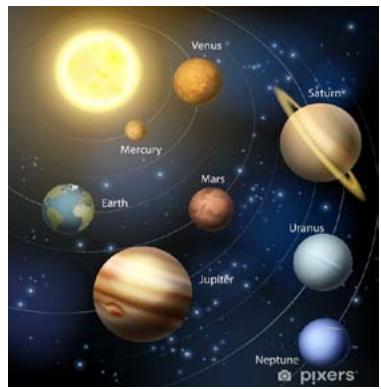 Figure 1: Planets in the solar system
## V. CONCLUSION
In the article, using the example of calculating the precession of the perihelion of the planet Mercury in the framework of the quantum theory of gravity, it is shown that using of the geometric theory of gravity of Einstein's General Relativity for non-equilibrium systems leads to errors. The calculation of the gravitational constant (Gm) presented in the article for the Mercury in the heliocentric system of Copernicus is valid only for the planets of the solar system. Nevertheless, the resulting formulas lead to reasonable ratios, so one can hope they at least qualitatively correctly reflect the actual situation.
### ACKNOWLEDGEMENTS
The author thanks for the discussion of the calculation of the precession of the perihelion of the orbit of Mercury, of the professor at the Physical Institute P.N. Lebedeva Nikolai Vladimirovich Kupryaev
Generating HTML Viewer...
References
14 Cites in Article
A Einstein (1915). The Collected Papers of Albert Einstein.
Hua Di (2013). Einstein's Explanation of Perihelion Motion of Mercury.
N Kupryaev (2018). Concerning the Paper by A. Einstein "Explanation of the Perihelion Motion of Mercury from the General Theory of Relativity.
I Prigogine,I Stengers (1994). Time, chaos, quantum" // Moscow: Progress.
J Farnes (2018). A unifying theory of dark energy and dark matter: Negative masses and matter creation (7) within a modified ΛCDM framework.
V Shikin (2013). Low frequency anomalies of the effective mass of charged clusters in liquid helium.
Stanislav Konstantinov (2018). Violation of the Equivalence Principle and the Boundary of Einstein's General Relativity.
S Turyshev (2009). Experimental tests of general relativity: recent progress and future directions.
H Quinn,C Parks,R Speake,Davis (2013). Improved Determination of G Using Two Methods.
V Kuskov,Ya. Kuskova (2014). The Amderminskoye deposit fluorite ores gravity concentration.
S Konstantinov (2021). Torsion Gravity.
V Levantovsky (1980). Unknown Title.
Craig Lage (2014). Laws of Astronomy after I. Kepler and I. Newton.
Tom Stockman,Gabriel Monroe,Samuel Cordner (2019). Venus is not Earth's closest neighbor.
No ethics committee approval was required for this article type.
Data Availability
Not applicable for this article.
How to Cite This Article
Stanislav Konstantinov. 2026. \u201cMercury in the Solar System\u201d. Global Journal of Science Frontier Research - A: Physics & Space Science GJSFR-A Volume 24 (GJSFR Volume 24 Issue A5).
Explore published articles in an immersive Augmented Reality environment. Our platform converts research papers into interactive 3D books, allowing readers to view and interact with content using AR and VR compatible devices.
Your published article is automatically converted into a realistic 3D book. Flip through pages and read research papers in a more engaging and interactive format.
Our website is actively being updated, and changes may occur frequently. Please clear your browser cache if needed. For feedback or error reporting, please email [email protected]
Thank you for connecting with us. We will respond to you shortly.