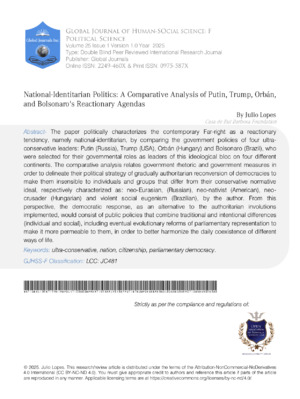
National Identitarian Politics A Comparative Analysis of Putin Trump Orbán and Bolsonaros Reactionary Agendas

Article ID

F9478

High-quality academic research on political policies, governance, and democracy.

National Identitarian Politics A Comparative Analysis of Putin Trump Orbán and Bolsonaros Reactionary Agendas

Julio Lopes
Julio Lopes
DOI

Abstract

The paper politically characterizes the contemporary Far-right as a reactionary tendency, namely nationalidentitarian, by comparing the government policies of four ultra-conservative leaders: Putin (Russia), Trump (USA), Orbán (Hungary) and Bolsonaro (Brazil), who were selected for their governmental roles as leaders of this ideological bloc on four different continents. The comparative analysis relates government rhetoric and government measures in order to delineate their political strategy of gradually authoritarian reconversion of democracies to make them insensible to individuals and groups that differ from their conservative normative ideal, respectively characterized as: neo-Eurasian, (Russian), neo-nativist (American), neo-crusader (Hungarian) and violent social eugenism (Brazilian), by the author. From this perspective, the democratic response, as an alternative to the authoritarian involutions implemented, would consist of public policies that combine traditional and intentional differences (individual and social), including eventual evolutionary reforms of parliamentary representation to make it more permeable to them, in order to better harmonize the daily coexistence of different ways of life.


National Identitarian Politics A Comparative Analysis of Putin Trump Orbán and Bolsonaros Reactionary Agendas

The paper politically characterizes the contemporary Far-right as a reactionary tendency, namely nationalidentitarian, by comparing the government policies of four ultra-conservative leaders: Putin (Russia), Trump (USA), Orbán (Hungary) and Bolsonaro (Brazil), who were selected for their governmental roles as leaders of this ideological bloc on four different continents. The comparative analysis relates government rhetoric and government measures in order to delineate their political strategy of gradually authoritarian reconversion of democracies to make them insensible to individuals and groups that differ from their conservative normative ideal, respectively characterized as: neo-Eurasian, (Russian), neo-nativist (American), neo-crusader (Hungarian) and violent social eugenism (Brazilian), by the author. From this perspective, the democratic response, as an alternative to the authoritarian involutions implemented, would consist of public policies that combine traditional and intentional differences (individual and social), including eventual evolutionary reforms of parliamentary representation to make it more permeable to them, in order to better harmonize the daily coexistence of different ways of life.

Julio Lopes
Julio Lopes

No Figures found in article.

Julio Lopes. 2026. “. Global Journal of Human-Social Science – F: Political Science GJHSS-F Volume 25 (GJHSS Volume 25 Issue F1): .

Download Citation

Journal Specifications

Crossref Journal DOI 10.17406/GJHSS

Print ISSN 0975-587X

e-ISSN 2249-460X

Classification
Not Found
Article Matrices
Total Views: 750
Total Downloads: 24
2026 Trends
Research Identity (RIN)
Related Research
Our website is actively being updated, and changes may occur frequently. Please clear your browser cache if needed. For feedback or error reporting, please email [email protected]

Request Access

Please fill out the form below to request access to this research paper. Your request will be reviewed by the editorial or author team.
X

Quote and Order Details

Contact Person

Invoice Address

Notes or Comments

This is the heading

Lorem ipsum dolor sit amet, consectetur adipiscing elit. Ut elit tellus, luctus nec ullamcorper mattis, pulvinar dapibus leo.

High-quality academic research articles on global topics and journals.

National Identitarian Politics A Comparative Analysis of Putin Trump Orbán and Bolsonaros Reactionary Agendas

Julio Lopes
Julio Lopes

Research Journals