
I. INTRODUCTION
Technological transformations, evolving consumer preferences, and intense rivalry characterize the worldwide economy. Manufacturers encounter challenges such as reduced product lifespan, the need for personalization, and fluctuations in the supply chain. Traditional manufacturing techniques often struggle to keep pace with these changes. Manufacturing flexibility, defined as the capacity to adjust production methods to varying circumstances efficiently and economically, has become a key strategic necessity. This research delves into how manufacturing flexibility provides organizations with a competitive advantage in the global market. It emphasizes the role of flexibility in enabling companies to respond to shifting market dynamics, manage risks, and enhance customer satisfaction. Globally, manufacturers are experiencing a profound shift due to changes in external markets and advancements in technology. The aim now extends beyond simply "producing superior products" to "enhancing production processes," which encompasses aspects such as management, engineering, service planning, and implementation. A few critical market transformations drive this dual focus on refining products and processes. The primary trends disrupting the traditional framework of the global manufacturing industry are economic adjustments triggered by downturns in developed nations and the rise of rapidly expanding emerging markets. Furthermore, the sector faces challenges from technological evolution related to Big Data, the Internet of Things, mobile and social computing, along with cloud-based technologies. Issues involving talent shortages, complex partner and supplier networks, intensified global competition, and increased regulations.
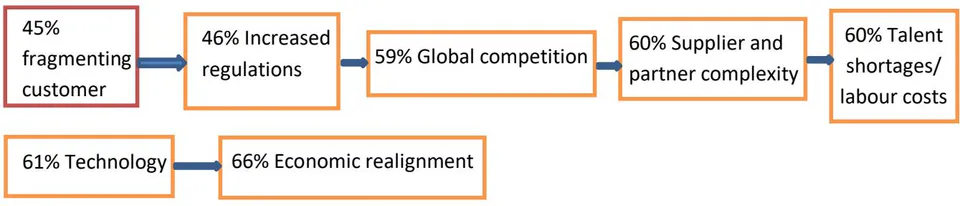
The influence of these modifications is viewed in different ways by executive functions and varies in strength according to the organization's size, sector, and geographical area. For example, firms in the industrial equipment field are more preoccupied with economic adjustments compared to others (74% of respondents). The shift in technology is particularly significant in Asia's rapidly expanding markets (75%), where companies can quickly embrace the latest tools due to their minimal reliance on outdated systems. Nonetheless, 69% of top executives in the manufacturing industry highlight labor expenses and workforce shortages as significant issues. Moreover, C-level leaders also identify increasing regulatory pressures as another vital concern (52%), forming the context in which all these transformations are occurring.
In response to these influences, manufacturing firms are implementing various approaches to modify their operations and identify innovative ways to distinguish themselves. One important strategy involves merging new services with current product lines to enhance value during both the sales process and the lifespan of the product. Other tactics focus on internationalizing product development and streamlining planning and engineering processes to create nearly limitless product variations based on fundamental platforms. This analysis explores how manufacturers are adapting their operations to flourish in the existing global landscape. The report highlights three key themes that underpin successful transformation efforts:
The service imperative, which transforms repair and maintenance into a vital differentiator and a significant profit source; reimagining strategy and planning to become the primary source of competitive edge rather than solely operational efficiency; and pervasive innovation, which extends beyond conventional product research and development to include all components of the enterprise ecosystem.
These three approaches establish a framework for turning change into tangible business achievements. By prioritizing these elements, manufacturers can realize substantial reductions in costs and growth in revenue.
Definitions used in the study:
Strategy and planning encompasses the choices made by a company regarding the design, sourcing, production, and servicing of its goods, along with the coordination of these activities.
Service pertains to the methods a company employs to maintain its products, provide its services, and manage these operations.
Manufacturing operations involve the implementation of production processes, which include procurement, logistics, manufacturing, scheduling, and oversight.
II. MANUFACTURING FLEXIBILITY
Manufacturing flexibility has been a significant focus in operations management, with researchers exploring its various aspects and advantages. The main aspects consist of:
Volume Flexibility: The capacity to modify production levels according to changing demand. Slack (1987) stated that volume flexibility is essential for handling seasonal variations and uncertainty in the market.
Product Flexibility: The ability to efficiently transition between multiple products or variations. This is crucial in sectors that require high customization, like electronics and automotive (Gerwin, 1993).
Process Flexibility: The capability of manufacturing processes to adjust to alterations in product design or production methods. This fosters innovation and minimizes downtime during changes (Upton, 1994).
Supply Chain Flexibility: The responsiveness of supply chains to disturbances, ensuring ongoing operations and resilience (Christopher & Towill, 2001).
Theoretical Foundations: According to the Resource-Based View (RBV), manufacturing flexibility is a critical, unique, and hard-to-replicate asset that offers a lasting competitive edge. Research done by Hayes and Wheelwright (1984) highlights the importance of flexible manufacturing systems (FMS) in achieving alignment with market needs.
Empirical Evidence: Studies indicate that companies exhibiting greater manufacturing flexibility perform better than their counterparts regarding operational efficiency, customer satisfaction, and adaptability in the market (Sethi & Sethi, 1990).


III. WAVES OF CHANGE
As market dynamics and technological advancements disrupt many long-established beliefs regarding manufacturing, a strategic shift is essential. It is anticipated that over two-thirds (68%) of manufacturing companies will undertake significant transformations in their business processes within the next three years. In terms of geography, a larger percentage of firms in Europe (74%) are likely to revise their fundamental operating frameworks compared to those in North America (64%) and Asia (67%). In light of these changes, innovative approaches are required to bring about meaningful transformation. Major focus areas for this manufacturing change include revising strategies and planning, emphasizing service, and fostering innovation widely. How manufacturers approach these areas can greatly influence their revenues and expenses.
Reassessing strategy and planning According to our research, the main factors contributing to business success are strategy and planning for products (43% of participants), services (37%), and manufacturing (31%). In all sectors, strategy and planning are more critical than operational execution as a competitive factor.
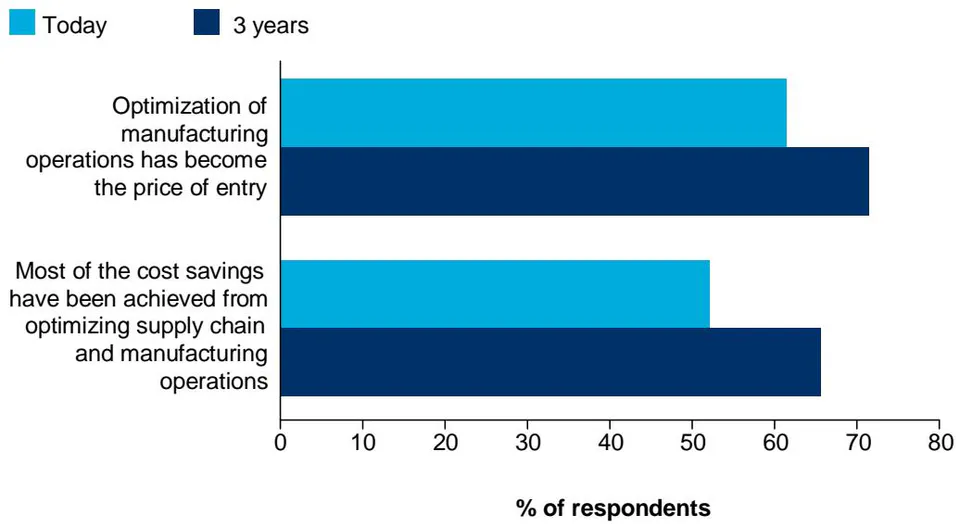
The growing focus on strategy and planning can be attributed to the diminishing effectiveness of traditional methods for enhancing profitability. More than half (52%) of those surveyed stated that they have exhausted almost all potential cost savings in their manufacturing processes. While this statistic suggests that there is still progress to be made, 65% of executives surveyed feel that optimizing operations has shifted from being a differentiator to merely the baseline requirement for the industry. This proportion is expected to increase to 71% within three years.
Another factor contributing to the increased focus on planning and strategy is customer fragmentation, which poses a significant challenge for manufacturers. This trend of customer fragmentation is especially evident in Asia (57%), where there is a wide range of customer requirements and financial capacities, capturing the attention of C-level leaders (57%). In light of this growing fragmentation, over two-thirds of those surveyed intend to implement Voice of the Customer strategies, with industries such as aerospace (72%), high technology (75%), and large corporations (79%) taking the lead in gaining deeper insights into their customers. More than half of the executives participating in the survey aim to create networked or "smart" products that establish a feedback mechanism utilizing customer information, particularly high tech (71%) and large companies (60%) at the forefront. Approximately 43% of manufacturers are considering moving more production closer to their customers, especially in the medical device (54%) and automotive (50%) sectors. However, manufacturers are not merely responding to challenges like the diminished role of operations as a competitive advantage and increasing customer fragmentation. One proactive approach being adopted is enhancing the alignment of strategy and planning between engineering and service departments, expected to grow from 54% currently to 73% in three years, as revealed by the survey. Improved synergy between engineering and service teams aligns with a stronger commitment from executives to utilize feedback from service delivery (currently at 52%) to influence decision-making and facilitate advancements in product development and quality (projected to be 65% in three years).
IV. POLICY CHALLENGE
Addressing the social and environmental issues of today effectively requires communities, nations, and regions around the globe to generate economic prosperity in ways that align with the principles of sustainable development. This, in turn, relies on their capacity to devise developmental strategies that leverage suitable forms of economic competitive advantage amidst increasingly competitive global markets. This challenge is exemplified by the objective set at the Lisbon Summit in March 2000, where the European Community aimed to become "the most competitive knowledge-based economy in the world" by 2010, capable of sustaining economic growth while creating better jobs and promoting social cohesion. A recent communication from the European Commission on 'corporate social responsibility' (CSR) aims to clarify how CSR can help achieve this objective. The Commission appropriately situates CSR within the broader framework of globalization and the evolving discourse on the role of businesses in society. The communication mainly concentrates on how to promote voluntary business actions and their outcomes within a setting of stakeholder dialogue. Consequently, it underscores the necessity to enhance micro-level management abilities, tools, and standards.
The prospect of a considerable macro-level change in the function of businesses in society has not been thoroughly investigated, including its implications for policy. There has been little to no examination thus far regarding whether CSR could alter the foundation of a nation's economic competitive advantage. Practitioners and analysts of CSR have generally remained disconnected from and unaware of the operation of the larger competitive landscape. The rationale behind CSR has stayed largely a concern at the micro level. Likewise, mainstream analysts and those designing the frameworks for international competition largely overlook the potential for a nation's economic competitive edge to be rooted in the social and environmental performance aspects of the business sector itself. The Copenhagen Centre has taken steps to bridge this gap by beginning to investigate how changes in the role of businesses in society might support new forms of international economic competitive advantage. At this juncture, the goal has been to spark essential discussions by outlining various issues, challenges, and dilemmas facing policymakers from government agencies, the business sector, and civil society organizations. Preliminary findings indicate that:
The societal gains from shifts in the business role in society will remain restricted unless these changes align with economic competitiveness strategies and outcomes at local, national, and regional levels.
Such strategies and results can and should be cultivated, being most effective when grounded in collaborations between the business sector, civil society, and public organizations.
Public policy has the potential to enhance the connections between these partnerships and the competitive advantages of nations.
V. COMPETITIVE PARADOXES
The effects of globalization on social and environmental aspects generate a spectrum of divergent opinions. While some emphasize the apparent benefits of global investments and commerce, others stress the obvious drawbacks. Similarly, the connection between economic advancement and social as well as environmental results has been a subject of intense debate. The most pressing concerns revolve around the destinies of over a billion individuals, primarily in less economically developed countries, who survive on less than one US dollar daily. Yet, the contradictions regarding economic growth are just as, if not more, evident in so-called advanced nations. Economies traditionally classified as 'Anglo-Saxon' are not only among the most competitive globally but also stand out in the developed world for their significant levels of income disparity among citizens. Across Europe, the remarkable economic progress of recent decades has been paralleled by a rise in inequalities stemming from uneven access to employment opportunities. In fact, the concept of access to work is evolving, as remote work, part-time positions, and flexible job arrangements become increasingly prevalent. By the mid-1990s, for instance, a quarter of all jobs in the UK were part-time.
Increasing demands are being made on public institutions at the national, regional, and international levels to transform public policies to implement the necessary checks and balances that oversee how economic activities lead to social and environmental results. The Lisbon declaration serves as a prominent instance where the European Community has recognized its duties and reiterated its dedication to becoming the leading competitive knowledge economy globally while also fostering and maintaining social unity. The South African Government has articulated, though in different terms, strategies and guidelines intended to prepare the economy for global competition while simultaneously promoting a defined agenda of black economic empowerment throughout the country's labor and financial sectors. These national and regional strategies reflect both deep-seated tensions and coherent planning efforts. Every facet of publicly funded social welfare spending across Europe faces scrutiny due to an apparent push for more streamlined economies. This occurs even though a knowledgeable-driven economy can certainly lead to disparities in a context where at least of adults possess only basic literacy skills in 14 out of 20 OECD nations, or in the UK, where it is estimated that about of the populace cannot read or comprehend simple government documents. Initiatives aimed at black empowerment from the South African Government face criticism from various quarters, with detractors claiming they compromise the nation's economic competitiveness and thus the foundation upon which black economic empowerment could be realized. Such criticisms persist despite a widespread acknowledgement that social unrest stemming from unequal development acts as a significant deterrent to potential foreign investment. These conflicting policies evoke discussions from the 1990s regarding the degree to which developing nations needed to 'catch up' to developed countries prior to tackling escalating environmental issues. Opponents of direct measures to elevate environmental standards often pointed to the Environmental Kuznets Curve, which is an inverted U-shaped model suggesting that pollution levels decline only after a certain level of economic affluence is achieved that allows governments to invest in environmental conservation (see Figure 1). For instance, economist Francis Cairncross posited that as impoverished nations become wealthier, and with trade acting as a substantial source of riches, their environmental criteria will improve.
VI. TRADITIONAL VIEW ON ECONOMIC COMPETITIVENESS
The economic competitiveness among countries is typically assessed through a range of metrics related to productive elements that reflect flexibility in the market, innovation, as well as technological and organizational progressiveness, along with social and political stability. There exists a multitude of competitiveness indexes. While each varies in focus, they generally cover similar areas. For instance, the IMD, which is a prominent European business institution, employs 314 criteria to formulate its economic competitiveness rankings for 49 nations. These criteria are categorized into four main domains: economic performance, efficiency of government and business, and infrastructure. The IMD's assessment does not incorporate corporate responsibility. Nevertheless, many principles of corporate responsibility are represented in how the IMD approaches so-called 'soft' matters, including 'values-in-society' and perspectives on gender and various forms of discrimination. It is noteworthy that most of these topics fall under the IMD's final category, 'infrastructure', indicating that the IMD perceives them as not directly contributing to business productivity. In fact, they are typically regarded as not even indirectly impacting business efficacy or overall productivity since these criteria are mostly articulated negatively, meaning they only score favorably toward economic competitiveness if they do not impede market flexibility or productivity. At times, this may verge on redundancy. For instance, the criterion concerning 'environmental regulations' is interpreted to imply "Environmental regulations and compliance do not obstruct the competitiveness of enterprises." In essence, there is hardly any evidence in the IMD framework to suggest that responsible conduct may enhance competitive edge, such as through fostering greater motivation among the workforce, sparking innovation, or improving brand awareness. The World Economic Forum (WEF) has also weighed in on the evaluation of economic competitiveness. The competitiveness index put forth by the WEF is computed based on five sets of criteria and associated data: the GDP per capita of the country as of 1992; the Economic Creativity Index; the Finance Index; the International Index; and the Economic Crises Index. While framed differently, the majority of the fundamental criteria included in these five categories are largely akin to those utilized by IMD. Consequently, it is not surprising that its Global Competitiveness Report yields a country competitiveness ranking that closely resembles that of the IMD.
In summary, the traditional perspective regarding economic competitiveness deals with social concerns in one or more of the following manners:
- Considered inputs for businesses (usually developed and provided from outside), rather than integral parts of business strategies and results;
- Facilitating economic competitiveness when they enhance human capital or other inputs at a low cost;
- Seen as neutral (at best) if they do not damage market flexibility and the overall dynamics of the social economy.
VII. CORPORATE RESPONSIBILITY
The impact of businesses on society is currently a significant issue among lawmakers, non-governmental organizations, labor unions, and the business sector itself. An increasing number of companies are showing a desire to tackle the 'triple bottom line' within their approaches, plans, and operations. This expanding sector has largely been championed by international corporations with high-end brands. Lately, more previously less prominent companies have also begun to participate, often due to the negative effects of growing public interest and frustration. The evolving function of businesses in society has various interpretations. Terms such as corporate sustainability, corporate social responsibility, and corporate citizenship have emerged to characterize this era of challenge and transformation. However, there is a rising agreement that the scope of this challenge goes beyond mere charitable contributions and legal obligations, extending to aspects like labor conditions in supplier factories, access to essential medications for those in poverty, and transparency regarding how management decisions are made. These represent key areas of corporate responsibility: • Human rights • Working environments • Equality and diversity • Safeguards for consumers • Environmental and health repercussions • Economic growth • Ethical business conduct • Lobbying and political engagement • The role of businesses in areas of conflict.
How is Corporate Responsibility Connected to Market Flexibility?
Advocates of free markets have long maintained that the most effective method to alleviate poverty is by deregulating markets, thereby harnessing the energy of capital effectively managed by profit-driven entrepreneurs. From this perspective has arisen a notable criticism of corporate responsibility, notably articulated by former OECD Chief Economist, David Henderson. Henderson contends that societal issues are most effectively tackled within liberal markets where businesses focus on profit-making and the government's role is to redistribute wealth through tax collection and public service provision. He asserts that when businesses voluntarily accept accountability for broader social and environmental impacts, they incur substantial costs, which ultimately hinder market efficiency and diminish the potential for wealth generation that could otherwise address poverty and social inequality. Illustrating the various business arguments for corporate responsibility helps counter this claim to some extent. However, the majority of these business arguments are still based on initial, short-term advantages related to reputation and financial gain. It remains conceivable that a company might find it beneficial in the short term to adopt certain corporate responsibility measures, while still facing long-term detriments due to diminished competitiveness. Some might argue, for instance, that the decline of Ben & Jerry's and the disappointing financial results of The Body Shop were closely linked to their perceived misguided focus on corporate responsibility, which gradually weakened their competitive edge. There is no denying that efforts made by companies like Nike to enhance labor standards in their global supply chains incur real expenses that are not necessarily recouped through higher sales and profits. Fully addressing labor standards does not guarantee immediate benefits. Although reduced reputational risks are tangible, they do little to equalize the competitive landscape with what John Elkington refers to as 'stealth companies'—organizations that operate below the public's radar while contributing little or nothing to meaningful change.
The concept of market flexibility has become so ideologically charged that some proponents of progressive corporate behavior outright dismiss it as a legitimate challenge. This viewpoint is flawed and could be detrimental. Economic competitiveness requires a vibrant and innovative business community. This environment is fostered and facilitated primarily by markets that promote and reward innovation, reduce unnecessary expenses, and enable companies to concentrate on achieving stability and success. The aspiration for corporate responsibility must align with the necessity for suitably flexible markets. There is, therefore, an evident challenge in ensuring that corporate responsibility initiatives do not stifle the vitality of the wider economy by becoming, for example, excessively bureaucratic.
Corporate Responsibility Clusters as Factors of Competitive Edge?
The early findings from Accountability and The Copenhagen Centre indicate that the evolving, relational features of corporate responsibility initiatives might be crucial in understanding its connections to a country's economic competitiveness and its capacity to effectively contribute to public policy goals. This connects with the concept of 'clustering,' a framework for examining economic phenomena that has gained significant traction among economists and business executives since it was introduced by Michael Porter from Harvard University. The term cluster describes groups of organizations that are intertwined not only through transactions but also through a wider range of interactions. These ties enable a collaborative yet self-organizing evolution within the business sector.
Regarding corporate responsibility, various shared challenges such as workforce inclusion, social investment approaches, continuous learning opportunities, diversity in gender and ethnicity, and involvement in decision-making are relevant across all industries to differing extents. These sectors often share similar stakeholder groups, and by collaborating with these groups, businesses can collectively tackle urgent issues affecting local and regional communities, as well as broader societal interest groups. Likewise, concerning environmental accountability, groups of companies likely draw from the same limited resources and face equivalent pressures to exhibit responsible practices, alongside similar regulations, tax obligations, and public policy contexts. The concept of 'corporate responsibility clustering' elevates the idea of cooperation among competing firms to a new, largely uncharted dimension. For instance, firms operating in nations with notably active NGO environments, like the UK, may become more adept at engaging with civil societies, managing global NGO relationships, enhancing their reputational management, and discovering innovative product and process opportunities linked to social and environmental performance. Companies that have collaborated with NGOs, labor unions, and government entities on issues ranging from 'conflict diamonds' to corruption to labor standards are likely to be better at identifying and establishing lucrative business partnerships. Service providers, including auditors and public relations consultants, will cultivate specialized expertise and networks in corporate responsibility, potentially opening avenues for international business prospects in the future. Public entities that adapt well to environments where corporate responsibility practices are more prominent and discussed may develop more fruitful relationships with the business sector. Furthermore, governments that are active on the global platform will likely advocate for corporate responsibility in international markets, thereby establishing a stronger basis for these practices to enhance the competitive edge of their local business communities.
'Corporate responsibility clustering' encompasses various elements. It transcends just the business realm and can involve many types of connections, including collaborations and legal disputes. The primary competitive edge offered by such clustering stems from numerous potential learning methods and activities, which can range from viral approaches (such as NGO initiatives spreading across different sectors) to preventive approaches (for instance, companies investing in knowledge and adaptation to avert future issues). Viewed this way, NGOs can serve as an incredibly economical consultancy for businesses, enhancing their capacity to learn, raising awareness of emerging concerns, and fostering organizational cultures that are more adaptable and responsive. If corporate responsibility is to promote social inclusion at both national and regional scopes, it must move beyond isolated actions and individual business cases. The factors highlighted earlier spark consideration and offer some guidance for the essential exploration of the underlying realities.
a) The Importance of Trust and Shared Values
Trust and shared values are seen as key factors for coordinating and controlling work within a flexible organization. From the standpoint of organizational theory, when tasks are intricate and continuously evolving, "direct supervision" becomes excessively costly, and "bureaucratic control" based on standardizing work is impractical.
Organizations need to depend on "unobtrusive control," or "the regulation of the cognitive foundations behind actions" (Perrow, 1986, p. 129).
This type of internal control promotes trust among colleagues and management, facilitating collaboration within the organization. Firms can choose to hire individuals who possess suitable values or cultivate those values within new employees through the interactive processes that occur within the organization. In contract theory, trust is viewed as an alternative to market mechanisms and bureaucracy for managing transactions. In situations of significant uncertainty and complexity, firms cannot manage transactions through market prices or bureaucratic regulations, instead relying on socialization as the main mechanism of mediation or control (Ouchi, 1980). Macneil (1980) further details the difference between market-oriented and trust-centered transactions, contributing significantly with his classification of "discrete" versus "relational" contracts. Discrete contracts are precisely specified in terms of duration and content, focusing solely on the exchange of goods, with a clearly defined allocation of costs, benefits, and obligations between the parties involved.
In contrast, relational agreements mainly focus on individuals rather than items, making them distinct and non-transferable. The value, terms, and length of exchanges are defined loosely, with transactions adapting based on common norms and beliefs shared among people. Consequently, trust plays a crucial role in both organization and contract theories as a means of coordination and control. Although more intricate and challenging to implement compared to other methods, control grounded in shared norms and values seems to be the most effective option when dealing with complex and ever-changing activities or transactions.
b) The Strategic Function of Human Resource Management
The significance of human resource management (HRM) in fostering a company's competitive edge has gained increased attention over the last ten years, leading to various lines of research. The strategic human resource management (SHRM) viewpoint considers HRM to be influenced by the company's surroundings, competitive strategy, and organizational structure (refer to Lawler, 1995, for a summary). When competitive strategies focus on innovation and adaptability within a complex and evolving environment, the pertinent HRM practices are similar to those found in the Japanese model (Aoki, 1990, 1994; Cole, 1994; Koike, 1994) as well as the participative management approach in the U.S. (Beer et al., 1990; Kochan and Osterman, 1994; Pfeffer, 1994). In these different frameworks, the main objectives of HRM include encouraging employee commitment to organizational tasks, nurturing employee initiative and creativity, and ensuring the availability of a skilled workforce. To achieve these objectives, a coherent set of HRM practices is essential, encompassing the hiring, development, evaluation, and motivation of personnel. Firstly, scholars stress the higher selectivity of firms involved in competency development strategies. Selection standards may be objective for technical abilities but often appear broad and subjective when assessing work attitudes and values or the ability of individuals to effectively function within the organization. Secondly, human resource development can be characterized as "a series of experiences that stretch individuals to learn new knowledge, attitudes, and behavior" (Beer et al., 1990). It primarily relies on job-related experiences, especially on-the-job training, which is best suited for cultivating experiential knowledge. Thirdly, individual performance evaluation is based on a mix of objective and subjective standards. Objective criteria can assess outcomes, while subjective criteria evaluate work attitudes and behaviors, which best demonstrate how individuals can contribute to the organization. Motivation techniques for the workforce can vary significantly by country. In the Japanese model, employees are encouraged to pursue continuous learning and problem-solving since these activities are included in performance assessments, influencing promotion prospects.
Changing forms of industrial organization: The rise of global production networks. As previously noted, organizational strategies based on competencies necessitate a reevaluation of the functions of firms and their connections with others engaged in complementary operations. By means of externalization and quasi-internalization, companies are creating intricate networks of inter-firm connections, which lead to a reconfiguration of production processes within their sector through the development of organized networks. These networks have been analyzed from various theoretical standpoints, among which the "strategic network" and "global commodity chain" models can be effectively merged for our examination. On one side, both focus on the arrangement of complementary tasks within the value chain, as well as the shifting power dynamics of firms within their respective markets. Conversely, each highlights different and supportive facets of production mechanisms. The strategic viewpoint on inter-firm networks primarily addresses the competitiveness of firms. It characterizes a strategic network as a "long-term, intentional collaboration among separate but related profit-driven entities that permits those involved to attain or maintain a competitive edge over outside rivals" (Jarillo, 1988, p. 32). Grounded in management theory, this strategic standpoint underscores the critical need for governance and coordination within inter-firm networks to serve as a robust source of competitive leverage. Consequently, a strategic network is driven by a central organization that facilitates the interactions among firms specializing at different levels of the value chain (Jarillo, 1988; Sydow, 1992; Miles and Snow, 1994). This perspective enables a connection between firms' organizational strategies and the dynamics of inter-firm relationships, by shifting the analytical focus from the individual firm to the network, while maintaining a coherent understanding of competitiveness and its organizational demands. Nevertheless, the strategic network framework provides limited insight into the broader social, institutional, and geographical contexts influencing firms' operations, which are often neglected in management and strategic studies.
c) The Competitive Environment
While it is crucial for all managers to understand how external factors impact their organization, they should also reflect on ways to manage and potentially influence these environmental forces to benefit their organization. This is generally less feasible for small enterprises, as they tend to have less power. Nonetheless, small businesses should analyze their surroundings for potential opportunities and challenges to identify where they might achieve a competitive edge and where their resources could be most effectively utilized.
Thinking strategically necessitates an understanding of alternate strategic aims and goals, as well as the capability to identify significantly different contexts. Furthermore, it involves diagnosing an organization based on various vital attributes and being able to modify those attributes to align the organization effectively with its surroundings in order to fulfill its strategic aims and goals.
Forecasting in a complex, ever-changing modern setting is inherently challenging; the uncertainties involved can lead to unpredictability and possible chaos. Managers gain their awareness of the environment and strategy through their experiences and insights, and by reflecting on what they observe. It is essential to evaluate the importance of events and observable occurrences. Nevertheless, when contemplating future strategic adjustments, additional considerations will include suppliers, clients, rivals, demand, technology, governmental regulations, and other factors. Encouraging managers to think about forthcoming changes, ask questions, and challenge assumptions will enhance their understanding and awareness, which should aid in decision-making.
Successful strategic management encompasses more than a mere set of straightforward steps. It demands that managers engage in strategic thinking, cultivate the capability to see transitioning conditions, and interpret an unclear and uncertain future by recognizing the interconnections between essential elements. This skill goes beyond a superficial understanding of major social, political, legal, economic, and technological trends.
Managers who engage in strategic thought can picture their organizations within the framework of global trends and occurrences, as well as identify crucial interconnections. They concentrate on how their organization ought to respond to new opportunities and challenges.
For any organization, specific environmental factors will exert substantial influence over decision-making. For some manufacturing and service organizations, customers may be the most influential factor; for others, it might be competition.
As outlined by Ansoff, the degree to which the environment is volatile or dynamic relies on six elements: the variability of the market landscape, the speed of transformation, the level of competition, the potential of technology, customer discrimination, and the pressures imposed by government and influence groups. He posits that in a more turbulent environment, firms must adopt bolder competitive strategies and a proactive stance toward innovation or change to thrive.
The competitive landscape is shaped by market structure and profitability, the intensity of competition, the degree of product differentiation, market expansion, the life cycle stage of products or services, the frequency of new product introductions, capital requirements, and economies of scale. It is crucial for managers to understand where the most significant opportunities and threats exist at any given moment and to concentrate on those aspects that currently impact the organization and warrant strategic focus.
d) Strategic Approach
Strategy is primarily about thinking and action rather than mere planning. It represents a method of managing the business based on strategic insight and viewpoint. Strategic management focuses on recognizing, selecting, and executing the strategy that an organization adopts. Managers must understand the challenges that need to be addressed for effective formulation and execution of strategic changes. Furthermore, they should comprehend the managerial and behavioral dynamics occurring within organizations to grasp how changes are actually implemented.
Strategic management is a continuous process that guarantees an advantageous alignment between the organization and its constantly evolving surroundings. This type of management defines the organization's purpose, examines the surrounding environment to identify opportunities, and integrates this examination with an assessment of the organization's strengths and weaknesses to pinpoint a viable niche where the organization can hold a competitive edge. Implementation also forms a crucial part of this process. The most effective strategy may fail if leadership does not convert that strategy into actionable plans, organizational structures, motivation and communication systems, control mechanisms, and other essential means for execution.
Strategic management entails an understanding of how robust the organization and its strategies are, potential improvements to their effectiveness, and awareness of changing conditions.
The key factors include:
The organization's capability to create value in significant ways, which
Utilizes resources effectively to achieve synergy while also
Addressing the needs of the organization's primary stakeholders, especially customers and owners.
The formulation of a new strategy must consider these criteria.
Research into small manufacturing companies across various industries indicates that gathering insights on diverse aspects of special environmental areas (such as customers, competitors, suppliers) helps align certain competitive strategies with their environments (specifically, stages in the industry lifecycle), while the frequency of environmental scanning does not influence these alignments.
Environmental scanning is typically regarded as essential for developing effective strategies. Furthermore, thorough scanning of the environment is deemed necessary for successfully aligning competitive strategies with external demands and attaining exceptional performance.
Environmental scanning is seen as a critical step in linking strategy development. By analyzing both the task and general environment, a firm can identify opportunities it can leverage and recognize threats to its performance or viability, therefore allowing the firm to craft a competitive strategy that aligns with essential environmental factors.
Organizations must grasp the intricacies and trends of a shifting environment. Some changes will stem from external influences, while others will result from the organization's own actions. Through this understanding, organizations should be capable of effectively managing change, including technological advancements, processes, and structures, to sustain a successful alignment with their environment. This, in turn, should lead to favorable and advantageous competitive results.
Thus, strategic management in smaller enterprises should encompass the following aspects:
- A thorough understanding of external factors and how they are evolving
- Recognition of possible future risks and opportunities
- Choices regarding suitable goods and services for well-defined target markets
- The proficient handling of resources necessary to develop and deliver these products to the market - ensuring quality, pricing, and timing are on point.
Strategic management is most effective when the resources align with the expectations and requirements of stakeholders and adapt to maintain relevance in a fluctuating environment. The external surroundings include suppliers, distributors, and customers, as well as financial institutions and business owners. To achieve success and, in many instances, profitability, organizations must fulfill the demands and expectations of their stakeholders. The various demands dictate what a company needs to excel at.
Therefore, for organizations to meet the expectations of their stakeholders, particularly their customers, while surpassing their competition, their competitive offerings should include:
- The capacity to address the recognized essential success factors for the specific industry or market
- Unique strengths and skills that provide a competitive edge
- The readiness and capability to leverage these strengths to meet the unique demands of individual customers, which can often justify a higher price.
Strategic achievement necessitates a solid comprehension of market demands and the ability to meet the needs of targeted customers more effectively and profitably than competitors do.
e) Competitive Advantage
True competitive advantage indicates that companies can fulfill customer needs more proficiently than their rivals. It is attained when genuine value is created for customers. To thrive, a business must create value. The critical components of creating value include:
- Being knowledgeable and connected to customers, particularly in grasping their value perceptions
- A dedication to quality
- An overall high standard of service
- Quick responses to opportunities and threats from competition
Small enterprises that understand their customers can establish competitive advantages and benefit from increased prices and customer loyalty. Enhanced capacity utilization can subsequently aid in cost reduction.
While it is essential to utilize resources effectively and appropriately, it is also vital to maximize the potential value of outputs by ensuring they adequately fulfill the needs of their intended customers. An organization accomplishes this by aligning its goals with those of its customers, allowing them to add more value or ensuring that, in the case of end consumers, they feel they are receiving true value for their expenditure.
f) Business Strategy within an Organization
The essence of business strategy lies in gaining a competitive edge. Typically, strategy focuses on achieving success over the long haul. It prioritizes growth of assets over immediate earnings. Therefore, companies require a strategy to maximize resource allocation efficiency. This becomes especially crucial for significant resource distribution decisions.
The role of strategy is not merely about its effect on profit margins. Instead, it can be understood in practical terms, guiding a business's trajectory and fostering consistent and concentrated efforts. This approach helps prevent erratic shifts from one temporary opportunity to another, enabling the development of business expertise and leadership. Ultimately, strategy must also promote an understanding of when changes are needed, ensuring adaptability.
Business strategy aims to ensure that a specific enterprise can endure, expand, and remain profitable in the long run.
Key factors to consider include:
- Attracting customers
- Pinpointing suitable market segments where competition is minimal
- Recognizing customer needs and determining the best ways to meet them
- Leveraging technology and planning for its future enhancements or alternatives
- Analyzing competitors to find ways to circumvent direct rivalry
- Inspiring individuals to channel their efforts and passion towards the strategic goals of the organization.
Henry Mintzberg suggests that business strategy can adopt one of three styles: planning, entrepreneurial, and adaptive. He states that selecting the appropriate style depends on various situational factors, such as the organization's size, age, and the influence of key decision-makers.
The planning style is a method that encompasses a well-defined set of goals, a comprehensive evaluation of the organization and its environment, along with a strategic action plan to achieve these goals. Managers should embrace the planning style when the organization is established, resources are sufficient for opportunity assessment, senior leaders are aligned on the organization's goals, and there's minimal environmental uncertainty. Different situations may prefer alternative approaches.
The adaptive style is a method where both the organization's goals and the means to reach them are perpetually evolving. The organization progresses cautiously through a series of small, disconnected actions. This adaptive strategy is most effective in scenarios where environmental uncertainty is significantly high, directing management's focus on immediate outcomes, and where internal conflicts hinder consensus among senior leaders about the organization's direction.
The entrepreneurial approach offers a strategic way in which a decisive leader, often the founder of the organization, utilizes personal insights and experiences to create a gut feeling about where the organization should head. This tactic is marked by daring choices, alternating between moments of reflection and quick action. The entrepreneurial approach tends to be more successful when the organization is relatively new and small, particularly when a singular, influential leader possesses a deep understanding of the business, or in times of crisis.
Small enterprises typically offer a limited range of products or services. Their assets and skills are constrained. Their strategic choices are generally straightforward and tightly focused. Such scenarios do not necessitate the complexity found in the planning mode. In small businesses, strategic planning approaches have been observed to be disorganized, inconsistent, and lacking thoroughness. They are best characterized as informal; seldom documented and rarely conveyed beyond the inner circle of the top executive. Furthermore, the strategic focus of small businesses often spans a shorter time frame compared to larger organizations, typically addressing periods of two years or less. According to Mintzberg's evaluation, we might anticipate that the strategic planning processes in small businesses align more closely with the entrepreneurial mode than with the planning mode. This is supported by survey findings.
g) Entrepreneurship and Strategic Management
There are many instances of entrepreneurs who, due to significant early achievements, believed they could depend solely on their instincts and ultimately encountered failure. In essence, while good ideas and visions are vital, they are not enough; they must be enhanced by logical analysis. Strategic management offers a framework and mindset to assess the entrepreneurs' visions through logical evaluation and decision-making.
Thus, the primary aim of strategic management is to steer the stream of ideas and visions and to translate them into actionable business decisions.
The Strategic Entrepreneurship Concept of Strategic Management in Small and Midsized Organizations
The idea behind strategic management for small businesses should revolve around the framework of strategic entrepreneurship. This framework blends both creative intuition and logical reasoning. The process of strategy begins with the entrepreneur within the company, who shares their perspective on the firm's progress and the specific goals they envision. This leads to the creation of a vision statement that defines the desired development trajectory of the business along with the objectives to achieve within a certain timeframe. The vision statement serves as a business-oriented representation of the entrepreneur's intuitive insights.
Subsequently, a logical procedure follows, involving familiar analyses of internal and external factors, as sound business choices need to consider both internal and external contexts alongside the entrepreneur's vision. Thus, the internal and external evaluations establish criteria that assist in selecting and executing the final decision from various possibilities, including monitoring. The initial exploration of alternatives is primarily intuitive. However, the final selection is a systematic approach that relies on criteria outlined in the vision statement, particularly its measurable objectives. The choice that best meets these criteria is the one made regarding the matter at hand. This reflects how entrepreneurs arrive at their crucial decisions.
VIII. STRATEGIC APPROACH AND SMALL AND MID Sized FIRMS
Experiences from managers of small businesses regarding strategic planning and management highlight the importance of potential adjustments to this approach.
To begin with, the procedure does not have to be as intricate or time-consuming as that utilized by larger corporations. It might simply entail addressing the following queries:
- What is our current position?
- What are our goals?
- Is it achievable?
- What actions will lead us there?
- What decisions are necessary for progress?
- How do we assess our performance?
Additionally, due to the compact nature of the organization, almost all key personnel can contribute to this process. This enables the organization to leverage valuable expertise while fostering employee engagement and effective communication. Ultimately, it transforms into a beneficial learning journey for all participants.
Lastly, it is crucial for upper management, or the lead manager, to embrace strategic management actively. The manager must acknowledge that their company is evolving and expanding. There is a necessity to delegate planning responsibilities beyond one individual to cultivate shared ownership. This shift aids in facilitating the transformation of a company into a more structured organization.
A strategic method in smaller enterprises presents various distinct benefits and drawbacks.
On the upside, the modest scale of a company typically avoids the complications and intricacies encountered by strategists in larger entities. Indeed, a small enterprise might simply be viewed as a strategic business segment. Additional benefits include a restricted range of products, services, and target markets, a comparatively small amount of resources, and a limited selection of choices.
On the downside, there are also some notable challenges. First, the management team is often quite limited, sometimes consisting of just a single individual. This manager, or entrepreneur, may have consistently guided the firm based on personal intuition, finding little value in structured processes. Second, the availability of information and data necessary for internal and external evaluations may be scant, if present at all. Third, critical staff members typically acquire their expertise through practical experience instead of systematic training, potentially leading to an aversion to change. Additional issues may involve the constraints of scarce resources and questions related to ownership of the business.
a) Planning for a Competitive Edge
If an organization achieves a competitive edge, it stands a better chance of survival. A substantial edge allows the organization to flourish. According to M. Porter, businesses typically have three overarching strategic options to create a competitive advantage: a differentiation approach, a low-cost strategy, and a focus strategy, often adopted by entrepreneurs, known as a niche strategy.
Companies employing a differentiation approach compete by distinguishing themselves from their primary rivals through unique methods. A company utilizing a low-cost strategy gains a competitive advantage by offering products or services at the lowest feasible price. When entrepreneurs maintain the ability to keep costs lower than their competitors, their businesses thrive. In contrast to the broad market approaches of cost leadership and differentiation, Porter's niche strategy encourages firms to concentrate on specific market segments—targeting particular audience types, segments of the product range, or smaller geographical areas. Niche-focused competitors are specialists who cater to a specific market segment that may be local or national. Those following niche strategies develop specialized skills that align with particular markets, resulting in higher profit margins. Successful entrepreneurs recognize that both establishing and sustaining a competitive edge is a significant challenge. Without vigilant management, this advantage can be swiftly diminished.
b) The Competitive Specialization
Even though grasping the business's mission is crucial for continued existence, it alone does not guarantee exceptional performance. This is attained through maximizing competitive specialization. Competitive specialization can be leveraged in three distinct ways.
To begin with, it can be enhanced or amplified so that it is more noticeable to consumers or so that they assign it greater worth, thus being willing to pay a higher price. For instance, a focus on product quality could be elevated by further improving the quality of the item and/or effectively marketing its quality. The outcome will be a rise in both the real and perceived quality levels, as well as a decrease in the price sensitivity of the item.
Next, specialization can be expanded to accommodate a larger customer base. The most straightforward method of achieving this is through geographic expansion, but any product aimed at a narrow market segment has the potential to expand its focus and attract different segments.
Lastly, specialization can be extended to ensure that it endures through advancements in technology and shifts in consumer preferences.
Amplifying specialization should be approached cautiously and based on solid data regarding customer views. Expanding specialization carries risks as well. Broadening the focus to include more market segments might diminish its perceived value among existing clients. Likewise, maintaining the relevance of a specialization can be tricky since some specializations are tied to single products or specific markets that have limited lifespans.
IX. RESULTS
Improved Responsiveness: Companies with advanced manufacturing flexibility experienced a reduction in lead times, allowing for quicker reactions to market needs.
Cost Optimization: Flexible manufacturing systems helped firms reduce production expenses by minimizing idle time and waste. For example, an automotive manufacturer achieved a decrease in production costs by utilizing process flexibility.
Personalization and Customer Satisfaction: Flexibility in product offerings enabled businesses to provide a broader selection of customized items, resulting in a boost in customer satisfaction ratings.
Risk Management: Flexibility in the supply chain was vital for handling disruptions. A consumer goods company effectively addressed global supply chain issues during the COVID-19 pandemic by utilizing digital supply chain solutions and varied sourcing strategies.
Competitive Edge: Companies with exceptional manufacturing flexibility consistently reported greater market share and profitability compared to their competitors with more rigid systems.
X. CONCLUSION
A fresh perspective on manufacturing
A combination of outside market forces, emerging technologies, and new competitors is driving manufacturers to change their business operations. The report indicates that a successful and enduring transformation necessitates a reevaluation of strategy and planning, a strong emphasis on creating value through services, and a commitment to innovation fueled by technology that goes beyond conventional methods.
Flexibility in manufacturing serves as a key element for gaining a competitive edge in the international market. By allowing companies to respond swiftly to evolving market dynamics, it boosts responsiveness, cuts expenses, and enhances customer satisfaction. The results from this research underline the vital significance of adaptable manufacturing systems in reaching operational excellence and strategic responsiveness.
For organizations aiming to adopt manufacturing flexibility, the following guidelines are suggested:
Embrace Technology: Incorporate cutting-edge manufacturing technologies like automation, robotics, and AI to improve both process and product adaptability.
Build Agile Supply Chains: Create robust supply chains capable of adjusting to disruptions through varied sourcing, immediate data analysis, and cooperative partnerships.
Educate Employees: Provide staff with the necessary skills to effectively operate and manage flexible manufacturing systems.
Foster Ongoing Improvement: Apply lean methodologies and continuous improvement efforts to maintain flexibility and foster innovation.
As worldwide markets continue to change, the ability to adapt in manufacturing will remain vital for securing a lasting competitive edge, enabling companies to prosper in an ever more intricate and unpredictable business landscape.
With that in mind, what actions should manufacturers take in
Defining their future transformation priorities?
Identify market trends
Research indicates that manufacturers should first understand the market trends anticipated to have the most significant effect in the next three years and subsequently align these insights with their ongoing strategy and planning. Economic challenges experienced globally over the previous decade, coupled with emerging technologies, stand out as the two primary elements (reported by and of respondents, respectively) that have prompted a foundational shift in manufacturing competition rather than merely a cyclical one.
Points for consideration:
- Are we aware of which market trends are likely to most affect our company in the forthcoming three years?
- Do we possess an economic model that evaluates the influence of our transformation efforts and priorities on our expenses and revenue?
Evaluate the coordination of strategic and planning efforts
The next step involves manufacturers examining how they synchronize their strategic and planning efforts throughout their organizations. Leaders should inquire how their strategy and planning align engineering, service, and supply chain/manufacturing sectors. Some probable ways to achieve tighter coordination in the coming three years include initiatives in global product quality (60%), global service (57%), and global product compliance (55%). Each of these initiatives relies on effective collaboration both within the organization and across its network of partners.
Points for consideration:
- Are we cognizant of the effectiveness of coordination between strategy and planning within and among our business departments (such as engineering and supply chain) to proactively address market shifts?
- Do we have strong methods for ensuring alignment in strategy and planning throughout our organization and partner network (for example, with global product quality, global compliance, or global product development)?
Evaluate advancement towards a service-oriented business model
Service should not merely be regarded as a means to boost the value of existing products but should be seen as a unique proposition that generates revenue independently. To initiate this, manufacturers need to utilize insights gained from service delivery to guide decisions and foster enhancements in both service planning and product development and quality. Over the next three years, of executives surveyed aim to utilize feedback from service execution to enhance their service value propositions, while more than half plan to leverage this data for product development and quality improvements; intend to treat service as a profit center.
Points for consideration:
- Do we have a robust human resources strategy in place for attracting, training, and retaining the skilled workforce necessary for ongoing service transformation?
- Are we optimizing our utilization of remote diagnostics and other direct feedback methods to enhance customer experiences with our products and services?
Understand sources of innovation
Manufacturers must approach innovation as an enterprise-wide effort. Leading manufacturers are sourcing innovative solutions from emerging markets and bringing them to developed ones (50% of surveyed manufacturers within three years). Alongside geographic sources for new innovation, firms are expanding the use of smart products (over half of total respondents, of very large firms, and over of high tech firms within three years) to give them greater insight into customer needs and preferences.
Questions to consider:
- Do our innovation efforts extend beyond traditional R&D to encompass all parts of the enterprise ecosystem?
- Do we embrace a design, build, and service anywhere philosophy, and how do we compare to competitor capabilities and customer expectations?
Thus, there will be no shortage of work for manufacturers that keep up with the speed at which market trends evolve and stand ready with a relevant value proposition. Indeed, those who choose the right priorities now are most likely to be the ones that thrive during this important period of industry transformation.