I. INTRODUCTION
According to Myers (2008), radio is Africa's most effective medium for political communication due to its broad reach and wide audience. Radio is an effective political communication tool that mobilizes large audiences, even those in marginalized and secluded communities (Muswede, 2009). The statements above highlight the potential of radio in politics, including on university campuses. In Kenya, the first university radio station in a public university that broadcasts student-based political programmes was MMUST FM, licensed to operate at Masinde Muliro University of Science and Technology-Kakamega in March 2006, Communications Authority, CA (2022). MMUST FM's editorial policy mandates that the radio station provide unlimited coverage on matters concerning the student community, including students' political activities on campus. Given this, it is essential to establish how much radio stations function in campus politics, just like in any other democracy where radio has proven to be a critical medium in sustaining democracy by analyzing the role of student-based political programmes.
In South Africa, university-based radio stations are mandated by law to serve institutional communities like organizations, universities, and colleges through community-oriented programmes. They were critical during the anti-apartheid campaigns, Osunkule, (2009). This phenomenon enables students to use radio, such as MMUST FM, to discuss issues through their political programmes relevant to the campus community by giving them room to participate in political dialogue. In light of this, a study examining student-based political programmes' role in facilitating political dialogue on campus would suffice.
When we trace the establishment of this broadcast medium, the Canadian Radio-Television and Telecommunications Commission (CRC) (2006) posits that since its inception, university-based radio stations have played a critical role in learning, research, and entertainment in universities. In Canada, where university-based broadcasting traces its early roots, the CRC licenses and regulates university radio stations. The CRC distinguishes two types of university radio stations: instructional (licensed for training professional broadcasters) and community-based campus radio (programming mainly provided by volunteers who are members of the university community). University radio stations in Canada have become an effective medium in promoting campus student culture. CRC, through its regulatory broadcasting policy, places the minimum range for purely Canadian content at ; this means the stations must air at least of Canadian content in their daily programming, from music to talk shows.
Given this, finding out how other university-based radio stations, such as MMUST FM, are coping with airing student-based political programmes and local political content on campus is essential.
On February 2nd, 2004, Anna University in Chennai, India, unveiled the country's first university-based radio station, Anna FM, United Nations Development Programme (UNDP) (2004). The station is a community-based university radio station that broadcasts community-based programmes to sensitize the public on their social, economic, and political rights. One of the political programmes that gained popularity at the station was titled Panchayat Vani, which translates to The People's Voice. This programme allowed students and the local community to participate in its production and debate on regional issues. McQuail (1987) argues that when small-scale media enables local community members to use it for their gain through participation, that is community media. Given this, a study that examines how university-based radio stations' political programmes allow the student community to debate local issues that affect them at the university level is critical.
Although young, political programmes run by students are becoming increasingly popular on university campuses as a legitimate space for political engagement. This study examines how university-based radio stations and student-based political programmes provide opportunities for students to discuss political issues, offering them a voice and promoting diverse political views. The study evaluates how these programmes create a platform for political dialogue, where students can bring their local concerns to the attention of their leaders and the administration.
II. LITERATURE SURVEY
In a qualitative survey conducted in Zimbabwe, Mwesige (2009) avers that the introduction of private radio stations in Sub-Saharan Africa during the 1990s considerably improved the ability of radio programmes to serve as a political voice for the masses. The rise of private radio broadcasting brought about new programme formats that actively engaged the public and created a platform for members of the public to be heard. In his study, Mwesige (2009) emphasizes this argument by stating that private radio stations allow greater public participation and engagement in political discourse:
'In addition, and perhaps more importantly, the public has an opportunity to call in and express their concerns and views; challenge official power; let off steam; listen and learn about political developments and the opinions of other citizens; or simply amuse themselves,' (Mwesige, 2009, pp. 217-218).
student community a political voice that only existed before. To assume that the existence of university radio stations with political talk-show programmes in universities has led to a more politically vocal university community could be wrong. Gamson (2001) demonstrated how radio programmes are public forums that support the audience's voices and views in a thriving political environment; for instance, the scholar concluded that radio programmes appropriately handle political discussions and create spaces where the masses are heard.
In a quantitative survey conducted in the USA targeting the American electorate, Tucker (2013) argues that community radio facilitates democratic participation. It provides a valuable platform for critical public engagement and discussion. Despite the arguments above, studies have yet to show how university-based radio political programmes enable the student community to express their political views on campus. From this basis, this study needs to determine whether the establishment and presence of university-based radio stations such as MMUST FM and political talk-show programmes have effectively enabled students to use political programmes to express their political views on campus.
In a quantitative survey, Tucker (2013) argues that radio has become a powerful medium for political discussions because it can sustain political dialogue. Radio talk shows, in particular, have allowed radio stations to engage the public in political debates. University-based radio programmes have the potential to be excellent facilitators of political debates by addressing topics that resonate with the student community. According to Tucker, radio facilitates dialogue among the masses. Ngugi and Kinyua (2014) argue that community radio platforms remain relevant and robust by creating strong democratic communities through dialogue.
Although there are studies supporting political programmes as a means of facilitating political dialogue, the underlying myth surrounding student political programmes in university-based radio stations needs to be demystified through conscious and well-intended academic research. It is inaccurate to assume that these programmes allow student communities to engage with their leaders and vice versa. Therefore, there is need is to examine the role of university based radio stations student-based political programmes in facilitating political dialogue on university campuses.
In a survey conducted in Sub-Saharan Africa, Myers (2008) established that radio is Africa's primary source of news and information, and its importance as a news source is undisputed. When analyzing the concept of community radio programmes in Kenya, Ngugi and Kinyua (2014) argue that grassroots radio stations in Kenya essentially prioritize local interests in their programmes. The radio stations disseminate local content, especially news. Despite this phenomenon, as illustrated above, the role of university-based radio stations in disseminating local political news to the student community still needs to be discovered. Given this scenario, this study examined the role of student-based political programmes in covering local political content on university-based radio stations.
According to a scholarly analysis by McQuail (1987), community radio can serve as a platform for public discussions, allowing a community to express their diverse opinions. This means that political programmes on these stations should aim to accommodate a range of political views in a democratic setting. However, it is also important to note that student-based political programmes on campus radio stations tend to have a variety of political opinions. In similar scholarly analyses, Ross and Rolt (2005) also suggest that community radio can allow diverse community opinions to be expressed and tolerated. When student-based political programmes facilitate diverse political opinions in universities, they open up a platform of robust political engagement through participation.
This study is guided by McQuail's Democratic Participant Media Theory (1987). According to this theory, individual citizens and minority groups have a right to access to media and the right to be served by the media, media should exist primarily for their audiences, local communities should have their own media to advocate for their needs, local users should have access to localized media which limits the influence of state-controlled and commercial media systems that do not encourage community-based political participation in the media. The theory is against the commercialization and monopolization of private media entities and opposes the bureaucratization of media organizations. It emphasizes communitarianism and encourages citizens to contribute to community matters. The theory upholds that communication can work at the grassroots level. The guiding principles for this study are access to local media by local users, community engagement, citizen participation in community matters, and the idea that small communities should run mass communication at the grassroots level. Baran and Davis (2012) further argue that democratic participant theory advocates media support for cultural pluralism at grassroots level. They argue that media is stimulated to empower local communities at the grass-root level.
The tenet of mass communication being managed at a grassroots level by small communities supports this study. It proposes that local programmes like the student-based political programmes on university based radio stations best tackle local issues. Therefore, these programmes can effectively communicate political content and news relevant to the student community. Student political programmes can enable them to engage in dialogue and interact through radio.
Using the theoretical and conceptual arguments above, it is essential to examine how student-based political programmes on campus radio have opened their airwaves for deliberation of diverse political opinions on university campuses.
III. PROBLEM STATEMENT
University-based radio stations exist in various universities in Kenya and are helpful in many ways. Recent studies have proven how these radio stations contribute to progress in universities through training, education, and providing information and entertainment to the student community in universities. The reality, however, is university radio stations that broadcast student-based political programmes are acting as critical mediums in students' politics, just like in any democratic society where radio is a channel between the political elite and the masses and a platform for public discourse. With increased political activity in electing representatives of the students' governing councils and the existence of university-based radio stations like MMUST FM broadcasting student-based political programmes within the university environment, it is critical to examine how the student community at MMUST leverages the existence of MMUST FM as a political space. Despite evidence on how critical university radio has become in institutional communities, there is a lack of proof explaining how university radio programmes functions as a political space in the university setting. Given this, it therefore justified to analyse the role of student-based political programmes in university based radio station.
IV. RESEARCH METHODOLOGY
The study used a cross-sectional mixed research design to simultaneously collect data from diverse individuals using quantitative and qualitative approaches. According to Kabir (2016), this design was suitable as it enabled the study to gather data from a large pool of subjects (undergraduate students) and compare differences between groups (student leaders and political programme producers). The cross-sectional design guided the study in using a survey research design for the quantitative approach and a phenomenological research design for the qualitative approach. The survey design enabled the study to provide a numeric description of the population's trends, attitudes, or opinions. On the other hand, the phenomenological research design enabled the study to describe the experiences of individuals (student leaders and political programme producers) about the phenomenon as described by participants (Giorgi, 2009; Moustakas, 1994). The phenomenological design further allowed the study to use multiple data collection methods (such as focus group discussions and key informant interviews) to explore the role of MMUST FM's student-based political programmes from an in-depth perspective.
The study was guided by the design during data collection. First, quantitative data was collected, followed by qualitative data. The cross-sectional approach strengthened the study by minimizing weaknesses related to dependence on one method.
This study utilized a cross-sectional research design to ensure the accuracy and consistency of the data. The design also facilitated the data analysis through descriptive and inferential statistics guided by the research question and objective, drawing inferences about how the quantitative results can simultaneously explain the qualitative results from various individuals.
This study selected its area from a pool of public universities in Kenya that run radio stations. The reason for choosing public universities was due to the large number of students in these institutions. For example, (Daystar University, 2022) has a student population of 2088 at its main campus, (St. Paul's University, 2022) has 5900 students at its main campus, and (United States International University 2022) has 7900 students at its main campus in Kenya. The decision to settle on a public university is supported by Kombo and Tromp (2014), who argue that a large study population yields more credible results than a small population.
According to the Communications Authority of Kenya (CA) report (2022), several radio stations have been licensed to broadcast in public universities in Kenya. These stations include Egerton Radio at Egerton University, which was established in June 2007; Equator FM at Maseno University, founded in June 2007; KU FM at Kenyatta University main campus, which was founded in 2009; MU Radio at Moi University, licensed in June 2009; MMUK Radio at Multimedia University-Main Campus founded in June 2013; Dedan Kimathi University FM at the Dedan Kimathi University of Technology established in June 2017; Laikipia University Radio at Laikipia University established in May 2022; UNC FM at the University of Nairobi established in June 2022; Chuka University Radio at Chuka University licensed in 2022; KSU FM at Kisii University licensed in 2022; MKsU FM at Machakos University licensed in May 2022 and MMUST FM in MMUST-Main Campus established in June 2006.
From this pool, the study selected MMUST FM for the following reasons: first, the radio station is located in the Western region of Kenya, which has the highest level of radio listenership in the country, at ; the region where the station is located has the highest percentage of listeners who listen to radio for more than three hours in a day, which is ; furthermore of radio listeners in the region access radio via FM radio receivers a module that MMUST FM solely broadcasts in, this is according to Media Council of Kenya State of the Media Survey Report (2021). These traits were critical for the study because the student community resides in this region when on campus, and the general population's radio consumer behaviour could have influenced theirs. Second, the radio station started broadcasting in March 2006, making it the first university radio station to be licensed in a public university in Kenya by the, CA (2022). It implies that MMUST is the public university with the longest time with a campus-based radio station compared to other public universities. Third, from their programme schedule, the university radio station broadcasts student-based political programmes from the university's main campus; this study zeroed in on university-based politics as its main subject. Fourth, the study area has an undergraduate student population of 10311, served by the central campus radio station, according to ((Masinde Muliro University of Science and Technology, 2022). The radio station has producers in charge of student-based political programmes and an active students' governing council that can access the radio station for political purposes. Study respondents were selected from this university.
A population is a segment of people, entities, or objects from which samples are taken for measurement, such as a population of students (Kombo & Tromp, 2014).
According to the MMUST University website (Masinde Muliro University of Science and Technology, 2022) and the electronic nominal database from the office of the Registrar of Academic Affairs (2022), the university has a student population of 16,907 with 10,311 taking undergraduate programmes at the main campus in 11 academic schools. The sampling frame for the study was drawn from the 10,311 undergraduate main campus students. The study targeted only the main campus population because main campus students can access the radio station's FM signal, which means they can easily access student political programmes on MMUST FM. This population constitutes the electorate during students' elections and the public when it comes to political governance.
According to Masinde Muliro University Students' Organization-MMUSO database (2022), the university has thirty-one (31) student leaders. The study targeted student leaders because they can access the radio station for political purposes. This population constitutes the political candidates during students' elections and political leaders during political governance.
The MMUST FM staff database (2022) indicates that the radio station has five programme producers and one technical operator—two of the five produce student political programmes. The study targeted the two producers in charge of these programmes.
In the quantitative approach, the study used systematic random sampling and stratified sampling to select participants. These methods ensured that each member of the population had an equal chance of participating in the study (Kombo & Tromp, 2014). To pick respondents from the student community, the study obtained a list of all students from eleven academic schools on the Main Campus and used these methods to select participants. The study systematically sampled respondents from each academic school (stratum) using a sequence of numbers from a random number table. The respondents came from this sampling frame.
In the qualitative approach, the study used two purposive sampling techniques to select participants. First, homogeneous sampling was used to select all the thirty-one (31) student leaders. Homogeneous sampling allowed the study to analyze student leaders since they share similar character traits regarding their occupation at the university. This group of participants consisted of the political leadership at the university. The study used expert sampling to select three radio producers in charge of student-based political programmes on MMUST FM. Expert sampling enabled the study to select individuals with a high level of knowledge and a demonstrable skill set and experience in producing and broadcasting student-based political programmes.
The study aimed to determine a sample of the target population of undergraduate students with access to student-based political programmes and study at the main campus. According MMUST University Website (Masinde Muliro University to the of Science and Technology, 2022) and the electronic nominal database from the office of the Registrar of Academic Affairs (2022), MMUST has 16,907 students, with 10,311 pursuing undergraduate programmes at the main campus in 11 academic schools. The study used the formula for determining the sample size for a finite population, as developed by Krejcie & Morgan (1970). Since the population of undergraduate students who have access to the radio station's student political programmes at the main campus was , the formula yielded a sample size of 370, as explained in the formula below:
Since the population size (N) is 10311 then we have,
| No. | Name of School | Total Number of Undergraduates=N | Sample Size=N |
| 1. | School of Education | 3333 | 120 |
| 2. | School of Business and economics | 2476 | 89 |
| 3. | School of Arts and Social Sciences | 929 | 33 |
| 4. | School of Nursing, Midwifery & Paramedics | 772 | 28 |
| 5. | School of Computing and Informatics | 532 | 19 |
| 6. | School of Disaster Management and Humanitarian Assistance | 507 | 18 |
| 7. | School of Agriculture and Veterinary Sciences and Technology | 473 | 17 |
| 8. | School of Engineering and Built Environment | 434 | 16 |
| 9. | School of Public Health, Biomedical Sciences & Technology | 422 | 15 |
| 10. | School of Natural Sciences | 407 | 14 |
| 11. | School of Medicine | 26 | 1 |
| Total | 10311 | 370 |
The study utilized a quantitative approach and sampled 370 undergraduate students proportionately distributed across the 11 academic schools at the university's main campus. The distribution of the students is shown in the calculation and table 1 above.
Concerning the qualitative approach, the study purposively picked all thirty-one (31) student leaders and two political programme producers at the radio station. This group of participants constituted the political leadership at the university and radio personnel in charge of producing student-based political programmes at the radio station. The study targeted four hundred and three (403) respondents.
This research used questionnaires, focus group discussions, and key informant interview guides to collect primary data from the participants. The questionnaires collected quantitative data while focus group discussions and key informant interviews collected qualitative data.
First, quantitative data was collected via questionnaires, and qualitative data was collected through focus group discussions targeting 31 student leaders. Three in-depth interviews were conducted, targeting radio political content producers at the radio station. Descriptive and inferential statistics were used to analyze quantitative data, and qualitative data was analyzed thematically based on emerging themes informed by research. This study presented quantitative data in tables and graphs, while qualitative data was presented in text to address the study's qualitative gap.
Data validity is the degree to which a test measures that which it is supposed to measure Frechtling, (2002). Mugenda and Mugenda (2008) define validity as the degree to which the research results obtained from data analysis represent the phenomenon under study. According to Table 2 below, Kaiser -Meyer -Olkin's measure of sampling adequately indicated a KMO value of greater than 0.5, meaning that the sample size was good enough to treat the sampling data as normally distributed. A KMO value above 0.5 is considered high enough to consider the usually distributed data. Bartlett's test sphericity tested the null hypothesis: "item to-item correlation matrix based on the responses received from respondents for all the effective variables was an identity matrix". Bartlett's test was evaluated through a chi-square test for all the variables, as shown in Table 2. It was all significant at a significance level, indicating that the null hypothesis was rejected.
| Factors | KMO Test | Barlett's Test of Sphericity | ||
| Chi-Square | df | Sig. | ||
| Role of Student Based-Political Programmes | .993 | 231.50 | 4 | 0.001 |
To ensure the credibility of qualitative data, the study utilized two methods: first, prolonged engagement with data to understand the researcher's personal experiences and identify viewpoints that may have resulted in methodological bias; this was done to clearly and accurately presenting participants' perspectives. Secondly, negative case analysis. The negative case analysis involved removing or deleting data points that did not align with the research themes. According to Kuper and Lingard (2008), these procedures effectively enhance the credibility of qualitative studies.
The reliability of an instrument is determined by its ability to measure what it is designed to measure accurately. The questionnaire's reliability was ensured by maintaining internal consistency and conducting a pilot study. According to Pandey (2015), a questionnaire is deemed reliable if a Cronbach's Alpha coefficient of 0.70 or higher is achieved. The variables were tested using a reliability test using SPSS, and the results are presented in Table 3.
| Variable | Cronbach alpha |
| Role of Student Based-Political Programmes | .987 |
A pilot study was conducted to test the reliability of research instruments such as questionnaires, focus group discussions, and key informant interview guides. The study was conducted at the Multimedia University of Kenya FM station (MMU FM) in Nairobi. MMU FM was chosen because it shares similarities with MMUST FM. Both radio stations are based in public universities and broadcast student-based programmes. The pilot study helped refine the research instruments by testing the survey instruments before the main study. The processes and approaches used in the pilot study were comparable to those used in the main study. Data from the pilot study was not used in the main study.
The study ensured consistency of qualitative data by adopting data triangulation. According to Fraser (2001) data triangulation involves the use of different methods and perspectives to collect qualitative data. This study used key informant interviews and focus group discussion sessions. This strategy produced a more comprehensive set of qualitative findings.
V. DATA ANALYSIS AND DISCUSSIONS
| Frequency | Percent (%) | ||
| Valid | Returned | 303 | 81.9 |
| Not Returned | 67 | 18.1 | |
| Total | 370 | 100.0 |
During the study, 370 questionnaires were distributed to the respondents, out of which 303 were filled correctly and returned, resulting in a response rate of . According to Saunders, Saunders, Lewis, and Thornhill (2007), a response rate of is considered satisfactory, is good, and and above is considered perfect. The study also conducted four focus group discussions with elected student leaders; three FGDs' had eight participants while one group had seven participants. All groups had a response rate above . Additionally, three key informant interview sessions were held with the political programmes producers at the radio station and all three producers participated. The research questions and findings were based on the responses provided by the respondents.
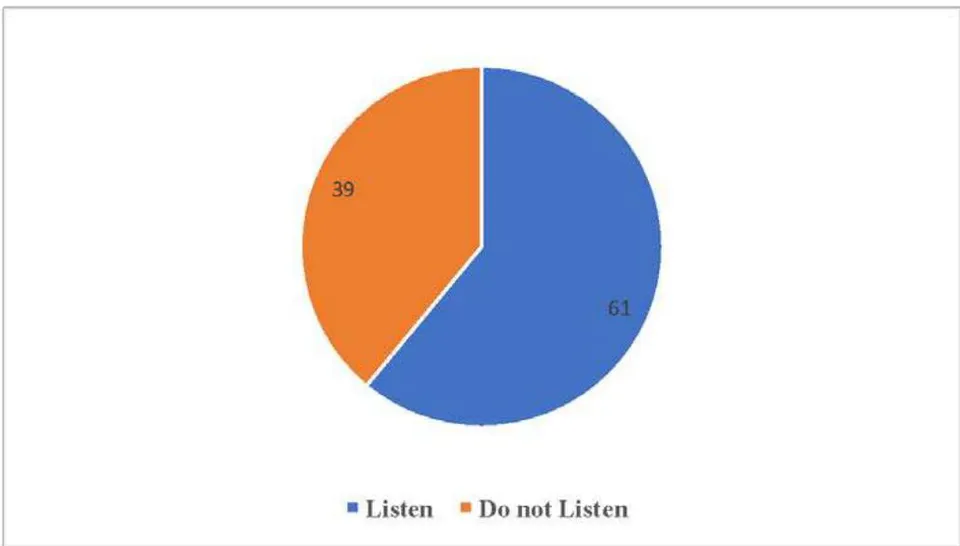
Figure 1 shows undergraduate students' listeninghip of student-based political programmes on MMUST FM. It demonstrates that the majority of the sampled respondents, , indicated that they do listen to student political programs on MMUST FM compared to who stated that they do not listen to these programs. The findings infer that most of the respondents who contributed to the study were familiar with student-based political programs on MMUST FM, which also enhanced the accuracy of the study results.
The study examined the role of student-based political programmes in MMUST FM in the following order: first, the role of these programmes in voicing political views on campus. Second, the role of these programmes in facilitating political dialogue was analysed. Third, the role of the programmes in covering local political news on campus and promoting diversity of political opinion on campus was examined. Table 5 below displays quantitative findings from the questionnaire.
| Description | N | SA (%) | A (%) | NS (%) | D (%) | SD (%) | Mean | SD |
| Political Voice | ||||||||
| MMUST FM's political programmes allow students to voice political views on campus. | 303 | 68(22.4) | 67(22.1) | 95(31.4) | 48(15.8) | 28(8.3) | 2.65 | 1.222 |
| Political Dialogue | ||||||||
| MMUST FM's political programmes facilitate political dialogue between the student leaders and students on campus | 303 | 71(23.4) | 69(22.8) | 100(33.0) | 40(13.2) | 23(7.6) | 2.59 | 1.198 |
| Local Political News | ||||||||
| MMUST FM's political programmes cover local news that affects students on campus | 303 | 22(7.3) | 33(10.9) | 114(37.6) | 83(27.4) | 51(16.8) | 3.36 | 1.106 |
| Diversity of Political Opinion | ||||||||
| MMUST FM's political programmes facilitate diversity of political opinion on campus. | 303 | 51(16.8) | 41(13.5) | 130(42.9) | 61(20.1) | 20(6.6) | 2.86 | 1.122 |
Table 5 demonstrates that of the sampled respondents strongly agreed, and agreed that MMUST FM's political programmes play the role of voicing students' political views on campus; were not sure. In comparison, and of the respondents disagreed and strongly disagreed, respectively. There were strong views from the focus group discussants that MMUST FM's political programmes allow students to voice their political opinions. One of the student leaders who took part in the focus group discussions clarified his argument in the following way:
'Political programmes in MMUST FM allow us to voice our political views. For example, a programme like Campus Vibe thatairs every week gives comrades a chance for our voices to be heard. In this way, MMUST FM provides a platform for our views to be heard. Comrades have been able to develop political understanding because of these programmes.' Personal Communication (Focus group discussion 2023) From the key informant interview guides, the radio producers stated that student-based political programmes in MMUST FM give the student community a voice to vent their political views. One of them said as follows:
"Political programmes in MMUST FM have given the student community a platform for their voices that did not exist before. Here, they have an avenue where their views can be heard in a structured manner. This gives them a sense of belonging in one way or another." Personal Communication (Key Informant Interview, 2023)
These findings affirm that MMUST FM's student-based political programmes are a vocal political instrument on campus. Generally, these findings give credence to the Democratic Participant Media Theory. In one of its tenets, McQuail (1987) posits that local media programmes are public forums where local voices and views are heard in a thriving community media environment.
The findings are also in line with other studies. For instance, Gamson (2001) established that radio programmes appropriately handled political discussions and created spaces where public members could have their say on the day's political issues. These findings further correspond with Tucker (2013), who argues that community media platforms provide a platform where members of a particular community can deliberate on issues. In his findings, Mwesige (2009) avers political talk-show programmes that allow the masses to vent their views freely without censorship. Mwesige (2009) further reinforces this finding by asserting that audiences freely sharing their political opinions through political programmes on radio increases political consciousness in society, which leads to good political governance. The finding demonstrates that MMUST FM's student-based political programmes are a popular medium for expressing students' political views on campus and could facilitate the growth of democratic space in MMUST.
Table 5 above demonstrates the findings from the questionnaires on the role of MMUST FM's student political programmes in facilitating political dialogue. The results indicate that and strongly agreed and agreed that MMUST FM's political programmes facilitate political dialogue on campus, were unsure, while and disagreed and strongly disagreed. The study sought views from discussants using the qualitative approach, and strong opinions from student leaders indicated that student-based political programmes facilitate political dialogue between them as student leaders and the students they represent in political leadership. One discussant demonstrated as follows:
'In my strongest opinion, I feel that a programme like Comrade Weekly, which allows comrades to call in and talk to us live in the studio, gives us a rare opportunity to converse with our electorate.' Personal Communication (Focus Group Discussion, 2023)
Producers of student-based political programmes on MMUST FM also believe they facilitate campus dialogue. One of the producers demonstrated as follows:
"When you analyse the structure of the talk show programmes, you will realise that students have an opportunity to talk to each other. Leaders have an opportunity to respond to questions from the student community, and the community has a chance to take their leaders into account. I think that is dialogue." Personal Communication (Key Informant Interview, 2023)
The qualitative and quantitative approaches of the study demonstrate how students communicate through political programmes in MMUST FM to facilitate political dialogue. MMUST FM facilitates one of the critical pillars of democracy: an exchange of ideas and opinions between the governors (student leaders) and the governed (student community). The finding aligns with the Democratic Participant Media Theory by McQuail (1987), who argues that community media should give spaces for community members to discuss community-based issues. The finding further agrees with Ngugi and Kinyua (2014), who observed that dialogue is enhanced by people who live together by the things they have in common. Dialogue is how a community possesses things in common through a community media platform. The study confirms Tucker (2013), who, in a survey, found that community radios like MMUST FM are critical linkages where community members can talk to each other without meeting face to face. Chibita (2010) lends credence to these findings by arguing in her conclusions that radio programmes, especially radio talk shows, have made it possible for radio stations to engage the public in political debates and dialogue. The findings give credibility to the argument that MMUST FM's student-based political programmes play a crucial role in facilitating political dialogue between student leaders and the student community, which is paramount to achieving the growth of democracy on campuses.
Table 5 above presents the results obtained from the questionnaires on the role of MMUST FM's student-based political programmes in covering local political news concerning students on campus. The data reveals that only and of the respondents strongly agreed and agreed that MMUST FM's political programmes cover local political news concerning campus students. Most participants, , were unsure, while disagreed and strongly disagreed with the statement. The quantitative findings indicate that MMUST FM needs to give more attention to local political news relevant to the student community on campus.
In the focus group discussion, student leaders had differing opinions on whether MMUST FM's student political programmes cover local political news relevant to the student community on campus. One student leader explained:
"News in MMUST FM does not focus on our political stories as it should. Most political news stories focus on regional and national politics; this can be very frustrating, especially when there are important stories to be told about students on their radio station." Personal Communication (Focus group discussion, 2023)
Another student leader had a contrary opinion and demonstrated as follows:
"Local student political news is given enough coverage at the radio station. For instance, during the campaign period, these political stories made us known to the student community. These news stories give us platforms we do not receive on national broadcasters like Citizen Radio." Personal Communication (Focus group discussion, 2023)
The radio producers in the key informant interview sessions disagreed. They explained that the programmes cover local political news. One of the producers who produce news programmes at the radio station demonstrated as follows:
"As a radio station, we try to cover local political stories that touch on students as much as possible. However, we have a challenge when collecting and analysing these stories, especially during the elections. This is because we are somehow thin on the ground, and our student volunteer reporters in the field are sometimes held up by their academic assignments. This is a challenge that many community radio stations like MMUST FM face." Personal Communication (Key Informant Interview, 2023)
The quantitative and qualitative findings contradict the argument made by Ross and Rolt (2005) that community radio provides a platform for public deliberation and a space where diverse community opinions can be expressed and tolerated.
The qualitative approach further revealed that the political programmes run by MMUST FM, which is a student-run radio station, are unreliable sources of local political news on campus. Although the establishment of campus radio stations has provided a new avenue for sharing local political news, most of the news covered on MMUST FM needs more content related to the students. This finding contradicts the research conducted by Myers (2008), who claimed that radio is the primary source of news and information in Africa, particularly in political contexts. The purpose of grassroots media like MMUST FM is to serve the interests of the local student community. However, this study indicates that MMUST FM needs to improve its coverage of local political stories to enhance and strengthen the political fabric of undergraduate students on campus.
According to Ngugi and Kinyua (2014), grassroots radio stations like MMUST FM have a responsibility to broadcast local content that impacts a particular community. Their research suggests that MMUST FM's coverage of political news could be improved by covering more local political news stories affecting campus students. By focusing on local issues that impact students on campus, MMUST FM can better serve the political interests of the student population at the university level.
Table 5 above shows that only of the respondents strongly agreed that MMUST FM's political programmes encourage diversity of political opinions on campus, agreed, disagreed, and strongly disagreed. The majority of the respondents, comprising , were unsure. The study's quantitative method reveals that MMUST FM's political programmes have not been successful in promoting a diversity of political opinions on campus. In contrast, the qualitative approach suggests that student leaders strongly believe that political programmes supported by MMUST FM facilitate a diversity of political opinions. One discussant illustrated this point as follows:
In my opinion, the student political programmes in MMUST FM facilitate a variety of political opinions because no one is denied the chance to air their opinion at the radio station. I have not seen any form of discrimination regarding opinions expressed by students at the radio station. Sometimes, when we have fascinating political discussions, everyone is allowed to contribute in one way or another irrespective of their year of study or the programme they are undertaking' Personal Communication (Focus group discussion, 2023)
The radio producers also elicited similar remarks. One producer explained:
"One unique programming trait is that we do not discriminate against any student. We have slots for the marginalised and disabled in our political programmes and encourage students from all disciplines and levels of study to participate in the political programmes. If students fail to convey their political opinions via MMUST FM, it is by choice and design. Inclusivity in programming is one of our core values as a radio station." Personal Communication (Key Informant Interview, 2023)
The qualitative approach shows that student-based political programmes at MMUST FM help establish and maintain an ideal campus community by providing a platform for student leaders to express their opinions. However, the quantitative data reveals that the student-based political programmes at MMUST FM should represent undergraduate students' broad range of views within the student community. These quantitative findings do not support McQuail's Democratic Participant theory (1987), which suggests that community media platforms should enable local communities to express their views at the community level. On the other hand, the qualitative findings align with Ross and Rott's (2005) argument that grassroots radio serves as a forum for public deliberation, where diverse community opinions can be expressed and tolerated.
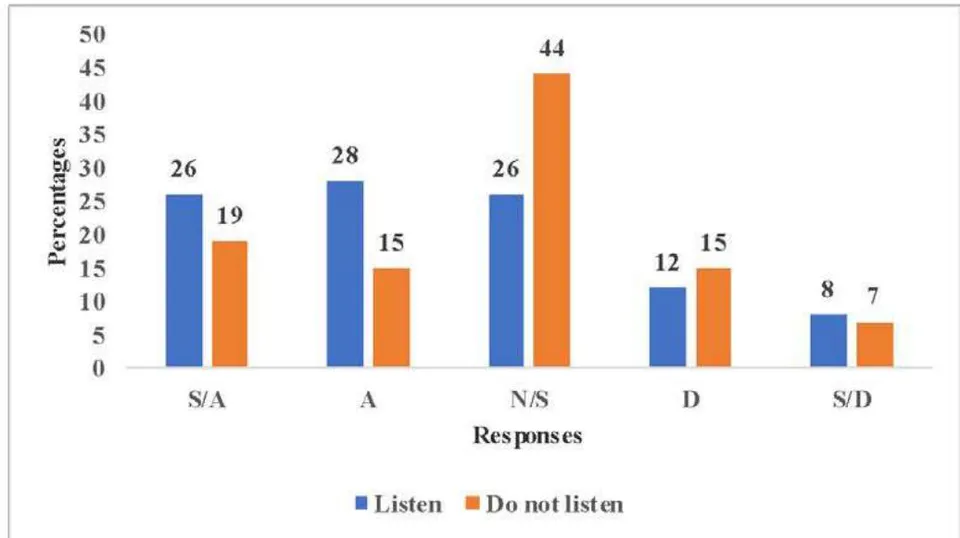
Figure 2 demonstrates that of the respondents who listen to MMUST FM's student-based political programmes strongly agreed that MMUST FM's political programmes facilitate political dialogue between student leaders and students on campus, compared to of respondents who do not listen to these programmes. Furthermore, of the respondents who listened to the programmes agreed with the statement, compared to of the respondents who did not listen to these programmes. In addition, of the respondents who listen to these programs returned not sure compared to of those who do not listen to these programmes; of the respondents who listen to the programmes disagreed with the statement compared to from those who do not listen to the programmes. Finally, of the respondents who listened to the programmes strongly disagreed with the statement, compared to who did not listen. These findings show that respondents who listen to student-based political programmes on MMUST FM feel that the programmes facilitate political dialogue on campus compared to those who do not listen to these programmes.
a) Inferential Statistics for the Role of Student-based Political Programmes in MMUST FM
Hypothesis: Role of Student-based Political Programmes in MMUST FM on Students' Politics
: The role of student-based political programs in MMUST FM has no significant influence on students' politics in MMUST
| Model | R | R Square | Adjusted R Square | Std. Error of the Estimate |
| 1 | .991a | .982 | .982 | 3.313 |
According to Table 6, the R-Square value is 0.982. The figure implies that the roles of student-based political programmes at MMUST FM explain of the variation in students' political involvement. These roles include voice to political views, political dialogue, local political news coverage on campus, and diversity of political opinion on campus.
| Model | Sum of Squares | Df | Mean Square | F | Sig. | |
| 1 | Regression | 177286.093 | 1 | 177286.093 | 16152.746 | .000b |
| Residual | 3303.656 | 301 | 10.976 | |||
| Total | 180589.749 | 302 |
According to Table 7, at a significance level of 0.05, the independent variable - the role of student-based political programmes in MMUST FM - is crucial in predicting students' politics. This is supported by a significance p-value of 0.000, lower than the 0.05 significance level .
| Model | Unstandardized Coefficients | Standardized Coefficients Beta | T | Sig. | ||
| B | Std. Error | |||||
| 1 | (Constant) | -6.845 | .534 | -12.831 | .000 | |
| Role of Student-Based Political Programmes in MMUST FM | 4.648 | .037 | .991 | 127.093 | .000 | |
According to Table 8, the Role of Student-Political Programmes in MMUST FM significantly impacted student politics at MMUST, as evidenced by the t-statistic of 127.0 and p-value of 0.00, which is less than the significance level. Therefore, we can reject the null hypothesis with a confidence level, indicating that the Role of Student-Political Programmes in MMUST FM positively influenced university politics.
VI. RSEARCH IMPLICATIONS
According to the study, the political programmes run by MMUST FM, a student-run radio station, serve as a platform for expressing political views and encourage discussions on diverse political opinions on campus. These findings align with McQuail's theory, emphasizing the importance of localized media programmes when dealing with local community issues. However, the study also found that the programmes have deficiencies in covering local political news that impacts students on campus. This neglects the democratic participant media theory, which suggests that local media outlets are better suited to cover local news than larger commercial and public media systems.
Based on the research, student-run political programmes have established a solid political foundation on campus and increased political awareness among the student community. However, MMUST FM's news editorial policy needs to fulfill the fundamental responsibility of a grassroots medium, which is to prioritize news stories that affect the student community it serves.
VII. CONTRIBUTIONS TO SCIENTIFIC
COMMUNITY AND FUTURE RESEARCH
Although the current study provides reliable data on how university radio stations political programmes influence students' politics, it is essential to acknowledge its limitations while interpreting the results. This study specifically focused on the role of student-based political programmes on MMUST FM. Even though most studies and legislations have classified university-based radio stations as community radio stations, the findings of this study state otherwise. For instance, most respondents felt that the university administration interferes with the editorial policy of the radio station. This scenario means that university-based radio stations significantly fail to live up to the ideals of a community radio station, which dictates that a radio station should be fully owned and run by the community. With this existing scenario, there is a need for a study to examine the concept and philosophy of a university-based radio station.
VIII. CONCLUSION
Based on the research, student-run political programmes have established a solid political foundation on campus and increased political awareness among the student community. However, MMUST FM's news editorial policy needs to fulfill the fundamental responsibility of a grassroots medium, which is to prioritize news stories that affect the student community it serves.
Funding
This research paper received no internal or external funding.
ORCID
Gabriel Mshindo Bombo https://orcid.org/0000-0001-6772-0369