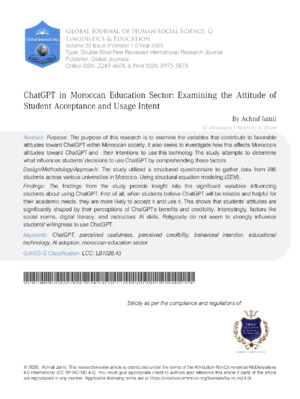
ChatGPT in Moroccan Education Sector: Examining the Attitude of Student Acceptance and Usage Intent

Article ID

JDT7G

Moroccan Education Attitude.

ChatGPT in Moroccan Education Sector: Examining the Attitude of Student Acceptance and Usage Intent

Achraf Jamil
Achraf Jamil
DOI

Abstract

Purpose: The purpose of this research is to examine the variables that contribute to favorable attitudes toward ChatGPT within Moroccan society. It also seeks to investigate how this affects Morocco’s attitudes toward ChatGPT and their intentions to use this technolog The study attempts to determine what influences students’ decisions to use ChatGPT by comprehending these factors. Design/Methodology/Approach: The study utilized a structured questionnaire to gather data from 286 students across various universities in Morocco. Using structural equation modeling (SEM). Findings: The findings from the study provide insight into the significant variables influencing students about using ChatGPT. First of all, when students believe ChatGPT will be reliable and helpful for their academic needs, they are more likely to accept it and use it. This shows that students’ attitudes are significantly shaped by their perceptions of ChatGPT’s benefits and credibility. Interestingly, factors like social norms, digital literacy, and instructors’ AI skills, Religiosity do not seem to strongly influence students’ willingness to use ChatGPT. Practical Implications: The results demonstrate how widely ChatGPT is accepted by Moroccan respondents. It highlights how important it is to raise ChatGPT’s perceived value and credibility in order to increase student adoption and usage. To fully realize ChatGPT’s educational benefits, educational institutions should carefully integrate it into their curriculum while guaranteeing its dependability. Originality/Value: While recents research has examined the variables influencing students attitudes and intentions of using ChatGPT and their possible effects. This study is the first of its kind to try to look into this relationship in the setting of a developing, collectivist society like Morocco.

ChatGPT in Moroccan Education Sector: Examining the Attitude of Student Acceptance and Usage Intent

Purpose: The purpose of this research is to examine the variables that contribute to favorable attitudes toward ChatGPT within Moroccan society. It also seeks to investigate how this affects Morocco’s attitudes toward ChatGPT and their intentions to use this technolog The study attempts to determine what influences students’ decisions to use ChatGPT by comprehending these factors. Design/Methodology/Approach: The study utilized a structured questionnaire to gather data from 286 students across various universities in Morocco. Using structural equation modeling (SEM). Findings: The findings from the study provide insight into the significant variables influencing students about using ChatGPT. First of all, when students believe ChatGPT will be reliable and helpful for their academic needs, they are more likely to accept it and use it. This shows that students’ attitudes are significantly shaped by their perceptions of ChatGPT’s benefits and credibility. Interestingly, factors like social norms, digital literacy, and instructors’ AI skills, Religiosity do not seem to strongly influence students’ willingness to use ChatGPT. Practical Implications: The results demonstrate how widely ChatGPT is accepted by Moroccan respondents. It highlights how important it is to raise ChatGPT’s perceived value and credibility in order to increase student adoption and usage. To fully realize ChatGPT’s educational benefits, educational institutions should carefully integrate it into their curriculum while guaranteeing its dependability. Originality/Value: While recents research has examined the variables influencing students attitudes and intentions of using ChatGPT and their possible effects. This study is the first of its kind to try to look into this relationship in the setting of a developing, collectivist society like Morocco.

Achraf Jamil
Achraf Jamil

No Figures found in article.

Achraf Jamil. 2026. “. Global Journal of Human-Social Science – G: Linguistics & Education GJHSS-G Volume 25 (GJHSS Volume 25 Issue G3): .

Download Citation

Journal Specifications

Crossref Journal DOI 10.17406/GJHSS

Print ISSN 0975-587X

e-ISSN 2249-460X

Classification
Not Found
Article Matrices
Total Views: 486
Total Downloads: 20
2026 Trends
Research Identity (RIN)
Related Research
Our website is actively being updated, and changes may occur frequently. Please clear your browser cache if needed. For feedback or error reporting, please email [email protected]

Request Access

Please fill out the form below to request access to this research paper. Your request will be reviewed by the editorial or author team.
X

Quote and Order Details

Contact Person

Invoice Address

Notes or Comments

This is the heading

Lorem ipsum dolor sit amet, consectetur adipiscing elit. Ut elit tellus, luctus nec ullamcorper mattis, pulvinar dapibus leo.

High-quality academic research articles on global topics and journals.

ChatGPT in Moroccan Education Sector: Examining the Attitude of Student Acceptance and Usage Intent

Achraf Jamil
Achraf Jamil

Research Journals