I. INTRODUCTION
Green chemistry is founded on guidelines that are designed to prevent and reduce the waste associated with the production of chemicals. Any modifications to existing processes as well as the creation of new processes that lead to more efficient and recyclable solvents, safer reactions, and renewable feedstocks are successes.[1]
Ionic liquids or molten salts are molecules composed wholly of ions and occur in the liquid state. An inorganic salts such as NaCl is an ionic liquid above its melting point. Due to their high melting point many inorganic salts are of little use in daily life. Instead, chemists have turned to imidazolium-based ionic liquids. These organic salts are current candidates for green solvents. They can be highly soluble, can have high ionic conductivity, are generally inflammable, have high thermal and chemical stability, and relatively low vapor pressures compared to cyclohexane, benzene, and acetone. Typically the imidazoliumsaltsunder investigation are alkylmethylimidazolium compounds. The novelty of this work is that dialkylated methylimidazolium salts are investigated.[2]
Trisubstituted imidazolium salts are a current research topic. They have been investigated as a solvent, an electrolyte solution additive, a reaction initiator, a product precursor, a molecular aggregator, and a composite material.[3]
The 1-octanol/water partition coefficient ( ) for these salts has come to signify the tendency of a charged organic molecule to cross a biological membrane, and as an estimate to the salt's environmental impact before widespread use. The purpose of this work is to add to existing data for the 1-octanol/water partition coefficient for these salts.
II. MATERIALS AND METHODS
a) Synthesis
The synthesis is shown below (Scheme 1). It is outlined in the literature.[7]

The chemicals used in the syntheses, the CAS numbers, sources and grades are below. The proton NMR was performed on a Bruker AV-III 300 MHz spectrometer. The solvent was DSMO and the standard was . The peak assignments are below.
1-methyl-3-octyl-1H-imidazol-3-ium bromide
3-methyl-1H-imidazol-3-ium (1-methylimidazole 616-47-7, Aldrich, 99%, 25.00 mL), 1-bromoctane (111-
83-1, Aldrich, 99%, 71.00 mL), and toluene (108-88-3, Aldrich, 99.8%, 40.00 mL) were mixed. The solution was refluxed for two days. The resulting mixture was frozen and the excess toluene was decanted. The product was thawed and washed with ethyl acetate (141-78-6, Aldrich, 99.8%). The solution was evaporated to dryness. The product was frozen and the excess reagents were decanted. δH(300 MHz; DMSO; Si(CH3)4) 8.90 (1 H, s, 2-H), 7.91 (1 H, d, 5-H), 7.78 (1 H, d, 4-H), 5.00 (2 H, t NH), 3.75 (3 H, s, NCH3), 2.00 (2 H, qt, CH2), 1.30 (10 H, s, CH2) 0.91 (3 H, br, CH3)) The x-ray photoelectric spectroscopy, FTIR, and 1H NMR markers are also in the literature.[8, 9].
1,2-dimethyl-3-octyl-1H-imidazol-3-ium iodide
To a stirred solution of 1-methyl-3-octyl-1H-imidazol-3-ium bromide (10.00 g) in acetonitrile (75-05-8, Aldrich, 99.8%, 175.00 mL) was added NaH (7646-69-7, Aldrich, 60% in mineral oil, 2.00 g). After allowing the mixture to stir four hours, iodomethane (74-88-4, Aldrich, 99%, 6.90 mL) was added and the reaction was stirred for 12 hours. The solution was filtered to remove any precipitated NaI. The resulting oil as washed with ethyl acetate (141-78-6, Aldrich, 99.8%, 3x75.00 mL) and the residual volatiles were then removed under vacuum. The residual nonvolatiles were removed by freezing and decantation. δH(300 MHz; DMSO; Si(CH3)4) 7.91 (1 H, d, 5-H), 7.78 (1 H, d, 4-H), 5.00 (2 H, t NH), 3.75 (3 H, s, NCH3), 2.85 (3 H, s, 2-CH3) 2.00 (2 H, qt, CH2), 1.30 (10 H, s, CH2) 0.91 (3 H, br, CH3)) The 1H NMR markers are in the literature.[10, 11]
Workers find the IUPAC nomenclature wearisome. This paper will represent the 1-methylimidazolium fragment as mim. The molecule 1-methyl-3-octyl-1H-imidazol-3-ium bromide is shortened to [omim]Br. Similarly, 1,2-dimethyl-3-octyl-1H-imidazol-3-ium iodide becomes [momim]I. The two letters hx will refer to the hexyl group.
[bomim]Cl
2-butyl-1-methyl-3-octyl-1H-imidazol-3-ium chloride was prepared in the same manner as [momim]l with the exception that 1-chlorobutane (109-69-3, Aldrich, 99.5%, 11.6 mL) was used instead of iodomethane. δH(300 MHz; DMSO; Si(CH3)4) 7.91 (1 H, d, 5-H), 7.78 (1 H, d, 4-H), 5.00 (2 H, t NH), 3.75 (3 H, s, NCH3), 2.50 (2 H, t, CH2), 2.00 (2 H, qt, CH2), 1.61 (2 H, qt, CH2) 1.30 (12 H, s, CH2) 0.91 (6 H, br, CH3)) [pomim]Cl
1-methyl-3-octyl-2-pentyl-1H-imidazol-3-ium chloride was prepared in the same manner as [momim]l with the exception that 1-chloropentane (543-59-5, Aldrich, 99%, 13.4 mL) was used instead of iodomethane. δH(300 MHz; DMSO; Si(CH3)4) 7.91 (1 H, d, 5-H), 7.78 (1 H, d, 4-H), 5.00 (2 H, t NH), 3.75 (3 H, s, NCH3), 2.50 (2 H, t, CH2), 2.00 (2 H, qt, CH2), 1.61 (2 H, qt, CH2) 1.30 (14 H, s, CH2) 0.91 (6 H, br, CH3)) [oomim]Cl
1-methyl-2, 3-dioctyl-1H-imidazol-3-ium chloride was prepared in the same manner as [momim]l with the exception that chlorooctane (111-85-3, Aldrich, 99%, 18.9 mL) was used instead of iodomethane. δH(300 MHz; DMSO; Si(CH3)4) 7.91 (1 H, d, 5-H), 7.78 (1 H, d, 4-H), 5.00 (2 H, t NH), 3.75 (3 H, s, NCH3), 2.50 (2 H, t, CH2), 2.00 (2 H, qt, CH2), 1.61 (2 H, qt, CH2) 1.30 (20 H, s, CH2) 0.91 (6 H, br, CH3)) [domim]Cl
2-decyl-3-methyl-2-octyl-1H-imidazol-3-ium chloride was prepared in the same manner as [momim]l with the with the exception that chlorodecane (1002-69-3, Aldrich, 98%, 22.6 mL) was used instead of iodomethane. δH(300 MHz; DMSO; Si(CH3)4) 7.91 (1 H, d, 5-H), 7.78 (1 H, d, 4-H), 5.00 (2 H, t NH), 3.75 (3 H, s, NCH3), 2.50 (2 H, t, CH2), 2.00 (2 H, qt, CH2), 1.61 (2 H, qt, CH2) 1.30 (22 H, s, CH2) 0.91 (6 H, br, CH3)) [bbmim]Cl
3-methyl-1H-imidazol-3-ium (1-methylimidazole 616-47-7, Aldrich, 99%, 25.00 mL), 1-chlorobutane (109-69-3 Aldrich, 99.5%, 43.00 mL), and toluene (108-88-3, Aldrich, 99.8%, 40.00 mL) were mixed. The solution was refluxed for two days. The resulting mixture was frozen and the excess toluene was decanted. The product was thawed and washed with ethyl acetate (141-78-6, Aldrich, 99.8%). The solution was evaporated to dryness. The product was frozen and the excess reagents were decanted. To a stirred solution of 1-methyl-3-octyl-1H-imidazol-3-ium bromide (10.00 g) in acetonitrile (75-05-8, Aldrich, 99.8%, 150.00 mL) was added NaH (7646-69-7, Aldrich, 60% in mineral oil, 2.67 g). After allowing the mixture to stir four hours, 1-chlorobutane (109-69-3 Aldrich, 99.5%, 17.8 mL) was added and the reaction was stirred for 12 hours. The solution was filtered to remove any precipitated NaCl. The resulting oil as washed with ethyl acetate (141-78-6, Aldrich, 99.8%, 3x75.00 mL) and the residual volatiles were then removed under vacuum. The residual nonvolatiles were removed by freezing and decantation. δH(300 MHz; DMSO; Si(CH3)4) 7.91 (1 H, d, 5-H), 7.78 (1 H, d, 4-H), 5.00 (2 H, t NH), 3.75 (3 H, s, NCH3), 2.50 (2 H, t, CH2), 2.00 (2 H, qt, CH2), 1.61 (2 H, qt, CH2) 1.30 (4 H, sx, CH2) 0.91 (6 H, t, CH3)) [pbmim]Cl
2-butyl-1-methyl-3-pentyl-1H-imidazol-3-ium chloride was prepared in the same manner as [bbmim]Cl with the exception that 1-chloropentane (543-59-9, Aldrich, 99%, 20.7 mL) was used instead of 1-chlorobutane. δH(300 MHz; DMSO; Si(CH3)4) 7.91 (1 H, d, 5-H), 7.78 (1 H, d, 4-H), 5.00 (2 H, t NH), 3.75 (3 H, s, NCH3), 2.50 (2 H, t, CH2), 2.00 (2 H, qt, CH2), 1.61 (2 H, qt, CH2) 1.30 (6 H, sx, CH2) 0.91 (6 H, t, CH3)) [hxbmim]Cl
2-butyl-3-hexyl-1-methyl-1H-imidazol-3-ium chloride was prepared in the same manner as [bbmim]Cl with the exception that 1-chlorohexane (544-10-5, Aldrich, , 23.5 mL) was used instead of 1-chlorobutane. 7.91 (1 H, d, 5-H), 7.78 (1 H, d, 4-H), 5.00 (2 H, t NH), 3.75 (3 H, s, NCH3), 2.50 (2 H, t, CH2), 2.00 (2 H, qt, CH2), 1.61 (2 H, qt, CH2) 1.30 (8 H, br, CH2) 0.91 (6 H, t, CH3)) [dbmim]Cl
2-butyl-3-decyl-1-methyl-1H-imidazol-3-ium chloride was prepared in the same manner as [bbmim]Cl with the exception that 1-chlorodecane (1002-69-3,
Aldrich, 98%, 34.8 mL) was used instead of 1-chlorobutane. δH(300 MHz; DMSO; Si(CH3)4) 7.91 (1 H, d, 5-H), 7.78 (1 H, d, 4-H), 5.00 (2 H, t NH), 3.75 (3 H, s, NCH3), 2.50 (2 H, t, CH2), 2.00 (2 H, qt, CH2), 1.61 (2 H, qt, CH2) 1.30 (16 H, br, CH2) 0.91 (6 H, t, CH3))
The UV/Vis spectra were produced on a Beckman DU-640B UV/Vis spectrophotometer. The salt, its phase, the , and the corresponding absorbance are shown in the Results and Discussion section. The maximum absorbance is in the neighborhood of 265.0 nm, which indicates the imidazolium ring.
The compound [oomim]Cl was excluded. The spectrum was simply noise. This may indicate a very similar blank and sample. The difference between the two---the UV/Vis spectrum---is noise.[13]
The compound [momim]I shows negative absorbance. Negative absorbance has no physical meaning except that the blank absorbs more light than the [momim]I.
This work finds the 1-octanol/water partition coefficient by the slow-stirring method.[14-18] The salt was added to a solution of 1-octanol saturated with water. Each solution was stirred for 45 days at . This was done slowly to prevent emulsification.
For this work initially 5.0 g of the organic salt was added to 5.0 mL of a saturated 1-octanol/water solution. When an emulsion formed, the solution was stirred for six hours and left to rest overnight. This removed the emulsion. Serial dilutions were done to keep the absorption values between -0.150 and 1.000. The aqueous layer was drawn off and compared to a saturated solution of 1-octanol. One extraction was done for each compound. The value was then calculated using
where and are the absorbances of the aqueous layer before and after extraction. and are the volumes of the water and 1-octanol phases. The symbols and are the dilution factors used to find and . [19,20]
III. RESULTS AND DISCUSSION
The UV/Vis data, the experimental log values, the calculated log values, and the absolute difference between them are shown below in Table 1.
| Compound in water phase | in nm | Absorbance at | Exp. Log Kow | Calc. Log Kow | |
| [momim]I | 248.0 | -0.1459 | -0.62 | -.8850 | 0.27 |
| [bomim]Cl | 269.0 | 0.4209 | 1.1 | 0.5020 | 0.6 |
| [pomim]Cl | 265.0 | 0.21450 | 0.98 | 1.031 | 0.051 |
| [domim]Cl | 263.0 | 0.1249 | 5.1 | 3.676 | 1.4 |
| [bbmim]Cl | 264.0 | 0.6850 | -1.3 | -1.614 | 0.31 |
| [pbmim]Cl | 264.0 | 0.6413 | -0.93 | -1.085 | 0.16 |
| [hxbmim]Cl | 259.0 | 0.1866 | -0.31 | -0.5560 | 0.25 |
| [dbmim]Cl | 232.0 | 0.2346 | 1.9 | 1.560 | 0.3 |
values, calculated log values, and the absolute difference between them. The calculated values were determined by the group contribution method rather than the linear free energy relation scheme.
Using the cLog P program[22] the calculated log values in Table 1 were found. The expectation is 85% of the calculated log values will be in error by less than 0.5, 10% by 0.5 to 1.0, and 5% by more than 1.0.[23] For this work, the values are 75%, 13%, and 13% respectively. The clog P program is best suited for molecules with typical fragments.[24] The charged five-membered ring and the long hydrocarbon chains may be misrepresented in this group additive method or the small sample size may explain the discrepancies.
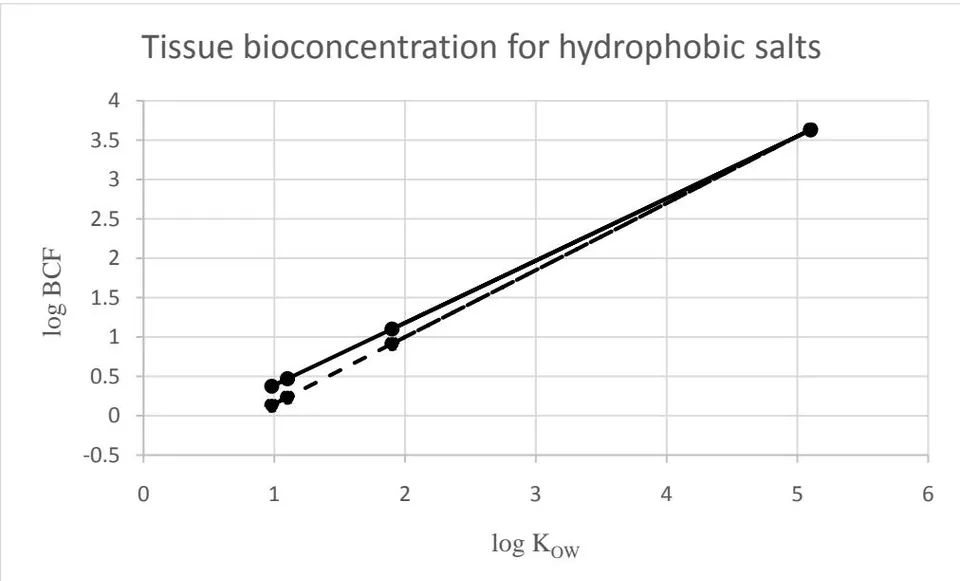
The toxicity of organic solvents in animal tissue, in soil, and in water is an ongoing concern. In this work we examine three toxicity indicators that are linked to the 1-octanol/ water partition coefficients. Positive value log values indicate the octanol phase is favored. These compounds are candidates for tissue storage. That is, candidates for the calculated of a bioconcentration factor (BCF). The soil sorption coefficient ( ) is the ratio of the mass of a chemical absorbed per weight of carbon in a soil to the concentration of the chemical in water. The lethal concentration of a chemical is defined as the lethal dose for half the population ( ).[25]
Two BCF models are shown in Figure 1. The lower dashed line is . The upper dashed line is . [25] The for benzene from these models is 1.3 and 1.1, respectively. [2]
Three models are shown below in Figure 2. The lower solid line is . The middle line is . The top dashed line is . [25] The for benzene for these three models are 1.7, 2.1, and 2.5, respectively. [2]
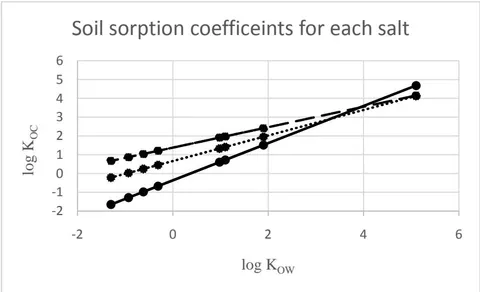
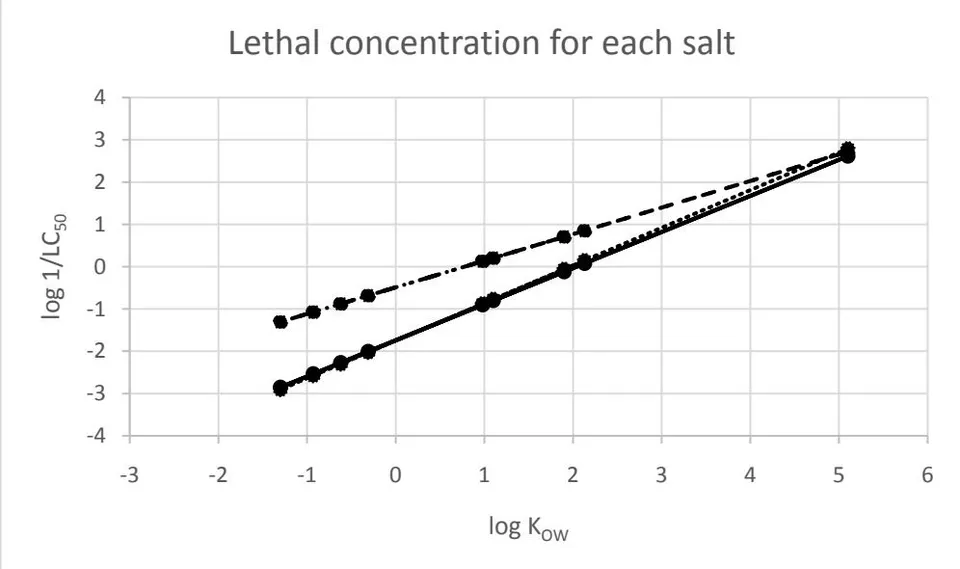
Figure 3 shows the log of the inverse lethal concentrations (1/LC ) for each salt. The top line is log(1/LC ) = 0.629 log(K ) - 0.489. The middle dotted line is log(1/LC ) = 0.854 log(K ) - 1.74. The solid line is log(1/LC ) = 0.89 log(K ) - 1.75.[25] The log(1/LC ) for benzene from these models are 0.85, 0.079, 0.15, respectively.[2]
IV. CONCLUSIONS
Green chemistry has taken a winding road in its search for benign solvents. Some, such as , have become firmly established. Others, such as imidazolium salts, continue to be under investigation. A physical quantity that continues to be of interest is the 1-octanol/water partition coefficients. One reason is their direct link to the environmental impact of the salts.
Dialkylated methylimidazolium salts have low vapor pressure compared to typical solvents such as benzene. This work shows they can be synthesized to be water soluble or lipophilic. This work also shows that every imidazolium salt is not "green". The salts with octyl and/or decyl substituents have comparable toxicity to benzene. It has recently been shown that cholinium alkanoates may provide a set of molecules that are more ecologically friendly.[35]
Conflict of Interests
The authors declare that there is no conflict of interests regarding the publication of this paper.