150 Years of the Housing Question

α
Alexandre Kramatschek Tavares
α Universidade Regional Integrada do Alto Uruguai e das Missões

Send Message

To: Author

150 Years of the Housing Question

Article Fingerprint

ReserarchID

07798

150 Years of the Housing Question Banner

AI TAKEAWAY

Connecting with the Eternal Ground
  • English
  • Afrikaans
  • Albanian
  • Amharic
  • Arabic
  • Armenian
  • Azerbaijani
  • Basque
  • Belarusian
  • Bengali
  • Bosnian
  • Bulgarian
  • Catalan
  • Cebuano
  • Chichewa
  • Chinese (Simplified)
  • Chinese (Traditional)
  • Corsican
  • Croatian
  • Czech
  • Danish
  • Dutch
  • Esperanto
  • Estonian
  • Filipino
  • Finnish
  • French
  • Frisian
  • Galician
  • Georgian
  • German
  • Greek
  • Gujarati
  • Haitian Creole
  • Hausa
  • Hawaiian
  • Hebrew
  • Hindi
  • Hmong
  • Hungarian
  • Icelandic
  • Igbo
  • Indonesian
  • Irish
  • Italian
  • Japanese
  • Javanese
  • Kannada
  • Kazakh
  • Khmer
  • Korean
  • Kurdish (Kurmanji)
  • Kyrgyz
  • Lao
  • Latin
  • Latvian
  • Lithuanian
  • Luxembourgish
  • Macedonian
  • Malagasy
  • Malay
  • Malayalam
  • Maltese
  • Maori
  • Marathi
  • Mongolian
  • Myanmar (Burmese)
  • Nepali
  • Norwegian
  • Pashto
  • Persian
  • Polish
  • Portuguese
  • Punjabi
  • Romanian
  • Russian
  • Samoan
  • Scots Gaelic
  • Serbian
  • Sesotho
  • Shona
  • Sindhi
  • Sinhala
  • Slovak
  • Slovenian
  • Somali
  • Spanish
  • Sundanese
  • Swahili
  • Swedish
  • Tajik
  • Tamil
  • Telugu
  • Thai
  • Turkish
  • Ukrainian
  • Urdu
  • Uzbek
  • Vietnamese
  • Welsh
  • Xhosa
  • Yiddish
  • Yoruba
  • Zulu

Abstract

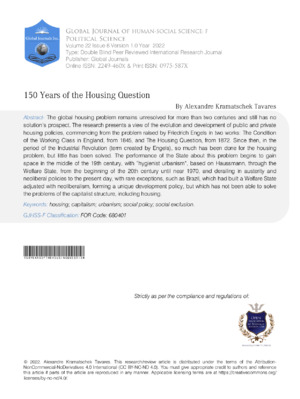
The global housing problem remains unresolved for more than two centuries and still has no solution’s prospect. The research presents a view of the evolution and development of public and private housing policies, commencing from the problem raised by Friedrich Engels in two works: The Condition of the Working Class in England, from 1845, and The Housing Question, from 1872. Since then, in the period of the Industrial Revolution (term created by Engels), so much has been done for the housing problem, but little has been solved. The performance of the State about this problem begins to gain space in the middle of the 19th century, with “hygienist urbanism”, based on Haussmann, through the Welfare State, from the beginning of the 20th century until near 1970, and derailing in austerity and neoliberal policies to the present day, with rare exceptions, such as Brazil, which had built a Welfare State adjusted with neoliberalism, forming a unique development policy, but which has not been able to solve the problems of the capitalist structure, including housing.

References

33 Cites in Article
  1. Referências Bibliográficas (null). REFERÊNCIAS BIBLIOGRÁFICAS.
  2. Adrià Alemany,Ada Colau (2018). Vidas hipotecadas. PISEAGRAMA.
  3. Ronaldo Araújo,De Sousa (2010). Modificações No Planejamento Urbanístico.
  4. Duncan Bowie (2011). Housing.
  5. (2006). Thirty Years of World Bank Shelter Lending: what have we learned?.
  6. Michael Cernea (2008). IRR: An Operational Risks Reduction Model for Population Resettlement.
  7. David Donnison,Clare Ungerson,Raquel Rolnik (1982). Housing Policy.
  8. M Edwards,; Foreword,Duncan Bowie (2011). Housing.
  9. Friedrich Engels (2008). A situação da classe trabalhadora na Inglaterra.
  10. Letícia Araújo (2015). O Airbnb e a questão da moradia em São Paulo.
  11. Escócia Government (2012). Rosborough, Dr Linda, Director, Marine Scotland, Scottish Government, since 2012.
  12. Alan Gilbert (2002). On the mystery of capital and the myths of Hernando de Soto: <i>What difference does legal title make?</i>.
  13. David Harvey (2013). Para entender O capital: Livro I.
  14. Jane Jacobs (2014). Morte e Vida de Grandes Cidades.
  15. Henri Lefebvre (2016). O Direito à Cidade. Itapevi.
  16. Karl Marx,Friedrich Engels (1998). Manifesto Comunista.
  17. Karl Marx (2004). Manuscritos econômico-filosóficos.
  18. Letícia Osório,Marques The Social Function of Property and the Human Right to Security of Tenure in Latin America with a Particular Focus on Brazil.
  19. ; Tese,Raquel Rolnik (2013). Guerra dos Lugares: a colonização da terra e da moradia na era das finanças.
  20. Julie Pollard (2009). Political Framing in National Housing Systems: Lessons from Real Estate Developers in France and Spain.
  21. Omar Razzaz (1998). Land Disputes in the Absence of Ownership Rights: Insights from Jordan.
  22. Alfredo Rodríguez,Ana Sugranyes (2012). EL PAPEL DE LAS POLÍTICAS DE PLANEACIÓN Y VIVIENDA EN LA PRODUCCIÓN DE LA MARGINALIDAD.
  23. Raquel Rolnik,Renato Cymbalista (1997). Impacto da aplicação de novos instrumentos urbanísticos em cidades do estado de São Paulo.
  24. Raquel Rolnik,Guerra (2019). dos Lugares: a colonização da terra e da moradia na era das finanças.
  25. Bárbara Rossi,Carvalho (2017). Rio de Janeiro de Pereira Passos: O poder da imagem na gestão da cidade.
  26. Ananya Roy (2005). Urban Informality: Toward an Epistemology of Planning.
  27. Luciana Royer,De Oliveira (2009). Financeirização da política habitacional: limites e perspectivas.
  28. ( Tese,Doutorado (2009). Materiais para a economia criativa: pesquisa em design.
  29. P Santoro,R Rolnik (2017). Novas frentes de expansão do complexo imobiliário-financeiro em São Paulo.
  30. Mark Stephens,Guerra (2019). A Critical Analysis of Housing Finance Reform in a 'Super' Home-ownership State: The Case of Armenia.
  31. The,Bank (1993). Housing Enabling Markets to Work.
  32. Pablo Trivelli (2009). Sobre la evolución de la política urbana y la política de suelo em el Gran Santiago em el período 1979-2008.
  33. Fábio Munhoz Svartman1,2,3,Maurício Mello Roux Leite2,Ana Garcia Sartori2,Renato Soares Gutierrez2,Ana Cadore2,Carla Tatiana Martins De Oliveira2,Renata Ullmann De Brito2,Cristiano Feijó Andrade1,3 (1999). Lung cancer screening with low-dose CT integrated with pulmonary care in a public hospital in southern Brazil: results from the first 712 patients.

Funding

No external funding was declared for this work.

Conflict of Interest

The authors declare no conflict of interest.

Ethical Approval

No ethics committee approval was required for this article type.

Data Availability

Not applicable for this article.

How to Cite This Article

Alexandre Kramatschek Tavares. 2026. \u201c150 Years of the Housing Question\u201d. Global Journal of Human-Social Science - F: Political Science GJHSS-F Volume 22 (GJHSS Volume 22 Issue F8): .

Download Citation

Explores 150 years of housing and social changes, emphasizing interdisciplinary insights and historical context.
Journal Specifications

Crossref Journal DOI 10.17406/GJHSS

Print ISSN 0975-587X

e-ISSN 2249-460X

Keywords
Classification
GJHSS-F Classification: FOR Code: 680401
Version of record

v1.2

Issue date

January 3, 2023

Language
pt
Experiance in AR

Explore published articles in an immersive Augmented Reality environment. Our platform converts research papers into interactive 3D books, allowing readers to view and interact with content using AR and VR compatible devices.

Read in 3D

Your published article is automatically converted into a realistic 3D book. Flip through pages and read research papers in a more engaging and interactive format.

Article Matrices
Total Views: 1660
Total Downloads: 59
2026 Trends
Related Research

Published Article

The global housing problem remains unresolved for more than two centuries and still has no solution’s prospect. The research presents a view of the evolution and development of public and private housing policies, commencing from the problem raised by Friedrich Engels in two works: The Condition of the Working Class in England, from 1845, and The Housing Question, from 1872. Since then, in the period of the Industrial Revolution (term created by Engels), so much has been done for the housing problem, but little has been solved. The performance of the State about this problem begins to gain space in the middle of the 19th century, with “hygienist urbanism”, based on Haussmann, through the Welfare State, from the beginning of the 20th century until near 1970, and derailing in austerity and neoliberal policies to the present day, with rare exceptions, such as Brazil, which had built a Welfare State adjusted with neoliberalism, forming a unique development policy, but which has not been able to solve the problems of the capitalist structure, including housing.

Our website is actively being updated, and changes may occur frequently. Please clear your browser cache if needed. For feedback or error reporting, please email [email protected]

Request Access

Please fill out the form below to request access to this research paper. Your request will be reviewed by the editorial or author team.
X

Quote and Order Details

Contact Person

Invoice Address

Notes or Comments

This is the heading

Lorem ipsum dolor sit amet, consectetur adipiscing elit. Ut elit tellus, luctus nec ullamcorper mattis, pulvinar dapibus leo.

High-quality academic research articles on global topics and journals.

150 Years of the Housing Question

Alexandre Kramatschek Tavares
Alexandre Kramatschek Tavares Universidade Regional Integrada do Alto Uruguai e das Missões

Research Journals