Summery-This paper analyzes the process of development of three-dimensional didactic resources created and tested with visually impaired students from Brazilian public schools which involved designers, teachers, and students collaboratively. The importance of interaction among the areas of Engineering, Design, and Education was also analyzed. The central results were the creation or adaptation of effective didactic resources as intermediary objects to help teachers, and visually impaired students in the teaching-learning process within the areas of Arts, Nature Sciences, and Mathematics. This paper points out the importance of collaborative activities involving users and designers along the process of assistive products development, measured with Rasch Analysis and through verbalizations of students, teachers, and designers.
Miguel Ángel Aires Borrás ${}^{\alpha}$, Cleyton Fernandes Ferrarini ${}^{\sigma}$, Plínio Cesar Marins ${}^{\rho}$, Andrea Regina Martins Fontes ${}^{\omega}$, Patrícia Saltorato ${}^{\yen}$, Camila Barros de Miranda Moram ${}^{\varsigma}$ & Thaís Andressa de Souza ${}^{\text{X}}$
## I. INTRODUCTION
Despite the efforts to universalize education, the perspective of inclusive education is still a significant challenge. Special Education needs special pedagogical resources for the effectiveness of the teaching and learning process, offering the necessary support to students to reach the ordinary school curriculum, and to develop their cognitive capacities (DA SILVA FILHO; BARBOSA, 2015).
In this context, Assistive Technology (AT), which concerns research, manufacturing, use of equipment, resources, or the strategies used to enhance the functional abilities of people with disabilities, can facilitate daily activities enhancing their functional capabilities, thus giving them autonomy, independence, and equality in carrying out activities and handling equipment (AGNOL et al., 2015).
In Brazil, Assistive Technology (AT) is defined as being an area of knowledge, of interdisciplinary characteristics, which includes products, resources, methodologies, strategies, practices, and services that aim to promote the functionality, related to activity and participation, of people with disabilities, impairments, or reduced mobility, aiming at their autonomy, independence, quality of life and social inclusion (BRASIL, 2009).
Considering the difficulties of access to learning for students with disabilities, Santos (2007) states that in the case of blindness, for example, there is a significant limitation to the teaching process, requiring that educational practices, with people with visual impairments, be designed to contemplate its peculiarities.
According to data from the Brazilian Institute of Geography and Statistics (IBGE, 2012), there are in Brazil 45.6 million people with some kind of disability, and severe visual impairment affects $3.5\%$ of the population.
The 2016 School Census (INEP, 2017) showed that there were 60,000 people with disabilities enrolled in Early Childhood Education in Brazil, and of these, $82.0\%$ were included in regular classes. Furthermore, the data showed that there was a leap in Elementary Education, in which the number of people with disabilities enrolled in Brazil rose by around 600 thousand of this amount, $57.8\%$ are in regular classes (INEP, 2017). However, in high school, this number dropped to just over 70,000 enrollments, with practically $100\%$ of the students enrolled in regular classes (INEP, 2017). The decline in enrollments of people with disabilities from Elementary to High School (a decrease of around $88.4\%$ ) indicates a possible difficulty in apprehending knowledge. That could indicate insufficient knowledge to allow them to progress through school levels, and on other hand, may suggest the inadequacy of didactic resources and infrastructure discouraging students from continuing their studies.
Analyzing data from the 2015 Higher Education Census (INEP, 2016), it can be seen that, due to a set of factors, such as the creation of new institutions and courses, as well as the encouragement of access through initiatives such as the University for All Program (ProUni), the National High School Exam (ENEM), and the Student Financing Program (FIES), the number of people enrolled in higher education has increased significantly. The number of people with disabilities entering these institutions has also grown. INEP (2016) points out that in 2015, 8,027,297 students enrolled in higher education courses in the country, which represented a growth of $90.06\%$ compared to 2004. Regarding students with special educational needs, the increase was much higher in the same comparison $(703.00\%)$, reaching 37,927 enrollments.
Despite the entry of people with disabilities having increased three and a half times concerning the total number of enrollments in higher education in the country in 2015, the percentage came to represent only $0.47\%$. Of these enrollments, 1,922 were people with blindness, and 9,224 were people with low vision (INEP, 2016). In the state of São Paulo, according to INEP data (2016), 407 blind people (3 in federal institutions) and 1,557 low-vision people (52 in federal institutions) enrolled in higher education.
Inserted in this context are people with visual impairment (PVI) who, despite the significant number of students with visual impairment glimpse the need for a pedagogical service that breaks the barriers imposed by society, researchers from the Education area show that the lack of teacher training for the correct use of technological/pedagogical resources as being one of the main obstacles which result in the exclusion of blind and low-vision students in several activities which make up the school curriculum. We highlight those whose incidence of images, formulas, graphs, and figures prevail, or are equal to the descriptive contents, as in the case of Mathematics, Chemistry, Physics, Geography, Biology, and Music.
Cerqueira and Ferreira (2000) state that in no other form of education, didactic resources are necessary for the education of students with visual impairment, as these require tactile contact and interaction with differentiated materials to allow their participation in the activities culminating in their learning. Borges (2009) indicates three prerequisites for people with disabilities to have access to and incorporate the use of technologies: information about the existence of artifacts, availability of resources to get them, and access from the place where the person is or lives.
We identify an established set of support materials for people with visual impairment that can be found in the national market or distributed free of charge by support or government institutions.
This gap is a great barrier to students with visual impairment attendance and maintenance. The teachers are responsible for adopting strategies and didactic resources to meet the school curriculum.
Although the current educational policy seeks to stimulate the inclusion of children with disabilities in the regular school system, it is a notorious shortage of pedagogical alternatives that facilitate this integration. In the specific case of students with visual impairment, according to Palm (2002), when this group of students is inserted in the regular school, besides facing the challenge of overcoming biological limitations imposed by the absence of sight, they also face constraints imposed by the educational system such as lack of preparation of teachers, lack of printed material in Braille and didactic resources that favor their teaching and learning process.
According to the MEC (BRASIL, 2001), it is evident that teaching based solely on theoretical exposition, without significant concrete experience, in which the student's direct participation is lacking due to insufficient adequate didactic resources, will tend to develop in any student an attitude that is unfavorable to the assimilation and understanding of the content created.
Vision is a highly motivating function for development in all its aspects. The visual perception of objects, people, shapes, colors, and movement arouses curiosity and interest and prompts the child to approach and explore the outside world. Children with low vision or blindness may have this interest diminished by the lack of stimuli and may thus become apathetic and quiet. The environment must be organized to actively promote development through the sensory channels that the child has so that they can participate in daily activities and learn like any other child (LAPLANE; BATISTA, 2008).
Cerqueira and Ferreira (2000) state that didactic resources are so important in no other form of education. Students with visual impairment need tactile contact and interaction with differentiated materials that allow their participation in activities culminating in their learning.
For Toledo and Pereira (2007), the visually impaired child can obtain knowledge through tactile perception and hearing but, for them to get to know the world, it is necessary to let them get objects that they can touch and feel, as well as check the size, weight, and shape.
This paper analyzes the development process of three-dimensional didactic resources created and tested with visually impaired persons (PVI) which involved designers, teachers, and students in collaborative design.
## II. RESOURCES AND TECHNIQUES
This research is Interdisciplinary, applied, objective, by sampling, based on direct observation and primary data, and experimental, as to the level of interpretation. By controlling the technical attributes and characteristics of the design and prototyping processes, an attempt will be made to deliver adequate didactic resources in the teaching-learning process for visually impaired students.
It is also possible to conclude when considering the characteristics of collaborative, interdisciplinary, and group design, applied, experimental, and direct observation, that this research is participatory and, while participatory, we can qualify it as research-action, because when seeking to achieve the proposed objectives, there will be consequent and effective practical action of the research team and sample group involved in the problem under observation (THIOLLENT,
### 2011). This research was developed according to the following steps:
a) Exploratory Phase: approval by the Ethics Committee of Plataforma Brasil; leveling of the research team as to the basic concepts of the areas involved (Education, Engineering, and Design), the problem to be solved, objectives, actors, and expected results;
b) Informational Design: Documentary research and expert interviews were conducted to define the knowledge base to be shared among the research team members and between them and the participating actors, and vice-versa;
c) Hypothesis Building and Review: Construction of assumptions about possible solutions to the problem posed in the research (Stage 1) and review of the hypotheses already posed in the project and throughout the execution of the project. Project worked on: Hypothesis "a" Ha0: The use of three-dimensional didactic resources enhances the learning of visually impaired students. Ha1: The use of three-dimensional didactic resources does not enhance the knowledge of visually impaired students; Hypothesis "b" Hb0: If Hypothesis "a" is accepted, then three-dimensional didactic resources promote school inclusion of the visually impaired students. Hb1: If Hypothesis "a" is not accepted, then three-dimensional didactic resources do not promote school inclusion of the visually impaired students; Hypothesis "c" Hc0: If Hypothesis "a" is accepted, then three-dimensional didactic resources stimulate greater knowledge apprehension by visually impaired students. Hc1: If Hypothesis "a" is not accepted, then three-dimensional didactic resources do not promote the most significant apprehension of knowledge by the visually impaired students;
d) Sampling: the research team, together with the Board of Education of Sorocaba Region and the Municipal Secretariat of Education, determined the sample size and characteristics of the object of study. The team visited the schools where students with visual impairment attend classes. Actors collaborated with the study's development and validated and received the developed didactic resources. For presenting and testing the didactic resources specifically with students with visual impairment and their teachers, and considering that the population with these characteristics in public schools located in the city of Sorocaba is limited, we intend to work with a nonprobability sample by typicity, leaving it up to the researchers to find a representative sample, not by random choice process. The study sampled 12 participants whose ages ranged from 15 to 54 years. Participants consisted of 5 students (A - man, low vision,
B - man, blind, C - woman, blind, D - man, blind, E - woman, blind); 4 teachers (A - woman, B - woman, C - man, D - woman) and, 3 designers (A, B, C). Participants or their legal guardians signed an informed consent form requested by the Research Ethics Committee of the Federal University of São Carlos;
e) Selection of School Contents, Methods, and Techniques for developing didactic resources: The knowledge and school contents in the areas of Art, Nature Sciences, and Mathematics that were contemplated with the construction of physical and digital didactic resources listed from the analysis of the National Curricular Parameters for High School, the textbooks (National Program of the Textbook), the Curricular Proposal of the State of São Paulo, the Common National Curricular Base (under discussion at the Ministry of Education), as well as from interviews with teachers and students, actors participating in the project. This stage was performed with the collection of data and information in documentary research and interviews with participating actors; holding seminars to discuss the data and information collected to carry out the selection of contents, methods, and techniques, the indication of need, the area of chemistry was added to the areas of knowledge initially covered by this project;
f) Conceptual/Preliminary Design, or Formal Knowledge/Informal Knowledge: consists of developing the first drawings and written explanations of the desired features and the use of resources for the activities planned in the previous step with the participation of students, teachers, and designers. At this stage, it is also intended to define the performance indicators for the didactic resources. It is known that the didactic resources for visually impaired, teachers and students, the following attributes are valued (CERQUEIRA; FERREIRA, 2000) - Size: The materials cannot be excessively large or small with the purpose of highlighting details of the material and enabling the proper apprehension of the totality of the didactic resource; Tactile Significance: The didactic resource must have a perceptible relief being constituted with, preferably, different textures each one highlighting a type of component of the material and highlighting contrasts of the kind smooth/rough, thin/thick; Acceptability: The material used cannot hurt or irritate physically or mentally the user with the intention of not provoking reactions of rejection; Visual stimulation: The resources should have strong and contrasting colors to stimulate the functional vision of the user; Fidelity: The resource and material used should be accurate and precise in relation to the original material as much as possible;
Ease of Handling: The resources should be easy to handle for their practical and functional use by the student, avoiding possible rejection of use; Resistance: Didactic resources should be made of materials that do not deteriorate easily, considering the frequent handling by students; and Safety: materials and resources must not offer risk to the health and physical or mental integrity of teachers, students, assistants, and the like';
g) Preparation of Material for Teacher Training: Based on the survey of characteristics and requirements carried out with the teachers, manuals for using the didactic resources were prepared;
h) Production of Didactic Resources: The didactic resources were made in the Prototyping Laboratory of the UFSCar at Sorocaba (LADEP). Manuals were prepared for guidance on the assembly and use of resources;
i) Validation of Didactic Resources: In regular meetings between the design team and participants, all the proposed resources were evaluated over six months when information was collected, and performance indicators were measured through interviews with teachers and students of these resources as well as through observations during use. The intention was to identify the need for improvements and adjustments for the final composition of the didactic material. Rasch Analysis of the collected data was performed.
It is important to describe some aspects of Rasch Analysis. According to Georg Rasch, at least much of science needs objectivity in the practice of comparisons for analyzes and conclusions (RASCH, 1964a, 1964b). Rasch (1966a) indicates that "two features seem indispensable in scientific statements: they deal with comparisons, and the comparisons must be objective. To complete these requirements, I have to specify the kind of comparisons and the precise meaning of objectivity" (RASCH, 1966a, p. 3).
For Stamler and Naples (2021), three core features of Rasch Measurement make it distinctive: the construct under investigation is normally distributed, the proposition that derived measures should be "test-free" and "person-free" and the objective of Rasch measurement is to construct a unidimensional scale and then test how well the data fits that model. Some authors explain that the assumption of normality manifests when raw scores are transformed with a logit transformation.
In Rasch (1980), the author explains the equation quite pedagogically by describing the case of throwing an ashtray from different heights (H1, lowest to a higher H6) and watching them crash to the ground with events of breaking (- or 0) or not breaking (+ or 1) the ashtray, subsequently indicating that the low and high falling distances would not reveal any difference of material density between the ashtrays, while the middle distances would do it.
The Rasch model has been used to verify the evaluation process of assistive technologies (FISCHL; FISHER, 2007; CARONNI et al., 2023) and, subsequently, the ability to objectively evaluate the analyzed objects, seeking to isolate the influence of the individual's ability on the process of perceiving the success of the assistive technology for the user.
Rasch Analysis was performed using the jMetrik computer program, which generated not only difficulty calibrations and capability estimates, but also goodness-of-fit statistics and standard errors (SE). The original Rasch model analyzes data from the interaction of two facets: items and persons, and the application can be extended to a third facet (RASCH, 1964a, 1964b, 1966a, 1966b, 1980). For this study, a three-facet model was used: the users and designers of the developed didactic resources (assistive devices), the didactic resources and their rated product features (fidelity, resistance, safety, size, tactile significance, user acceptance, visual stimulation), and the designers.
It is worth stressing that the junction of users and designers in a single entity was possible because they developed the learning resources collaboratively, in a product development process where any change in design characteristics was discussed and approved by both actors involved in this process. It can be said that for the application here of the Rasch model, it was considered that "User + Designer = Person 's". The items are the product features rated by person s. The main equation of the Rasch Model is the following (RASCH, 1964a, 1964b, 1966a, 1966b):
$$
P (X _ {i s} = 0 | \theta_ {s}, b _ {i} = \frac {e ^ {(\theta_ {s} - b _ {i})}}{1 + e ^ {(\theta_ {s} - b _ {i})}}
$$
Where,
$X_{ts} =$ response of person s to item $i$ (0/- or $1 / + )$
$\theta_{s} =$ ability level for person s
$b_{i} =$ difficulty of item $i$
Students were asked to compare their learning of the content without the aid of the three-dimensional material to the possibility of recalling the knowledge built through the tactile resources available. The first step was to ask questions about the concepts covered in each area of expertise throughout elementary school. Students were encouraged to explore the material and tell us their impressions: what they were feeling if something in the material bothered them and if they understood the function of that material. It is important to point out that the students have different affinities with each area of knowledge. Each student had a unique experience, in different schools and with different teachers, in different concrete life situations. We do not try to compare one student to another but, to analyze the supposed impact of the absence of materials in their school experiences.
## III. RESULTS
Concerning the teaching and learning process, certain relevant aspects must be considered regarding the visual references adopted by the educator because there is a natural predominance of vision over the other senses, and this causes knowledge that is not accessible to the student with visual impairment to be used by the seeing person to talk to him. This student develops a language and knowledge driven by the visual, staying at the level of verbalism and mechanical learning.
According to Cerqueira and Ferreira (2000), this importance takes into account that one of the ordinary problems of the visually impaired, especially the blind, is the difficulty of contact with the physical environment, the lack of appropriate material, the child's insufficient contact with things in the world, there is often a lack of motivation of the student for learning, so parameters such as size, tactile significance, and acceptance must be taken into account for the preparation of adapted didactic resources. In the evaluation of these dimensions, 6 resources were used for validation (Table 01):
Table 01: Prototypes used for validation.
<table><tr><td></td><td>Prototype 1: sculpture
'Venus of Willendorf'</td><td>Plastic sculpture in 1:1 scale, 11cm high, printed from an archive available on the internet of a European museum.</td></tr><tr><td></td><td>Prototype 2: sculpture
'Three Shadows' by Auguste Rodin</td><td>Small-scale plastic sculpture printed from an archive available on the internet of a French museum.</td></tr><tr><td></td><td>Prototype 3: representation of the painting 'Abaporu' by Tarsila do Amaral</td><td>Three-dimensional plastic puzzle, printed from a new project consisting of pieces differentiated by color.</td></tr><tr><td></td><td>Prototype 4: 'Food Chain' representation</td><td>Scheme of small-scale plastic parts, joints, and fittings representing the food chain on top of a perforated wooden base with Braille text.</td></tr><tr><td></td><td>Prototype 5: representation of a 'Neuron'</td><td>Plastic representation of a neuron, printed from a new project adapted from files found on the internet with texts in braille.</td></tr><tr><td></td><td>Prototype 6: representation of a 'Tactile Graphic'</td><td>Scheme of magnet parts, joints, and fittings allowing the representation on a clipboard and manual recording of the result of a graph on a bond sheet.</td></tr></table>
Five students were interviewed (A, B, C, D, and E), one with low vision and four with congenital blindness. Two interactions with the resources were performed in classrooms of two schools. The resources were presented to all the students, with a dynamic in which the resources were shown, and the students were questioned about the referred concepts.
In general, the students thought that the resources could be used in the classroom by everyone because learning through three-dimensional resources is much better than just looking at images in books.
They also praised the ease of transporting these materials (for their light weight and resistance).
Regarding the sculpture 'Venus of Willendorf' (prototype 1), student A received two copies: one shiny and one matte. Initially, he gave a general description, then indicated that the brighter one hindered his vision preferring the matte one:
"It's a person, a little chubby, his face is covered, it looks like a kind of abstract figure, it's a woman because she has breasts [...] I'm having some difficulty because, it's shiny, and all the same color only, no contrast, changed the piece for a more matte one, it helped a little, he associated that in the Middle Ages, people were fatter" Student A.
Student D was able to identify the shape alone with tactile perception, and he also thought the original work was larger:
"I believe it's an armless person, or it's glued to the body, it seems to be bald or spiky hair, it has some "little tires", a person that doesn't even have a neck, head well glued to the body, it's a woman, I think the original statue is much bigger, this must be a miniature of the original" Student D.
About the resource 'The Three Shades' (prototype 2), Student A needed an external description because he could not distinguish the content from tactile manipulation. After the external description, he commented on the men depicted and indicated improvements in contrast, robustness, and size. In his account, he highlights the advantage of making the tactile perception of the object, pointing out that usually, Art classes are very abstract:
"The three men, they seem discouraged, by the posture, sad, the hands together, I don't know this work, it also lacks contrast to understand, it seems more fragile, the size should be a little larger [...] It would be different if it had only contact. It helps to understand better when you get the material since art is a very abstract discipline" Student A.
As for the material that represents Tarsila's painting 'Abaporu' (prototype 3), the teacher, in the interview with student A, disassembled the pieces and tried to assemble them. According to the interviewee, the material has merit for the idea, texture, and contrast. Teacher D praises the possibility of being shared with sighted students and indicated the need to improve the friction of the fittings (Figure 01).
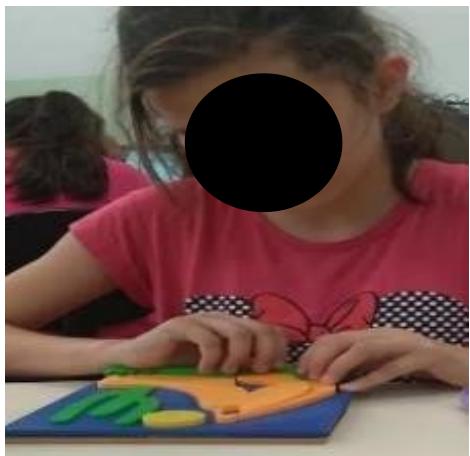
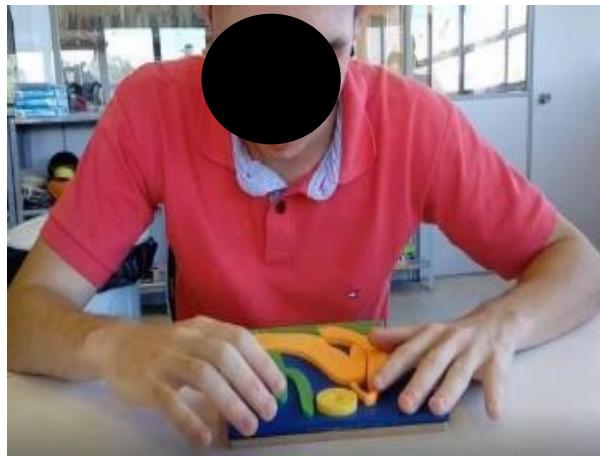 Source: Field research. Figure 01: Students using the didactic resource 'Abaporu' (Art class).
For student D, on the other hand, the material was a little confusing when he was manipulating it. He reported being afraid of breaking the pieces and explained that he found it difficult to assemble. He suggested that each piece should have a different texture (trying to associate the color).
After the external intermediation, the student was able to perceive the foot, the legs, the cactus, and the head he found it different, he even found it funny, and said:
"It must be in the desert, Northeast, and it's, tense there [...] not everyone has the same opportunity, they work a lot and don't have time to study" Student D.
Student E remembered her explanations in class when she learned through a drawing made with colored glue. This representation is better for understanding. She suggested widening the fittings to make assembly easier:
"This one is better because the relief is higher with glue. It ends up confusing, or the glue comes off. I give this one a score of 9.5 and glue 1 of 5 to understand. [...] I would change it, and I would leave it more open, more distant one piece from the other, to show it better, especially the "little head", it doesn't show up much" Student E.
In Nature Science class, the resources 'Food Chain' and 'Neuron' (prototypes 4 and 5 respectively) were presented to all students, performing a dynamic in which the resources were shown, and the students were encouraged to participate.
The 'Food Chain' (prototype 4), which student A liked best, as he could easily identify the pieces because of the contrasting colors used. He made the connections quickly and further explained the food chain (Figure 02).
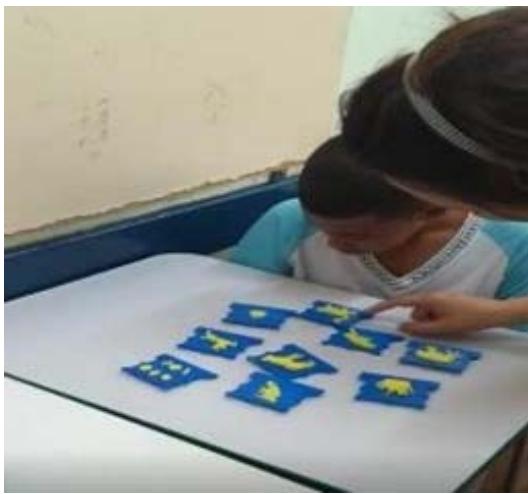
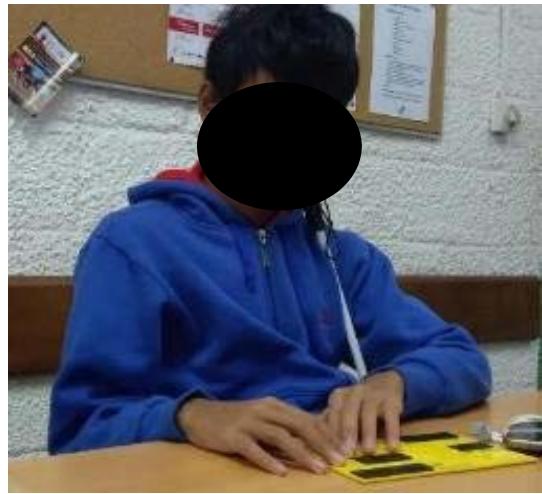 Source: Field research. Figure 02: Dynamic with 'Food Chain' and 'Neuron' resources (Nature Science class).
After the description of the material, student D was able to use the material by identifying the Braille texts, the reliefs of the animals, and the links forming the chain. This material could be used in the classroom and shared among everyone.
Student E needed a descriptive and conceptual explanation of the material for learning this concept. She praised the suitable shape chosen for the resource and verbalized that it is easy to use and does not hurt.
Regarding the 'Neuron' resource (prototype 5), student D was able to read the braille text (constituent parts of a neuron), but although it is not hurting, he explained that it is screwing up a little. Student E reported that it is easy to understand and does not hurt. She suggested it as an improvement making it a little bigger and sturdier.
After receiving the description, he praised the material and the ease of understanding the concepts through it. She pointed out the issue of size. The student highlights the advantage of tactile reading:
"I found it much easier, very simple, when we see it in books we have to imagine, now I can understand, I will know the theory and the practice together, I found it very good indeed. That material is a little disproportionate to use in the classroom" Student E.
The Math material, representation of a 'Tactile Graphic' (prototype 6) was presented through integration (Figure 03). Student A liked the resource, highlighting its advantage even for sighted people. He pointed out the lack of negative (a minus sign in high relief with a negative sign and in Braille) and positive, the increase of the magnets' fitting holes, the decrease of the magnets' strength, the division into four quadrants, the more minor points and only ten coordinates.
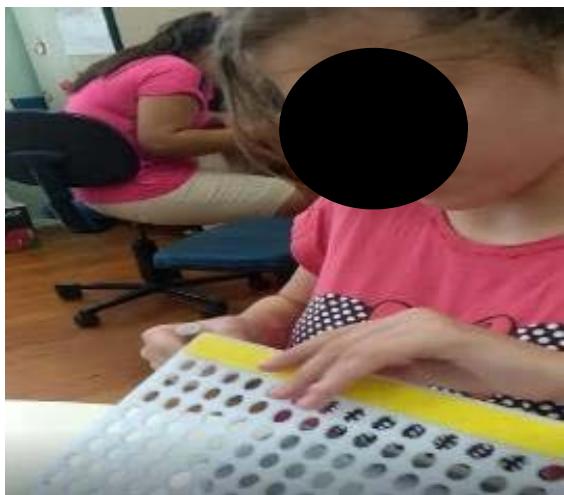
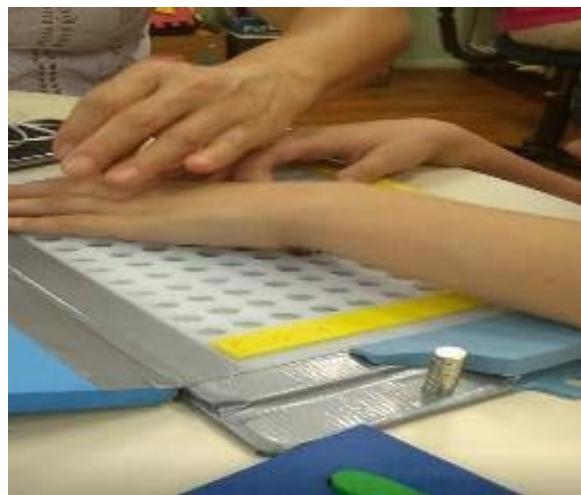 Source: Field research. Figure 03: Students using the 'Tactile Graphic' (Math class).
Student B also received an explanation of how it works, praised the material, and said that it would help a lot in the classroom. Like student A, he verbalized difficulty with the strength of the magnets.
Student B also received an explanation of how it works, praised the material, and said that it would help a lot in the classroom. Like student A, he verbalized difficulty with the strength of the magnets.
Student C also received an explanation of the operation, and praised the material, saying that it aroused her curiosity and interest. Like students A and B, she expressed difficulty with the strength of the magnets, complaining that her finger hurt during manipulation. Despite this observation, it was the material that student C liked the most.
Student D received the explanation of the Graph and loved the resource, it was his favorite, and interesting. Like the other interviewees, he indicated a decrease in the strength of the magnets:
"Genius! I'm worse than a child (and smiled). Very good! The Math stuff is the most interesting. You can make fun of it!" Student D.
Student E also received an explanation of use, loved the resource, and could distinguish with tactile perception the different materials used (plastic, EVA - Ethylene Vinyl Acetate, paper, clipboard, and magnet). She emphasized the possibility of using it both in the classroom. Like the other students, she highlighted the strength of the magnets.
"You have to be very careful with the magnet. It can be used in the classroom and the resource room. It will be good for the resource room teacher who won't have to do so many lessons. He will be able to do homework at school. The material is resistant and easy to use. I wasn't afraid to use it, I liked it very much [...] The magnet is very strong" Student E.
In Room 1, Math class (prototype 6 'Tactile Graphics'), the teacher showed on the blackboard the cardinal, positive and negative points that the material represents in the equation. Those concepts were taught in the previous year. The sighted students did not remember much about the subject and were uninterested.
The visually impaired student wanted to participate more, so Teacher A did a dynamic in which the numbers were spoken, and she was finding them on the Graph and placed the magnets. Student E found the magnets too strong but managed to find the numbers on the 'X' and 'Y' axis of the Cartesian plane. She put on the chain, put on the sheet of paper, and called friends to help her force the drawing board, to build the Graph, missing only a few points. Then she showed it to the whole class and talked about how she did it, and the axes to connect the points: quadrants of the 'X' and 'Y' line points.
The Math teacher suggested an improvement to do with the material with the 4 quadrants because the Graph does not show the negative numbers. It would be better to make the dots smaller or on a larger board.
When asked if they liked it, the sighted students were very positive. According to them, it is easier to learn. It is made of a material that does not break, does not hurt, and is still a lot of fun. The student with low vision also liked the material, reporting that the colors were intense, facilitating contrast and understanding.
The interviews with four teachers point out that the didactic resources were collectively developed involving students, designers, and teachers while expanding their knowledge related to design and 3D printing, mutual learning among designers and users.
Indeed, Raposo and Mól (2010) observed that the elaboration of didactic resources within an inclusive process benefits everyone's learning and participation. The concern to anticipate the teaching/learning process was noticed to elaborate the demand for resources effectively:
"The main function is to facilitate the student's understanding and the 3D learning resources end up helping a lot in visualizing the theoretical concepts. It is designed for the blind, so it is projected to be touched, but nothing prevents students that are not impaired from better observing and understanding the textbook content. For the blind it is of great value, we had contact with some blind students, and they were amazed by the material they could have contact with" Teacher C.
"[...] I think it would be very exciting to use the resources because it could help not only for visually impaired students but for everyone, especially for understanding abstract content" Teacher D.
This point is highlighted by Cast (2014) who states that setting teaching objectives and creating materials and broader forms of assessment makes it possible for everyone to learn according to a common education track.
## IV. DISCUSSION
A central finding of this research was the importance students placed on experiencing benefits in using the didactic resources. They pointed out the ease of learning and that they became more independent. One of them revealed that "the didactic resources sparked his curiosity for Math and made it easier to learn." Although some teachers gave examples, the most common use of tactile didactic resources was to boost productivity to lessen the performance gap between people with visual impairments and their non-disabled peers.
According to Cerqueira and Ferreira (2000), it is extremely important to consider that one of the basic problems of the visually impaired, especially the blind, is the difficulty of contact with the physical environment, the lack of appropriate resources, the child's insufficient contact with objects, and the lack of motivation for learning.
For this reason, didactic resources and assistive technologies assume fundamental importance in the education of students with visual impairment, especially when it comes to science teaching through images, photos, tables, and videos, contributing to the student's understanding of the content being discussed.
Although no resource learning met all the performance criteria indicated by Cerqueira and Ferreira (2000), they met the majority of them and were well accepted by those involved in the process. The considerations made by all the involved should be considered and adapted for the next resource development having fulfilled the aim of the proposed validation.
The efficiency of a didactic resource is constituted by its ease of use, incentive, or possibilities that the object provides during the teaching-learning process according to Cerqueira and Ferreira (2000). The student, guided by the teacher, uses the teaching recourse employing either physical, perceptual, or cognitive contact. As previously discussed by Béguin (2003), these resources only function if they can be a mediating instrument of learning, once, through its interface the user reaches the proposed objectives.
For Béguin (2016), the objects materialize a preconceived model of content and use, so their evaluation is essential to improve and validate the concepts they incorporated in the light of the perception of users and those who conceive them (designers, teachers, and students).
The effectiveness of the developed didactic resources is due to the integration and close collaboration of designers, students, and teachers, which is in agreement with what Naranjo et al. (2000), Cardinali and Ferreira (2010), Cast (2014), and Soares et al. (2020) indicate: that integration is indispensable for developing a didactic resource mental representation as good as possible, making learning meaningful and increasing the teaching effectiveness.
Regarding usability, the didactic resources have their use analyzed according to Borges (2009), looking at the three prerequisites for access and incorporation of the tool (resource): (i) information about the existence; (ii) availability to get them, and (iii) access to them, from the place where the user is.
The main aspects that influenced the use and willingness to use the devices at school followed the characteristics of materials intended for people with visual impairment proposed by Cerqueira and Ferreira (2000) and the scope of usability presented by Stanton and Barber (1996). They cover aspects such as functionality (which included ease of performance opportunities, as well as increased comfort and safety), accessibility of the device, and the school's readiness to integrate them into school activities, i.e., to adapt them to the task. The results showed that experiences and opinions about the devices influenced their use and even determined whether they were used.
Exploratory visits and interviews confirmed Bersch's (2017) proposal that resources that were accessible and integrated into activities were more likely to be used than those that were not. This kind of concern arises as educators are faced with a lack of methods and alternatives for learning (FERREIRA; DICKMAN, 2007) and this lack of tactile/concrete resources is noticeable even for the education of sighted students.
In addition, as discussed by Vaz et al. (2012), the use of didactic resources is essential in the appropriation of concepts, because they provide the student with greater comfort and safety in school-related activities. As pointed out by teachers and students themselves, the reasons for using them rely on their speed, smoothness, safety, and comfort. This indicates the students' perception of the benefits based on their own experiences of facilitated operation rather than on secondary information provided by others.
According to the results, the effective use of didactic materials, tactile, is not so simple, because, according to Silveira (2010), teachers need to acquire skills so that they can contribute to the construction of dynamic and inclusive educational approaches so that students with visual impairment have access to the same learning opportunities and participation in school life and in the community that sighted students have.
For Boucher (2007), usability could be confirmed through this interaction, when the user can work effectively, efficiently, and satisfactorily, always seeking to achieve the proposed goals in each circumstance.
Finally, for the application of Rasch Analysis it was considered the assumption that with greater ease of interpreting an item or product feature, given equivalent abilities of potential users, there would be a correlation between the lesser difficulty of interpreting the item with the effectiveness of that item for the user and, therefore, of delivering what is expected for the tactile feature.
The Rasch Analysis was based on the parameters determined as 150 for maximum iteration number, 0.005 for convergence criteria, and 0.3 for regulation of extreme values in Rasch Analysis as shown in Table 02.
Table 02: Rasch Analysis Results.
<table><tr><td>Item</td><td>Difficulty</td><td>Std Error</td><td>WMS</td><td>Std WMS</td><td>UMS</td><td>Std UMS</td></tr><tr><td>Size</td><td>0.82</td><td>0.84</td><td>1.13</td><td>0.68</td><td>1.14</td><td>0.68</td></tr><tr><td>Visual Stimulation</td><td>0.82</td><td>0.84</td><td>1.13</td><td>0.68</td><td>1.14</td><td>0.68</td></tr><tr><td>Fidelity</td><td>0.09</td><td>0.89</td><td>0.87</td><td>-0.34</td><td>0.79</td><td>-0.43</td></tr><tr><td>Resistance</td><td>-0.86</td><td>1.11</td><td>0.95</td><td>0.16</td><td>0.79</td><td>0.03</td></tr><tr><td>Safety</td><td>-0.86</td><td>1.11</td><td>0.95</td><td>0.16</td><td>0.79</td><td>0.03</td></tr><tr><td>Tactile Significance</td><td>-2.22</td><td>1.88</td><td>0.06</td><td>-0.81</td><td>0.05</td><td>-0.85</td></tr><tr><td>Acceptance</td><td>-2.22</td><td>1.88</td><td>0.06</td><td>-0.81</td><td>0.05</td><td>-0.85</td></tr></table>
Aktulun (2019) resumes the interpretation of parameter-level mean-square fit statistic in Rasch Analysis (Table 03) and points out that the ideal range for WMS and UMS values has been determined to be between 0.50 and 1.50 and the ideal coverage for standardized WMS and UMS values is between -1.90 and 1.90.
Table 03: Interpretation of parameter-level mean-square fit statistics.
<table><tr><td>Criteria</td><td>Range</td><td>Comments</td></tr><tr><td rowspan="4">Weighted Mean Square and Unweighted Mean Square</td><td>>0.20</td><td>Makes the scale distort the features of the subject matter and degrade the quality of</td></tr><tr><td>1.5 – 2.0</td><td>Unproductive for the construction of measurement, but not degrading.</td></tr><tr><td>0.5 – 1.5</td><td>Productive for measurement.</td></tr><tr><td>< 0.50</td><td>Less productive for measurement, but not degrading. May produce misleadingly high reliability and separation coefficients.</td></tr><tr><td rowspan="4">Standardized WMS (Std WMS) and Standardized UMS (Std UMS)</td><td>≥3.0</td><td>Data is very unexpected if they fit the model (perfectly), so they probably do not. But, with In a large sample size, substantive misfit may be small.</td></tr><tr><td>2.0 – 2.9</td><td>Data is noticeably unpredictable.</td></tr><tr><td>-1.9 – 1.9</td><td>Data have reasonable predictability.</td></tr><tr><td>≤ -2.0</td><td>Data are too predictable. Other "dimensions" may be constraining the response patterns.</td></tr></table>
## V. FINAL CONSIDERATIONS
The lack of awareness and reflection on the educational practice considering the precariousness of the teaching work in Public Education - including poor training, financial and prestige devaluation, and the lack of adequate structural and material conditions - hinder the fulfillment of rights established by the legislation related to the schooling of people with disabilities.
It is important to encourage these teachers to carry out an educational practice that is, in fact, transformative. In addition, there is also the need to raise the awareness of the regular classroom teaching staff. This commitment should be collective and the whole school team should be involved, especially because, in most cases, these teachers are trained in only one area of knowledge, not being trained to teach other subjects.
The issue of three-dimensional materials is still somewhat recent, but there is a growing interest in applying such technology in special education and social inclusion. Not only the individual learning of blind or low-vision students is at stake in the use of 3D-printed didactic resources. It is noticeable that blind people benefit when they work with concrete models and can analyze how the schemas and representations work. Knowledge becomes more real and meaningful, especially when these resources are used in regular classrooms. The exchange of knowledge among players within the educational process is invaluable.
The presented didactic resources were validated providing these teachers the possibility of working with a different, expressive, and necessary material, helping them to perform an educational work that makes sense. Touching is how blind and low-vision people, in social interaction, understand the world.
Analyzing the interviews and reports produced during this research, it became clear how fundamental this project has been for the participating students. The validation of the didactic resources is viewed to evaluate the effectiveness of the tested prototypes put into use; in this sense, we can highlight the inclusive nature of the resources, praised by both the visually impaired and the sighted students.
The 3D-printed learning resources applied in the regular classroom acted as agents of inclusion, attracting sighted students to work together with visually impaired students, resulting in school and social inclusion.
The resources developed are not enough to act alone to transmit knowledge. Like other types of didactic resources, the ones presented here help teachers to transmit knowledge to students, and students to learn more appropriately.
Pedagogical guidelines and usage guides accompany the 3D printed didactic resources, but, even though these were detailed, the teachers felt it was difficult for them to use the materials, possibly due to the lack of preparation in dealing with new technologies. Teachers confirmed the potential of these resources for teaching visually impaired students and for use in regular classrooms to complement the learning of sighted students.
The results indicated that the impact of these new representations (didactic resources of tactile and universal perception) and interactions between the involved actors (mutual design process) anticipated inadequacies of the process, since the evaluated prototypes obtained few indications of improvement. Furthermore, according to the reports, the materials aroused interest and curiosity on the part of the users, aspects favorable to the stimulation of learning.
From the verbalizations of the interviewees, it was possible to conclude that the resources studied favored the teaching and learning process, as in several moments, the students were able to easily use the materials and understand the concepts presented. The evaluated resources were considered by the users as learning mediators, offering through tactile perception, the achievement of the proposed teaching objectives.
From Rasch Analysis became possible to see that the items Tactile Meaning and Acceptability (WMS = 0.06; UMS = 0.05) are problems. Although those items should be suppressed from analysis, their values of standardized WMS and UMS can be considered. That analysis indicates the greater effectiveness of the characteristics of Tactile Significance, Acceptance, Safety, Resistance, Fidelity, Visual Stimulation, and Size, in this order for the resources produced. It also demonstrates the need to improve the quality of the questionnaire applied for users and designers, especially regarding product characteristics Tactile Significance, and Acceptance.
Considering the research results it is possible to accept hypothesis "a" (Ha0: the use of three-dimensional didactic resources enhances the learning of visually impaired students), hypothesis "b" (Hb0: If Hypothesis "a" is accepted, then three-dimensional didactic resources promote school inclusion of the visually impaired students) and the hypothesis "c" (Hc0: If Hypothesis "a" is accepted, then three-dimensional didactic resources stimulate greater knowledge apprehension by visually impaired students).
This research throws light on the challenge of public policies that do not present satisfactory results in reconciling engineering, education, and health in the validation of didactic resources. In this sense, it is up to the research to point out its limitations. In this way, we tried to propose techniques and methods that can materialize some projects with content capable of meeting the fragility of public policies in the context of inclusive education.
The research also highlights the didactic resource as being the mediation of the activity between the teacher and the student, as if it were a link for learning in inclusive education, seeking to meet assessment steps.
### ACKNOWLEDGMENT
The authors would like to thank the National Council for Scientific and Technological Development (CNPq) for funding the research project n. 442261/2016-0 entitled "VerTátil: development of didactic resources for the teaching and learning of visually impaired persons" and the Coordination for the Improvement of Higher Education Personnel (CAPES) for funding the scholarship for one of the authors (TURINO, 2019).
Generating HTML Viewer...
References
38 Cites in Article
A Agnol,B Salton,J Strapazzon,M Gomes (2015). O público-alvo da educação especial na perspectiva da educação inclusiva.
Özgün Aktulun (2019). Validity and Reliability Study of Turkish Version of Number Sense Screener for Children Aged 72-83 Months.
P Béguin (2003). Design as a mutual learning process between users and designers.
P Béguin (2016). A concepção dos instrumentos como processo dialógico de aprendizagens mútuas.
R Bersch (2017). Unknown Title.
José Borges,Angélica Dias (2009). Empoderamento digital: diferenças nas vidas dos cegos brasileiros.
Tese (2009). Doutorado em Ciências em Engenharia de Sistemas e Computação.
A Boucher (2007). Ergonomie Web -Pour des sites web efficaces.
Alane Martins Andrade,Julya Da Silva Rodrigues,Barbara Monteiro Lyra,Jessica Da Silva Costa,Mariana Nunes Do Amaral Braz,Márcia Amaral Dal Sasso,Helaine Carneiro Capucho (2001). Evolução do programa nacional de segurança do paciente: uma análise dos dados públicos disponibilizados pela Agência Nacional de Vigilância Sanitária.
Brasil (2016). Statistical Synopsis of Higher Education 2015.
Brasil (2009). Subsecretaria Nacional de Promoção dos Direitos da Pessoa com Deficiência.
S Cardinali,A Ferreira (2010). A aprendizagem da célula pelos estudantes cegos utilizando modelos tridimensionais: um desafio ético.
(2014). Design for Learning guidelines.
The John,W,Alden Trust (2007). Smith, Peter John, (born 31 Dec. 1936), Chairman, Gateshead Health NHS Foundation Trust (formerly NHS Trust), 1998–2012.
J Cerqueira,M Ferreira (2000). Os recursos didáticos na educação especial. Benjamin Constant Magazine.
Raimundo Silva Filho,Elma Barbosa (2015). Educação Especial: da prática pedagógica à perspectiva da inclusão.
A Ferreira,A Dickman (2007). Unknown Title.
C Fischl,A Fisher (2007). Development and Rasch Analysis of the Assessment of Computer-Related Skills.
Inep (2017). INSTITUTO NACIONAL DE PESQUISAS EDUCACIONAIS ANÍSIO TEIXEIRA.
Ibge Instituto,De Geografia E Estatística (2012). Cartilha do Censo 2010: Pessoas com Deficiência / Luiza Maria Borges Oliveira / Secretaria de Direitos Humanos da Presidência da República (SDH/PR) / Secretaria Nacional de Promoção dos Direitos da Pessoa com Deficiência (SNPD) / Coordenação-Geral do Sistema de Informações sobre a Pessoa com Deficiência.
Adriana Laplane,Cecília Batista (2008). Ver, não ver e aprender: a participação de crianças com baixa visão e cegueira na escola.
María Naranjo,Azucena Martín,Maria Gómez (2000). Da integração à escola inclusiva na espanha.
Marília Amorim,Daniel Portella,Alessandra Pires,Carlos Silva,Valéria Freitas (2002). Social determinants and oral cancer mortality in Brazil: A 20-year analysis.
P Raposo,G Mól (2010). A diversidade para aprender conceitos científicos: a ressignificação do ensino de ciências a partir do trabalho pedagógico com alunos cegos.
G Rasch (1964). Table 4: Item statistics in Rasch analysis..
G Rasch (1964). Objective Comparisons.
G Rasch (1966). State responsibility.
G Rasch (1966). AN ITEM ANALYSIS WHICH TAKES INDIVIDUAL DIFFERENCES INTO ACCOUNT.
G Rasch (1980). Probabilistic Models for Some Intelligence and Attainment Tests.
Fernanda Dos Santos,Larissa Pedreira,Tânia Menezes,Juliana Do Amaral,Valdenir Da Silva,Nildete Gomes (2007). Cognitive Stimulation to the Elderly in Intensive Care as a Nursing Care.
Helena Piúma,Gustavo Barbosa,Eduardo Vilarinho,Rosemary Shinkai (2010). Concordance analysis between two questionnaires of self-reported bruxism.
J Soares,A Fontes,C Ferrarinni,M Borrás (2020). Multicase study on product design in the area of assistive technology in Brazil.
N Stanton,C Barber (1996). Factors Affecting the Selection of Methods and Techniques Prior to Conducting a Usability Evaluation.
S Stemler,A Naples (2021). Rasch Measurement v. Item Response Theory: Knowing When to Cross the Line.
M Thiollent (2011). Research-action methodology.
C Toledo,D Pereira (2007). Deficiência visual no Ensino Fundamental.
T Turino (2019). Validação de material didático para pessoas com deficiência visual: construção mútua entre usuários e projetistas.
J Vaz,A Paulino,F Bazon,K Kiill,T Orlando,M Reis,C Mello (2012). Material didático para ensino de Biologia: possibilidades de inclusão.
Explore published articles in an immersive Augmented Reality environment. Our platform converts research papers into interactive 3D books, allowing readers to view and interact with content using AR and VR compatible devices.
Your published article is automatically converted into a realistic 3D book. Flip through pages and read research papers in a more engaging and interactive format.
Summery-This paper analyzes the process of development of three-dimensional didactic resources created and tested with visually impaired students from Brazilian public schools which involved designers, teachers, and students collaboratively. The importance of interaction among the areas of Engineering, Design, and Education was also analyzed. The central results were the creation or adaptation of effective didactic resources as intermediary objects to help teachers, and visually impaired students in the teaching-learning process within the areas of Arts, Nature Sciences, and Mathematics. This paper points out the importance of collaborative activities involving users and designers along the process of assistive products development, measured with Rasch Analysis and through verbalizations of students, teachers, and designers.
Our website is actively being updated, and changes may occur frequently. Please clear your browser cache if needed. For feedback or error reporting, please email [email protected]
Thank you for connecting with us. We will respond to you shortly.