99.99℅ Approximation to Angle Trisection

Article ID

ELW52

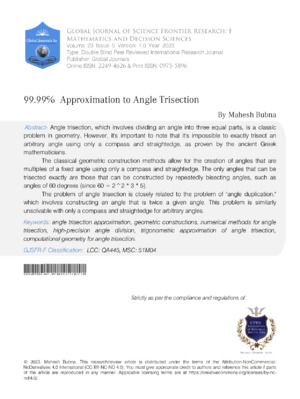
Clear image of a mathematical research journal article on angles.

99.99℅ Approximation to Angle Trisection

Mahesh Bubna
Mahesh Bubna
DOI

Abstract

Angle trisection, which involves dividing an angle into three equal parts, is a classic problem in geometry. However, it’s important to note that it’s impossible to exactly trisect an arbitrary angle using only a compass and straightedge, as proven by the ancient Greek mathematicians. The classical geometric construction methods allow for the creation of angles that are multiples of a fixed angle using only a compass and straightedge. The only angles that can be trisected exactly are those that can be constructed by repeatedly bisecting angles, such as angles of 60 degrees (since 60 = 2^2 * 3 * 5). The problem of angle trisection is closely related to the problem of “angle duplication,” which involves constructing an angle that is twice a given angle. This problem is similarly unsolvable with only a compass and straightedge for arbitrary angles. If you’re interested in an approximation of angle trisection, one approach involves using numerical methods to approximate the trisected angle. However, this wouldn’t involve a pure geometric construction and would likely require the use of calculators or computers to perform the calculations.

99.99℅ Approximation to Angle Trisection

Angle trisection, which involves dividing an angle into three equal parts, is a classic problem in geometry. However, it’s important to note that it’s impossible to exactly trisect an arbitrary angle using only a compass and straightedge, as proven by the ancient Greek mathematicians. The classical geometric construction methods allow for the creation of angles that are multiples of a fixed angle using only a compass and straightedge. The only angles that can be trisected exactly are those that can be constructed by repeatedly bisecting angles, such as angles of 60 degrees (since 60 = 2^2 * 3 * 5). The problem of angle trisection is closely related to the problem of “angle duplication,” which involves constructing an angle that is twice a given angle. This problem is similarly unsolvable with only a compass and straightedge for arbitrary angles. If you’re interested in an approximation of angle trisection, one approach involves using numerical methods to approximate the trisected angle. However, this wouldn’t involve a pure geometric construction and would likely require the use of calculators or computers to perform the calculations.

Mahesh Bubna
Mahesh Bubna

No Figures found in article.

Mahesh Bubna. 2026. “. Global Journal of Science Frontier Research – F: Mathematics & Decision GJSFR-F Volume 23 (GJSFR Volume 23 Issue F5): .

Download Citation

Journal Specifications

Crossref Journal DOI 10.17406/GJSFR

Print ISSN 0975-5896

e-ISSN 2249-4626

Issue Cover
GJSFR Volume 23 Issue F5
Pg. 29- 37
Classification
GJSFR-F Classification: LCC: QA445, MSC: 51M04
Keywords
Article Matrices
Total Views: 1079
Total Downloads: 12
2026 Trends
Research Identity (RIN)
Related Research
Our website is actively being updated, and changes may occur frequently. Please clear your browser cache if needed. For feedback or error reporting, please email [email protected]

Request Access

Please fill out the form below to request access to this research paper. Your request will be reviewed by the editorial or author team.
X

Quote and Order Details

Contact Person

Invoice Address

Notes or Comments

This is the heading

Lorem ipsum dolor sit amet, consectetur adipiscing elit. Ut elit tellus, luctus nec ullamcorper mattis, pulvinar dapibus leo.

High-quality academic research articles on global topics and journals.

99.99℅ Approximation to Angle Trisection

Mahesh Bubna
Mahesh Bubna

Research Journals