Different vertices are colored in a plan. Adjacent vertices are colored differently from nonadjacent vertices, which are colored the same color. One color is used for a single point, two color are used for points without a loop, and a maximum of four color are used for points with a loop. A maximum of four color are used to color all points.
## I. INTRODUCTION
In a plan, different vertices are colored. Adjacent vertices are colored differently, whereas non-adjacent vertices are colored the same. A maximum of four color are required.
### a) Points without a Loop[1]
In a plan, only one color is necessary for a single point, while two colors are enough for points without a loop. (Figure 1)
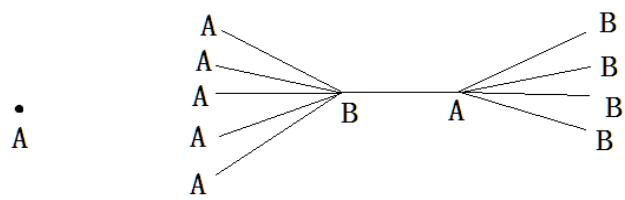 Figure 1: 1-color and 2-color chromatic graphs
### b) Points with a Loop
In a plan, points with a loop create a "circle". Two colors are used for even numbers of points, and three colors are used for odd numbers of points (left in Figure 2). The central point in the "circle" formed by the central point and adjacent points (middle and right in Figure 2) is colored with a single color. The points around the center point create a "circle". When the number of "circle" points is odd, three colors are utilized (right in Figure 2). Otherwise, only two colors are utilized (the middle in Figure 2). For the central point and all adjacent points, a maximum of four colors are used.
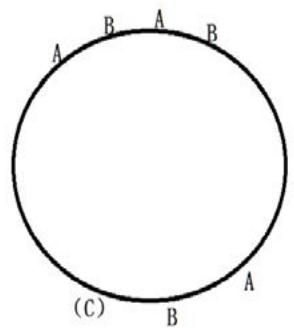
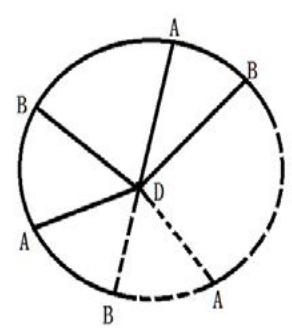
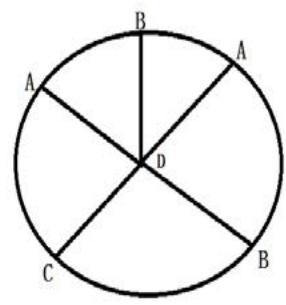 Figure 2: 3-color and 4-color chromatic graphs
### c) Coloring Relationship between Four Colors
The "circles" created by the central point and neighboring points can be joined by points of one, two, or three colors (Figure 3). Figure 3 represents a schematic diagram. The color of the central point is subject to change, as is the color of the connecting points.
1) 1 Color: When a point on the "circle" is connected, this point is colored with one color. If there is no central point, color from the connected point in turn and utilize a maximum of three colors. If there is a central point, select one of the other three colors other than the connected point's color for the central point. Then color each connected point in turn with the remaining three colors, excluding the color of the central point (including the color of the connected point on the "circle"). Use a maximum of four colors.
2) 2 Colors: When two center points have different colors, two "circles" are connected, and the adjacent points (points on the "circles") between the two central points are colored with two different colors other than the color of the two central points. The "circles" of a number of central points with different colors are connected in pairs. When the "circles" of the central points in Figure 3's colors A, B, C, and D are connected, the points on the "circle" of color A's central point are linked to the points on color B's central point. The common points are represented by the colors C and D. The common points that are connected to the central point's "circle" with color C are represented by the colors B and D. The common points connected to the "circle" of the central point with color D and so on are represented by colors B and C. The color of the central point and the color of the adjacent points on the "circle" can only be a maximum of 4 colors.
3) 3 Colors: If two central points share the same color, the other three colors can be used for the points on the "circle" that connect with the two central points. A maximum of four colors may be used for the color of the central point and the color of neighboring points on the "circle".
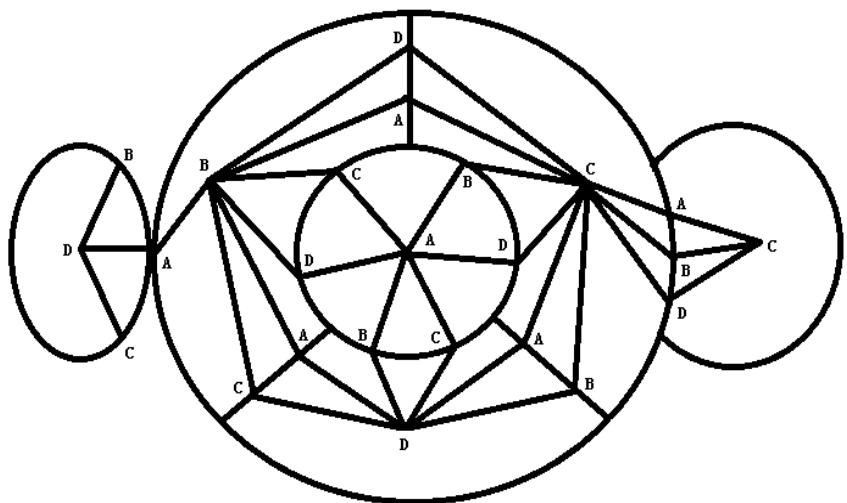 Figure 3: Coloring relationship between four colors
### d) Color Selection and Order (Figure 4)
In Figure 4, point "?" will be colored with Color A if it is adjacent to the points with 4 colors and cannot be colored. Color B will be applied to the point colored in Color A above. The example in Figure 4 serves as an illustration of how the choice of colors and the order in which they are colored might give the impression that one is unable to color.
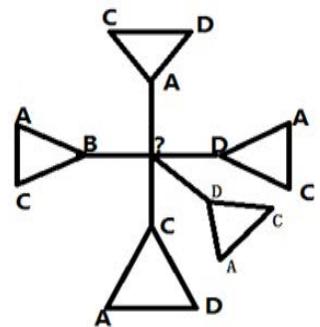 Figure 4: Reasons for 4 colors failing to be colored
### e) How to Color (Figure 5)
Any local center in Figure 5 is highlighted in color A (1A), and the five neighboring points are highlighted in colors 1-1B, 1-2C, 1-3B, 1-4C, and 1-5D. These five points can each have a different color.
Choose the second local central point that is adjacent to the first local central point but not the points that are adjacent to it, and then color it with 2A. (The "circle" that is formed by this second local central point and the adjacent point is adjacent to 1-1B and 1-5D on the first local central point's colored "circle." The connecting points between the "circles" are these two points. Colors A and C can be selected for the second local central point). Choose three colors for the second local center point, except Color 2A. Color the uncolored points (points on the "circle") close to the second local central point with colors 2-1B, 2-2C, and 2-3D (*Select color and coloring order).
Choose 3A, 4C, 5B, and 6D in turn as the local central points to color the adjacent points (points on the "circle"). A maximum of four colors are needed.
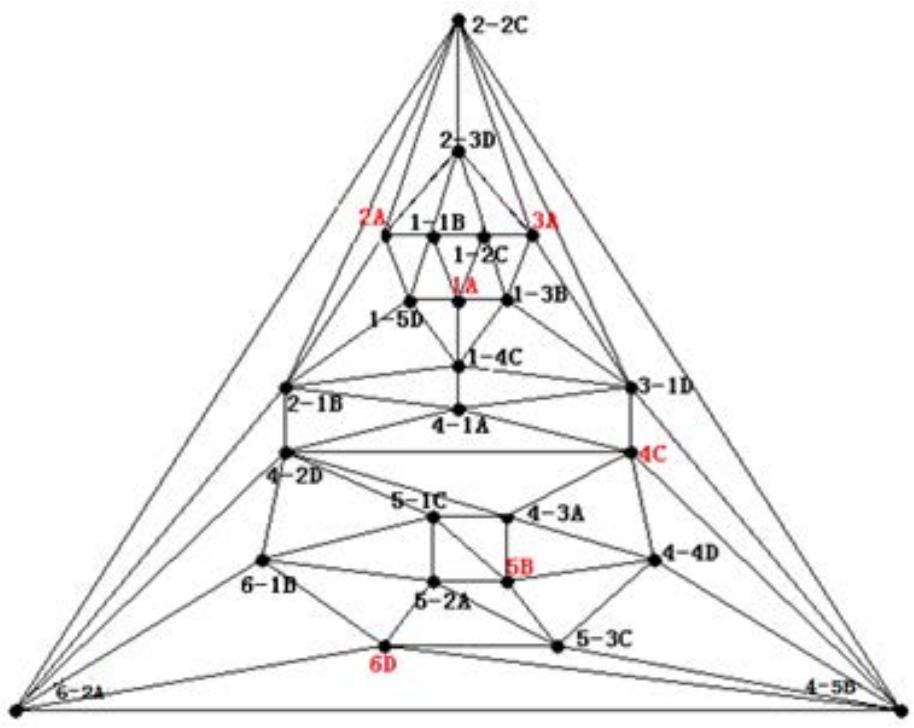 Figure 5: 4-color coloring method
### f) Summary
Different vertices are colored in a plan. Adjacent vertices are colored differently from nonadjacent vertices, which are colored the same color.
One color is used for a single point, while two colors are used for connected points that do not create a loop.
For points with a loop without a central point (points on the "circle"), three colors are used.
For points with a loop and a central point, choose one local central point and color it with a single color. Select the remaining three colors in turn to color the adjacent points (points on the "circle"). A maximum of four colors are used.
Continue to search for an adjacent local central point outside the colored "circle" (the local central point and the adjacent points form a "circle"). To color the local central point, choose one of the colors that was not used for the adjacent colored points. Then, paint the nearby non-colored points (points on the "circle") with the remaining three colors except the color of the local central point.
Continue to color. To color every point, a maximum of four colors is required.
## II. USING THE TRIANGLE METHOD FOR MAP COLORING [2]
In the plan is not in the same straight line, three points determine a plane, then three points form a triangle is a plane figure in the most basic, most simple, the most stable, the closed graph. [3] In the plan of the numerous points, take an arbitrary three adjacent points of the adjacent $\Delta ABC$ (Figure 6), then 3 color ABC, in the plan to take a point D and ABC three adjacent, while D and ABC three is connected form a triangle. Let take a little E and A, B, C, D four-color. E will be with four-color colored the same, namely E in $\Delta ABD$ and C the same colour, in $\Delta ACD$ and B the same colour, in $\Delta BCD$ and A the same colour, in $\Delta ABC$ and D the same color, E and another three-color connected to form a new triangle. [4] In the triangle with three points, let take a point only in the triangle interior and exterior two kinds of circumstances, the two cases of points are not adjacent, this point and triangle with three points are connected and form a new triangle.
To choose a point for coloring, the points are the same and a triangle with three points are connected, and forming a new triangle, the point of at least one color of four colors. Point by point coloring to all point by one color of A, B, C, D four color.
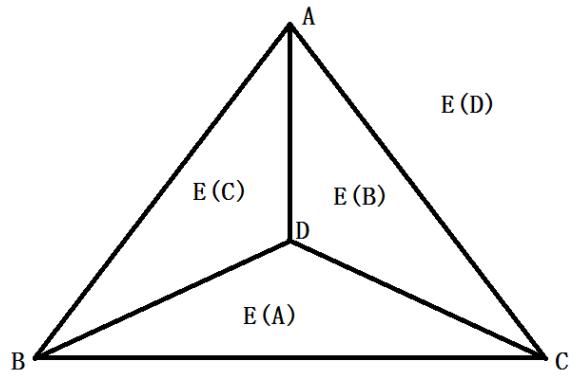 Figure 6: 4-color relationship
## III. MAP COLORING METHOD, RELATIONSHIP BETWEEN CIRCLES AND TRIANGLES
The points on the circle require a maximum of 3 colors and a total of 4 colors for the center point (left in Figure 7). After transformation (middle in Figure 7), it is simplified into a triangle coloring relationship diagram (right in Figure 7).
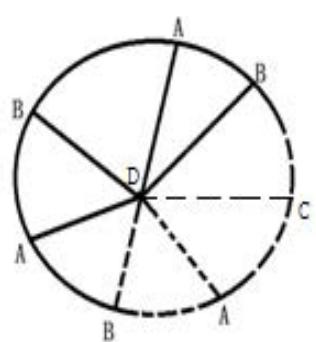
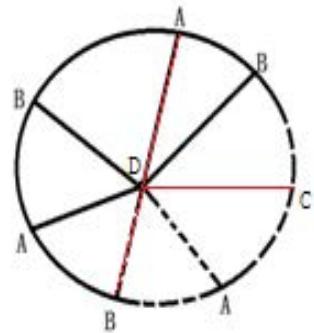
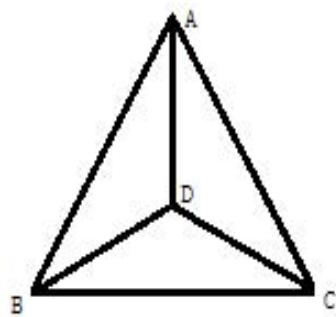 Figure 7: Relationship between circles and triangles
## IV. A PRACTICAL APPLICATION OF CIRCULAR MAP COLORING METHOD
a) Perform statistical analysis on all points.
b) For single point coloring, 1 color is required.
c) Label and color points that do not form loops, Two colors are required.
d) Label and color the points on the circle without a core point, 2-3 colors are required.
e) Coloring points on circles with core points. Coloring all non colored points point by point using the circular map coloring method.
f) The color selection and order of coloring points.
1. Color of adjacent points of colored points $\leq 3$.
2. If there is a coloring conflict issue, in order to reduce color adjustment, adjacent points that do not form a loop should be colored or labeled again; If there is still a color conflict, label adjacent points on the circle without a core point, and then color and label again; If there are still color conflicts, the points on the circle that have already been colored with core points should be colored again.
3. After selecting any point, color it in order. After adjacent points are colored, select any point again until all points are colored.
4. The difficult coloring points are the intersection points of coloring in different directions and the intersection points of the beginning and end of the circular direction.
Conflicts of Interest
The author declares no conflicts of interest regarding the publication of this paper.
Generating HTML Viewer...
References
4 Cites in Article
Shijun Han (2023). A Map Coloring Method.
S Han (2020). Four Color Conjecture, Happy World,2020-A-00021917.
S Han (2022). Using the Triangle Method for Map Coloring, The All Committee Meeting of the Professional Committee of Combinatorial Mathematics and Graph Theory of the Chinese Mathematical Society and the Tenth National Congress of Combinatorial Mathematics and Graph Theory.
Explore published articles in an immersive Augmented Reality environment. Our platform converts research papers into interactive 3D books, allowing readers to view and interact with content using AR and VR compatible devices.
Your published article is automatically converted into a realistic 3D book. Flip through pages and read research papers in a more engaging and interactive format.
Different vertices are colored in a plan. Adjacent vertices are colored differently from nonadjacent vertices, which are colored the same color. One color is used for a single point, two color are used for points without a loop, and a maximum of four color are used for points with a loop. A maximum of four color are used to color all points.
Our website is actively being updated, and changes may occur frequently. Please clear your browser cache if needed. For feedback or error reporting, please email [email protected]
Thank you for connecting with us. We will respond to you shortly.