
I. INTRODUCTION
Higher education is going through a great deal of change worldwide. The world pandemic because of Covid-19 has highlighted the importance of active engagement by its citizens and social innovation by all public, private, and governmental actors. The catalyst for social change and innovation is to ensure and sustain an economy that benefits everyone in society. One response to these challenges is the development of the entrepreneurial university model, which adds a strong third mission to Higher Education Institutions (HEI's) (Stolze, 2021).
Social innovation has been receiving growing attention from policy makers, international institutions, non-governmental organizations, researchers and the business sector around the world. Despite a growing belief that social innovation represents one of the key solutions to solving current societal problems, the field of social innovation research in higher education institutions (HEIs) provides disparate discussions of this phenomenon. This situation severely impedes the advancement of social innovation practice and research in its policy area. Communities are expecting the HEIs to actively engage with them and take responsibility by transferring their competence to the direct local context to stimulate social innovation and sustainable development. One of the greatest challenges faced by higher education institutions is the effective management of their efforts to solving societal problems, such as the sustainable development goals (SDGs), in an increasingly complex and competitive global environment. This environment evolved dynamically to include numerous aspects that HEIs should carefully consider (Whittle & Rampton, 2020):
Cooperation with actors from surrounding ecosystem for the transfer of knowledge and talents.
Cooperation on innovative pedagogies that empower academics and students as social innovators and change makers.
Uptake of digitalization, empowering the further transition to knowledge- and digitally driven universities; and
Development of digital and entrepreneurial skills among academics, researchers and students.
Need for New Roles for Higher Education Institutions: The 2020 global pandemic began a period of enormous change and created unparalleled societal challenges. Many HEI's had to embrace digital technology in order to meet its obligations to students. Teaching remotely becomes the norm for HEI's. It transformed the whole concept of education and placed enormous emphasis on community wellbeing and engagement.
Sustainability has made inroads into HEIs, with only few universities implementing it holistically (Menon & Suresh, 2020). Initiatives adopted by institutions have been successful in incorporating sustainability in education, research, campus operations and outreach programs (Menon & Suresh, 2020) Experiences of community partners with higher education qualifications highlight the importance of the third level education providers in promoting social justice, recognizing that community challenges are not confined to a lack of material resources, but a dearth of knowledge about the local resource (Machimana et al., 020). Universities can partner with communities to address critical twenty-first century challenges and LaDuca et al. (2020) reflected on an innovative initiatives mat provided for transdisciplinary community engagement in pursuit of social justice.
Core Arguments, Themes, and Issues Addressed: In an increasingly complex and rapidly changing world, discussions about how best to educate and prepare graduates for the new challenges of the twenty-first century abound. Knowledge Alliances between HEIs and businesses which aim to foster innovation, entrepreneurship, creativity, employability, knowledge exchange and/or multi-disciplinary teaching, learning and research are therefore becoming increasingly necessary and relevant. The changing nature of contemporary society highlights that social issues are often highly complex and multi-faceted. As we enter an era where cooperative and creative skills, competencies and attitudes are recognized as significant in responding to societal challenges, developing graduates capable of operating effectively in multi-disciplinary and inter-disciplinary environments is critical. The challenge of equipping students with relevant skills and knowledge in the future employment markets can only be achieved by working globally and collaboratively and learning from the wide variety of partners and their networks about the various ways to prepare graduates across disciplines. Higher education includes a set of systematized knowledge and practical skills, which allow solving theoretical and practical problems on a professional profile, using and creatively developing modern achievements of science, technology and culture. Consequently, higher education aims to ensure that their graduates, by realizing their acquired knowledge in the process of working life, benefit society and the State as a whole, ensuring its constant development.
To draw possible solutions to the complex challenges mentioned above, the core themes discussed below include:
Introduction of the spheres of influence for enhancing social innovation in higher education and the varied facets of social innovation in HEIs.
Contribution of the higher education institutions in fostering the development of the social innovation ecosystem.
Uptake of digitalization in higher education institutions as a driver of social oriented innovations.
Development of a social innovation competence framework meant to educate entrepreneurs to go internationally.
Discussion of higher education practices for social innovation and sustainable development.
Introduction of a higher education social enterprise program that advances understanding of social entrepreneurship and social enterprise development in higher education.
Discussion of the dimensions of societal impact of research produced by HEIs and introduction of a framework for managing research with societal impact in HEIs.
Discussion of the role of HEIs in creating socially responsible innovations.
Analysis of how responsible research and innovation activities are understood by regional stakeholders, particularly regarding how the roles of different actors are constituted, and how different actors facilitate social innovation.
Introduction of a co-creation platform developed on a quadruple helix framework for solving week social challenges.
Analysis of social innovations emerging from academic nursing-community partnerships.
Discussion of social innovation in HEIs from a Disability Studies perspective.
Analysis of the possibilities of using financial instruments such as social impact bonds for additional funding of higher education institutions.
Questions Raised and Solutions provided by following research questions emerge:
How to develop students to become the next generation of 'innovators' prepared to create, collaborate and navigate the world's complexities (Der Zwaan, 2017)?
How can HEIs equip their students (and other learners) with the knowledge and skills necessary to engage with and respond to twenty-first century challenges and opportunities?
How can various stakeholders (academia, private and public sector institutions and end-users) be more actively engaged in developing changes in education to support multi-disciplinary education?
How to boost the HEIs' ability to translate research results into the economy and civil society?
How to foster digitally facilitated social innovation collaboration?
The overall research questions that incorporate the above are two-fold: What is the HEIs' role in creating social change, transformation and impact? And how to strengthen the HEIs' social innovation efforts in order to be sustainable?
Answers provided below include:
Identifying conditions for innovation in academic settings to produce socially relevant outcomes.
Insights about how HEIs promote social innovation and suggests how the present system can be improved.
Understanding the capacity of the HEIs in fostering community-based learning that leads to social change and inclusion.
Exploring digital challenges in HEIs and social innovation opportunities from digital transformation in HEIs.
Highlighting the key role that the HEIs play in production of research with societal impact.
Discussing higher education practices for social innovation and development, stressing the importance of a multidisciplinary approach.
Presenting innovative pedagogies that empower students as social innovators and change makers.
Debating the potential of social innovation in higher education from a user-led, inclusive and participatory perspective related to disability studies.
Examining the co-creation platform concept aimed at improving the wellbeing of those in the most vulnerable positions through co-creating societal innovations, services, and capacity building.
Outlining the crossing points of the quadruple-helix model and the priority guidelines for the development of scientific research and innovations with societal impact.
Exploring the peculiarities of social impact bonds and the possibilities of their application in higher education for additional funding of HEIs.
Many authors have performed bibliometric analysis to determine the trends in the Role of Higher Educational Institutions for building Social Entrepreneur. The study checked the most research producing journal in the field of Social Entrepreneurship, highly cited articles, most research producing countries, famous authors, and research area. Campos et al. (2018) argued that organization distinguishes staff with behavior and social skills among all Social Entrepreneurship is considered as most important, thus bibliometric technique used to find research trend of Social Entrepreneurship in the field of management and leadership by obtaining data from Web of Science In the light of previous studies conducted on Social Entrepreneurship, there is a chance to track and identify the current development in the field of Social Entrepreneurship, using highly relevant keywords from the most reliable worldwide abstracting and indexing database that is Dimensions. Current study took the opportunity to fill the missing gap and present analysis by visualization of statistics.
The main objective of the study was to amalgamate the state-of-the-art research on Social Entrepreneurship; current study collected published articles data from the software Dimensions during the year 2013-2022. The study result explains under such perspective: yearly growth of publishing articles on Social Entrepreneurship, most influential countries, articles, authors, institutions &research journals patterns. The current aim of the study is to identify and evaluate Social Entrepreneurship publishing patterns and trends from the Year 2013-2022 by considering the most productive authors, countries, organizations, key journals patterns.
The following research questions have been considered to answer the research objective:
What are the publishing trends in Social Entrepreneurship from 2013-2022?
What are the top Social Entrepreneurship research publishing journals?
Which of the authors, journals, and organizations are most productive in Social Entrepreneurship?
II. METHODOLOGY
Bibliometric Analysis is a statistical investigation tool, deal with a quantitative approach (Makar & Trost, 2018) (Wallace & Van Fleet, 2012) which access the trend of literally working on a particular field and conclude the research outcomes (Blakeman, 2018). The bibliometric method has been adopted and widely used by different fields of knowledge, mostly used by the medical science field (Hart & Perlis, 2021). WOS is one of the biggest world-renowned databases, famous for providing abstracting and indexing services; universities around the world acknowledge their researchers to publish in WOS indexed journals (Diem & Wolter, 2013). Data retrieved from software Dimensions, employed title search "Higher Educational Institutions" AND "Social Entrepreneurship" and it generates 2181 academic records. The data was retrieved and download on July 02, 2022, refine by document type which consists of (i) article, (ii) proceeding paper, (iii) review, (iv) book chapter. The bibliometric research study presents network analysis, publishing trend, most productive author, journals, and countries (Su et al., 2019), author keyword, countries collaboration by utilizing HistCite, Bibexcel, Scientopy, biblioshiny and VOS viewer software, for the literature published during 2013-2022.
The quantitative approach gives the opportunity to statistically analyze the structure of Social Entrepreneurship literature and draw a conclusion by the interconnection of various items with attributes, cocitation, and country collaboration. The research study depicts the publication growth throughout 2000-2020, top research producing countries, institutions, journals, highly cited articles, authors and countries (Islam et al., 2021; Rajeswari et al., 2021).
a) Data Source and Search Strategy
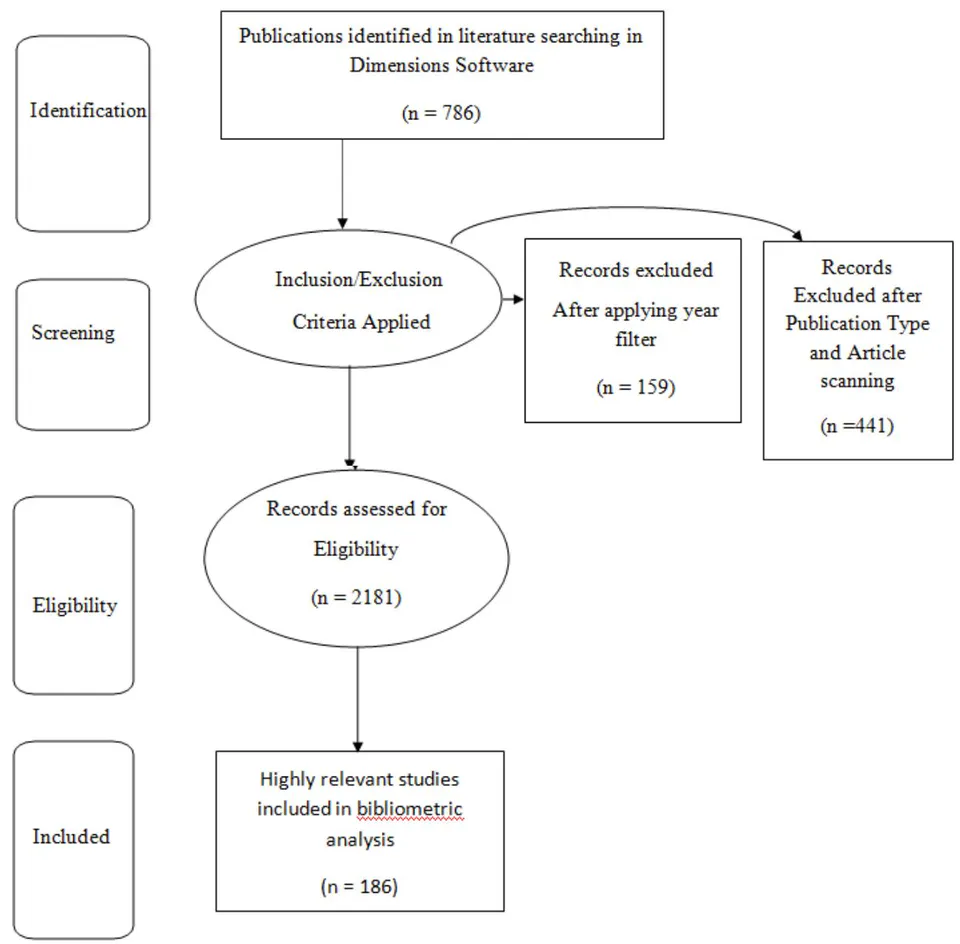
The data from software Dimensions was retrieved on July 02, 2022, as a result of a search query; the database provides 2181 bibliographic records. A four-phase search and selection criteria were framed in Figure 1 (Khan et al., 2020).
III. DATA ANALYSIS
This session provides a comprehensive analysis of the bibliometric study. After sort-out, each record and screening of each bibliometric record by reading title and abstract, 186 unique records verified used for current studies.
a) Total Publication Growth trend
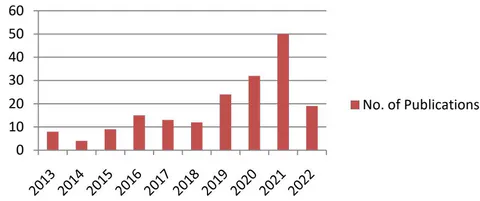
Figure 2 illustrates year-wise research publication and citation on Social Entrepreneurship from 2013-2022. The research publishing trend indicates a significantly increasing from 2014 till 2021 with little fluctuation where the boom in publication on Social Entrepreneurship has been observed from 2013 to 2022. The most research productive year on Social
Entrepreneurship was 2021 in which 50 research documents were published. The citation count is variant with highest received in 2021 and lowest receive in 2014.
b) Top publishing countries
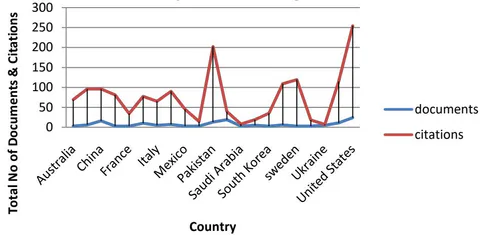
The top research producing countries in the field of Social Entrepreneurship enlisted in table 1. United States of America (USA) is the only country that has over 24 publications. The USA is the most research producing county with 157 publications and 254 citations followed by Russia contributed 19 with 39 citations. India stands at the sixth level of the list with only 10 publications with 77 citations.
| Country Name | Total Documents | Citations | Total link Strength |
| United States | 24 | 254 | 27 |
| Russia | 19 | 39 | 0 |
| China | 16 | 96 | 6 |
| Pakistan | 13 | 202 | 7 |
| United kingdom | 11 | 115 | 7 |
| India | 10 | 77 | 4 |
| Malaysia | 7 | 90 | 5 |
| Canada | 6 | 96 | 2 |
| Spain | 6 | 109 | 9 |
| Italy | 5 | 65 | 9 |
| South Africa | 5 | 19 | 0 |
| Ukraine | 5 | 7 | 1 |
| Australia | 3 | 69 | 4 |
| Finland | 3 | 81 | 4 |
| France | 3 | 34 | 0 |
| Mexico | 3 | 45 | 0 |
| Norway | 3 | 14 | 2 |
| Saudi Arabia | 3 | 8 | 3 |
| south Korea | 3 | 35 | 8 |
| Sweden | 3 | 119 | 2 |
| Taiwan | 3 | 18 | 1 |
c) Most Research contributing Institutions
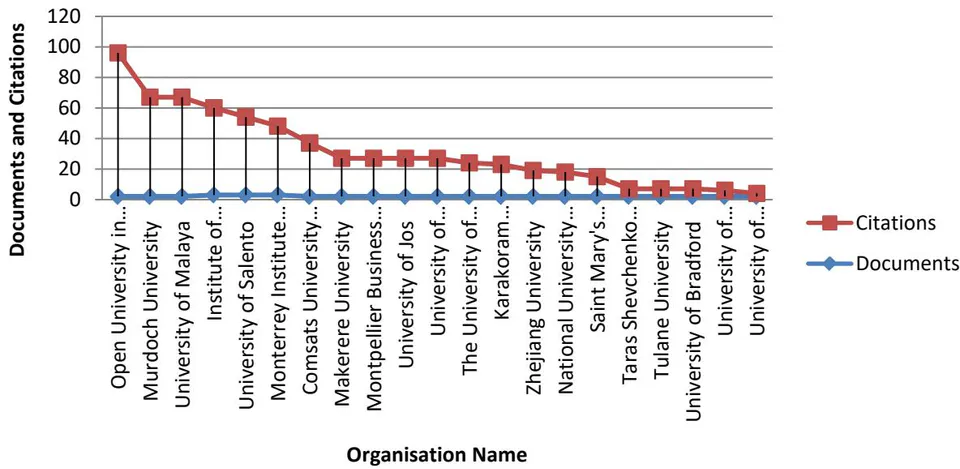
The top research contributing organizations the field of Social Entrepreneurship shown in table 2 which indicated that Institute of Management Technology, India is at top and the only university published over 03 research publication (n=03) and received citations 57 followed by University of Salen to produced 03 publications and received 45 citations. Open University in The Netherlands received highest citations 94 and University of Massachusetts Dartmouth received the lowest citation impact.
| Organization | Documents | Citations | Total link strength |
| Open University in The Netherlands | 2 | 94 | 0 |
| Murdoch University | 2 | 65 | 0 |
| University of Malaya | 2 | 65 | 1 |
| Institute of Management Technology | 3 | 57 | 1 |
| University of Salento | 3 | 51 | 0 |
| Monterrey Institute of Technology and Higher Education | 3 | 45 | 0 |
| Comsats University Islamabad | 2 | 35 | 0 |
| Makerere University | 2 | 25 | 4 |
| Montpellier Business School | 2 | 25 | 0 |
| University of Jos | 2 | 25 | 4 |
| University of Southampton | 2 | 25 | 4 |
| The University of Texas at Dallas | 2 | 22 | 0 |
| Karakoram International University | 2 | 21 | 0 |
| Zhejiang University | 2 | 17 | 1 |
| National University of Malaysia | 2 | 16 | 2 |
| Saint Mary's University | 2 | 13 | 0 |
| Taras Shevchenko National University of Kyiv | 2 | 5 | 1 |
| Tulane University | 2 | 5 | 0 |
| University of Bradford | 2 | 5 | 0 |
| University of Technology Malaysia | 2 | 4 | 0 |
| University of Massachusetts Dartmouth | 2 | 2 | 0 |
| Organization | Documents | Citations | |
| Open University in The Netherlands | 2 | 94 | |
| Murdoch University | 2 | 65 | |
| University of Malaya | 2 | 65 | |
| Institute of Management Technology | 3 | 57 | |
| University of Salento | 3 | 51 | |
| Monterrey Institute of Technology and Higher Education | 3 | 45 | |
| Comsats University Islamabad | 2 | 35 | |
| Makerere University | 2 | 25 | |
| Montpellier Business School | 2 | 25 | |
| University of Jos | 2 | 25 | |
| University of Southampton | 2 | 25 | |
| The University of Texas at Dallas | 2 | 22 | |
| Karakoram International University | 2 | 21 | |
| Zhejiang University | 2 | 17 | |
| National University of Malaysia | 2 | 16 | |
| Saint Mary's University | 2 | 13 | |
| Taras Shevchenko National University of Kyiv | 2 | 5 | |
| Tulane University | 2 | 5 | |
| University of Bradford | 2 | 5 | |
| University of Technology Malaysia | 2 | 4 | |
| University of Massachusetts Dartmouth | 2 | 2 |
d) Highly Cited Articles on Social Entrepreneurship
Table 3 compiled a list of the Research Articles on Social Entrepreneurship. It can be observed from table No. 3 that all articles received more than 5 citations.
The top Source Journal is Sustainability, entitled 'Insights for Shaping Entrepreneurship Education: Evidence from the European Entrepreneurship Centers' by Ndou, Valentina; Secundo, Giustina; Schiuma, Giovanni; Passiante, Giuseppina published in International Journal of Entrepreneurial Behaviour & Research in the year 2018 received 30 citations and followed by article of Entrepreneurship Education and Sustainable Development Goals: A literature Review and a Closer Look at Fragile States and Technology-Enabled Approaches (2019) in International Small Business Journal Researching Entrepreneurship with 29 citations.
e) Highly Cited Articles on Social Entrepreneurship
Table 3 compiled a list of the Research Articles on Social Entrepreneurship. It can be observed from table No. 3 that all articles received more than 5 citations.
Giovanni; Passiante, Giuseppina published in International Journal of Entrepreneurial Behaviour & Research in the year 2018 received 30 citations and followed by article of Entrepreneurship Education and Sustainable Development Goals: A literature Review and a Closer Look at Fragile States and Technology-Enabled Approaches (2019) in International Small Business Journal Researching Entrepreneurship with 29 citations.
| Source | Documents | Citations | Total link Strength |
| Sustainability | 9 | 143 | 5 |
| Education + Training | 5 | 104 | 1 |
| Journal of Cleaner Production | 3 | 90 | 0 |
| The International Journal of Management Education | 5 | 76 | 1 |
| Entrepreneurship and Regional Development | 2 | 43 | 0 |
| International Journal of Entrepreneurial Behaviour & Research | 3 | 42 | 1 |
| Social Enterprise Journal | 3 | 35 | 3 |
| Frontiers in Psychology | 6 | 34 | 1 |
| Cogent Business & Management | 2 | 25 | 0 |
| Journal of Global Entrepreneurship Research | 2 | 25 | 0 |
| Journal of Innovation And Entrepreneurship | 2 | 24 | 0 |
| Studies in Higher Education | 2 | 23 | 0 |
| Gender In Management an International Journal | 2 | 22 | 0 |
| Journal of Business Research | 2 | 15 | 0 |
| Ieee Access | 2 | 14 | 0 |
| Journal of Small Business And Enterprise Development | 2 | 9 | 0 |
| Procedia - Social And Behavioral Sciences | 2 | 8 | 0 |
| Higher Education Quarterly | 3 | 7 | 0 |
| Public Administration Review | 2 | 7 | 0 |
| International Journal of Educational Management | 2 | 5 | 0 |
| International Small Business Journal Researching Entrepreneurship | 2 | 5 | 0 |
f) Most productive authors and their affiliation
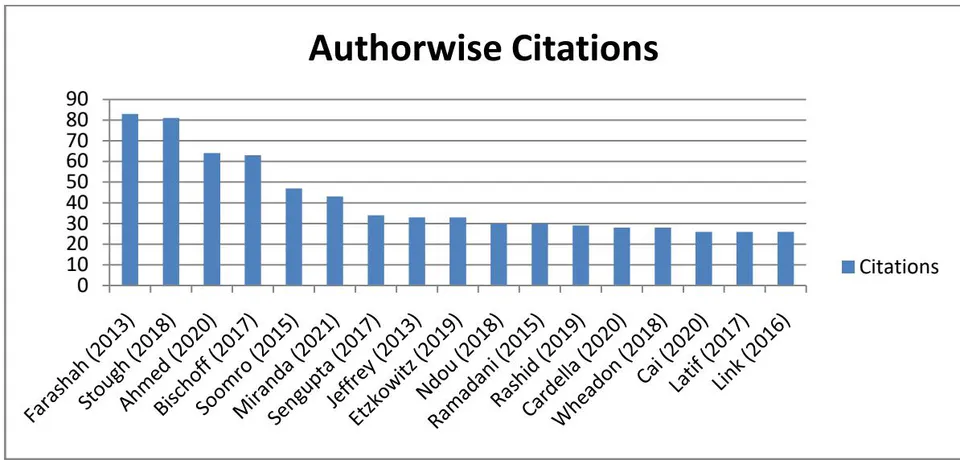
The list of most productive authors in Social Entrepreneurship is compiled in Table 4. The author
Farashah (2013) affiliated with UmeA¥ University, Sweden emerged as a top author with 83 total citations.
| S.No. | Document (Author Wise) | Citations | Links |
| 1 | Farashah (2013) | 83 | 0 |
| 2 | Stough (2018) | 81 | 0 |
| 3 | Ahmed (2020) | 64 | 1 |
| 4 | Bischoff (2017) | 63 | 6 |
| 5 | Soomro (2015) | 47 | 0 |
| 6 | Miranda (2021) | 43 | 0 |
| 7 | Sengupta (2017) | 34 | 2 |
| 8 | Jeffrey (2013) | 33 | 0 |
| 9 | Etzkowitz (2019) | 33 | 1 |
| 10 | Ndou (2018) | 30 | 3 |
| 11 | Ramadani (2015) | 30 | 0 |
| 12 | Rashid (2019) | 29 | 1 |
| 13 | Cardella (2020) | 28 | 0 |
| 14 | Wheadon (2018) | 28 | 0 |
| 15 | Cai (2020) | 26 | 1 |
| 16 | Latif (2017) | 26 | 0 |
| 17 | Link (2016) | 26 | 0 |
IV. CONCLUSIONS AND RECOMMENDATIONS
Higher education providers are expected to encourage the members of their wider scientific and academic community to promote conversations amongst communities, governments, and businesses, at local, regional, national, or international level, leading to various opportunities for active community engagement, educational change, and social innovation. These areas, where social innovations can take place in higher education and priorities should be as follows:
Governance and Networking: For social innovation to happen there is a need for new, overarching, and connected governance structures, with distinctive, intercorrelated roles and responsibilities. Also, HEI's need to ensure that social and community engagement is endorsed and there is a social integration strategy in place.
Teaching and Learning: Engagement as a key element of institutional teaching and learning strategies needs to be embedded. HEI's need to ensure that all educational programmes leading to an award embed the concept of social community. This will assist in strengthening the concept of innovation that can lend itself to developing communities and help to foster an equitable society.
Social and Community Engagement: HEI's should take responsibility to devise new methods to engage with communities to meet societal needs and demands. It is essential that the higher education institute bridges the gap with the local community and enriches development through education, focused research, volunteering, and activities specific to their region. Higher education students should be given opportunities for national and international engagement so that the learning environment is aligned with enterprise and the wider community. This would also assist in meeting social and economic objectives.
Cooperation and collaboration: HEI's should bring together capabilities of its staff and students to work collaboratively with local communities, businesses, industry leaders, to achieve sustainable outcomes for their mutual benefit. They need to support social, cultural, and economic development as identified by Conrad (2015).
Funding: Funding streams will vary across Europe. Inherent in any funding mechanism is the investment that provides and sustains equal access and also embraces diversity. Sustainable funding for teaching, leaning, research, and community engagement with different opportunities can lead to promote interdisciplinary research whilst identifying benefits for the community. Creative sources of funding, such as social impact bonds, are needed to create academic carrier incitements to engage in collaborative teaching, learning and research with the surrounding society for social innovations. Funding needs to be part of the wider discourse with governments focusing on a wider social policy strategy that discusses and addresses issues of hardship across society.