This article contends that addressing environmental concerns in the South African context requires acknowledgment of the intertwined issues of land grabbing, littering, illegal dumping, and inadequate service delivery. It suggests that Pentecostals, as members of diverse communities, should shift their focus from spiritual matters to initiatives aimed at caring for the earth. Therefore, the article delves into Mogale City and Rand West City Local Municipality in South Africa as a case study, illustrating their contribution to the ongoing environmental degradation. The increasing incidence of land grabbing in these areas poses a threat to the pollution of the Wonderfontein spruit/stream, which flows from Kagiso through the townships of Swanieville 1, extensions 2 and 3, and continues east of Mohlakeng township to the west of Bekkersdal township. Inadequate service delivery has resulted in a backlog of waste removal, leading to concerning levels of littering and illegal dumping in both municipalities.
## I. INTRODUCTION
discussions surrounding earth care began to gain prominence after the mid-twentieth century, as noted by McKibben (1997), Walsh (1977), and White (1967). Lynn White argued that the interpretation of Genesis 1:26-28 has contributed to an environmental crisis by promoting the idea of human superiority (White 1967). He stressed that this crisis would persist until the notion from Christianity, that nature exists solely to serve humanity, is rejected, stating, "we shall continue to have a worsening ecologic crisis until we reject the Christian axiom that nature has no reason for existence save to serve man" (White 1996, 1207). Van Dyk (2011, 524) further suggests that Genesis 2:28 reinforces human dominion over the earth and is anthropocentric, contending that the Bible offers little guidance on ecological and conservation matters (Van Dyk 2017, 835).
However, Hitzhusen (2019 § 2.2) offers a critique of White's argument, advocating instead for a contextual approach to the pericope. Loader (1987, 9) concurs, stating that it is inaccurate to attribute the ecological crisis solely to biblical faith. Rather, Loader argues, it is the interpretations and emphases within modern Christianity that are at fault.
From this defense, Conradie (2003, 127) outlines key areas that South African theological discussions should address, including (a) the looming threat of global warming, (b) the dangers posed by ozone depletion, (c) the issues surrounding acid rain and air pollution, (d) the challenge of disposing of nuclear waste, (e) the management of highly toxic waste, (f) the urgent need to address the destruction of rainforests and other ecosystems, (g) the rapid loss of biodiversity, (h) soil salination, and (i) the collapse of fishing industries due to over-fishing. His stance advocates for environmental stewardship (Sherkat & Ellison, 2007), a concept further elaborated by Southgate (2006, 185), which entails:
human beings are called to be stewards of creation tends to be the default position within ordinary Christian groups. The concept of stewardship is affirmed in recent major documents in both the evangelical and Catholic traditions.
Sadly, some of the residents in Mogale City and Rand West City Local Municipality in South Africa have created an environmental crisis by neglecting the responsibility to care for the earth and degrading it as they litter and pollute the environment and stream. This crisis stems from the trend of land-grabbing in the two areas. Hence the author argues that earth care in these two areas should take cognizance of the triple challenges of land grabbing, littering and poor service delivery. The article follows Sherkat and Ellison's (2007) environmental stewardship and uphold the view that, "in many contexts Christians (Pentecostals included) are not environmental activists and environmental activists are not Christians" (Conradie 2011, 158) and the plea that the "current South African context would clearly have to address issues of access to land, housing, urban planning and sustainability." Conradie's (2009, 15). It submit to Conradie's (2010, 301) view of "doctrinal constructs" since the scriptures do not address modern ecological concerns. It also points to the argument that the Spirit participated in creation (Gen 1:2) to promote the involvement of Pentecostals in earth care.
Accordingly, the article applies a Bosadi-Pentecostal approach to address the ongoing earth degradation to raise biblical awareness and propose a biblical strategy that will encourage earth care among Pentecostals members of the identified communities in the two municipalities. This approach underscores the involvement of Pentecostal who emphasizes the role of the Holy Spirit in their tradition and allows for arguing that the Holy Spirit has a role in earth care as in Genesis 1:2.
Masenya (2001,110) applies Bosadi to address the challenges of earth care in Psalm 127:3-5, and alongside it addresses the challenges of women from a Bosadi perspective, thus called eco-bosadi. This approach is earth-centered and argues that African women and the earth are usually treated as objects. Her approach shifts from dominating the earth to preserving it as part of women identity (Masenya 2001, 222). Her approach hinges on a hermeneutic of suspicion to address earth care as the biblical texts have an anthropocentric bias.
A Pentecostal approach takes cognizance (a) of the South African, African Pentecostal context, considering emerging mega-churches and mostly small independent churches in the townships (Anderson 2004, 12-18) and (b) that these Pentecostals have a passion to preach repentance to humans (Anderson 2004, 2-27, Resane 2021, 3).
The article opt to combine the above approaches to provide a balanced response that considers the retrieval of biblical text and the critiquing the anthropocentric and androcentric reading of the text. This then introduces a Bosadi-Pentecostal question: How can Pentecostals minister effectively in the context of the triple challenges of land grabbing, littering and poor service delivery and promote earth care and a relevant biblical strategy in Mogale City and Rand West City Local Municipality in South Africa?
## II. CONTEXT OF MOGALE CITY AND RAND WEST CITY LOCAL MUNICIPALITY IN SOUTH AFRICA
Mogale City (former Krugersdorp Municipality) and Rand West City Local Municipality (A merger of Randfontein Municipality and Westonaria Municipality) are part of the West Rand District Municipality of Gauteng Province in South Africa. The two were established after the discovery of gold in the late nineteen century. Three townships of Swanieville, Mohlakeng and Bekkersdal form part of the two municipalities. The former were established as the previous government implemented the Group Areas Act of 1966, while Swanieville was an informal settlement established after people rented pieces of land at farm later the dwellers called Swanieville (earlier called Mshenguville) (Mabin 1993e,12). Section 17(1) of the Group Areas Act of 1966 states:
no person who is a member of any group shall occupy and no person shall allow any such person to occupy any land or premises in a specified area which was not lawfully occupied... except under the authority of a permit.
Consequently, Africans in the townships lived in structural and socio-economic conditions the apartheid government designed. The newly elected democratic government in 1994 later converted these to be three informal townships of Swanieville 1, extension 2 and 3. A stream Wonderfontein spruit/stream that runs from Kagiso, south of Swanieville, east of Mohlakeng and west of Bekkersdal to the Donaldson Dam, west of Bekkersdal.
In 2022, backyard tenants from around Mogale, Mohlakeng, Roodepoort and Soweto began to erect shacks on the south-west of Swanieville 1, east of extension 2 and 3. Others occupied the land west of extension 2 and 3. All these flow from inadequate provision of proper housing in Mogale City, Johannesburg Metro, and Rand West City Local Municipality and some of the surrounding townships and informal settlements caused by over-population due urban migration as people look for better opportunities in the cities. Turok & Borel-Saladin (2016) adds that many poor people in Gauteng Province live in shacks. It is not surprising that the two pieces of land were occupied in 2023. The pieces of land are on a hill and slopes from south-west of Swanieville 1, east of extension 2 and 3 to the stream running in the valley between the areas (see formal settlement at the back and illegal settlements near the stream and reeds at foreground of picture 1). Mogale City does not provide refuse collection on these pieces of land. This lack of service results in littering and illegal dumping.
## III. LITTERING AND ILLEGAL DUMPING IN THE TOWNSHIPS AND INFORMAL SETTLEMENTS
The Group Areas Act of 1966 allowed for the provision of substandard services (water, sanitation, roads, waste management) to townships and quality services in suburbs. Waste management in suburbs. Substandard service contributed to the lowering of self-esteem and dignity of the African masses living in townships (Ngeleka 2010). These perpetuated what Pityana (1970, 9) called a story of "The history of black and white people from the days of colonialism displays a concerted attempt by white people at repudiating the humanity of the black man." Hence, littering, and illegal dumping in every open space became common in townships leading to historic waste management challenges.
On the contrary, littering and illegal dumping was upsent in suburbs. African accepted to live double standards, namely, keeping suburbs clean and tidy and townships dirty and filthy. They were employed to clean the yards and streets of their masters. Consequently, the African masses did no place value in caring for the earth. Earth care was only associated with their masters. This development created an unconscious binary between faith and environmental care, where there was no regard dumping rubbish next to schools, homes, health facilities, shops, and churches in the townships. To date, is not surprising to see littering and illegal dumping next to the above-mentioned spots. Illegal dumping now form part of the informal settlements, townships and elsewhere in the country. Poor service delivery in many townships as municipalities are no longer able to provide minimum services exacerbate this trend, thus affecting the poor living in these areas (Masiya, Davids & Manga 2019, 34-36). As such, illegal dumping in townships and informal settlements
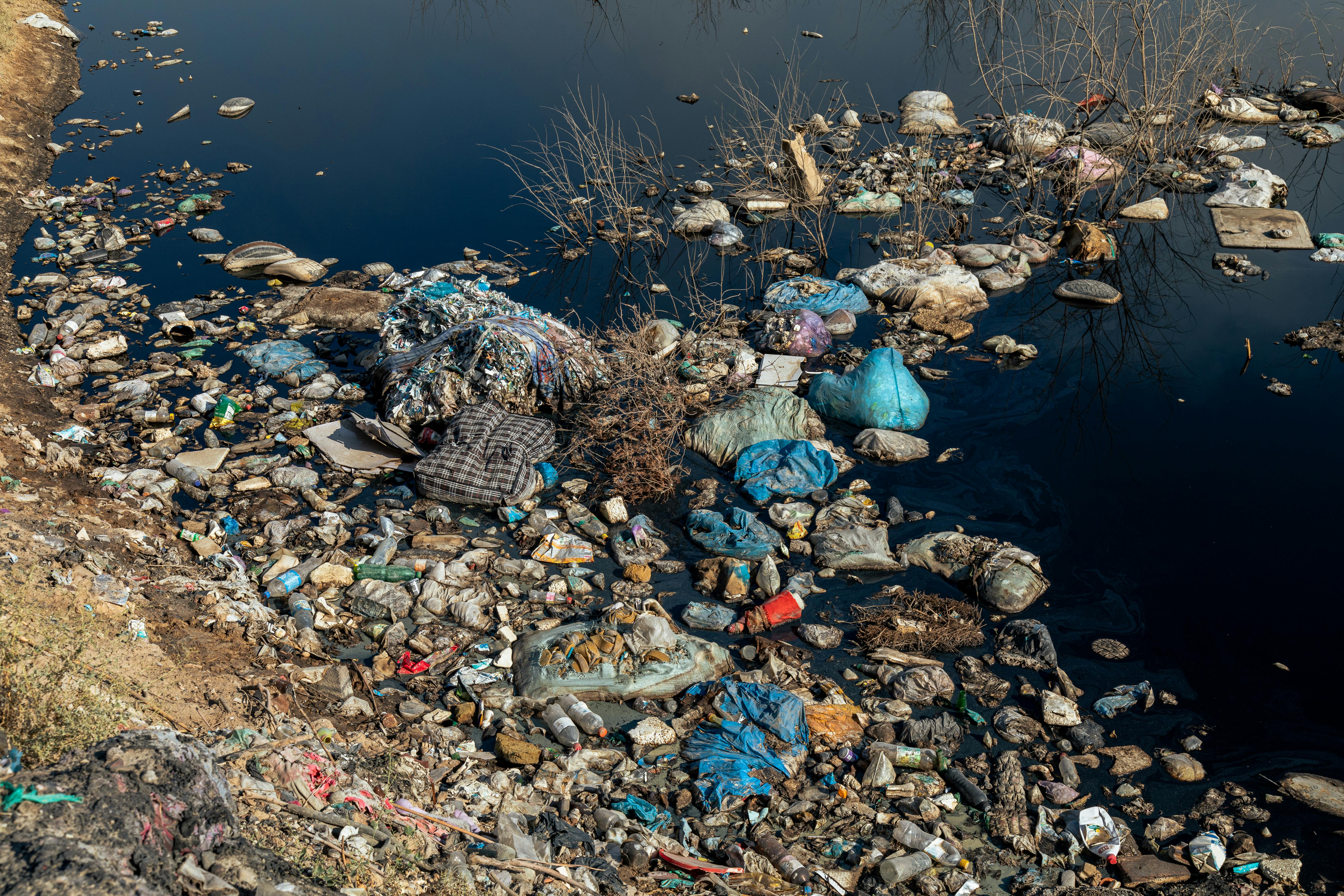
is uncontrollable in the post-1994 South Africa (Grangxabe, Maphanga, Madonsela 2023). The land south-west of Swanieville 1, east of extension 2 and 3 is no exception as former backyard residents settle. The result is that the informal settlement south of Swanieville 1, west of extension 2 and 3 (see picture 1) is going to add to the ongoing problem of uncollected refuse in Mogale City, thus threatening to pollute the stream that run along the settlement as it is not easy to stop people dumping on a spot once they a few individuals begun dumping (see picture 3). Uncollected refuse in these spots pile up. During rainy seasons water will naturally drag all forms of waste to the stream and speed up the pollution process (see part of the stream in picture 2).
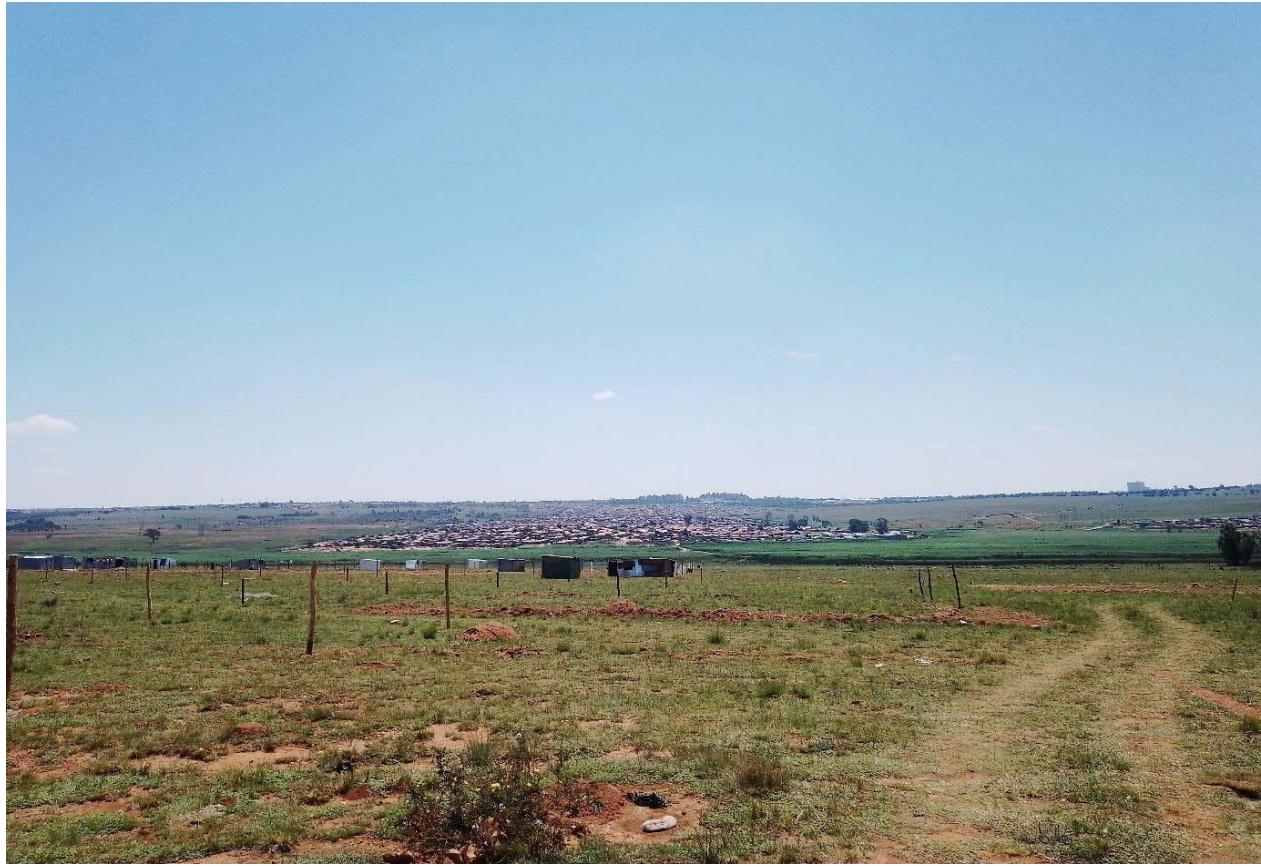
Picture 1: The pictures were taken on Sunday afternoon, 12 November 2023.
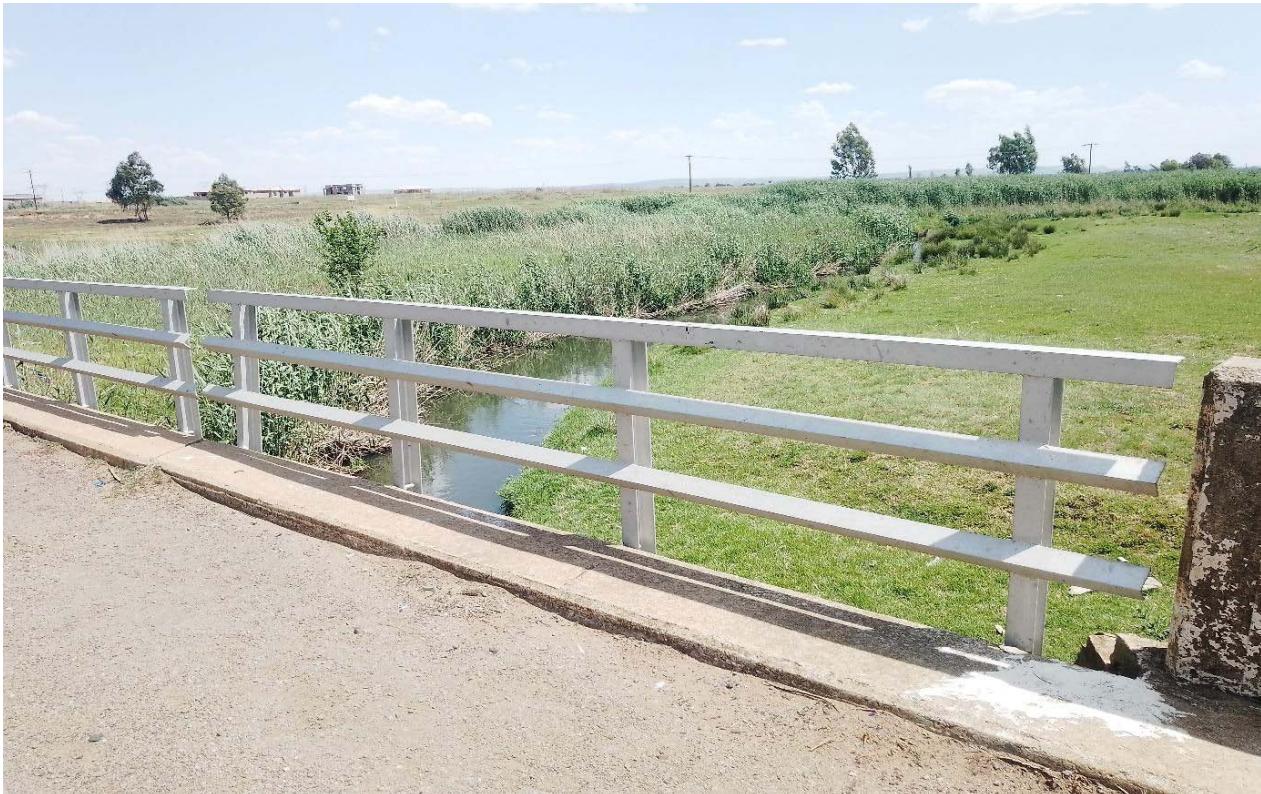
Picture 2
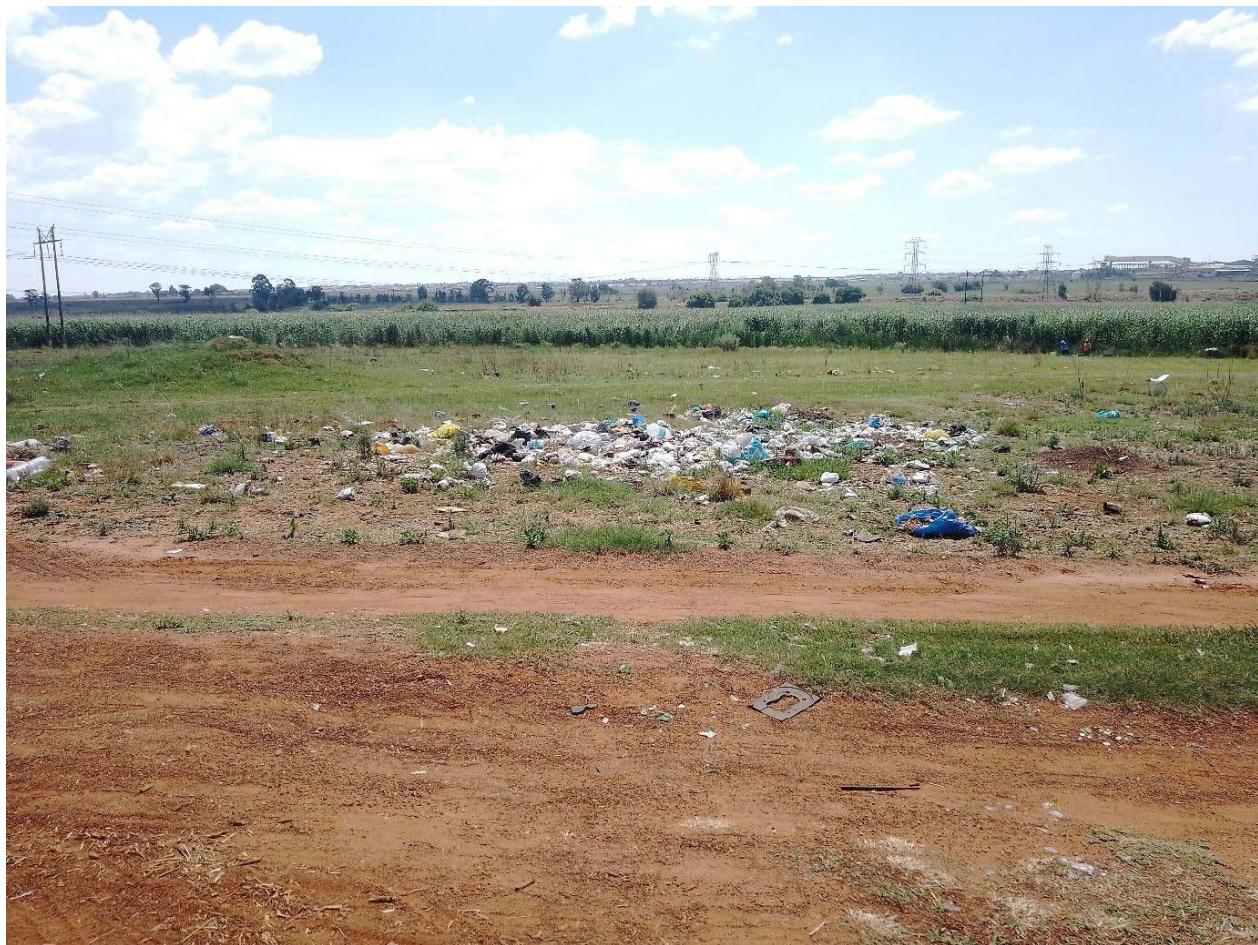
Picture 3
## IV. A STRATEGY TO CREATE AWARENESS AND PROMOTE EARTH CARE AMONG PENTECOSTALS IN THE TWO TOWNSHIPS
The article holds that Pentecostals, who profess to love God, should accept three facts, namely, they are (a) part of the community that has occupied the vacant land, (b) home and away from home, that is they need to address the tension of being present on earth and awaiting the cosmic redemption of creation, and (c) accountable to God and should embrace spiritualities that reflect earth care initiatives. Hence, this section provides a five-step strategy on earth care to create awareness and promote earth care among Pentecostals and community members in the area mentioned above. First, is discussing the UN resolution on environmental crisis and responses of the World Council of Churches and All Africa Conference of Churches. Second, is discussing the Genesis 2:15 as a theological basis to engage in earth care initiatives. Third, is discussing Pentecostal, eco-bosadi and Ubuntu perspectives of earth care. Fourth, is promoting Missional-Pentecostal earth care Bible study lesson. Fifth, is encouraging collaboration in the earth care initiative.
a) The United Nations World Council of Churches, All Africa Conference of Churches, and Earth Care In 1972, the United Nations established the United Nation Environmental Program addressing global environmental issues caused by human actions. One of the streams is faith and earth to engage faith communities in earth preservation through (https://www.unep.org/about-un-environment/faith-earth-initiative, United Nations 2012).
1) Strengthening partnership with faith-based organization's leadership for policy impact.
2) Greening faith-based organization's investments, operations, and assets; and
3) Establishing an accessible knowledge-based support system using faith scripts and scientific evidence.
The World Council of Churches responded to the UN's call by crafting the document, namely, Summit Earth. "Challenges for the Churches", a Letter to the Churches. Redeeming the Creation, the Rio Earth Summit (1992) and Climate Change and the Quest for Sustainable Societies (1998).
The All-Africa Conference of Churches (AACC 1992, 23) document use stewardship to promote earth care initiative. The document further states that: "Bad stewardship is comparable to 'stealing' from others, especially our children and grandchildren, by the destruction of resources which is also theirs from God" (AACC 1992, 23). The AACC also adopted the African Union's Agenda 2063 to promote a hazard free environment.
### b) Earth Care in Genesis 2:15
The section looks at the following text that infer to earth care. Genesis 2:15. The ESV reads: "The LORD God took the man and put him in the garden of Eden to work it and keep it." Two verbs helped understand the text, to "work/till" (הַ) (abad) and "to guard" (הַ) (shamar) it. Abad refers, in the context of the pericope, to serve, to tend, or to dress or to care; and shamar, meaning to keep, watch, or preserve. The ESV uses work and keep it, thus communicating that the first two humans were given the responsibility to be stewards of God's perfect garden (Skerka & Ellison 2007).
The aspect of interrelatedness features in this text. God relied on humans to care and preserve the Garden. Humans relied on the Garden for survival and the Garden relied on humans to care and preserve it. We, accordingly, could say that the text reflects a holistic view instead of a dichotomized relationship between humankind and the earth with the Triune God as the creator of humankind and the earth.
On the contrary, it must be noted that Van Dyk (2011, 524, 529, 533) holds that the garden story is not historical and posits that the Bible does not provide texts addressing earth care (ecological) issues (Van Dyk 2017, 835) and discourages using it for promoting stewardship (Van Dyk 2011, 533). The article holds that although the Bible was not written to address ecological matters, it is possible to use the same Bible to each teach earth care and preservation by using "Constructs" (Conradie 2010, 310). It also argues that the Garden of Eden was complete and did not need humans to be to till and cultivate it but needed them to care (abad) and preserve (shamar) it. This view and use is noticed in ancient cultures of Egypt and Mesopotamia and intrinsic in the role and title of Joseph who was made to oversee a household (Layton 1990, 633-355). Accordingly, the article follows Conradie (2006, 306) argument that:
Doctrinal constructs are not only employed to find similarities but to construct similarities, to make things similar, if necessary. The scope of such doctrinal constructs is often quite comprehensive: they purport to provide a clue to the core meaning of the contemporary context as a whole and the Biblical text.
c) Pentecostal, Eco-Bosadi and Ubuntu Perspectives of Earth Care
Genesis 2:6 describes the creation of the first human being (male) and uses Adam as 'adamaih' which means earth's surface. Adam was created from the soil of the earth, thus creating a relationship between God the creator, the first human being (male) and the earth (soil). God touched soil particles and formed the first human being before breathing into his nostrils to be a living being. This story echo a harmonious relationship between God, the human being, and the soil-earth. The story also promotes the interrelatedness between earth and humans.
Naturally, all Pentecostals do not struggle with the view that God created the first human being out of soil of the earth. This action introduces the human-soil relationship that shows the biblical soil origin of humans and later point to the end of humans mentioned in Genesis 3:19 and Ecclesiastes 12:7. Pentecostals also accept the presence of the Triune God in the creation story by pointing to Genesis 1:2, John 1:1-4 and Colossians 1:15-17. Thus, placing the first human being at the center and as the crown of creation (Gnanakan 2014, 71-72), with the responsibility of caring and preserving the Garden, God created. Unfortunately, this anthropocentric view has contributed to the abuse and destruction of the earth because "[c]reation can be spoiled by wicked, disobedient or ignorant lesser beings." (Turaki 1997, 56)
Human activities in the past centuries have caused some theologians to question the anthropocentric view. As such, Masenya (2001) critiques placing the first human being at the center and argues for an ethnocentric interpretation of the creation story she calls eco-bosadi. This view emphasizes that humankind arrived last on earth; contents that since creation existed before the first human being, the creation story should be earth-centered, thus promoting that humankind, specifically males, should not destroy, exploit, and abuse the earth as they do with women (Masenya 2001, 222).
The article posits that eco bosadi, conceptualized from Bosadi, where Masenya (1997, 440-441, 448) argues for an Ubuntu approach of interpreting Scripture since, in the past, Black theology did not address the situation of Black women in South Africa. This approach flows from an Ubuntu worldview that promotes a close relationship between humankind and nature. Ultimately encouraging the worldview that the land is sacred and possess a mother role (life giving ability) (Maathai 2010, 95). Understandably, the land that holds some sacred places should be treated with respect and reverence (Odey et al., 2013, 9) and humans should seek to maintain harmony between the earth, God, and themselves. Maintaining harmony promotes the interrelatedness between the earth and humans and an integrated approach to earth care.
Such relationship is captured in the maxim "umuntu ngumuntu ngabantu" (isiNguni languages) or "motho ke motho ka batho" (Setswana/Sesotho languages). (I am because we are), promoting the values of solidarity, care, and respect for the earth. It also echo the view that African women play a critical role in food security and related activities as many rural African women depend on the land, as Chirinda (2021, 80) explains that:
African women are the primary land tillers. Their stories are connected to the land where they live and where they produce food, fetch firewood, dig wells and, where they sleep after death. For women, the land is their sacred home.
The above views displays that these African women, who are also the majority in all [South] African churches (Chisale 2018,1), need the earth to survive and cannot afford to have humans degrade it. Thus, ecobosadi is well positioned to address the denigration and abuse of the land.
Additionally, Africans believe that the Supreme Bing supply and withhold rain (see Mbiti 2012) needed to sustain plant, animal, and human life. Hence the practice of offering some sacrifices or appeasing the ancestors, led by either a king/queen or indigenous healer in times of drought (Mbiti 2012,22-26). Thus, accentuating that there is no separation between the material and spiritual.
The eco-bosadi and Ubuntu approach emphasizes upholding harmony between the Triune God (as the creator and owner), the earth and humans (as stewards of God's creation). Such harmony includes partnering with males in the quest to be ethnocentric; and is a step closer to creating earth-care awareness among Pentecostals in the informal settlements near the townships mentioned in the article.
### d) Missional-Pentecostal Bible Study Lesson
As mentioned above, poor people live in informal settlements and do not get basic municipal service. This condition perpetuates a feeling of despair and loss of human dignity. Hence, the section promotes a holistic missional approach of using the Bible to develop a Pentecostal Bible study lesson as means to address the mindset of people, Pentecostals included, residing in townships and informal settlements. It first posits that: "[m]ission is a multifaceted ministry, in respect of witness, service, justice, healing, reconciliation, liberation, peace, evangelism, fellowship, church planting, contextualization, and much more" (Bosch 1991,512). Second, is that mission involves the Triune God (Bosch 1991, 390, Mashau 2012,3). Third is recognizing the mission of Christ stated in Matthew 28: 16-20 and fourth the mission of the church flowing from Christ's mission. The mission of the church should always point the Triune God, the initiator of missions (Mashau 2012,7).
A missiology approach embraces that missions is God the Father's initiative (mission Dei) to have humans restored. He sent the Son to accomplish this mission and the Son sent the Holy Spirit to continue the mission. The Son is also commissioned to redeeming the earth (Romans 8:18-23, Colossians 1:15-20 and Revelation 21-22). This approach uses the hermeneutics of trust to engage earth care.
Providing accurate and simple information is an intrinsic component that should be used to curb earth degradation. This information enabled us to first use Genesis 2:15 to teach that, in the beginning, humans are created to be good stewards of the earth and to care for it. Placed alongside this text is Gensis 1:26 that teaches that humans are created in the image of God. Teaching these beliefs will enable Pentecostals and residents living in these areas to embrace caring as a virtue and an ethic as observed in the Ubuntu worldview discussed above. It will also promote human-soil/earth interconnection.
This teaching also resonate with the Ubuntu worldview of seeking harmony between humans and creation, as creation and humans will experience the goal of redemption. (Rom 8:18-23). This teaching further resonate with eco-bosadi as it elevates the earth and reject the abuse and degrading the earth. Hence the third teaching that, humans need a clean and health hazard free environment. And to teach that humans need a clean stream as it provide necessary conditions for various species living in and around the stream.
Second, is to emphasize that Christ's mission is cosmic that is, Christ death on the cross is not limited to redeeming humans but also redeeming creation as Paul teaches in Romans 8:18-23 and Colossians 1:19-20. Accordingly, each person of the Trinity participates in the plan of redemption (Van Gemeren 1990, 243). The two texts echo that this mission involves the Triune God with the Father sending the Son and the Son sending the Holy Spirit; the Son has also sent the church to proclaim the message of redemption to different nations (Bosch 1991, 114, 206).
### e) Collaboration of Different Stakeholders in the Earth Care Initiatives
Since Ubuntu encourages community and ecobasadi aims to transform a community. It is insufficient for Pentecostals in the area to disregard forging close relationship with other stakeholders championing earth care initiatives in Gauteng Province. Forging close relationships with other stakeholders will enable the Pentecostals to look beyond the walls of the church but look at the community so that the interest of the community not a section of the community is protected. Protecting the interest of the community should include involving the administrative and political divisions of the two local municipalities. These include the waste management departments of Mogale City and Rand West City local municipality, the Speaker of each municipality, Members of Mayoral Committees responsible for human settlement and for environmental management from the two municipalities and local ward councilors. Other important formal stakeholders that provides valuable scientific information are organizations promoting earth care and the academic institutions in Gauteng Province.
Finally, Pentecostals in the area should also reach out to other Christian organizations and churches, other faith organizations, the business sector, education sector, taxi associations, sports and cultural organizations, and the leaders of the ward committees, burial societies/stockvels, youth organizations, and the South African Congress of Civic organizations.
## V. SUMMARY
Land grabbing in Mogale City and Rand West City Local Municipality in South Africa is created by insufficient houses in Gauteng Province and is accompanied by a backlog of refuse removal that results in worrying littering and illegal dumping in the two municipalities. The current spate of land grabbing in the two areas will lead to the pollution of the Wonderfontein spruit/stream that run from Kagiso past the townships of Swanieville 1, extension 2 and 3, run on the east of Mohlakeng township to the west of Bekkersdal township.
The objective of this article is to create an awareness campaign and propose a four-step strategy based on Bosadi and Pentecostalism to mobilize Pentecostals in the two municipalities to consider themselves as part of these communities residing in the invaded land because of lack of housing, and embrace earth care initiatives, in collaboration with members of these communities and other stakeholder in Mogale City and Rand West City Local Municipality in South Africa.
Generating HTML Viewer...
References
34 Cites in Article
Brian Muyunga (1992). The All Africa Conference of Churches (AACC): Youth, Peacebuilding, and Development in Africa.
A Anderson (2004). New African initiated Pentecostalism and charismatics in South Africa.
Felicidade Chirinda (2021). Christian and African concepts of God for liberation.
David Bosch (1991). David J.BOSCH, Transforming Mission. Paradigm Shifts in Theology of Mission. Maryknoll, New York: Orbis Books, 1991, 587 pages. ISBN 0-88344-719-3 (paperback). ISBN 0-88344-744-4 (cloth). [The American Society of Missiology Series, No. 16.].
Sinenhlanhla Chisale (2018). Domestic abuse in marriage and self-silencing: Pastoral care in a context of self-silencing.
Ernst Conradie (2003). How can we help to raise an environmental awareness in the South African context?.
Ernst Conradie (2006). THE CHURCH AND THE ENVIRONMENT: SEVEN STATIONS TOWARDS THE SANCTIFICATION OF THE WHOLE EARTH.
Ken Gnanakan (1966). NEW ESSA PUBLICATIONS.
Xolisiwe Grangxabe,Thabang Maphanga,Benett Madonsela (2023). Public participation on waste management between nature reserves and surrounding informal settlement: A review.
Joseph Liu,Anupama Suresh,Marilly Palettas,Julie Stephens,Akaansha Ganju,Evan Morgan,Mahmoud Kassem,Yanjun Hou,Anil Parwani,Anne Noonan,Raquel Reinbolt,Jeffrey Vandeusen,Sagar Sardesai,Nicole Williams,Mathew Cherian,Gary Tozbikian,Daniel Stover,Maryam Lustberg,Zaibo Li,Bhuvaneswari Ramaswamy,Robert Wesolowski (2019). Features, Outcomes, and Management Strategies of Male Breast Cancer: A Single Institution Comparison to Well-Matched Female Controls.
Scott Layton (1990). The Steward in Ancient Israel: A Study of Hebrew ('aser) 'al-habbayit in Its near Eastern Setting.
Olimpiu-Nicolae Benea (1987). Christ, the Image of the Invisible God, the Proscenium of Old and New Testament. Perspectives of Knowing God from Colossians.
Alan Mabin (1993). Between Zevenfontein and Hillbrow: alternatives for South African urban planning.
Wangari Maathai (2010). Replenishing the earth. The challenge for Africa. spiritual values for healing and the world.
Madipoane Masenya (1997). Redefining ourselves: A bosadi (womanhood) approach.
Madipoane Masenya (2001). An ecobosadi reading of Psalm 127:3-5.
Thinandavha Mashau (2012). A reformed perspective on taking mission and missiology to the heart of theological training.
Masiya Tyanai,D Davids Yul,Mary Mangai (2019). Assessing service delivery: Public perception of municipal service delivery in South Africa.
J Mbiti (2012). Concepts of God in Africa.
Bill Mckibben (1997). Benthic Habitats and the Effects of Fishing.
Sthandiwe Mthuli,Shamim Bodhanya,Nafiisa Sobratee (2010). How should strategy prevail if organisations are seen as having the properties of complex adaptive systems?.
Elizabeth Odey,B Bebia,A Okpachui (2013). African Traditional Religion and environmental sustainability.
N Pityana (1970). Employment.
Kelebogile Resane (2021). Pentecostal Ecumenism: The Legacy of David Du Plessis.
C Southgate (2006). Stewardship and its competitors: A spectrum of relationships between humans and the non-human creation.
Darren Sherkat,Christopher Ellison (2007). Structuring the Religion‐Environment Connection: Identifying Religious Influences on Environmental Concern and Activism.
Y Turaki (1997). Racism, Ethnicity and the Media in Africa.
Ivan Turok,Jackie Borel-Saladin (2016). Backyard shacks, informality and the urban housing crisis in South Africa: stopgap or prototype solution?.
(2012). Global environmental outlook.
Jerome Walsh (1977). Genesis 2:4b-3:24: A Synchronic Approah.
Rajula Watson (2004). Development and justice: A Christian understanding of land ethics.
Lynn White (1967). The historical roots of our ecological crisis.
(1992). WORLD COUNCIL OF CHURCHES.
Samuel Kobia (1992). Letter from the WCC General Secretary.
Explore published articles in an immersive Augmented Reality environment. Our platform converts research papers into interactive 3D books, allowing readers to view and interact with content using AR and VR compatible devices.
Your published article is automatically converted into a realistic 3D book. Flip through pages and read research papers in a more engaging and interactive format.
This article contends that addressing environmental concerns in the South African context requires acknowledgment of the intertwined issues of land grabbing, littering, illegal dumping, and inadequate service delivery. It suggests that Pentecostals, as members of diverse communities, should shift their focus from spiritual matters to initiatives aimed at caring for the earth. Therefore, the article delves into Mogale City and Rand West City Local Municipality in South Africa as a case study, illustrating their contribution to the ongoing environmental degradation. The increasing incidence of land grabbing in these areas poses a threat to the pollution of the Wonderfontein spruit/stream, which flows from Kagiso through the townships of Swanieville 1, extensions 2 and 3, and continues east of Mohlakeng township to the west of Bekkersdal township. Inadequate service delivery has resulted in a backlog of waste removal, leading to concerning levels of littering and illegal dumping in both municipalities.
Our website is actively being updated, and changes may occur frequently. Please clear your browser cache if needed. For feedback or error reporting, please email [email protected]
Thank you for connecting with us. We will respond to you shortly.