Neural Networks and Rules-based Systems used to Find Rational and Scientific Correlations between being Here and Now with Afterlife Conditions
Neural Networks and Rules-based Systems used to Find Rational and
To: Author
Article Fingerprint
ReserarchID
8R2EM
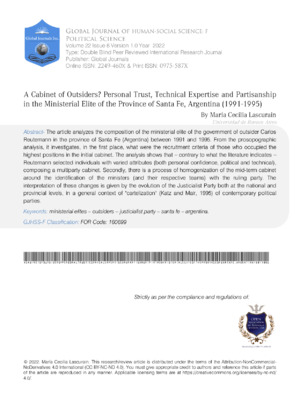
The article analyzes the composition of the ministerial elite of the government of outsider Carlos Reutemann in the province of Santa Fe (Argentina) between 1991 and 1995. From the prosopographic analysis, it investigates, in the first place, what were the recruitment criteria of those who occupied the highest positions in the initial cabinet. The analysis shows that -contrary to what the literature indicates -Reutemann selected individuals with varied attributes (both personal confidence, political and technical), composing a multiparty cabinet. Secondly, there is a process of homogenization of the mid-term cabinet around the identification of the ministers (and their respective teams) with the ruling party. The interpretation of these changes is given by the evolution of the Justicialist Party both at the national and provincial levels, in a general context of “cartelization” (Katz and Mair, 1995) of contemporary political parties.
María Cecilia Lascurain. 2026. \u201cA Cabinet of Outsiders? Personal Trust, Technical Expertise and Partisanship in The Ministerial Elite of the Province of Santa Fe, Argentina (1991-1995)\u201d. Global Journal of Human-Social Science - F: Political Science GJHSS-F Volume 22 (GJHSS Volume 22 Issue F8): .
Crossref Journal DOI 10.17406/GJHSS
Print ISSN 0975-587X
e-ISSN 2249-460X
The methods for personal identification and authentication are no exception.
Total Score: 101
Country: Argentina
Subject: Global Journal of Human-Social Science - F: Political Science
Authors: María Cecilia Lascurain (PhD/Dr. count: 0)
View Count (all-time): 187
Total Views (Real + Logic): 1521

Total Downloads (simulated): 30
Publish Date: 2026 01, Fri
Monthly Totals (Real + Logic):
Neural Networks and Rules-based Systems used to Find Rational and
A Comparative Study of the Effeect of Promotion on Employee
The Problem Managing Bicycling Mobility in Latin American Cities: Ciclovias
Impact of Capillarity-Induced Rising Damp on the Energy Performance of
The article analyzes the composition of the ministerial elite of the government of outsider Carlos Reutemann in the province of Santa Fe (Argentina) between 1991 and 1995. From the prosopographic analysis, it investigates, in the first place, what were the recruitment criteria of those who occupied the highest positions in the initial cabinet. The analysis shows that -contrary to what the literature indicates -Reutemann selected individuals with varied attributes (both personal confidence, political and technical), composing a multiparty cabinet. Secondly, there is a process of homogenization of the mid-term cabinet around the identification of the ministers (and their respective teams) with the ruling party. The interpretation of these changes is given by the evolution of the Justicialist Party both at the national and provincial levels, in a general context of “cartelization” (Katz and Mair, 1995) of contemporary political parties.


We are currently updating this article page for a better experience.
Lorem ipsum dolor sit amet, consectetur adipiscing elit. Ut elit tellus, luctus nec ullamcorper mattis, pulvinar dapibus leo.