

I. INTRODUCTION
Anxiety is a feeling of threat experienced in anticipation of an undesirable event that may be unknown or specified and is a normal phenomenon (Kleigman, 2015). But when it becomes disabling, causing distress and impairs overall functioning, it is considered as an anxiety disorder (Robin M Murray, 2008). Anxiety disorders can significantly interfere with academic, social, and emotional, and family functioning. The onset of any anxiety disorder was seen in childhood. In different studies of impairing childhood anxiety disorder, 5% to 13% of children younger than 18yrs have an anxiety disorder.
a) Need for the study
Childhood anxiety disorders are the most common type of psychiatric problem in children, which can cause excessive distress, are usually not assessed, diagnosed, and treated properly and if left untreated, can follow a chronic and fluctuating course into adulthood.
Children experience anxiety just as the adults who can begin at a very early age and is said to be mainly due to the pressures that come from outside sources such as family, friends, or school (Nidhi Luthra, 2007).
In this competitive world, fear of examination in students is highly increasing. The thought and the pressure to perform well in exams have heightened fear and anxiety and even panic attacks (Rajive Sood, 2004).
Status of anxiety disorder research from India about management is lacking, and research areas like family studies are not touched.
b) Role of Homoeopathy
The experience of anxiety is unique for each person, and the Homoeopathic approach is personalized, which is a 'holistic' method of diagnosis and of prescription which is called individualization.
Individualized Homoeopathic medicine (IHM) was found effective in reducing the symptoms of anxiety in patients. The current study established the fact that Homoeopathic medicines were very useful in psychological medicine (Lakshmipathy R Prabhu, 2012). The anxiolytic effect of the Homoeopathic preparation of Pulsatilla nigricans in Swiss albino mice is proved (S Keerti Jogdand, 2015).
II. MATERIALS AND METHODS
a) Study Setting
A sample of 30 cases presenting with an anxiety disorder was obtained from the school health program conducted by Sarada Krishna Homoeopathic Medical College in Kanyakumari district and also from its outpatient department, and rural centers.
b) Selection of Samples
A sample of 30 cases presenting with anxiety disorders was selected using a purposive sampling technique. For that, every child will be screened for anxiety disorders using SCARED (screening for childhood anxiety related emotional disorders) diagnostic tool.
c) Inclusion Criteria
Patients of pediatric age group between 8yrs to 18yrs
Children of both sex
School going children
d) Exclusion Criteria
- Patients taking medicines for any other chronic illness
e) Study Design
Interventional before and after treatment without control
f) Brief of Procedures
Every case is subject to screening using a diagnostic tool, Screen for child anxiety related emotional disorders (SCARED), and those cases identified with anxiety disorders will be sent for detailed case taking. Data was obtained from the patients, bystanders, and physician's observation and the physical examination. Medicine was prescribed according to the individualization and totality of symptoms. The improvement was monitored after 3 to 6 months of administration of medicine by recording the variations in the scoring criteria of the SCARED tool. Pre and post-treatment analysis is done using Screen for child anxiety related emotional disorders (SCARED). Observations are noted in tables and charts. Statistical analysis is done, and results are presented.
g) Data Collection
Data were obtained from the patient & bystanders through the interview technique and also from the physician's observation and physical examination. The diagnosis was made through proper screening and assessment of the patient using proper diagnostic tools (SCARED).
h) Statistical Techniques
- Paired 't' test
i) Statistical Analysis
| SL. No. | X | Y | d = x-y | d - d | |
| 1 | 22 | 12 | 10 | 1.7 | 2.87 |
| 2 | 16 | 9 | 7 | -1.3 | 1.69 |
| 3 | 28 | 18 | 10 | 1.7 | 2.87 |
| 4 | 20 | 7 | 13 | 4.7 | 22.09 |
| 5 | 41 | 22 | 19 | 10.7 | 114.49 |
| 6 | 15 | 9 | 6 | -2.3 | 5.29 |
| 7 | 13 | 9 | 4 | -4.3 | 18.49 |
| 8 | 21 | 13 | 8 | -0.3 | 0.09 |
| 9 | 16 | 13 | 3 | -5.3 | 28.09 |
| 10 | 20 | 14 | 6 | -2.3 | 5.29 |
| 11 | 28 | 13 | 15 | 6.7 | 44.89 |
| 12 | 27 | 18 | 9 | 0.7 | 0.49 |
| 13 | 31 | 24 | 7 | -1.3 | 1.69 |
| 14 | 32 | 18 | 14 | 5.7 | 32.49 |
| 15 | 18 | 12 | 6 | -2.3 | 5.29 |
| 16 | 20 | 11 | 9 | 0.7 | 0.49 |
| 17 | 29 | 20 | 9 | 0.7 | 0.49 |
| 18 | 19 | 8 | 11 | 2.7 | 7.29 |
| 19 | 32 | 23 | 9 | 0.7 | 0.49 |
| 20 | 14 | 11 | 3 | -5.3 | 28.09 |
| 21 | 27 | 21 | 6 | -2.3 | 5.29 |
| 22 | 24 | 15 | 9 | 0.7 | 0.49 |
| 23 | 29 | 16 | 13 | 4.7 | 22.09 |
| 24 | 29 | 17 | 12 | 3.7 | 13.69 |
| 25 | 30 | 16 | 14 | 5.7 | 32.49 |
| 26 | 23 | 20 | 3 | -5.3 | 28.09 |
| 27 | 30 | 26 | 4 | -4.3 | 18.49 |
| 28 | 19 | 16 | 3 | -5.3 | 28.09 |
| 29 | 38 | 33 | 5 | -3.3 | 10.89 |
| 30 | 33 | 29 | 4 | -4.3 | 18.49 |
X = Score before treatment, Y = Score after treatment, D = Mean difference
Null Hypothesis:
Standard error of the mean differences:
The mean of the differences,
The estimate of population standard deviation is given by,
The estimate of standard error of mean, Standard error (S.E)
The test statistics is Paired t:
| Variable 1 | Variable 2 | |
| Mean | 24.8 | 16.43333 |
| Variance | 51.68276 | 40.59885 |
| Observations | 30 | 30 |
| Pearson Correlation | 0.818731 | |
| Hypothesized Mean Difference | 0 | |
| df | 29 | |
| t Stat | 11.02574 | |
| P(T<=t) one-tail | 3.44E-12 | |
| t Critical one-tail | 1.699127 | |
| P(T<=t) two-tail | 6.88E-12 | |
| t Critical two-tail | 2.04523 |
Interpretation of results:
■ Comparison with the tabled value:
On comparing the score before and after treatment, the means were 24.8 and 16.43333 and the variances were 51.68276, and 40.59885 respectively (Table 1, Table 2). The data showed a positive correlation of 0. Since the calculated value is greater than the tabled value at 5% and 1%, the null hypothesis was rejected at 95% significance and the hypothesis that Homoeopathy is effective in treating anxiety disorders in children is accepted.
j) Data Analysis
Data presentation including charts and tables
| Age | Number of Patients | Percentage |
| 6-8 | 12 | 40 |
| 9-11 | 9 | 30 |
| 12-14 | 6 | 20 |
| 15-17 | 3 | 10 |
| Probable Risk Factors | Antenatal Causes | Natal Causes | Environmental (At Home & School) | Developmental Delay | Unknown Causes |
| Number Of Patients | 12 | 18 | 6 | 7 | 6 |
| Percentage | 40 | 60 | 20 | 23.33 | 20 |
| Score | 10-15 | 16-20 | 21-25 | 26-30 | 31-35 | 36-40 | 41-45 |
| No. Of Patients | 3 | 8 | 4 | 9 | 4 | 1 | 1 |
| Percentage | 10 | 26.66 | 13.33 | 30 | 13.33 | 3.33 | 3.33 |
| Type of anxiety disorder | Number of patients | Percentage |
| Generalized Anxiety Disorder (GD) | 3 | 10 |
| Separation Anxiety Disorder (SP) | 23 | 76.66 |
| Social Anxiety Disorder (SC) | 25 | 83.33 |
| Panic Disorder (PD) | 5 | 16.66 |
| Significant School Avoidance (SH) | 5 | 16.66 |
| Co-morbidity | Number of Patients | Percentage |
| ADHD | 3 | 10 |
| Epilepsy | 2 | 6.66 |
| Intellectual Disability | 4 | 13.33 |
| Learning Disability | 7 | 23.33 |
| Attention Deficit Disorder | 5 | 16.66 |
| Oppositional Defiant Disorder | 1 | 3.33 |
| Nocturnal Enuresis | 5 | 16.66 |
| Cerebral Palsy | 2 | 6.66 |
| Remedy prescribed | Number of patients | Percentage |
| Lycopodium clavatum | 2 | 6.66 |
| Carcinosinum | 2 | 6.66 |
| Calcarea carbonica | 4 | 13.33 |
| Cuprum metalicum | 1 | 3.33 |
| Tuberculinum | 1 | 3.33 |
| Silicea terra | 3 | 10 |
| Calcarea phosphorica | 4 | 13.33 |
| Natrum muriaticum | 3 | 10 |
| Phosphorous | 4 | 13.33 |
| Tarantula | 1 | 3.33 |
| Arsenicum album | 2 | 6.66 |
| Opium | 1 | 3.33 |
| Baryta carbonica | 1 | 3.33 |
| Natrum sulphuricum | 1 | 3.33 |
| Mild Improvement | Moderate Improvement | Marked Improvement | |
| Number of patients | 11 | 10 | 9 |
| Percentage | 30 | 33.33 | 36.66 |
III. RESULTS
a) Distribution of cases according to age
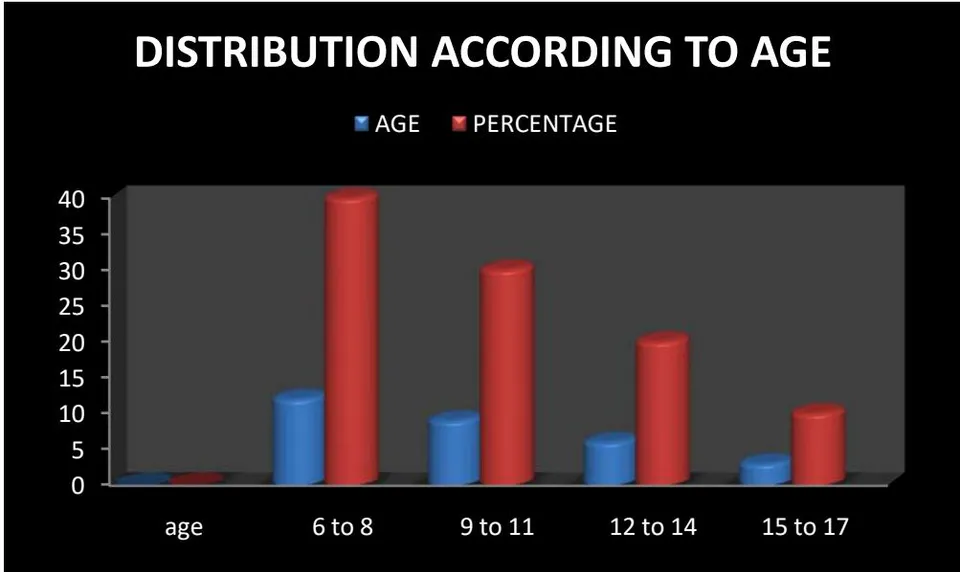
Out of thirty cases, twelve patients (40%) were of age 6 to 8 years old, nine patients (30%) were of age 9 to 11 years old, six patients (20%) were of age 12 to 14 years old, and three patients (10%) were of age 15 to 17 years old.
b) Distribution of cases according to probable risk factors
Out of 30 cases, twelve patients (40%) have antenatal risk factors, eighteen patients (60%) have natal risk factors, six patients (20%) have environmental risk factors, seven patients (23.33%) have developmental delay and six patients (20%) have unknown probable risk factors.
c) Distribution of cases according to antenatal risk factors
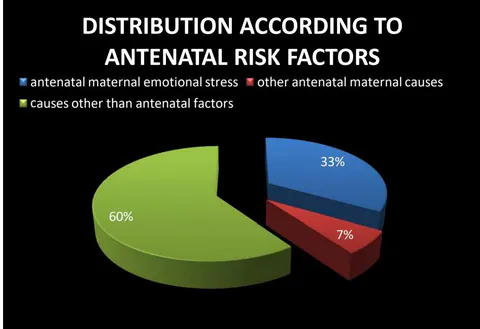
Out of 30 cases, twelve patients (40%) have antenatal risk factors. Out of the twelve patients, ten of them had antenatal maternal emotional stress as a risk factor.
d) Distribution of cases according to screening with the children with anxiety-related emotional disorders (SCARED) tool
Out of 30 patients, three patients (10%) had the score range from 10 - 15, eight patients (26.66%) had the score between 16 - 20, four patients (13.33%) had the score range from 21 - 25, nine patients (30%) had score 26 - 30, four patients (13.33%) had score 31 - 35, one patient (3.33%) had score between 36 - 40, and one patient (3.33%) had score between 41 - 45.
e) Distribution of cases according to the type of anxiety disorder
Out of 30 cases, twenty five patients (83.33%) had social anxiety, twenty three patients (76.66%) had separation anxiety, five patients (16.66%) had panic disorder, five patients (16.66%) presented with significant school avoidance, and three patients (10%) had a generalized anxiety disorder.
f) Distribution of cases according to co-morbidity of anxiety disorders in children
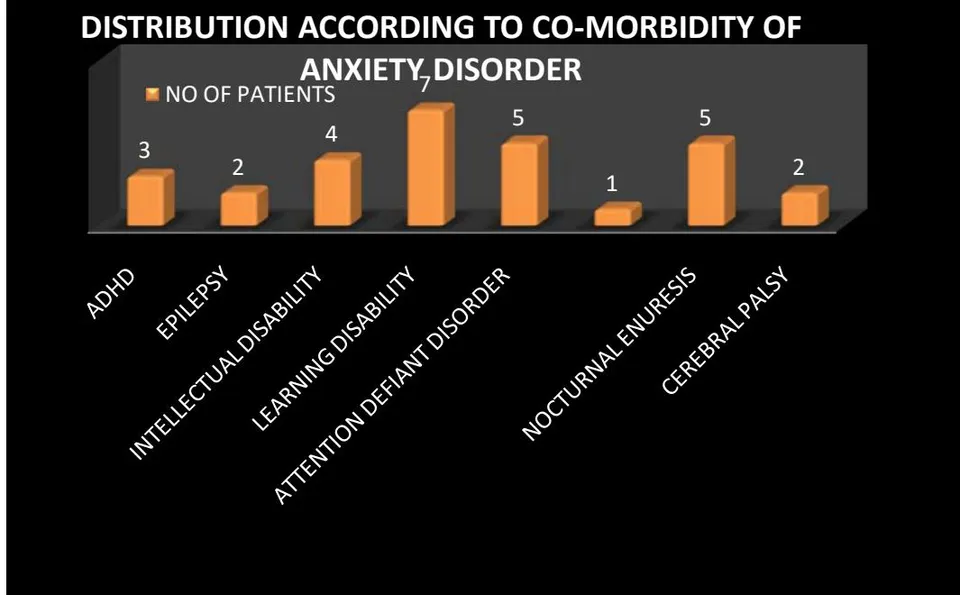
Out of 30 patients, three patients (10%) had attention deficit hyperactivity disorder (ADHD), two patients (6.66%) had epilepsy, four patients (13.33%) had intellectual disability, seven patients (23.33%) had learning disability, five patients (16.66%) had attention deficit disorder, one patient (3.33%) had oppositional defiant disorder, five patients (16.66%) had nocturnal enuresis, and two patients (6.66%) had cerebral palsy.
g) Distribution of cases according to the remedy prescribed
Out of 30 cases, two patients were given Lycopodium clavatum, two patients with Carcinosinum, four patients were given Calcarea Carbonica, one patient with Cuprum metallicum, one patient with Tuberculinum, three patients with Silicea terra, four patients with Calcarea phosphorica, three patients with Natrum muriaticum, four patients with Phosphorous, one patient with Tarentula, two patients with Arsenicum album, one patient with Opium, one patient with Baryta carbonica, and one patient were given Natrum sulphuricum.
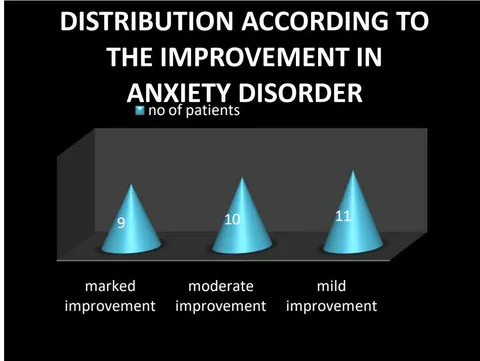
h) Distribution of cases according to the improvement in the anxiety disorder
Out of 30 cases, 9 patients (30%) had marked improvement, 10 patients (33.33%) had moderate improvement and 11 patients (36.66%) had mild improvement.
IV. DISCUSSION
In the study, out of 30 cases, twelve patients (40%) were of age 6 to 8 years old, nine patients (30%) were of age 9 to 11 years old, six patients (20%) were of age 12 to 14 years old, and three patients (10%) were of age 15 to 17 years old. Therefore commonly affected age group was 6 to 8 years (Table 3, Figure 1).
There was no gender difference, according to this study. Among the 30 cases, fifteen patients (50%) were females and the fifteen patients (50%) were males.
Out of 30 cases, twelve patients (40%) have antenatal risk factors, eighteen patients (60%) have natal risk factors, six patients (20%) have environmental risk factors, seven patients (23.33%) have developmental delay and, six patients (20%) have unknown probable risk factors. Out of the twelve patients with antenatal risk factors, ten of them had antenatal maternal emotional stress as a risk factor (Table 4, Figure 2).
Environmental risk factors like parenting style, childhood adversities, relationship stress, etc. were found to be associated with anxiety disorder. Nearly 20% of women suffer from mental health disorders during gestation. 5.12% had anxiety and 6.69% were having anxiety, and depression (De Mond M Grant, 2013). In the study, 60% of cases have natal risk factors, and 40% have antenatal risk factors, and 20% have developmental delay as risk factor than environmental causes, which is 23.33%. Also, antenatal maternal stress is found to be another important antenatal risk factor where further research is required.
Out of 30 patients, three patients (10%) had the score range from 10 -15, eight patients (26.66%) had the score between 16 -20, four patients (13.33%) had the score range from 21 - 25, nine patients (30%) had score 26 - 30, four patients (13.33%) had score 31 -35, one patient (3.33%) had score between 36 - 40, and one patient (3.33%) had score between 41 – 45 (Table 5). The tool consists of 41 items and five factors that parallel the DSM–IV classification of anxiety disorders. In this study, many patients had specific social phobias. But these couldn't be assessed using the SCARED tool, which were generally considered as social phobia.
Out of 30 cases, twenty five patients (83.33%) had social anxiety, twenty three patients (76.66%) had separation anxiety, five patients (16.66%) had panic disorder, five patients (16.66%) presented with significant school avoidance, and three patients (10%) had a generalized anxiety disorder (Table 6, Figure 3).
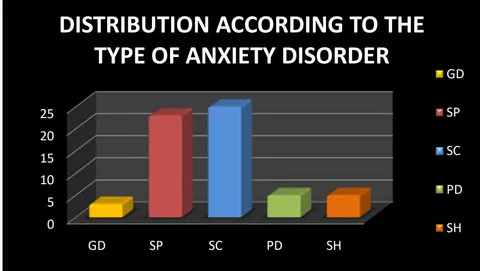
The most commonly identified type of anxiety disorder was social anxiety, which includes specific social phobias, and separation anxiety disorder. An inter anxiety co-morbidity was seen in most of the cases.
The majority of the cases have a learning disabilities, attention deficit disorder, and nocturnal enuresis. Other co-existing conditions were attention deficit hyperactivity disorder, epilepsy, intellectual disability, oppositional defiant disorder, and cerebral palsy (Table 7, Figure 4). In most of the cases, these comorbid conditions can be a causative or risk factor of anxiety disorder. Therefore managing anxiety disorders can also improve the co-morbid conditions simultaneously.
Out of 30 cases, two patients were given Lycopodium clavatum, two patients with Carcinosinum, four patients were given Calcarea Carbonica, one patient with Cuprum metallicum, one patient with Tuberculinum, three patients with Silicea terra, four patients with Calcarea phosphorica, three patients with
Natrum muriaticum, four patients with Phosphorous, one patient with Tarentula, two patients with Arsenicum album, one patient with Opium, one patients with Baryta carbonica, and one patient was given Natrum sulphuricum. According to the remedy analysis, the individualized Homoeopathic medicines are effective in managing anxiety disorders in children. Among these medicines, Calcarea Carbonica, Calcarea phosphorica, and Phosphorus are the mostly used remedies (Table 8). The improvement is assessed after a duration of 3 - 6 months after Homoeopathic treatment using individualized Homoeopathic medicines.
Out of 30 cases, nine patients (30%) had marked improvement, ten patients (33.33%) had moderate improvement, and eleven patients (36.66%) had mild improvement (Table 9, Figure 5).
V. CONCLUSION
The following conclusions are drawn from the study:
The majority of patients belong to age groups 6 – 8 years (40%) and 9 – 11 years (30%).
There is no sex difference according to the study's prevalence of anxiety disorders in children.
Out of 30 patients, the number of patients from average socio-economic status was fourteen (46.66%), from below-average socio-economic status were three (10%), and above-average socio-economic status were thirteen (43.33%).
In the study the probable risk factors identified were antenatal, natal, environmental and developmental delay as risk factors. Twelve patients (40%) have antenatal risk factors, eighteen patients (60%) have natal risk factors, six patients (20%) have environmental risk factors, seven patients (23.33%) have developmental delay and, six patients (20%) have unknown probable risk factors. Out of 30 cases, twelve patients (40%) have antenatal risk factors. Out of the twelve patients, ten of them had antenatal maternal emotional stress as a risk factor.
The majority of patients had a score 26 – 30 and 16 -20 with a percentage 30% and 26.66%, respectively.
The type of anxiety disorder more prevalent in the study was social anxiety and separation anxiety disorder, with a percentage of 83.33% and 76.66%, respectively.
The most common co-morbidity identified in the study was learning disability (23.33), attention deficit disorder (16.66%), and nocturnal enuresis (16.66%).
The Individualized Homoeopathic medicine was given, and the mostly used remedies were Calcarea carbonica, Calcarea phosphorica, and Phosphorus.
The concept of disease in Homoeopathy is of prime importance in the Homoeopathic system. It stresses the importance of individuality of a person as a whole.
Results of the study suggest that the individualistic approach of Homoeopathy was found effective in the management of anxiety disorders in school going children. Also, studies have proven that Homoeopathic medicines are effective as Psychological medicine.
APPENDIX Screen For Child Anxiety Related Emotional Disorders (Scared)
| 0Not true or hardly ever true | 1Somewhat true or sometimes true | 2Very true or often true | |
| 1. When I feel frightened, it is hard to breath | |||
| 2. I get headache when I am at school | |||
| 3. I don't like to be with people I don't know well | |||
| 4. I get scared if I stay away from home | |||
| 5. I worry about other people liking me | |||
| 6. When I get frightened, I feel like passing out | |||
| 7. I am nervous | |||
| 8. I follow my mother or father wherever I go | |||
| 9. People tell me that I am nervous | |||
| 10. I feel nervous with people I don't know | |||
| 11. I get stomachaches at school | |||
| 12. When I get frightened I feel like I am going crazy | |||
| 13. I worry about sleeping alone | |||
| 14. I worry about being as good as other kids | |||
| 15. When I get frightened, I feel like things are not real | |||
| 16. I have nightmares about something bad happening to parents | |||
| 17. I worry about going to school | |||
| 18. When I get frightened, my heart beats fast | |||
| 19. I get shaky | |||
| 20. I have nightmares of something bad happening to me | |||
| 21. I worry about things working about me | |||
| 22. When I get frightened, I sweat a lot | |||
| 23. I am a worrier | |||
| 24. I really get frightened for no reason at all | |||
| 25. I am afraid to be alone at home | |||
| 26. It is hard for me to talk with people I don't know well | |||
| 27. When I get frightened I feel like choking | |||
| 28. People tell me that I worry too much | |||
| 29. I don't like to be away from family | |||
| 30. I am afraid of having anxiety (or panic) attacks | |||
| 31. I worry that something bad might happen to my parents | |||
| 32. I feel shy with people I don't know well | |||
| 33. I worry about what is going to happen in future | |||
| 34. When I get frightened I feel like throwing up | |||
| 35. I worry about how well I do things | |||
| 36. I am scared to go to school | |||
| 37. I worry about things that have already happened | |||
| 38. When I get frightened, I feel dizzy | |||
| 39. I feel nervous when I am with other children or adults and I have to do something while they watch me(for example: read aloud, speak, 40. play a game, play a sport) | |||
| 41. I feel nervous when I go to parties, dances, or any place where there will be people that I don't know well | |||
| 42. I am shy |
Scoring:
A total score of 25 may indicate the presence of an Anxiety Disorder. Scores higher than 30 are more specific. TOTAL =
A score of 7 for items 1, 6, 9, 12, 15, 18, 19, 22, 24, 27, 30, 34, 38 may indicate Panic Disorder or Significant Somatic Symptoms. PN =