
I. INTRODUCTION
The hospitality hotel industry is one of the most affected by the covid-19 pandemic. Not only many people lost their jobs in the hotel industry, but they have also seen significant changes in the way jobs should develop. The impact of employees in the hospitality hotel industry investigates the various ways workers are exposed during and after the narrative begins with a discussion of how badly the hospitality hotel industry has been hit in more counties than others, including – India, Europe, China.
The covid 19 pandemic has fundamentally changed the world. The restaurant hotel industry has been hit the hardest by the covid impact. Despite researchers searching every possible way to put the hotel industry in such next level form. The Paper is been introduced to understand the new trends new changes in the food and beverage service hotel industry what all new innovations have been developed what all will be coming next in future the covid has taken the hotel industry far ahead in future what all new technologies been introduced might have not adapted yet but due to pandemic and the social distancing make us to do things which are very new and hygienic.
II. OBJECTIVES
To identify the new trends of the Food and Beverage industry.
To analyze the impact of covid 19 in the hotel industry and especially Radisson Blu.
III. LITERATURE REVIEW
This study focuses on the new trends and changes in the food and beverage service hotel industry. There are few literature reviews: According to Mr. Mukhles M. AL- ababneh from Al- Hussein bin Talal university who has done research on achieving service recovery through service innovation in the hotel industry, he said many things that can be achieved by enhancing the service quality such as establishing customer satisfaction, customer loyalty, service innovation.
Ms. Ruhi from IFTM University who has done research on reshaping the hotel industry with artificial intelligence (AI) and robotics technology, this project contributes and shares the knowledge about how the hotel industry is going towards artificial intelligence and robotics in the future.
Mr. Rakesh Dani from graphic era university and Mr. Yashwant Singh Rawal from amity university has done research on Impact of new innovations in food and beverage service hotel industry, how robotics and AI is taking place in the hotel industry as a new era of food and service hotel industry companies like caféX, Zume pizza, Robot themed restaurants are taking a step towards the latest technology and how the covid-19 has put the hotel industry in future so fast.
Mr. Yashwant Singh Rawal from Amity university and Mr. Rakesh Dani from Graphic era university has done the research on next generation trends in food and beverage service sector, like how hotel industry embrace sustainability and environment, how beverage sector is taking a step towards the shots, stick packs, ready to drink teas, enhanced water
This study is done by Mr. Kyung Hwa Seo and Mr. Jee hye Lee on the topic of the emergence of service robots and restaurants: integrating trust perceived risk and satisfaction, they have researched over how the robotics and artificial intelligence takes place and works instead of humans, how well they can perform and will there be some risk as the robotics will be pre-programmed.
IV. METHODOLOGY
My project is based on majorly primary data like questionnaire and field survey and some sort of secondary data as well, mainly collected from the books and by my colleagues where as every data is analysed. I have collected more from the books colleagues & ground surveys with my own and very less from the websites and pre research done by the professors and researchers.
V. NEW TRENDS IN FOOD & BEVERAGE INDUSTRY POST COVID 19
a) The Shortage of
The biggest shift in the restaurant hotel industry in the post covid world is labour shortage. As the restaurants reopens and they need a fresh start many of the restaurants find a shortage of fully staffed restaurant. Many employees still see the industry as a risk-taking job that is why there's shortage of employees in the restaurants.
b) Future restaurant business
Restaurant business is not just a post-pandemic issue because traditional business has been in question for decades. How do restaurants need to change to move forward?
c) Transparency and communication
There will be a hyper awareness of safety and sanitation on the part of consumers in the post pandemic world
d) Innovation and creativity
Many restaurants and bars have introduced service extensions such as delivery take away options, most of the companies are going towards health and immunity, next generation plant-based options. These off-premises have been adapted by the consumer widely
e) Contactless technology and virtual presence
Contactless payments method in the hospitality industry allows the guest to pay without touching anything just with his own card. Contactless delivery allows the guest to take the delivery of food with a contactless method. Contactless delivery & payments method took the industry on the future technology which we couldn't adapt so easily the covid made us to use it.
f) The new
The covid 19 outbreak created a situation that people had never seen before; ushering in a new normal era after the term "covid19" was coined. Because of the pandemic, the before and after corona eras were separated.
g) Contactless purchasing
Most notably, the increase in food service purchasing using untact methods has been observed; the observation has clearly stated that people are more inclined towards contact or contactless services to minimise human contact.
h) Food technology is accelerating
Food technology has accelerated as a result of covid 19 Robotics in food service operations has grown significantly, with many cafes such as Briggo in The United States and lounge X in Korea.
i) Consumer perspective
Consumers in the food service industry have gone through and will continue to go through tremendous changes as a result of covid, Due to covid restrictions on in-dining food service during the pandemic, customers have been unable to enjoy in-dining experiences, though even in the absence of government restrictions, some customers are still hesitant to in-dining due to the possibility of covid transmission.
j) Changes post pandemic
Food service researchers should pay attention to which of the mentioned factors will remain even after the pandemic has passed, such as robotic service and some cleaning and sanitization practises
k) Employee's perspective
The pandemic has revealed a high level of risk embedded in the food service Industry in terms of job security from an employee's perspective. The food service industry has been one of the hardest hit sectors of the economy by the pandemic. Because the food service Industry is notorious for having a high employee turnover rate.
i) Plant based food
Veganism remains popular, with a large market potential as consumers seek healthier lifestyles. As celebrities, celebrity chefs and supermarkets fill the aisles to promote meat-and dairy free diets, the trend is also leveraging the power of the internet to spread the word: Veganuary, a vegan website, offers tips on how to live well without sacrificing taste, as well as educating consumers on balanced diets.
j) Thrive on creativity
According to food consultant and freelance writer David Yip, as most businesses focus on recouping profits and cutting operational costs, the dining trends that emerge will be those that strike a balance between creativity and profitability. In fact, during the pandemic, the industry responded quickly, for example, by extending lunch and dinner hours and sticking to shorter menus.
Chefs, sommeliers, and mixologists interacted with their guests via virtual dining experiences. Some restaurants and bars "co-work" in the same space, combining their businesses into a single dining experience, which helps to offset rent costs and marry the strengths of their businesses.
k) Ghost kitchens
What exactly is a host kitchen, and is it a viable option? Ghost kitchens rely on food delivery, another hot trend that will continue in 2022. A ghost kitchen is a restaurant that only operates from its kitchen and has no dining area. Ghost kitchens were first introduced in the city where the property rent is so much that a restaurant is impossible to be profitable without a substantial financial backing.
l) Improved packaging
With the increase in food delivery due to covid-19 pandemic, takeout containers and other forms of delivery packaging have seen a significant increase in use. Because delivery packaging is now such an important part of the food service industry expect restaurants to improve their packaging options throughout the year. This year, expect restaurants to improve their delivery packaging by increasing durability, making it reheatable, and using less wasted space to better fit food items.
m) Health-conscious menu will dominate
With an increasing customer preference for a health-conscious diet, the restaurant industry must adapt by adding dishes catering to their health-conscious guests. younger generations are willing to pay more for healthy meals that include buzzwords like GMO-free, all-natural, organic. The rise of vegan cuisine is one recent trend that the hotel industry must catch up with people eating less meat year after year, vegan cuisine is no longer limited to those on full vegan diets, and as a variety expands, it's becoming more appealing to those on flexitarian, vegetarian and even omnivores
VI. DATA ANALYSIS AND INTERPRETATION
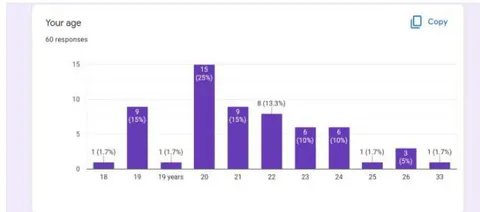
According to the survey 1.7% people are of age group 18 15% are of 19 25% are of 20 15% are of 21 13.3% are of 22 10% are of 24 1.7% are of 25 5% are of 26 and 1.7and% are of 33 age group.
VII. CONCLUSION
The covid 19 has resulted in a massive change in the hotel industry and pushed it into the future and trends overall economy and society. The way people are ordering the food through the drive through and online orders as well. We learned a lot more about the future by this project, about AI and robotics. I tried my level best to provide the most of the information about the topic and to tell the new trends and what all can come in future. However, the hotel industry is coming back to life and we are putting our best efforts into the hotel industry for the comeback. We have learnt how people have inclined more towards hygiene and sanitation more towards the quality rather than quantity.