Loading menu…

A Comparative Study of the Educational Practices and Competencies of Teachers in the United States and Guatemala in Teaching Reading

Send Message

To: Author

A Comparative Study of the Educational Practices and Competencies of Teachers in the United States and Guatemala in Teaching Reading

Article Fingerprint

ReserarchID

3WXX1

A Comparative Study of the Educational Practices and Competencies of Teachers in the United States and Guatemala in Teaching Reading Banner

Key Research Insights

Synthesized scholarly intelligence & interactive research assistant
  • English
  • Afrikaans
  • Albanian
  • Amharic
  • Arabic
  • Armenian
  • Azerbaijani
  • Basque
  • Belarusian
  • Bengali
  • Bosnian
  • Bulgarian
  • Catalan
  • Cebuano
  • Chichewa
  • Chinese (Simplified)
  • Chinese (Traditional)
  • Corsican
  • Croatian
  • Czech
  • Danish
  • Dutch
  • Esperanto
  • Estonian
  • Filipino
  • Finnish
  • French
  • Frisian
  • Galician
  • Georgian
  • German
  • Greek
  • Gujarati
  • Haitian Creole
  • Hausa
  • Hawaiian
  • Hebrew
  • Hindi
  • Hmong
  • Hungarian
  • Icelandic
  • Igbo
  • Indonesian
  • Irish
  • Italian
  • Japanese
  • Javanese
  • Kannada
  • Kazakh
  • Khmer
  • Korean
  • Kurdish (Kurmanji)
  • Kyrgyz
  • Lao
  • Latin
  • Latvian
  • Lithuanian
  • Luxembourgish
  • Macedonian
  • Malagasy
  • Malay
  • Malayalam
  • Maltese
  • Maori
  • Marathi
  • Mongolian
  • Myanmar (Burmese)
  • Nepali
  • Norwegian
  • Pashto
  • Persian
  • Polish
  • Portuguese
  • Punjabi
  • Romanian
  • Russian
  • Samoan
  • Scots Gaelic
  • Serbian
  • Sesotho
  • Shona
  • Sindhi
  • Sinhala
  • Slovak
  • Slovenian
  • Somali
  • Spanish
  • Sundanese
  • Swahili
  • Swedish
  • Tajik
  • Tamil
  • Telugu
  • Thai
  • Turkish
  • Ukrainian
  • Urdu
  • Uzbek
  • Vietnamese
  • Welsh
  • Xhosa
  • Yiddish
  • Yoruba
  • Zulu
Reading Preferences
Font Size
Line Spacing
Background
This converted HTML version may contain rendering inconsistencies. Please refer to the PDF for the authoritative version, or click here to provide feedback.

Abstract

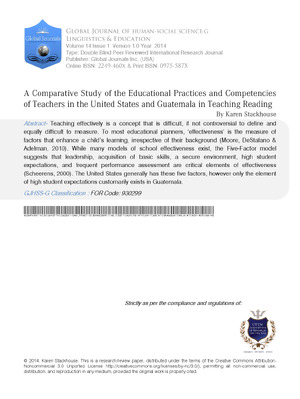
Teaching effectively is a concept that is difficult, if not controversial to define and equally difficult to measure. To most educational planners, ‘effectiveness’ is the measure of factors that enhance a child’s learning, irrespective of their background (Moore, DeStafano & Adelman, 2010). While many models of school effectiveness exist, the Five-Factor model suggests that leadership, acquisition of basic skills, a secure environment, high student expectations, and frequent performance assessment are critical elements of effectiveness (Scheerens, 2000). The United States generally has these five factors, however only the element of high student expectations customarily exists in Guatemala.

References

37 Cites in Article
  1. 1. M. Adams (1990). Beginning to Read: Thinking and Learning About Print. Cambridge
  2. 2. D. Barone (2006). Narrowing the literacy gap: what works in high-poverty schools.
  3. 3. K. Bush,D. Saltarelli (2000). The two faces of education in ethnic conflict: Towards a peacebuilding, education for children. The two faces of education in ethnic conflict: Towards a peacebuilding, education for children
  4. 4. California Department of Education (1995). The California Task Force on Reading: Every Child a Reader.
  5. 5. Central Intelligence Agency (2010). The World Factbook: Guatemala. Updated December
  6. 6. Central Intelligence Agency (2010). The World Factbook: United States. The World Factbook
  7. 7. C. Copple,S. Bredekamp (2006). Basics of developmentally appropriate practice. NAEYC, Washington D.C
  8. 8. Kendra Dupuy (2008). Education in peace agreements. Conflict Resolution Quarterly, 26(2), 149-166.
  9. 9. I. Fountas,G. Pinnell (1996). Guided reading: Good first teaching for all children. Portsmouth, NH: Heinemann
  10. 10. J. Funk (2008). Creating a literacy-rich environment. Early Childhood News
  11. 11. H. Garner (1993). Multiple intelligences: The theory in practice. A reader.
  12. 12. Guatemala Literacy Project (2010). Rotary Club of Ephrata, WA.
  13. 13. Guatemala Reading Association (2011). Guatemala City, Guatemala.
  14. 14. Meike Heckt (1999). Mayan Education In Guatemala: A Pedagogical Model And Its Political Context. International Review of Education, 45(3-4), 321-337.
  15. 15. V. Jacobs (2002). Reading, writing, and understanding. In R.D. Robsinson (Ed.). Readings in reading instruction: Its history, theory, and development, 170-177.
  16. 16. Susanne Jonas (2000). Democratization Through Peace: The Difficult Case of Guatemala. Journal of Interamerican Studies and World Affairs, 42(4), 9-38.
  17. 17. Jeanne Liuzzo-Jeup (2011). Director of Training for the Institute for Multi-Sensory Education. Northville, MI
  18. 18. E. Meyer (2008). Literacy education in Guatemala: The challenge of resources. McMaster School for Advancing Humanity
  19. 19. A. Moore,J. DeStefano,E. Adelman (2010). Using opportunity to learn and early grade reading fluency to measure school effectiveness in Ethiopia, Guatemala, Honduras, and Nepal.
  20. 20. P. Moore (2005). New essentials for teaching reading in pre-K-2.
  21. 21. Ira NAEYC (1998). Learning to read and write: Developmentally appropriate practices for young children. Young Children, 53(4), 30-46.
  22. 22. National Literacy (2011). Literacy Statistics. Literacy Statistics
  23. 23. National Progress (2010). Literacy Statistics. Literacy Statistics
  24. 24. A. Nilsen,D. Nilsen (2003). Vocabulary development: Teaching vs. testing. In R.D. Robsinson (Ed.). Readings in reading instruction: Its history, theory, and development, 196-204.
  25. 25. M. Novelli,M. Cardozo (2008). Conflict, education and the global south: New critical directions. International Journal of Educational Development, 28(4), 473-488.
  26. 26. J. Paulson,J. Rappleye (2007). Education and conflict: Essay review. International Journal of Educational Development, 27, 370-347.
  27. 27. P. Rose,M. Greeley (2006). Education in fragile states: Capturing lessons and identifying good practice.
  28. 28. D. Russell (1961). Reading research that makes a difference. In R.D. Robsinson (Ed.). Readings in reading instruction: Its history, theory, and development, 2-6.
  29. 29. J. Scheerens (2000). Improving school effectiveness.
  30. 30. P. Shannon (1989). Broken promises: Reading instruction in twentieth-century America. Granby, MA: Bergin & Garvey
  31. 31. A. Smith (2005). Education in the twenty‐first century: Conflict, reconstruction and reconciliation. Compare: A Journal of Comparative and International Education, 35(4), 379-391.
  32. 32. C. Smith (1990). Guatemalan Indians and the State.
  33. 33. N. Smith (2002). American reading instruction. (Special Ed.). Newark
  34. 34. E. Thorndike (1914). The measurement of ability in reading. Teachers College Record, XV, 1-71.
  35. 35. Edward Thorndike (1917). Reading as reasoning: A study of mistakes in paragraph reading. Journal of Educational Psychology, 8(6), 323-332.
  36. 36. E. Thorndike (1927). The teacher’s word book 30,000 words.
  37. 37. K. Tomasevski (2004). Manual on rights-based education: Global human rights requirements made simple. Asia and Pacific Regional Bureau for Education

Funding

No external funding was declared for this work.

Conflict of Interest

The authors declare no conflict of interest.

Ethical Approval

No ethics committee approval was required for this article type.

Data Availability

Not applicable for this article.

How to Cite This Article

Karen Stackhouse. 2014. "A Comparative Study of the Educational Practices and Competencies of Teachers in the United States and Guatemala in Teaching Reading". Global Journal of Human-Social Science - G: Linguistics & Education GJHSS-G Volume 14 (GJHSS Volume 14 Issue 4 (G1)).

More Citation Formats

Download Citation

Journal Specifications

Crossref Journal DOI 10.17406/GJHSS

Print ISSN 0975-587X

e-ISSN 2249-460X

Keywords
Classification
GJHSS-G Classification FOR Code: 930299
Version of record
v1.2

Issue date
January 30, 2014

Language
English
Order Article Reprint
Experience in AR

Explore published articles in an immersive Augmented Reality environment. Our platform converts research papers into interactive 3D books, allowing readers to view and interact with content using AR and VR compatible devices.

Read in 3D

Your published article is automatically converted into a realistic 3D book. Flip through pages and read research papers in a more engaging and interactive format.

Article Matrices
Total Views: 2.1K
Total Downloads: 123
All Trends

Request Access

Please fill out the form below to request access to this research paper. Your request will be reviewed by the editorial or author team.
X

This is the heading

Lorem ipsum dolor sit amet, consectetur adipiscing elit. Ut elit tellus, luctus nec ullamcorper mattis, pulvinar dapibus leo.

High-quality academic research articles on global topics and journals.

A Comparative Study of the Educational Practices and Competencies of Teachers in the United States and Guatemala in Teaching Reading

Karen Stackhouse
Karen Stackhouse