
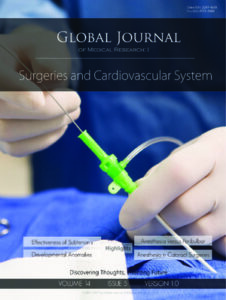
A Comparison Study of Complication Rates a To PICC or to CVC?

Article ID

0L05E

A Comparison Study of Complication Rates a To PICC or to CVC?

Hilman Harryanto
Hilman Harryanto
Krishanth Naidu
Krishanth Naidu THE CANBERRA HOSPITAL
Bella Nguyen
Bella Nguyen
David Hardman
David Hardman
DOI

Abstract

Background: Cost-effective, safe and dependable central venous access is fundamental in the care of anpatients. This study sets out to compare the complication rates between electively insertedperipheral (PICCs) and central venous cathethers (CVCs) in operating theatres. Methods: A retrospective clinical audit was undertaken. Complications included in this study are: malposition events, thrombotic/thrombophlebitis, infectio n and dysfunctio n. Results: A total of 189 patients met the inclusion cr iteria. Malpositioning of the catheter tips and thrombotic/thrombophlebitic events more often occurred after PICCs insertion than CVCs. There was no statistical difference in the catheter associated infection and dysfunctio n rate for PICCs and CVCs. The highest number of complications occured in the first 7 indwelling days. Conclusion: This study highlights that the potential advantages of reduced expected cost- and labour- effectiveness of PICCs as traditionally perceived, may be inaccurate, and further awareness of complications associated with PICCs need to be considered.

A Comparison Study of Complication Rates a To PICC or to CVC?

Background: Cost-effective, safe and dependable central venous access is fundamental in the care of anpatients. This study sets out to compare the complication rates between electively insertedperipheral (PICCs) and central venous cathethers (CVCs) in operating theatres. Methods: A retrospective clinical audit was undertaken. Complications included in this study are: malposition events, thrombotic/thrombophlebitis, infectio n and dysfunctio n. Results: A total of 189 patients met the inclusion cr iteria. Malpositioning of the catheter tips and thrombotic/thrombophlebitic events more often occurred after PICCs insertion than CVCs. There was no statistical difference in the catheter associated infection and dysfunctio n rate for PICCs and CVCs. The highest number of complications occured in the first 7 indwelling days. Conclusion: This study highlights that the potential advantages of reduced expected cost- and labour- effectiveness of PICCs as traditionally perceived, may be inaccurate, and further awareness of complications associated with PICCs need to be considered.

Hilman Harryanto
Hilman Harryanto
Krishanth Naidu
Krishanth Naidu THE CANBERRA HOSPITAL
Bella Nguyen
Bella Nguyen
David Hardman
David Hardman

No Figures found in article.

Krishanth Naidu. 2014. “. Unknown Journal GJMR-I Volume 14 (GJMR Volume 14 Issue I5): .

Download Citation

Journal Specifications
Classification
Not Found
Article Matrices
Total Views: 4204
Total Downloads: 2148
2026 Trends
Research Identity (RIN)
Related Research
Our website is actively being updated, and changes may occur frequently. Please clear your browser cache if needed. For feedback or error reporting, please email [email protected]

Request Access

Please fill out the form below to request access to this research paper. Your request will be reviewed by the editorial or author team.
X

Quote and Order Details

Contact Person

Invoice Address

Notes or Comments

This is the heading

Lorem ipsum dolor sit amet, consectetur adipiscing elit. Ut elit tellus, luctus nec ullamcorper mattis, pulvinar dapibus leo.


High-quality academic research articles on global topics and journals.

A Comparison Study of Complication Rates a To PICC or to CVC?

Hilman Harryanto
Hilman Harryanto
Krishanth Naidu
Krishanth Naidu THE CANBERRA HOSPITAL
Bella Nguyen
Bella Nguyen
David Hardman
David Hardman

Research Journals






























































