
I. INTRODUCTION
This research focuses on private institutions that offer foreign degrees. It is particularly significant for understanding student retention, as the factors influencing retention are not yet well understood. While previous studies have explored various aspects of this issue, they have often approached it from different angles. Researchers have investigated methods to reduce student dropout rates, and many countries have made significant strides toward inclusive education by adapting their educational practices and strategies (Mittler, 2000, p. 53; Farooq, 2013). This study aims to develop a conceptual model to better understand the factors affecting student retention in higher education institutions that offer foreign degrees, particularly in the context of Sri Lanka's economic crisis.
Understanding these underlying factors is crucial for authorities to propose effective solutions. Student satisfaction is a key issue for organizational progress; in the context of universities, students are considered customers, and their satisfaction is critical for institutional success (Ali et al., 2016). The goal of this research is to create a conceptual framework that can guide future studies. Specifically, the study will review both theoretical and empirical literature, compare and contrast existing models, and evaluate their strengths and weaknesses. Ultimately, the aim is to develop the most effective conceptual model for future research.
In Spain, factors such as teaching staff, teaching methods, and course administration significantly impact student satisfaction levels (Weerasinghe & Dedunu, 2017). Additionally, Weerasinghe and Fernando (2018) found that university facilities are the most influential factor in student satisfaction. This study will investigate the primary factors affecting student retention in foreign degree programs during the economic crisis and assess how the downturn has impacted students' ability to continue their studies. Identifying these factors is essential for policymakers and educational administrators to address student challenges and implement effective support measures. The goal is to provide insights that will inform policies aimed at improving student retention and success.
In Sri Lanka, higher education is overseen by the Ministry of Higher Education, which includes state universities and higher education institutes. There are also non-government and semi-government universities and higher education institutions in the country. The Ministry of Higher Education, along with regulatory bodies such as the University Grants Commission, oversees and regulates these institutions (Vigashini, 2022). This study specifically focuses on higher education institutions in Sri Lanka that offer foreign degrees, excluding other types of institutions. It will analyze student retention trends during the economic crisis, recognizing that these trends may differ under normal circumstances. The study will be limited to current students and will not address new enrollments or other student categories. The paper will begin with a review of relevant literature, followed by a description of the research methodology. Subsequent sections will present the findings, discuss their implications, and offer recommendations based on the research.
II. PROBLEM STATEMENT
The research problem is closely related to the Theory of Planned Behavior (TPB) proposed by Ajzen (1985). TPB is a psychological theory that connects beliefs to behavior, suggesting that three core components- attitudes, subjective norms, and perceived behavioral control collectively shape individual behavioral intentions. This study aims to develop a conceptual framework to identify the factors influencing student retention in higher education institutions offering foreign degrees in Sri Lanka, especially during the ongoing economic crisis.
Recently, Sri Lankan higher education institutions have experienced a significant decline in student numbers, partly due to unmet expectations of these institutions (Rameez et al., 2020, p. 341-349). The study will review various conceptual frameworks proposed by previous scholars and analyze the related theories. It will also assess the strengths and weaknesses of these models, exploring their opportunities and limitations. Unlike previous studies that focused on new enrollments, this research emphasizes current students, making it particularly relevant in the context of recent economic challenges. A survey conducted by Save the Children in July 2022 found that over of families in Sri Lanka face food insecurity, affecting their children as well (Chia et al., 2022). The economic downturn has shifted priorities for students, parents, and graduates, revealing a clear research gap that this study intends to address.
The objective is to develop a conceptual model for future research, though the specific variables to be included are still under consideration. The study will examine independent, dependent, intervening, and moderating variables, drawing on relevant theories and previous research. The research is specifically focused on higher education institutions in Sri Lanka that offer foreign degrees.
III. LITERATURE REVIEW
Sri Lanka is well-regarded for its relatively strong education system, as indicated by its high literacy rate. Formal education begins at age six and continues for an additional thirteen years. Students must pass the Ordinary Level examination in grade ten to choose a stream for their Advanced Level studies, after which they proceed to tertiary education. Higher education in Sri Lanka is provided by both government and private institutions. While private institutions charge tuition fees, government education is generally free, though some specialized courses may require payment. Quality in higher education extends beyond just attending lectures. The availability of university facilities such as libraries, Wi-Fi, common study areas, and computer labs- is crucial for student satisfaction (Zhai et al., 2017). Specialized courses may require additional resources like laboratory facilities and industrial training, which necessitate expensive equipment and well-trained personnel. Access to library resources, internet facilities, hostels, and sanitary services also supports students' academic needs. Providing these resources requires substantial funding. Government universities receive their funding from the national treasury, while private institutions rely on tuition fees.
The ongoing economic crisis has profoundly impacted the Sri Lankan public. The pandemic led to campus closures starting in March 2020, followed by lockdowns and social distancing measures (Majumdar, 2022). The country's bankruptcy declaration by the central bank resulted in job losses and shortages of essential items such as food, medicine, and fuel. Education was not prioritized during this crisis. Intermittent curfews and strikes further disrupted the education system, causing extended closures of schools and universities. As family incomes fell and living expenses soared, the government imposed various taxes, forcing people to focus on essential needs and neglect education.
During the economic crisis, many students in higher education faced new challenges. Frequent power cuts began in December 2021, despite government assurances about petroleum reserves (Jayasuriya, 2022; Arai, 2022). Import difficulties due to the Ukraine-Russia war and insufficient foreign currency exacerbated the situation (Tharoor, 2022; Arai, 2022).
Prices for essential goods and services surged, making it difficult for students to pay course fees on time. While tuition fees were not directly increased, other expenses imposed by institutions rose significantly. Many students either postponed their courses or dropped out without notifying their institutions, leading to a waste of student effort and financial resources, as well as inefficient use of faculty time (Slate, 1994; Berelson, 1960). Some students completed their current courses but opted out of more expensive advanced courses, causing an unexpected decline in higher-level course registrations. Authorities attempted to address this decline but did not achieve the desired outcomes, as the underlying causes were not accurately identified. If the trend of discontinuation persists and preventive measures are not implemented, the impact will be felt both in the short and long term. Rogers (1969) argued that students who leave without completing their degrees reflect failures in selection, teaching, faculty-student relationships, or the academic environment. The economic, social, and potentially political repercussions will be significant, compelling authorities to address factors affecting higher education continuity. Identifying key factors will enable the development of strategies to support and improve student retention during the crisis.
Several theories can explain students' decisions to continue their studies. Lee (2010) suggests that the ongoing use of education can be understood through various theories: Expectation Confirmation Theory, the Technology Acceptance Model, the Theory of Planned Behavior, and Flow Theory. Expectation Confirmation Theory examines how satisfaction and future intentions are shaped by initial expectations and subsequent experiences (Alraimi et al., 2015). The Technology Acceptance Model posits that technology acceptance depends on users' perceptions of its usefulness and ease of use, influenced by external factors such as social influence (Venkatesh et al., 2000). The Theory of Planned Behavior encompasses three components- attitudes, subjective norms, and perceived behavioral control- that collectively shape an individual's behavioral intentions.
According to the empirical literature, several key factors influence students' decisions to pursue a doctorate in Malaysia, including rewards/opportunities, personal attributes, work-related knowledge, financial support, program structure, and social support. This study corroborates these findings, indicating that these six factors significantly impact respondents' decisions to undertake doctoral studies. However, it is worth noting that rewards/opportunities, program structure, and support exhibit high standard deviation values, which are acceptable but noteworthy. The study did not fully account for cultural or contextual factors that may affect students' choices. Elements such as socioeconomic status, cultural expectations, and regional educational policies can greatly influence students' decisions (Ng et al., 2011).
Another study indicates that both institutional and external factors affect students' decisions to pursue postgraduate studies (Koe & Saring, 2012). Institutional factors include aspects such as the university's location, affordability, reputation, academic programs, and learning resources. External factors involve influences from parents and peers, as well as the country's overall image. The findings reveal a strong positive relationship between a university's reputation and the likelihood of students enrolling in postgraduate programs. However, the study found that the influence of family and peers did not significantly impact foreign undergraduates' decisions to attend graduate school. Furthermore, this research specifically focused on the intentions of foreign undergraduates regarding graduate studies at a public university.
Harris and Halpin (2002) carried out a study examining various independent variables that affect individuals' decisions to pursue higher education. These variables included self-efficacy, locus of control, parental influence, family influence, peer influence, relative functionalism, the glass ceiling effect, teacher-student interactions, overall perceptions of college, and financial aid. The researchers employed a literature-based, rational factors approach to identify and develop these variables. The primary goal of their study was to create and validate a questionnaire designed to collect data on the factors influencing the pursuit of higher education.
a) Teacher-Student Interaction
Teacher-student interaction is essential for enhancing student satisfaction. While lecturers are primarily responsible for delivering lectures, preparing and grading assignments, and other academic tasks, students often have higher expectations from their teachers. They seek not only instruction but also acknowledgment of their efforts and personal assistance when needed. A key aspect of fostering these relationships is faculty approachability. This means that teachers should be available and accessible both inside and outside the classroom, particularly at critical moments when students need support (Kuh et al., 2005). Teachers might occasionally be asked to intervene in personal matters, which can be challenging. If managed poorly, these situations can lead to complications, but with a strategic approach, teachers can build stronger, more positive relationships with their students.
When students feel valued and supported, they are more likely to remain committed to their studies and consistently attend classes. Loyal students tend to speak positively about their lecturers and overlook minor mistakes. If lecturers handle this loyalty effectively, it can benefit the institution as well. Research shows that the more contact a student has with faculty members, the better their chances of persisting through to graduation (Pascarella & Terenzini, 2005). Loyal students can also introduce new students to the institution and share positive experiences with their families and friends.
However, fostering these relationships can add extra responsibilities to lecturers, who may already have full schedules and unchanged compensation. Therefore, management should recognize and support the additional efforts of teachers by offering appropriate appreciation, which could include both financial and non-financial incentives. While engaging closely with students is important, teachers must also maintain academic standards and uphold ethical principles, ensuring that these interactions do not compromise the quality of education.
b) Financial Aid
During an economic crisis, financial concerns often become a top priority. Both students and parents may struggle to pay course fees on time due to financial losses caused by the downturn. In response, institutions may offer financial aid, such as fee reductions or waivers. Some affiliated universities also assist by reducing or waiving royalty fees. Research suggests that a combination of loans and grants generally has a greater impact on student persistence than single grants or loans alone, although work-study programs may not be as effective in enhancing persistence as some studies have suggested (Astin, 1975; Herndon, 1981).
However, institutions themselves face financial challenges during crises, including increased costs for utilities and employee wages, which can make it difficult to significantly lower course fees. To address these challenges, institutions may offer flexible payment plans, allowing students to pay fees in installments rather than in a lump sum. For those able to pay the full amount upfront, discounted rates are often provided as an incentive.
Additionally, higher education institutions have implemented various measures to support students financially during difficult times. These measures include offering discounted payment plans for students enrolling in multiple courses, providing extra discounts for those registering for a second course at the same institution, and offering special discounts for students who refer new students to the college or university. Scholarships, both full and partial, are available based on various criteria to further assist students.
Institutions also help students secure loans by preparing necessary documents and facilitating connections with financial institutions and banks to streamline the loan application process. They accept various payment methods, including cash, checks, and credit cards.
To further support students, higher education institutions maintain dedicated finance offices that provide guidance and advice for resolving financial issues. However, it's important to note that these services are support mechanisms rather than direct financial aid.
c) Institutional Factors
Angulo-Ruiz and Pergelova (2013) proposed that institutional factors play a crucial role in influencing student retention and can impact other aspects of institutional commitment. Institutional factors refer to elements intrinsic to the institution itself, including teacher-student interactions, financial aid, program structure, and learning facilities. Key components supporting the educational process include lecture halls, computer laboratories, multimedia projectors, libraries, and computers. Additionally, general facilities such as restrooms, recreational areas, hostel accommodations, canteens, and gymnasiums are vital for student satisfaction. The institution's location and the availability of transportation options are also significant, as they affect easy access to the campus.
Institutional factors encompass not only physical facilities and infrastructure but also human resources, including both academic and non-academic staff. A teacher alone cannot guarantee student satisfaction if the institution lacks adequate infrastructure. For example, class size and class level are important factors influencing student satisfaction (Feldman, 1977). Institutions that prioritize quality often hire experienced and qualified teaching staff, which benefits students. Some institutions also invest in staff development to keep them up-to-date with advancements that can enhance the student experience. Conversely, institutions that neglect staff development may see a decline in the quality of education offered to students.
d) External Factors
External factors are those that originate outside of the institution itself. Students, who come from external environments, are influenced by two main sub-factors: student attributes and social influences. Student attributes include motivation: Motivation has a great impact on students' success (Ozen, 2017), which is the drive or inspiration that prompts students to take action, and self-efficacy, which refers to an individual's belief in their ability to perform tasks and achieve specific goals (Bandura, 1977). Social influences encompass family and peer influences. Students are often financially supported by their parents, and decisions about education are also shaped by friends and family members. Research by Koe and Saring (2012) highlights that external factors, such as country image and parental or peer influences, play a significant role in students' decisions to continue their education. In Sri Lanka, education is highly prioritized, and strong encouragement from family can significantly impact students' commitment to their studies. Additionally, peer influence is crucial, as the values and behaviors of friends can also motivate students to pursue their education further.
e) Gender
Males and females exhibit differences in physical strength, mental resilience, and emotional experiences, which extend to their thoughts, perceptions, expectations, problem-solving approaches, and skills. Gender significantly influences intentions regarding the continuation of higher education, as the expectations of males and females often differ.
In higher education, males are generally more willing to confront challenges. They tend to work independently and rely less on teachers for solutions. This contrasts with female students, who may seek more guidance from teachers and are often more dependent on this support, even after receiving advice. Additionally, female students sometimes face challenges in applying theoretical knowledge to real-life problems, though they generally have higher completion rates (Paura & Arhipova, 2014).
When it comes to financial management, females are typically more diligent. They are more likely to repay educational loans on time compared to males, who may be more resistant to settling their financial obligations. Female students usually do not explore as many alternatives for education loans, while male students are more proactive in seeking favorable loan terms. Furthermore, male students are often more willing to relocate to institutions that offer better educational opportunities, whereas female students may be more hesitant to make such moves.
f) Higher Education Continuation
Higher education continuation intention refers to a student's decision to progress to the next level of their course. Advancing in education requires a strong commitment, as students recognize that costs will rise, workloads will become more demanding, and assignments will increase in complexity. There is a notable connection between student satisfaction, retention, and institutional goals (Schertzer & Schertzer, 2004). This stage of education demands considerable effort, including exam preparation, assignment completion, and participation in oral exams. To continue, students must be highly motivated and foresee significant benefits, such as financial rewards or enhanced reputation, from completing their higher education.
Continuing in higher education presents challenges, as students often encounter new environments and peers different from those in their previous level of study. Economic factors further exacerbate these challenges. The recent economic crisis has led to a significant devaluation of currency, resulting in a sharp increase in course fees for higher education. This makes pursuing further education even more difficult for students.
IV. DEVELOPMENT OF A CONCEPTUAL MODEL
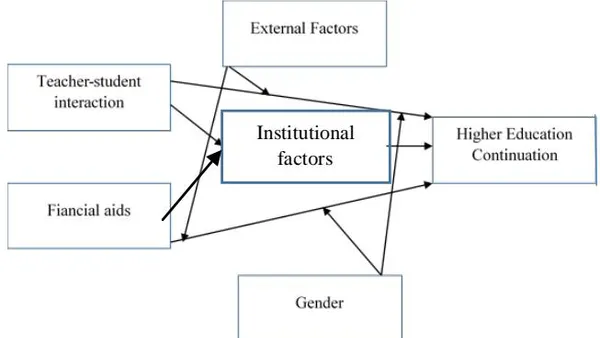
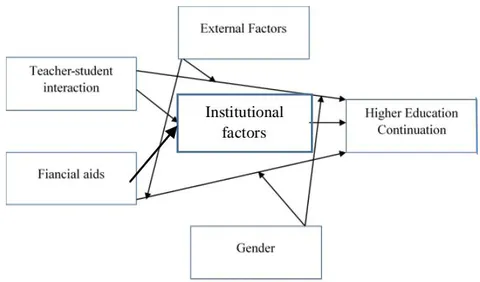
Continuing higher education presents a significant challenge for students, influenced by a variety of factors. Research identifies three major factors that notably affect students' ability to persist in higher education. First, teacher-student interaction strongly and positively correlates with students' continuing higher education. According to Kranea et al. (2017), positive relationships between students and teachers are fostered by mutual respect. Financial aid also shows a strong positive correlation with higher education continuation. Khan et al. (2011) report that economic hardship is a major reason for student dropouts. Teacher-student interaction has a notable positive correlation with institutional factors. The link between student-teacher relationships and dropout rates has been well-documented by several scholars (Lessard, Fortin, Joly, Royer, & Blaya, 2004). Financial aid is closely related to institutional factors as well, with Lindsay (2004) highlighting the strong connection between the two. Financial aid encompasses any formal financial support provided to students to cover tuition or living expenses, including loans, grants, scholarships, and work-study programs. Institutional factors influence how teacher-student interaction affects higher education continuation. Paulsen & Feldman (1995) argue that institutional and departmental cultures can shape teaching practices.
Institutional factors also mediate the relationship between financial aid and higher education continuation. St. John et al., (2000) notes that while a financial aid package may attract students to a college, it may not be sufficient to retain them if the cost of living proves challenging. External factors moderate the relationship between teacher-student interaction and higher education continuation. Liu et al. (2023) explain that students hold multiple social identities, such as being children, peers, and classmates, which influence their educational experience.
Similarly, external factors moderate the relationship between financial aid and higher education continuation. Jackson (1986) found that while the cost of college negatively impacts college choice, financial aid that reduces costs has a positive effect. The impact of teacher-student interaction on higher education continuation also varies significantly between genders. Duffy et al. (2001) discovered that gender plays a significant role in shaping the dynamics between students and teachers. Moreover, the effect of financial aid on higher education continuation differs by gender as well. Research by McDonough (1997), Jun & Colyar (2001), Plank & Jordan (2001), and Gandara (2001) indicates that family influences significantly affect students' future educational aspirations.
V. CONCLUSION
Although many factors influence continuation in higher education under normal circumstances, these factors can shift significantly during an economic crisis. Again it can be shifted when considering the higher education institutes offering only foreign degrees. According to the literature, teacher-student interaction, financial aid, and institutional factors become more prominent compared to other factors during such times. The literature further indicates that institutional factors play a mediating role in the relationships between teacher-student interaction and higher education continuation, as well as between financial aid and higher education continuation.
In typical situations, as previous research has shown, there is a positive correlation between teacher-student interaction, financial aid, and institutional factors with higher education continuation. Additionally, external factors are found to moderate the relationships between both teacher-student interaction and higher education continuation, as well as between financial aid and higher education continuation. The literature also suggests that gender has a notable moderating effect on these relationships.
The proposed model, illustrated in Figure 1, aims to further explore these dynamics in the context of understanding the factors influencing student retention in higher education institutions offering foreign degrees during Sri Lanka's economic crisis.