
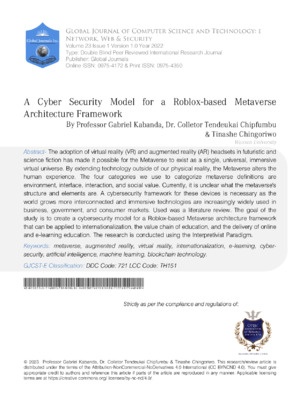

A Cybersecurity Model for a Roblox-based Metaverse Architecture Framework

1
Professor Gabriel Kabanda
2
Dr. Colletor Tendeukai Chipfumbu
3
Tinashe Chingoriwo
Tinashe Chingoriwo

Send Message

To: Author

GJCST Volume 23 Issue E1

Article Fingerprint

ReserarchID

CSTNWS81K4T

A Cybersecurity Model for a Roblox-based Metaverse Architecture Framework Banner
  • English
  • Afrikaans
  • Albanian
  • Amharic
  • Arabic
  • Armenian
  • Azerbaijani
  • Basque
  • Belarusian
  • Bengali
  • Bosnian
  • Bulgarian
  • Catalan
  • Cebuano
  • Chichewa
  • Chinese (Simplified)
  • Chinese (Traditional)
  • Corsican
  • Croatian
  • Czech
  • Danish
  • Dutch
  • Esperanto
  • Estonian
  • Filipino
  • Finnish
  • French
  • Frisian
  • Galician
  • Georgian
  • German
  • Greek
  • Gujarati
  • Haitian Creole
  • Hausa
  • Hawaiian
  • Hebrew
  • Hindi
  • Hmong
  • Hungarian
  • Icelandic
  • Igbo
  • Indonesian
  • Irish
  • Italian
  • Japanese
  • Javanese
  • Kannada
  • Kazakh
  • Khmer
  • Korean
  • Kurdish (Kurmanji)
  • Kyrgyz
  • Lao
  • Latin
  • Latvian
  • Lithuanian
  • Luxembourgish
  • Macedonian
  • Malagasy
  • Malay
  • Malayalam
  • Maltese
  • Maori
  • Marathi
  • Mongolian
  • Myanmar (Burmese)
  • Nepali
  • Norwegian
  • Pashto
  • Persian
  • Polish
  • Portuguese
  • Punjabi
  • Romanian
  • Russian
  • Samoan
  • Scots Gaelic
  • Serbian
  • Sesotho
  • Shona
  • Sindhi
  • Sinhala
  • Slovak
  • Slovenian
  • Somali
  • Spanish
  • Sundanese
  • Swahili
  • Swedish
  • Tajik
  • Tamil
  • Telugu
  • Thai
  • Turkish
  • Ukrainian
  • Urdu
  • Uzbek
  • Vietnamese
  • Welsh
  • Xhosa
  • Yiddish
  • Yoruba
  • Zulu

The adoption of virtual reality (VR) and augmented reality (AR) headsets in futuristic and science fiction has made it possible for the Metaverse to exist as a single, universal, immersive virtual universe. By extending technology outside of our physical reality, the Metaverse alters the human experience. The four categories we use to categorize metaverse definitions are environment, interface, interaction, and social value. Currently, it is unclear what the metaverse’s structure and elements are. A cybersecurity framework for these devices is necessary as the world grows more interconnected and immersive technologies are increasingly widely used in business, government, and consumer markets. Used was a literature review. The goal of the study is to create a cybersecurity model for a Roblox-based Metaverse architecture framework that can be applied to internationalization, the value chain of education, and the delivery of online and e-learning education. The research is conducted using the Interpretivist Paradigm.

Funding

No external funding was declared for this work.

Conflict of Interest

The authors declare no conflict of interest.

Ethical Approval

No ethics committee approval was required for this article type.

Data Availability

Not applicable for this article.

Professor Gabriel Kabanda. 2026. \u201cA Cybersecurity Model for a Roblox-based Metaverse Architecture Framework\u201d. Global Journal of Computer Science and Technology - E: Network, Web & Security GJCST-E Volume 23 (GJCST Volume 23 Issue E1): .

Download Citation

Secure Roblox metaverse with innovative cybersecurity architecture for virtual environments. Perfect for researchers and developers.
Issue Cover
GJCST Volume 23 Issue E1
Pg. 11- 33
Journal Specifications

Crossref Journal DOI 10.17406/gjcst

Print ISSN 0975-4350

e-ISSN 0975-4172

Keywords
Classification
GJCST-E Classification: DDC Code: 721 LCC Code: TH151
Version of record

v1.2

Issue date

August 1, 2023

Language

English

Experiance in AR

The methods for personal identification and authentication are no exception.

Read in 3D

The methods for personal identification and authentication are no exception.

Article Matrices
Total Views: 2209
Total Downloads: 24
2026 Trends
Research Identity (RIN)
Related Research

Published Article

The adoption of virtual reality (VR) and augmented reality (AR) headsets in futuristic and science fiction has made it possible for the Metaverse to exist as a single, universal, immersive virtual universe. By extending technology outside of our physical reality, the Metaverse alters the human experience. The four categories we use to categorize metaverse definitions are environment, interface, interaction, and social value. Currently, it is unclear what the metaverse’s structure and elements are. A cybersecurity framework for these devices is necessary as the world grows more interconnected and immersive technologies are increasingly widely used in business, government, and consumer markets. Used was a literature review. The goal of the study is to create a cybersecurity model for a Roblox-based Metaverse architecture framework that can be applied to internationalization, the value chain of education, and the delivery of online and e-learning education. The research is conducted using the Interpretivist Paradigm.

Our website is actively being updated, and changes may occur frequently. Please clear your browser cache if needed. For feedback or error reporting, please email [email protected]
×

This Page is Under Development

We are currently updating this article page for a better experience.

Request Access

Please fill out the form below to request access to this research paper. Your request will be reviewed by the editorial or author team.
X

Quote and Order Details

Contact Person

Invoice Address

Notes or Comments

This is the heading

Lorem ipsum dolor sit amet, consectetur adipiscing elit. Ut elit tellus, luctus nec ullamcorper mattis, pulvinar dapibus leo.


High-quality academic research articles on global topics and journals.

A Cybersecurity Model for a Roblox-based Metaverse Architecture Framework

Professor Gabriel Kabanda
Dr. Colletor Tendeukai Chipfumbu
Tinashe Chingoriwo
Tinashe Chingoriwo

Research Journals





























































