I. INTRODUCTION
The cosmological redshift is a consequence of the changing size of the universe; it is not related to velocity at all. The gravitational redshift in curved expanding spacetime is a generalization of the Doppler shift in flat spacetime to curved expanding spacetime, is the reddening of light from distant galaxies as the universe expands. In the widely accepted cosmological model based on General relativity, redshift is mainly a result of the expansion of space: this means that the farther away a galaxy is from us, the more the space has expanded in the time since the light left that galaxy, so the more the light has been stretched, the more redshifted the light is, and so the faster it appears to be moving away from us. Hubble's law follows in part from the Copernican principle. Light waves become stretched in route between the time they were emitted long ago, and the time they are detected by us today. It is tempting to refer to cosmological redshifts as Doppler shifts. By referring to cosmological redshifts as Doppler shifts, we are insisting that our Newtonian intuition about motion still applies without significant change to the cosmological arena. A result of this thinking is that quasars now being detected at redshifts of would have to be interpreted as traveling a speeds of more than or 4 times the speed of light. This is, of course, quite absurd, because we all know that no physical object may travel faster than the speed of light. To avoid such apparently nonsensical speeds, many popularizers use the special relativistic Doppler formula to show that quasars are really not moving faster than light. The argument being that for large velocities, special relativity replaces Newtonian physics as the correct framework for interpreting the world. By using a special relativistic velocity addition formula the quasar we just discussed has a velocity of 92 percent the speed of light. Although we now have a feeling that Reason has returned to our description of the universe, in fact, we have only replaced one incomplete explanation for another. The calculation of the quasar's speed now presupposes that special relativity (a theory of flat spacetime) is applicable even at cosmological scales where general relativity predicts that spacetime curvature becomes important. The special relativistic Doppler formula is introduced to show how quasars are moving slower than the speed of light! It is also common for popularizers of cosmology to describe how 'space itself stretches' yet continue to describe the expansion of the universe as motion governed by the restrictions of special relativity. By adopting general relativity as the proper guide, such contradictions are eliminated [1]. General relativity must replace special relativity in cosmology because it denies a special role to observers moving at constant velocity, extending special relativity into the arena of accelerated observers. It also denies a special significance to special relativity's flat spacetime by relegating it to only a microscopic domain within a larger geometric possibility. Just as Newtonian physics gave way to special relativity for describing high speed motion, so too does special relativity give way to general relativity. This means that the special relativistic Doppler formula should not, in fact cannot, be used to quantify the velocity of distant quasars. We have no choice in this matter if we want to maintain the logical integrity of both theories. The instantaneous physical distance is not itself observable. Cosmological 'motion' cannot be directly observed. It can only be inferred from observations of the cosmological redshift, which general relativity then tells us that the universe is expanding.
II. HUBBLE'S LAW
One of the most remarkable discoveries in twentieth century astronomy was Hubble's (1929) observation that the redshifts of spectral lines in galaxies increase linearly with their distance. Hubble took this to show that the universe is expanding uniformly, and this effect can be given a straightforward qualitative explanation in the FLRW models. The FLRW models predict a change in frequency of light from distant objects that depends directly on scale factor . There is an approximately linear relationship between redshift and distance at small scales for all the
FLRW models, and departures from linearity at larger scales can be used to measure spatial curvature. Hubble's law ( : recession velocity = Hubble's constant × distance) describes the situation: farthest objects receding fastest. It didn't explain why? Hubble himself was not entirely happy with his distance-velocity formula, which decisively contributed to the inflationary model of the universe. In the paper, jointly with Tolman, he wrote —The possibility that the redshift may be due to some other cause connected with the long time or distance involved in the passage of light from nebulae to observer, should not be prematurely neglected.[II][2]
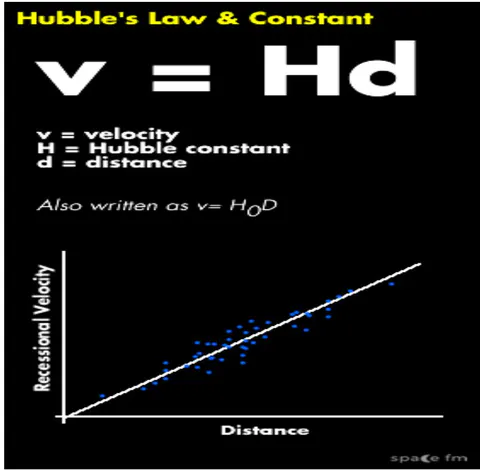
"The Hubble velocity distance rule is an interesting example how two independently correct facts, i.e. the common Doppler shift and Hubble's experimental distance vs redshift law when —marriedll together resulted in an unfortunate conclusion. This happened because the only cause of redshift that Hubble was aware, was the common Doppler shift, and thus he obtained a distance-velocity plot" [4]". In a general setting and from a logical point of view, the existence of relative velocity is a necessary but not sufficient condition to record a wavelength shift. In Euclidean geometry e.g. wavelength shift uniquely implies existence of a relative velocity while in hyperbolic geometry it does not have a unique implication. Thus while the existence of relative velocity always results in a wavelength shift, the presence of a shift may or may not imply the existence of a relative velocity. Euclidean geometry cannot induce changes in wavelength of electromagnetic radiation. The case of . In Euclidean space geodesics do not deviate. This is the case of hyperbolic space. Geodesics deviate at an exponential rate [4]. If cosmological redshift has nothing to do with the Doppler effect, how do we know that galaxies that are very far away are also receding from us? How to compare between two unrelated concepts, the Doppler redshift and the cosmological redshift? Andromeda galaxy is blueshifted because it's sufficiently nearby where the spacetime is approximately flat and special relativity dominates. Its blueshifted according to the Doppler Effect in flat spacetime. Andromeda one of about 100 blueshifted galaxies that we observe. Andromeda has a —blueshiftII. It has a negative recessional velocity of roughly -300 km/s. Andromeda's tangential or side-ways velocity with respect to the Milky Way is relatively much smaller than the approaching velocity. Locally the spacetime is flat no cosmological redshift, their blueshifts is just due to the Doppler Effect. What causes the peculiar velocity of the galaxy? Is it a free fall or something else? As you probably know, we interpret the redshifts of galaxies to mean that the universe is expanding. So if you could staple the galaxies to the 'fabric' of space, all of them would appear to be moving away from us -the farther away they are, the faster! Why? This is cheating! According to the isotropy principle our position is not preferred. Conversely the farther observer would see our nearby objects recede faster with respect to him than his nearby objects! A contradiction.
III. COSMOLOGICAL REDSHIFT PARADOX
If an isolated object is distant and redshifted from an observer, how could he decide whether it is a Doppler redshift or a cosmological redshift? Where is the border in the space strictly separating the expansion of the space from the expansion within the space. How could the photon aware weather it travels either through a cosmological path or an intergalactic path in order to experience either a cosmological redshift or a Doppler redshift, respectively?
An object O is in the middle between two objects A and B. To visualize the picture, think of the three objects as they were fixed in the fabric of the spacetime. Due to the expansion of the spacetime each object moves away from each other; as if the middle one is fixed while the two others move away from it. An observer on A would receive a cosmological redshift from B that is greater than the cosmological redshift that he received from O. Accordingly, to an observer at
A; B would recede faster than O. After a time t, the distance separating O and B would be greater than that separating A and O. Since the spacetime is isotropic, there is no preferred position. Did an observer on B agree with this picture? An observer on B, conversely, would find after time t that the distance separating O and A would be greater than that separating O and B. Whom should we believe? It would be a paradox if we believed both of them. The cosmological redshift and its consequence recession velocity are no longer a distance indicator. We must seek for another cause for the cosmological redshift? We interpret the cosmological redshift as a curvature's manifest.
Hubble's law doesn't explain why distant objects were receding fastest
Again consider a point is equidistance in between two points and . Fig.(2). If the expansion of the spacetime is doubled, i.e. would be equidistance 2d from both points and . It was mistakenly [5] calculated that the rescission velocity of from is double than that of from
Hence, we conclude: B (the furthest from A) recedes faster from A than O does.
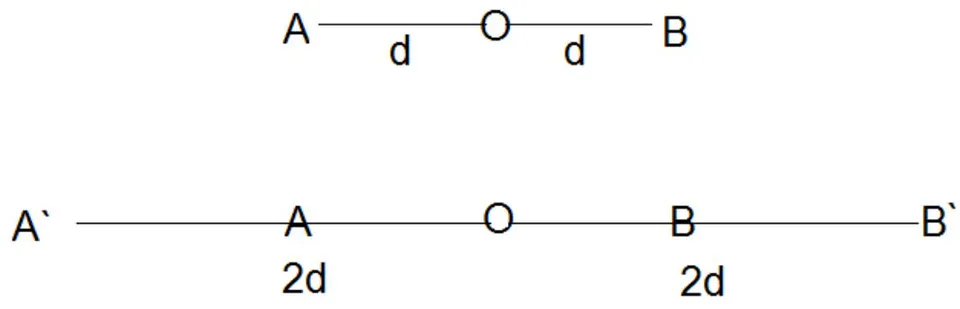
The misconception is that, B was actually shifted 3d from the original position of A, i.e.
To overcome this confusion, we visualize the previous picture from a different point of view, Fig. (3). Assume a right triangle OAB. The vertex O at the right angle d distance from the vertex A and 2d distance from the other vertex B. After time , if the vertex A recedes an additional distance d from O such that = 2 then B also will recede an additional distance d from O such that = 3, then
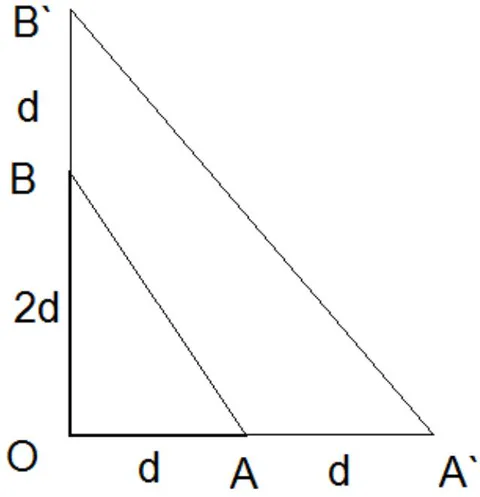
Unless there is a convincing reason led B to speed faster than A, the two points recede from O by the same velocity. If we assume priory the separating distances were doubled after time , 2) then B recedes from O faster than A. So, we conclude what we already assumed. Hubble's law doesn't explain why distant objects were receding fastest.
IV. QUASAR'S REDSHIFT IN CONFLICT WITH HUBBLE LAW
Quasars are believed to be objects ejected from the centers of the Galaxies or Black holes. According to Hubble's law, if the object is bright then its low redshifted and nearby while the distant object is faint and high redshifted. The Quasars are very bright, so why they shouldn't be nearby? Why we just accept one part from Hubble's law, that is: the high redshift of the Quasar indicates that its distant and ignored the other part, that is: the brightness of the Quasars indicate they are nearby? Finally, why our Galaxy and many other nearby Galaxies didn't eject Quasars from their centers? Why this job is exclusive for distant Galaxies? Because our Galaxy and many others nearby Galaxies are inactive, said astronomers. Why they are the inactive among the active distant Galaxies? It is clear such a paradigm is not satisfactory and insufficient, it depends on many unjustified reasons, many contradictions and inconsistent. The paradigm must be reconsidered and readjusted. The bright the Quasar, the high it's redshift and the distant it is. The bright the Galaxy the low redshift, the nearby it is. Brightest Galaxies associated with brightest Quasars, but faint Galaxies not. So, if the Quasars agree in their brightness they disagree with their redshifts. Yes, the scenario concerning the Quasars no more than speculations and guesses to fabricate suitable explanations to fit current observations. The problem relies on the similarity of the cosmological redshift to the Doppler redshift that both of them cause recession speed. The first by the expansion of the spacetime and the other by receding within the spacetime. If the high redshift of the Quasar is due to the cosmological redshift of the expanding spacetime, why it shouldn't agree and coincide with the redshift of the hosting Galaxy. The anomalous pair NGC 4319 and M 205: [16]
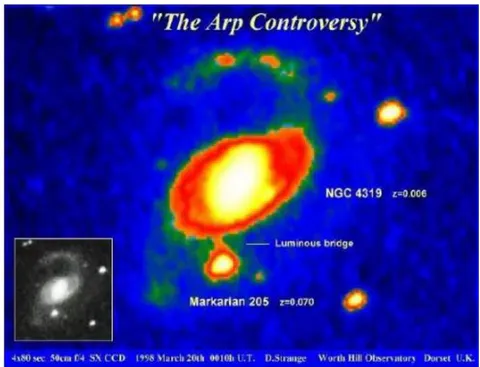
The cosmological redshift must be interpreted in a different way, as I do, as manifests the curvature of the hyperbolic spacetime. Astronomers have found many galaxy pairs and galaxy groups in which the members are evidently close to each other—even interacting—yet have redshifts that are radically at odds! Their redshifts don't make sense: If two galaxies are roughly in the same place then their measured redshifts should agree with each other, since redshift is supposed to be a measure of their distance (although the redshift may include a relatively minor Doppler component due to local motion). The observational fact that they don't is considered anomalous. The mystery is in the cause, and also why some of the anomalies are so extreme. "Locally the spacetime is flat, where special relativity together with its Doppler redshift dominates to measure peculiar velocities, there is no cosmological redshift in this case. For distant objects the spacetime is hyperbolic where the cosmological redshift manifests the curvature" [6]. For example, observations tell us that space within galaxies, which are rather diffuse objects, do not expand. Thus, where is the —border linell in space which divides expanding space from non expanding space?
V. QUASARS REDSHIFTS DON'T EXHIBIT TIME DILATION
The phenomenon of time dilation is a strange yet experimentally confirmed effect of relativity theory. One of its implications is that events occurring in distant parts of the universe should appear to occur more slowly than events located closer to us. Relativity has shown that anything causing a change in lengths (length contraction) must also affect time as well (time dilation).
Wavelength times frequency always equals the speed of the wave. For light . The inverse of the frequency is time. Hence the expanding universe produces a cosmological time dilation; as well as redshift.
For example, suppose that a clock attached to a Quasar with a very large redshift measures the frequency of a particular ultraviolet light beam, emitted within the Quasar, as cycles per second. We receive it on Earth shifted into the infrared, with a frequency cycles per second. Thus it takes 10 of our seconds for us to see the Quasar clock tick off one Quasar second. For example, when observing supernovae, scientists have found that distant explosions seem to fade more slowly than the quickly-fading nearby supernovae. However, a new study has found that this doesn't seem to be the case - quasars, it seems, give off light pulses at the same rate no matter their distance from the Earth, without a hint of time dilation. Astronomer Mike Hawkins from the Royal Observatory in Edinburgh came to this conclusion after looking at nearly 900 quasars over periods of up to 28 years. When comparing the light patterns of quasars located about 6 billion light years from us and those located 10 billion light years away, he was surprised to find that the light signatures of the two samples were exactly the same. If these quasars were like the previously observed supernovae, an observer would expect to see longer, —stretchedll timescales for the distant, —stretchedll high redshift quasars. But even though the distant quasars were more strongly redshifted than the closer quasars, there was no difference in the time it took the light to reach Earth. [7].
Quasars have redshifts variation not correlated with time dilation. The light signature of quasars located 6 billion light years from us and those 10 billion light years away were exactly the same, without a hint of time dilation. This quasar conundrum doesn't seem to have an obvious explanation. Thus the high redshifts of quasars may not necessarily represent their distances.
Further, in some observations, the redshifts have been found to exhibit some periodicity in their distributions as represented by the Karlsson formula [8].
The periodicity further makes it difficult for the redshift to represent distance. M Hawkins is very clear, his finding is that: the redshift of the Quasars do not exhibit time dilation. Moreover, he gave many suggestions [9].
It means the quasars may be nearby, not as distant as their redshifts and the Hubble law would indicate.
The origin of all matter was not at the big bang but over time in a grand ongoing creation scenario.
The Universe is not expanding.
Several explanations are discussed, including the possibility that time dilation effects are exactly offset by an increase in timescale of variation associated with black hole growth, or that the variations are caused by microlensing in which case time dilation would not be expected. [9].
In April 2010, Marcus Chown wrote in an article entitled [10] —Time waits for no quasar—even though it shouldll for New Scientist online. The edifice of the big bang hangs on the interpretation that the quasar redshifts are cosmological. If they are not: it brings into question the origin of quasars, and, it means the quasars may be nearby, not as distant as their redshifts and the Hubble law would indicate. This latter idea is linked to the work of Halton Arp [11] and others that showed strong correlation between parent galaxies that have ejected quasars from their active cores. The origin of all matter was not at the big bang but over time in a grand ongoing creation scenario. Arp [11] believed quasars were ejected from the active hearts of parent galaxies and their redshifts were largely intrinsic, not distance related. Because most of the high redshift objects in the Universe are quasars, if their redshifts are due to cosmological expansion then they are good evidence for an expanding universe. If the quasar redshifts are not reliable as a distance indicator, as Arp's hypothesis of ejection of quasars from the active cores of relatively nearby galaxies suggests, then the conclusion that the universe is expanding can be avoided. Arp, in fact, believed in a static universe [11]. The Hubble law, determined from the redshifts of galaxies, for the past 80 years, has been used as strong evidence for an expanding universe. This claim is reviewed in light of the claimed lack of necessary evidence for time dilation in quasar and gamma-ray burst luminosity variations and other lines of evidence. It is concluded that the observations could be used to describe either a static universe (where the Hubble law results from some as-yet-unknown mechanism) or an expanding universe described by the standard cold dark matter model. In the latter case, size evolution of galaxies is necessary for agreement with observations. Yet the simple non-expanding Euclidean universe fits most data with the least number of assumptions [12].
VI. TENSION BETWEEN THE VALUES OF HUBBLE CONSTANT
The Cold Dark Matter model ( CDM) represents the current standard model in cosmology. Within this, there is a tension between the value of the Hubble constant, , inferred from the local distance ladder ( ) and the angular scale of fluctuations in the Cosmic Microwave Background CMB ( ).
Universe is expanding. One camp of scientists, the same camp that won the Nobel Prize for discovering dark energy, measured the expansion rate to be , with an uncertainty of only . But a second method, based on the leftover relics from the Big Bang, reveals an answer that's incompatibly lower at , with an uncertainty of only . It's possible that one of the teams has an unidentified error that's causing this discrepancy, but independent checks have failed to show any cracks in either analysis. Instead, new physics might be the culprit. If everyone measured the same rate for the expanding Universe, there would be nothing to challenge this picture, known as standard CDM. But everyone doesn't measure the same rate. Currently, the fact that distance ladder measurements say the Universe expands faster than the leftover relic method is one of the greatest puzzles in modern cosmology. The universe is currently expanding too fast — faster than theorists predict when they extrapolate from the early universe to the present day. —If the late and early universe don't agree, we have to be open to the possibility of new physics,II. A mathematical discrepancy in the expansion rate of the Universe is now "pretty serious", and could point the way to a major discovery in physics, says a Nobel laureate; Prof Riess [13].
VII. HUBBLE CONSTANT FOR THE HYPERBOLIC UNIVERSE
Given the values of the observed average density of the universe and the cosmic horizon, we can calculate the value of the Hubble constant in the hyperbolic universe ,
We calculate Hubble constant from our hyperbolic scale factor [14], [15],
The theoretical calculated value of Hubble constant in the hyperbolic universe (without invoking Dark Matter and Dark Energy) is very consistent with the observed value inferred from the standard candles. Our Hyperbolic Universe paradigm provides a new physics resolves the tension in the values of inferred from the local distance ladder and the angular scale of fluctuations in the Cosmic Microwave Background CMB.
Hubble constant For flat universe,
The Hubble constant for flat universe with a critical energy-density, where
Note that if we assume a flat universe and we substitute the observable density of the universe to obtain Hubble constant,
VI. CONCLUSION
- Hubble's law says: the furthest object recedes faster than the nearest one. Hubble's law doesn't explain why distant objects were receding fastest. We show this is not true.
- Quasar's redshift in conflict with Hubble law.
- Quasars Redshifts Don't Exhibit Time Dilation.
- Tension between the values of Hubble constant.
- We interpret the cosmological redshift as a curvature's manifest. -
- We calculate Hubble constant theoretically due to the hyperbolic universe: agrees current observation.