
I. INTRODUCTION
In the past year, the term Metaverse got great attention [1]. At the same time, it is evident that its full implementation as an interconnected web of virtual worlds (VW) [2] is still far in the future [3]. The Metaverse can be considered the successor to the mobile internet, much like the mobile internet is regarded as the successor technology of the internet. While the mobile internet leverages existing infrastructure, it fundamentally changes how, where, when, and why we access the internet. A similar change can also be expected from the Metaverse. With emerging technologies, even with a good understanding of the field, it is often unclear what further innovations and inventions are needed to reach mass application [4].
Both science and economy require tools to assess the development status of the Metaverse and the virtual worlds comprising it. The former have to identify gaps in research and development to create a roadmap. The latter needs to identify promising development approaches and comparatively mature virtual worlds to make successful investments.
This study aims at addressing this need by presenting a maturity model for the assessment of virtual worlds. Based on a scientific definition of the Metaverse [5], eight core attributes are identified, which would make a complete Metaverse. For each of these core attributes, five maturity levels (ML) are defined.
The Metaverse core attributes derived from the definition are presented in Section 2. Each of the core attributes is explained in Section 3, which includes a depiction of the corresponding five maturity levels, too. Thus, the complete maturity model can be presented in Section 4, and in Section 5, the results of an exemplary application to the virtual world Decentraland are explained. Finally, a discussion is included in Section 6.
II. METAVERSE DEFINITION AND CORE ATTRIBUTES
The following definition of Metaverse will be analyzed in order to identify core attributes making a complete Metaverse: "The Metaverse is an interconnected web of ubiquitous virtual worlds partly overlapping with and enhancing the physical world. These virtual worlds enable users represented by avatars to connect and interact with each other, to experience and consume user-generated content in an immersive, scalable, synchronous, and persistent environment. An economic system provides incentives for contributing to the Metaverse." [5]
The notion that many virtual worlds make the Metaverse indicates that virtual worlds should be the object of maturity assessments.
The text passages of the definition translate into Metaverse core attributes as depicted in Table 1.
| Definition Passage [5] | Metaverse Core Attribute |
| "...an interconnected web..." | Interoperability |
| "...partly overlapping with and enhancing the physical world." | Physical and digital coexistence |
| ".user-generated content..." | User-generated content |
| ".immersive,..." | Immersive realism |
| ".scalable,..." | Scalability |
| ".synchronous..." | Synchronicity |
| ".and persistent..." | Persistence |
| "An economic system..." | Economy |
III. EXPLANATION OF CORE ATTRIBUTES AND MATURITY LEVELS
a) Persistence
Persistence means that the state of the virtual world is maintained indefinitely if it is not changed by a user. Specifically, this means that there are no pauses, restarts, or even an end [6]. For the persistence of a virtual platform, it is essential that the user always has access and that entering or leaving has no influence on the virtual world.
A virtual world on maturity level 1 would not be persistent. It could be turn-based and have frequent resets. ML 2 requires a VW to be accessible at almost all times, with planned resets or updates taking place sometimes. On ML 3, the VW has sometimes resets or needs to halt for updates. ML 4 means the platform is in general persistent with rare exceptions. ML 5 would mean a fully persistent virtual world.
b) Synchronicity
This attribute indicates whether users can communicate and interact with each other in real-time and whether this can be experienced worldwide or just limited to regions.
Synchronicity is fundamental to smooth social interactions. It depends to a large extent on the latency of network connections [7].
Synchronicity ML 1 corresponds to a VW without any online presence, as it is known from offline computer games. ML 2 requires real-time interactions between users, but within a limited VW space and with a limited number of users. ML 3 means users can interact live, but only within regions of the physical world. ML 4 allows all users to interact in real-time with no general limits in regions or numbers of users, but with rare exceptions when latency increases or communication pauses. ML 5 is equivalent to ML 4 without pausing or latency problems.
c) Scalability
The vision of the Metaverse comprises the idea that an unlimited number of users can experience virtual worlds simultaneously [8]. This attribute is strongly related to the computing power of the platforms running the virtual worlds as well as the bandwidth of connections [7].
The number of users, who can simultaneously use a virtual world, will measure scalability in this context. This is meant without splitting the virtual world into different instances in order to limit the number of users per instance. The relation between maturity levels and number of users can be seen in Table 2.
Table II: Scalability Maturity Levels
| Maturity Level | No. of simultaneous users in the virtual world (not split into different instances) |
| 1 | Up to 10 |
| 2 | Up to 250 |
| 3 | Up to 1000 |
| 4 | Up to 10,000 |
| 5 | No limit |
d) Physical and Digital Coexistence
This core attribute relates to interfaces connecting the virtual and physical world. Important aspects are the means for users to control their avatars and to experience the virtual world. In addition, many other interfaces can be taken into account, which connect and mirror physical objects to virtual objects in line with the idea of digital twins [9], or connections of the economic systems in the virtual and physical world, e. g., virtual currencies that can be exchanged to fiat currencies of the physical world.
The five maturity levels related to physical and digital coexistence correspond to the number of available interfaces. They are defined as follows. ML 1 represents a purely virtual world with no interfaces to the physical world beyond screen and controller-based means for the user to control an avatar. ML 2 has one advanced interface, such as virtual reality capability or a transferable currency. The third maturity level requires the VW to have several interfaces. On ML 4, in general, changes in the physical world can influence the virtual world and vice versa. ML 5 means the physical and virtual world are continuously interfacing.
e) Interoperability
While the last core attribute is related to interfaces between the physical and virtual worlds, interoperability refers to interfaces between the virtual worlds constituting the Metaverse. This is about the ability to exchange data between different VWs, enabling, for example the use of one avatar with its accessories in many or even all virtual worlds or trading virtual assets between virtual worlds. Interoperability is an essential precondition forming one Metaverse consisting of many virtual worlds [2].
The maturity levels for this core attribute relate mainly to the number of transferable components and the number of interconnected virtual worlds. ML 1 describes a virtual world without any interfaces to other VWs. A virtual world with ML 2 regarding interoperability has interfaces to make one component transferable, e.g. avatars or assets. ML 3 requires interfaces for several components, and ML 4 means that VWs have interfaces to transfer relevant components but might not be connected to all VWs in the Metaverse. This might be the case when concurring systems or interface standards evolve. On ML 5, finally, there is full interoperability between all virtual worlds.
f) User-generated Content (UGC)
Even the technologically most advanced virtual world needs to have attractive content to attract users. Such content could, for example be games, events, exhibitions, concerts, and many more. But, also assets, avatar-skins, architecture etc. could be seen as relevant content [9]. No single company will be able to compete against a platform that allows its users to create content and shape the virtual world.
Maturity level 1, in this regard is a VW that does not allow UGC. On ML 2 users have minimal possibility to change the virtual world with UGC still not being in the vendor's strategic focus. ML 3 refers to a world where users can create content, and this plays an important role. ML 4 refers to the situation in which UGC is possible in a large variety and complexity, and where the monetization of UGC is directly possible in the VW. ML 5 means that the users actually create the VW building on a given base environment. Every aspect of UGC can be monetized.
g) Economy
A fully functioning economy will be an essential aspect of the Metaverse [10]. This is true as it is the precondition to incentivize the users to create content [11] and to drive investments into a virtual world. Such an economy requires elements like, for example a virtual currency, marketplaces, or ownership registries for assets or land.
Regarding economy maturity, level 1 means that the VW has no economy. In-app or in-game purchases might be possible. A virtual world reaches ML 2 by having aspects of a virtual economy, including a virtual currency. Fiat money can be exchanged into the virtual currency. ML 3 requires an economy with self-regulating markets. Fiat money purchases are possible. ML 4 adds the aspect of virtual jobs and a job market enabling the generation of a physical world income. On ML 5, finally, a fully developed virtual economy with self-regulating markets blends with the physical economy.
h) Immersive Realism
Immersive realism is the degree to which a user feels to be drawn into the virtual world. This has aspects related to content, experiences, and interactions in a VW similar to a book or a movie. In addition, there are technical aspects to serve human sensors with optical, acoustic and haptic information [3]. With respect to this core attribute, the latter are evaluated to determine the maturity level, as they can be analyzed more objectively.
A virtual world on ML 1 in this topic does hardly provide any feeling of immersion. For example, conversations are text chat based, and avatars do not show any facial expressions. ML 2 provides little immersive experience, e.g., avatars provide a feeling of individual presence, users can act freely, and there is voice chat available. ML 3 comprises individual avatars with gestures and facial expressions increasing the immersive feeling in avatar interactions. Virtual reality (VR), 3D audio, and motion tracking capabilities foster this experience. ML 4 adds haptic feedback and high-end VR. And ML 5 represents a VW with a high level of realism, which serves all human senses, thus creating an immediate, immersive experience which can hardly be distinguished from the physical world.
IV. THE METVERSE MATURITY MODEL
After explaining the Metaverse core attributes and the characteristics of the corresponding maturity levels in Section 3, this Section presents the complete Metaverse maturity model. It is depicted in Table 3.
For the visualization of assessment results, radar charts are proposed. They are appropriate for multivariate data with more than three variables which correspond to the core attributes [12].
V. MATURITY ASSESSMENT OF DECENTRALAND
An assessment of the virtual world Decentraland using the presented Metaverse Maturity Model is shown in the following. Decentraland is a virtual world using the Ethereum blockchain as a decentral backbone [13]. Furthermore, it is governed by a decentralized autonomous organization (DAO), involving users and contributors in important decisions related to the virtual world [14].
a) Evaluation
In Decentraland, various items are persistent in the sense they exist independently from the presence or connection of a specific user. For example, parcels of land in the VW, experiences (so-called scenes in Decentraland), or assets are persistent. Some assets related to avatars, e. g. clothing, are persistently saved to the user's account. The same is true for the in-world currency called MANA [15]. According to Table 3, this high level of persistence is rated to be at ML 4.
In general, Decentraland is a real-time virtual world with moderate latency requirements. The ability for a user to interact with other users on the other hand, depends on so-called realms and islands. Decentraland is powered by several content servers, each providing realms. Within a realm, a cluster of connected avatars is called an island. Islands change dynamically as avatars join or leave depending on the proximity. Only users within the same realm and island can interact, and there is a limited number of users permitted per island [16]. But in general, communication between all users is possible and is not limited to nearby locations in the physical world. This leads to the core attribute synchronicity being on ML 4.
As outlined in the previous paragraph, the number of users per island is limited. The maximum is 100 users per island [17]. As can be seen from Table 3, the corresponding maturity level for scalability is 2.
At the time of this study, Decentraland can be accessed via a web and a desktop client only [18]. VR headsets are not supported natively, nor other user interfaces. There is an in-world currency, MANA which can be used to trade assets or land in the virtual world, for example. As MANA can also be exchanged into fiat currencies, e. g. US dollar, it has an impact on the physical world, too [19]. This leads the core attribute physical and digital coexistence to be evaluated to ML 2.
As explained in Section 2.E to reach ML 2 regarding interoperability a virtual world would need to have interfaces to make at least one component, e. g. avatars, assets, or wearables, transferable to other virtual worlds. As this is not the case with Decentraland, its interoperability ML is 1.
User-generated content plays a vital role in Decentraland. Users can create scenes or experiences on land they own. They can create assets and wearables, and organize events like parties or concerts. All user-generated content can be monetized. Wearables, assets, or land can be traded, and event tickets can be sold [15]. Users can even participate in the DAO controlling the VW and thus influence important decisions regarding Decentraland. Therefore, the attribute user- generated content is on maturity level 4.
As explained in the previous paragraph, UGC can be monetized. Decentraland features its own marketplace [19], but assets are being traded on other marketplaces like OpenSea, too [20]. The example of land clearly shows the relationship between supply and demand. As land in Decentraland is limited, the prices are high [21]. Furthermore, users and their avatars can get hired for jobs and earn money [22]. Maturity level for the core attribute economy is evaluated to 4.
The last remaining core attribute to assess is immersive realism. As can be seen from Figure 1, the visualization of Decentraland is rather in a comic style than realistic. Due to the user-generated content, the environment is rich and appealing. On the other hand, interactions with other users are limited. Users report that most places in Decentraland are relatively empty; avatars gather at very few popular places [23]. And gestures and emotes of the avatars are very limited, too [15]. Users can talk to each other via voice chat. In total, the feeling of immersion is limited, which leads to a maturity level of 2.
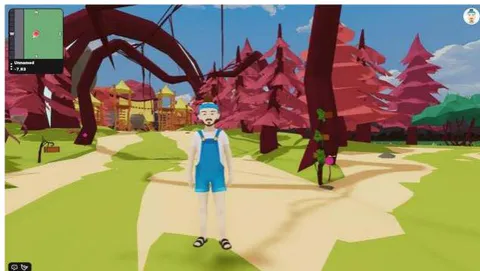
Table III: Metaverse Core Attributes and Corresponding Maturity Levels
| Maturity Levels | |||||
| Core Attribute | 1 | 2 | 3 | 4 | 5 |
| Persistence | turn-based; no persistence; resets are normal | persistent online-platform; not turn-based; continuously online and accessible; planned resets, respawns and updates occur sometimes | persistent virtual world, continuously online; entering or leaving has no impact on the world; no resets; partly not persistent | Large parts of the virtual world are fully persistent; some exceptions exist | Fully persistent virtual world - no exceptions |
| Synchronicity | Not an online world; no real-time interaction | Live interaction with a limited number of users in a limited space (e. g. lobby) | Live interaction with all users in the virtual world, but limited to regions of the physical world | Live interaction with all users in the virtual world; worldwide; sometimes exceptions with increasing latency or pausing | Whole virtual world is accessible in real time; live communication and interaction; worldwide |
| Scalability | Up to 10 users simultaneously | Up to 250 users simultaneously | Up to 1000 users simultaneously | Up to 10,000 users simultaneously | No limit |
| Physical and digital coexistence | No connection to the physical world, except for screen and controller-based means to control an avatar. | One interface, e. g. VR or virtual currency Tradable for fiat money | Additional interfaces, several interfaces | Generic changes in the physical world influences virtual world and vice versa | physical and virtual worlds are continuously interfacing |
| Interoperability | No interoperability; prohibitive | One component, e. g. avatar or asset transferable | Several components transferable | Interoperability with several other virtual worlds | Interoperability with all other virtual worlds |
| User-generated content (UGC) | No UGC is possible. UGC is not in vendors focus. | Users have very limited possibilities to change the virtual world. UGC is not in vendors' focus. | UGC plays an important role. Users can create worlds or spaces, assets, etc. | UGC is possible in a large variety and complexity; UGC can be monetized | Virtual world depends heavily on UGC. The world has to be created by users building on a given base environment. Everything can be monetized. |
| Economy | No economy; in-app purchases available | virtual economy with virtual currency; fiat money can be exchanged for virtual currency | virtual economy; free self-regulating market (supply and demand); fiat money purchases | virtual economy; free self-regulating market (supply and demand); virtual jobs and services can generate physical world income | Fully developed economy; self-regulating markets; virtual economy blending with physical world economy |
| Immersive realism | Hardly any feeling of immersion; text chats; avatars without facial expressions | Little immersive experience; avatars provide feeling of individual presence; user can act freely; voice chat | Individual avatars with facial expressions and gesture; voice chat; VR; 3D audio; motion tracking; individual social presence for all users | Including haptic feedback; high-end VR | High level of realism perfectly serving all human senses; creates an immediate immersive experience; hardly distinguishable from the physical world |
b) Complete Evaluation Result
Combining the assessment results from the previous Section 5.A leads to the overall picture
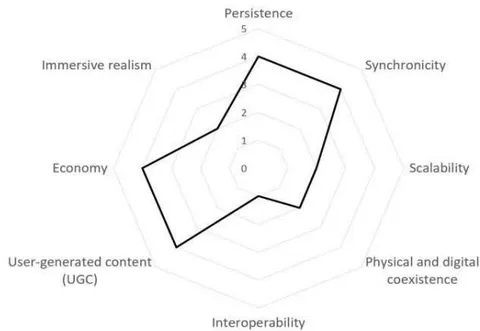
The maturity assessment results show a heterogeneous picture. Half of the core attributes are rated on a high maturity level of 4, i.e. persistence, synchronicity, user-generated content, and economy. As Section 5.A explains the rating in these core attributes depends largely on architectural decisions by the developer team and strategic choices by the governing organization. Immersive realism reached a ML of 2. It depends to some extent on strategic decisions, too, e.g. when it comes to attracting users to participate in the world and to populate it. On the other hand, this attribute also depends on technical development and advancement. This is true for such aspects of avatar interactions as emotes, gestures, and facial expressions. In contrast, the ability of a virtual world to reach high maturity levels in scalability and physical and digital coexistence depends mainly on generic technical advancements. These are related to aspects such as available computing power and connectivity bandwidth for attribute scalability. Physical and digital coexistence primarily relates to the availability of affordable user interface hardware for average users. Interoperability, finally, does not only depend on the virtual world itself but also on technological advancement in terms of standards and the strategic decision of other virtual worlds to apply these standards. Concerning this attribute, Decentraland stays on maturity level 1. There would have been possibilities to reach level 2, for example, by enabling the use of ready player me avatars [24] in Decentraland.
In the previous paragraph, it was pointed out that Decentraland reaches high maturity ratings in core attributes that depend mainly on strategic decisions by the governing entity rather than technology. This implies that Decentralands' strategy is to implement a virtual world in line with the Metaverse vision.
VI. DISCUSSION
Demand for a maturity model for virtual worlds constituting the Metaverse has various reasons. Assessments of existing virtual worlds can indicate important fields for research and development in general. At the same time, assessing an individual VW might provide improvement proposals, which could add to the development roadmap or even the future strategy of the respective VW. And to add another example, maturity assessment results could be an important input for investment decisions. They could answer the question of whether a specific technology is more or less relevant to foster Metaverse development, or provide an indication of whether a specific virtual world has promising technology and strategy, which could make it an attractive spot to invest time and money.
The proposed Metaverse maturity model is based on today's understanding of the Metaverse vision. While it might be helpful to guide decisions in the early stages, already, it will most probably require adaptations in the future. For some applications, e.g. for a company to decide whether investing in virtual real estate is promising, the presented maturity model might not be enough to make an informed decision. Additional data such as the number of active users, acquired funding, which enables further development, or strategic statements of the governing entities can be important, too.
Future research should evaluate and validate the proposed model. As already stated, the model should be adapted according to a future understanding of the Metaverse. In addition, indeed, the presented maturity model should be applied. It can be used to evaluate and compare various virtual worlds at a certain time. Moreover, it can make the development of specific virtual worlds visible and better understandable.