Loading menu…

A Novel Classifier for Digital Angle Modulated Signals

Β§ Vidya Jyothi Institute of Technology, Hyderabad , India

Send Message

To: Author

A Novel Classifier for Digital Angle Modulated Signals

Article Fingerprint

ReserarchID

CSTIT78S3R

A Novel Classifier for Digital Angle Modulated Signals Banner

Key Research Insights

Synthesized scholarly intelligence & interactive research assistant
  • English
  • Afrikaans
  • Albanian
  • Amharic
  • Arabic
  • Armenian
  • Azerbaijani
  • Basque
  • Belarusian
  • Bengali
  • Bosnian
  • Bulgarian
  • Catalan
  • Cebuano
  • Chichewa
  • Chinese (Simplified)
  • Chinese (Traditional)
  • Corsican
  • Croatian
  • Czech
  • Danish
  • Dutch
  • Esperanto
  • Estonian
  • Filipino
  • Finnish
  • French
  • Frisian
  • Galician
  • Georgian
  • German
  • Greek
  • Gujarati
  • Haitian Creole
  • Hausa
  • Hawaiian
  • Hebrew
  • Hindi
  • Hmong
  • Hungarian
  • Icelandic
  • Igbo
  • Indonesian
  • Irish
  • Italian
  • Japanese
  • Javanese
  • Kannada
  • Kazakh
  • Khmer
  • Korean
  • Kurdish (Kurmanji)
  • Kyrgyz
  • Lao
  • Latin
  • Latvian
  • Lithuanian
  • Luxembourgish
  • Macedonian
  • Malagasy
  • Malay
  • Malayalam
  • Maltese
  • Maori
  • Marathi
  • Mongolian
  • Myanmar (Burmese)
  • Nepali
  • Norwegian
  • Pashto
  • Persian
  • Polish
  • Portuguese
  • Punjabi
  • Romanian
  • Russian
  • Samoan
  • Scots Gaelic
  • Serbian
  • Sesotho
  • Shona
  • Sindhi
  • Sinhala
  • Slovak
  • Slovenian
  • Somali
  • Spanish
  • Sundanese
  • Swahili
  • Swedish
  • Tajik
  • Tamil
  • Telugu
  • Thai
  • Turkish
  • Ukrainian
  • Urdu
  • Uzbek
  • Vietnamese
  • Welsh
  • Xhosa
  • Yiddish
  • Yoruba
  • Zulu
Reading Preferences
Font Size
Line Spacing
Background
This converted HTML version may contain rendering inconsistencies. Please refer to the PDF for the authoritative version, or click here to provide feedback.

Abstract

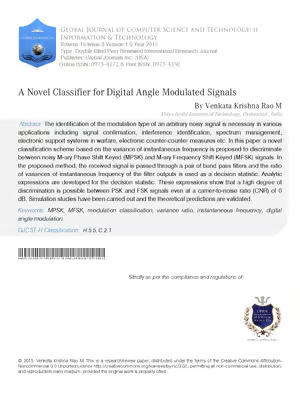
The identification of the modulation type of an arbitrary noisy signal is necessary in various applications including signal confirmation, interference identification, spectrum management, electronic support systems in warfare, electronic counter-counter measures etc. In this paper a novel classification scheme based on the variance of instantaneous frequency is proposed to discriminate between noisy M-ary Phase Shift Keyed (MPSK) and M-ary Frequency Shift Keyed (MFSK) signals. In the proposed method, the received signal is passed through a pair of band pass filters and the ratio of variances of instantaneous frequency of the filter outputs is used as a decision statistic. Analytic expressions are developed for the decision statistic. These expressions show that a high degree of discrimination is possible between PSK and FSK signals even at a carrier-to-noise ratio (CNR) of 0 dB. Simulation studies have been carried out and the theoretical predictions are validated.

References

16 Cites in Article
  1. 1. Partha Pratim Bhattacharya (2011). Smart Radio Spectrum Management for Cognitive Radio. International Journal of Distributed and Parallel Systems (IJDPS), 2(4), 12-24.
  2. 2. A Sai Raghu,T Srikanth,Dr Ch,Sumanth Kumar (2014). Modulation Classification of LPI Radar using Higher Order Statistics(HOS). International Journal of Engineering Research & Technology, 3(4), 2330-2334.
  3. 3. Jackie Hipp (1986). Modulation based on statistical moments. IEEE MILCOM-86 Conference, 1-20.
  4. 4. T Callaghan,J Perry,J Tjho (1985). Sampling and algorithms aid modulation recognition. Microwaves RF, 117-121.
  5. 5. F Liedtke (1984). Computer simulation of an automatic classification procedure for digitally modulated communication signals with unknown parameters. Signal Processing, 6(4), 311-323.
  6. 6. F (1985). Automatic classification of high frequency signals. Signal Processing, 9(3), 177-190.
  7. 7. L Dominguez (1991). A general approach to the automatic classification to the radio communication signals. Signal Processing, 22(3), 239-250.
  8. 8. M Hagiwara,M Nakagawa (1987). Automatic estimation of input signal type. Proceedings GLOBECOM-87, 254-258.
  9. 9. M Subbarao (2013). A Novel Technique for Automatic Modulation Classification and Time-Frequency Analysis of Digitally Modulated Signals. International Journal of Signal Processing, Image Processing and Pattern Recognition (IJSIP), 6(2), 1-12.
  10. 10. Ataollah Ebrahimzadeh,Shermeh,Reza Ghazalian (2010). Recognition of communication signal types using genetic algorithm and support vector machines based on the higher order statistics. Digital Signal Processing, 20, 1748-1757.
  11. 11. Jian Liu (2012). based on daubechies5 wavelet and fractional fourier transform in cognitive radio. IEEE 14th International Conference on Communication Technology (ICCT), 115-120.
  12. 12. S Rice (1948). Statistical Properties of a Sine Wave Plus Random Noise. Bell System Technical Journal, 27(1), 109-157.
  13. 13. John Proakis (1983). M.D. Bryce Policies and Methods for Industrial Development. Mc Graw-Hill Series in International Development. New York, London, Sydney, Toronto, Mc Graw-Hill Book Company, 1965, X p. 309 p., 60/–. Recherches Γ©conomiques de Louvain, 33(2), 223-224.
  14. 14. Neal Gallagher,J,Gary Wise (1981). A Theoretical Analysis of the Properties of Median filters. IEEETrans.ASSP, 29(6), 466-471.
  15. 15. Unknown Title. ITU-T Recommendations, 21, 22.
  16. 16. Krishna Venkata,M Rao (2015). Investigation of Window Effects And The Accurate Estimation Of Spectral Centroid. Global Journal of Researches in Engineering (J), XV, 31-41.

Funding

No external funding was declared for this work.

Conflict of Interest

The authors declare no conflict of interest.

Ethical Approval

No ethics committee approval was required for this article type.

Data Availability

Not applicable for this article.

How to Cite This Article

Venkata Krishna Rao M. 2015. "A Novel Classifier for Digital Angle Modulated Signals". Global Journal of Computer Science and Technology - H: Information & Technology GJCST-H Volume 15 (GJCST Volume 15 Issue H3).

More Citation Formats

Download Citation

Journal Specifications

Crossref Journal DOI 10.17406/gjcst

Print ISSN 0975-4350

e-ISSN 0975-4172

Keywords
Classification
GJCST-H Classification H.5.5
C.2.1
Version of record
v1.2

Issue date
August 27, 2015

Language
English
Order Article Reprint
Experience in AR

Explore published articles in an immersive Augmented Reality environment. Our platform converts research papers into interactive 3D books, allowing readers to view and interact with content using AR and VR compatible devices.

Read in 3D

Your published article is automatically converted into a realistic 3D book. Flip through pages and read research papers in a more engaging and interactive format.

Article Matrices
Total Views: 2.7K
Total Downloads: 244
All Trends

Request Access

Please fill out the form below to request access to this research paper. Your request will be reviewed by the editorial or author team.
X

This is the heading

Lorem ipsum dolor sit amet, consectetur adipiscing elit. Ut elit tellus, luctus nec ullamcorper mattis, pulvinar dapibus leo.


High-quality academic research articles on global topics and journals.

A Novel Classifier for Digital Angle Modulated Signals

Venkata M
Venkata M Vidya Jyothi Institute of Technology, Hyderabad , India