
I. INTRODUCTION
COVID-19 is a highly infectious disease with an extreme morbidity rate. The key reasons behind the recent drop in infection rates is public health awareness by wearing masks, social distancing, country lockdown, travel bans, etc. However, it is impossible for a country with limited resources such as Bangladesh to carry on with extreme preventive measures. Hence, it is strongly recommended to wear masks as it is the easiest and the most effective safety measure for
a) Problem Statement
With the frequent detection of more infectious COVID-19 variants, it is vital to wear masks for minimizing COVID-19 expansion effectively. However, citizens are not sufficiently conscious of the risks, and are reluctant to wear masks. Therefore, this research implements a system that ascertains citizens wearing masks by detecting mask-free individuals. It also warns them, followed by penalization if necessary. The system uses authenticated encryption or tag creation approach, thus making the system exceptionally secured.
b) Rationale of the study
Like the entire world, Bangladesh was able to control corona-virus outbreaks with maintaining lockdowns, medications, and public awareness campaigns. The arrival of the Covid-19 epidemic has inflicted a massive blow on Bangladesh's economy. But lockdown, vaccine activities are not a permanent solution to prevent Covid-19.
While vaccination can be a viable solution, in this scenario, public perception makes it insufficient. The public's dissatisfaction stems mostly from vaccination side effects, limited efficacy, and unavailability. On the other hand, a prolonged lockdown would be the prudent choice for most governments in these increasingly dire conditions. Because of the lengthy country-wide lockdown, the global economic crisis, and the resulting disruption of demand and supply chains, the economy is likely to experience a prolonged slowdown in recent months. Moreover, people of Bangladesh are not conscious enough about wearing facemasks. Results from unbiased research involving a large number of participants in various Bangladeshi locations show that wearing masks can prevent the spread of Covid-19. Despite the dismal outcome, the studies demonstrate how important face masks are. Face masks have been shown to drastically prevent severe infections in the older population [3]. Other than that, MAC is used to authenticate NID data in this system. The usage of hash functions and symmetric encryption is widespread.
c) Research objectives
The study's main goal is to raise public awareness of COVID-19 outbreaks in order to reduce outbreaks. As a result, the system's primary goal is to send warnings and fines to the non-mask bearing persons or maintain enough awareness. As vaccination can not provide entire protection. Our primary objective is to slow the alarming progression of COVID cases. However, this technologies might also be used to track and act in other areas. NID data is used to identify individuals and must be kept safe since it contains sensitive information. For authentication, we used MAC, an established way for secure communication. The objective is to maintain NID data security and no erroneous identification during the system application procedure. The motive is to design a system that will be suitable for Bangladesh and other overcrowded countries.
- Limiting the COVID dispersion
- Those who do not use masks are being tracked down and penalized to increase awareness.
- The use of MAC ensures that no personally identifiable information is accessed or manipulated, and that authentication and consent are maintained.
II. BACKGROUND
This section provides a detailed discussion of related works on COVID-19 dissemination, mask ensuring works were previously done, NID security and MAC in security.
This paper presents an analysis of the current COVID-19 condition in Bangladesh, as well as some recommendations on how the government could address the crisis. Considering its economic position,
Bangladesh is fighting the disease's spread. Almost all country has embraced nontherapeutic methods, but there is a continuous discussion about whether they have been adequately understood and applied. Bangladesh being a low-middle-income country, is subjected to several regulations aiming at minimizing the virus's spreading. This research focused solely on the medical situation in Bangladesh and the constraints in preventing the development of COVID [17]. It depicted the entire COVID condition in Bangladesh, as well as the irresponsibility of people who were not wearing masks. While maintaining the lockdown at all costs with increasingly stringent maintenance, the country is confronted with severe problems. As a result, a new viable approach may be able to reduce the rising COVID problem. Considering the circumstances in Bangladesh, no other model was presented [3].
COVID-19 and other respiratory problems have been studied in the past using a model. In this approach, behaviors like wearing masks and being alone may be measured and interpreted. This model demonstrated a number of things, including how transmission risk and the distance between two linked up people [6].
Their research indicates that broad public usage of face masks could be highly beneficial in reducing communal dissemination and crisis impact. Face masks are estimated to have the most community-wide advantages if used in association with nonpharmaceutical techniques and when adoption is almost uniform, and concordance is strong [7].
In the previous study on NID concerns, the publication "Security Concerns with National ID Cards" introduced three major components of NID. The pros and limitations of a National ID card were covered in the first section, followed by a discussion of its security features and finally a look at prospective threats and their impacts. The threats are detailed in the security analysis section. Many modern technologies, such as ID cards, have faults that need to be considered. Man-in-the-middle attacks, skimming assaults, and authorized personnel have abused the system are all examples of data falsification. Most of the confidential information is disclosed unintentionally - and occasionally intentionally - by the general populace which demonstrates the importance of NID data protection. The purpose of this study is to examine the defining characteristics of national ID cards, the security characteristics of resident ID cards, potential risks, and access controls [5].
Entities from across the world are attempting to grow the maximum cyber security mechanism. The information they convey is usually highly secretive which can be misused. Today, information security is becoming highly significant. To verify the validity of messages, the MAC technique uses a symmetric key cryptography strategy. The MAC approach uses a symmetric key cryptography strategy to check message correctness. To keep the MAC process running, the sender and receiver exchange a symmetric key . A message authentication code (MAC) is a cryptographic checksum created on the core message and sent with it to ensure message legitimacy. [4]. Message authentication and integrity are included in the security characteristics of message transmission. Examples of practical MAC applications include the Internet of Things, where GSM is used for networking, smart meters, and health parameter tracking.
III. THEORETICAL FRAMEWORK
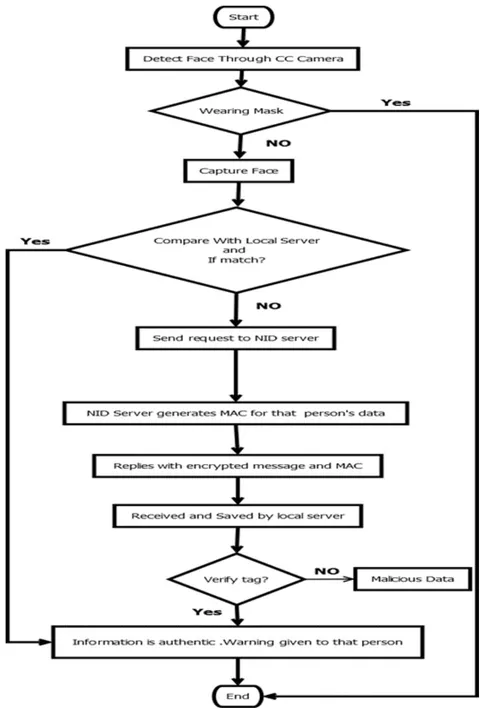
The implementation of this work is intended for major road crossings [17]. The system's data is arranged into two tables. These are referred to as the Local Server and the NID Server. Even though the system is based on real-time data, the data on the servers is drawn from practical scenarios. The initial function of this system to identify those who are not wearing a mask. The live camera will be looking over everyone's face while they travel along the road. The camera is deliberately placed at a major junction. Individuals without masks will be identified and captured using image processing algorithms. Following that, the image is compared to pictures stored on our local server database to determine personal information of the person. This storage is for the purpose of not accessing the NID server more than once for the same person. So, for instance, suppose that the image does not correspond to anyone in the database. The info is sent to the national identity card server, which keeps track of sensitive personal data for all NID users. Obtained image is compared to the images stored on this server. Name, NID number, and some details of that person are transmitted to the local server which is promptly identified.
A symmetric approach is selected to provide secure communication. The whirlpool method is used in this system to ensure that personal details such as NID numbers, names, contacts, and mailing addresses is not altered with. After that, it will engender an authentication code for the message. When this MAC identifier is combined with the personal information to be communicated, it is delivered to the sender's side, which is our own local server. On the receiving end, the MAC is evaluated to ensure that the data is genuine and allowed. A tag is computed when the information is sent into the tag generation algorithm. Those who possess the secret key are the only ones who can authenticate the tag. The Diffie-Hellman Key Exchange protocol is required for generating this shared secret key. The information received is removed if the tag is not valid; if the tag is legitimate, Personal information is stored on a local server for onward purpose. If an attacker attempts to fake personal information, it will be impossible and will be identified because of the security measures in
IV. RESEARCH METHODOLOGY
This chapter covers the several approaches utilized in the procedure, data collection, and analysis pertinent to the work. It will incorporate the work sequence, research design, frameworks, data gathering, and security management.
The system implementation has been conducted in a series of steps. A general model diagram depicts the system implementation design (figure 2.2) [17].
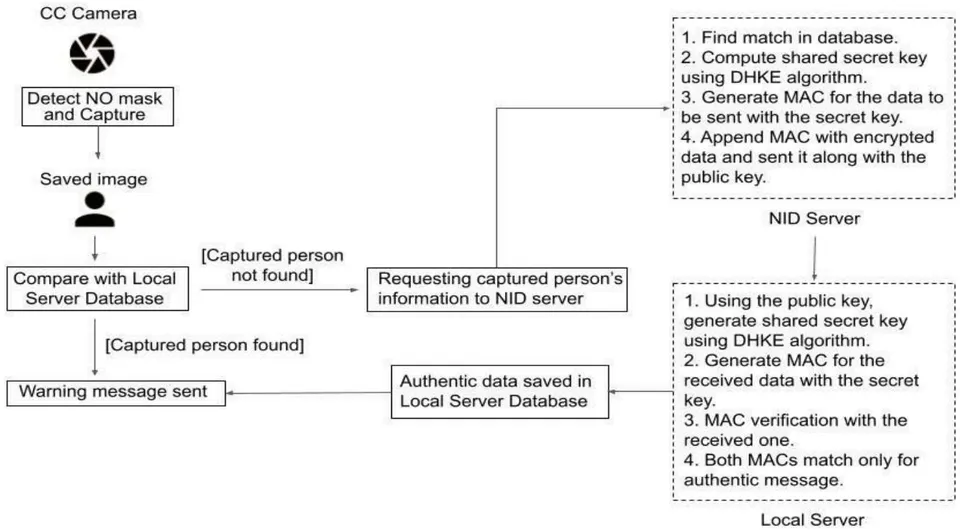
This section depicts the critical components of a progressive approach. The tasks are conducted via three modules which are described below in detail.
1) Face Mask Detection
The main functionalities of this module are:
- To recognize individuals who might not be wearing a mask.
- Take a photo of the individual's face.
Using Python, Keras, and OpenCV, a code for face mask identification is constructed within this module. The mask scanner algorithm is being designed to assess whether or not someone is putting a mask. Face detection is intended to evaluate whether any faces are viewable in a photograph or film footage. Face detection finds a face in an image. A face detector locates any uncovered individual recognized by the system, subsequently detected by a facemask recognizer. A face, mask, and other ratios are recognized by this module. Keras is a deep learning framework with a high-level interface [9]. When there are multiple faces, a bounded rectangle surrounds each oneso we know where they are. Captured face image is sent to the server to find out the person's identity.
2) Local Server
The main functionalities of the local server are:
- Comparing the image collected with those in the directory.
- If information isn't available in this database, contact the national id server.
- That person receives a warning notice.
- To validate the message authentication code, construct a shared private key.
3) NID Server
The main functionalities of the NID server are:
- The requested records are securely delivered in response to a request from the local server.
- Compute shared secret key for tag generation.
- Addition to creating a message authentication code and concatenate it to the message to be delivered.
V. RESULT DISCUSSION
The purpose of this chapter is to present an observation of the experimental data obtained using the constructed model. This portion also discusses the outcome of each phase and the method that we employed in our model.
The shared secret key is calculated at first using the Diffie Hellman Key Exchange protocol. This system utilizes Diffie-Hellman Key Exchange to distribute a shared secret key producing the private keys of both the source and the destination. The Whirlpool algorithm is used to encrypt the message and construct the tag. Whirlpool is a block cipher that encrypts data with 512-bit blocks and a 512-bit key. Tags are generated using this shared secret key. The message is attached with the Message Authentication Code (MAC) and sent to the local server from the NID server. We used a socket connection between the NID server and the local server for requesting and transmission of data. Socket programming is used to establish a connection between two network nodes. The link is connected on both ends [13]. The first steps in socket programming are to import the socket library and create a simple socket. Both endpoints of the link are connected. Warning messages at the last step are also sent via socket programming [14]. The receiver side, which indicates the local server, follows the same approach. The same implementation is used to generate the MAC compared to the MAC obtained from the sender-NID server. As soon as the authentication is completed, the local server verifies the message's authenticity and saves it in the database for later alerting notifications.
The purpose of using MAC is validation of data transmission. A MAC is a hash function that utilizes a secret key as well as the data as input, and the security protection constraint is that estimating the tag value of the data without the key should be operationally challenging [10]. The MAC estimations yield an error in the data if the original message is altered throughout transmission. Message authentication and message integrity are offered as security facilities for communication processes [11]. The tag formation mechanism employed in this system is derived from the PGV compression function [12].
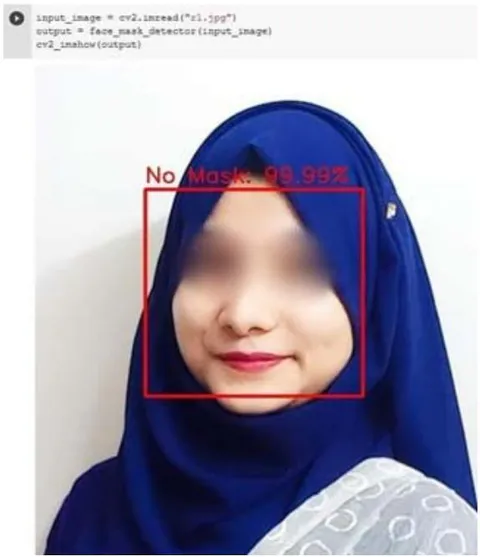
a) No mask detection
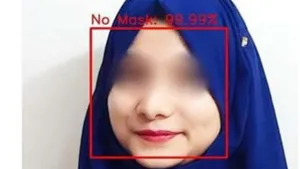
When someone approaches the machine without wearing a mask, the machine identifies this and snaps a photo of them.
b) Local Server
| No | Image | Name | NID | MailID | ConcatenateMessage | MacValue |
| 1 | [BLOB - 7.3 KIB] | ARSHIA HABiB | 7184456708 | [email protected] | [email protected]' Elx17!!x0... | b' Elx17!!x0!bxq[x00]"!UUX01x01Rr02x06x01Ux03... |
| 2 | [BLOB - 13.3 KIB] | MD. MUMINUL BARI | 6184456708 | [email protected] | [email protected]'brz[rx10[PL...] | brz[rx10][PinDX!5DQUUX06rVr04Rx05x0eQQvnXu14X... |
| 3 | [BLOB - 5.6 KIB] | FOYSAL AL GABID | 5151856708 | [email protected] | [email protected]' Mfx16... | b' _Mfx16x07[%!Xfxx04Q'x08Qv07x00x03x03x04vrl... |
| 4 | [BLOB - 3.6 KIB] | Md. Sujaur Rahman | 6454310268 | [email protected] | [email protected]' [x02ID'SB...] | b'[x02ID'SBGdPZWXVx06x0Cv0x01U08v03SUS'x15AX... |
| 5 | [BLOB - 105.8 KIB] | Shaznin Sultana | 6490576885 | [email protected] | [email protected]'OrRt... | b'OrRL''!db''x12x04v0x00Wv04XTu04'TTx17'... |
| 6 | [BLOB - 178.5 KIB] | Sadia Alreen | 5090306855 | [email protected] | [email protected]'alx03Q[SvP...] | brax03Q]SvPx11x01v06x0FVIVnSuTJPx16x05x... |
| 7 | [BLOB - 6.2 KIB] | MD. SAJAD HOSSAIN SAWRAN | 5183456902 | [email protected] | MD. [email protected]'... | b'.L'x00x0e"PWyIocGFPx06vrgXx15Kx03x03PxA... |
| 8 | [BLOB - 12.2 KIB] | MEHEDI RIDOY | 7403275517 | [email protected] | [email protected]/RQVSx08a... | b'/RQVSx08a!llWkXv0Vx07x04x0Bx07x00x06x... |
Fig. 3.2: Local server
Using socket programming, the NID server connects to the local server.
c) Socket Successfully Establish
{"code_caption":[],"code_content":[{"type":"text","content":"c, addr = s.accept()\nprint('Got connection from', addr) "}],"code_language":"txt"} {"code_caption":[],"code_content":[{"type":"text","content":"send a thank you message to the client. encoding to send byte type. \nc.send(bytes('Thank you for connecting'), "utf-8") "}],"code_language":"txt"}
Fig. 3.3: Connection setup

Socket successfully created
d) NID Server to Compare Detected Image
Image captures are forwarded to NID if they cannot be found local server. After comparing the NID image to the captured image, the next step is to proceed to the next step.
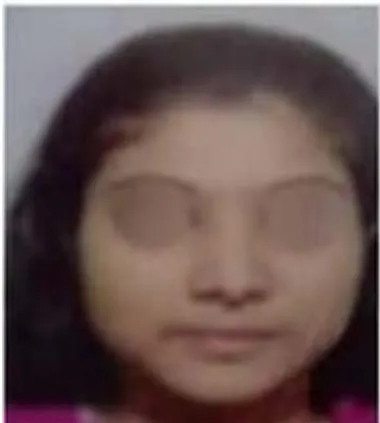
The NID server's data is extremely private and crucial. During the system application process, the purpose is to keep NID data secure. A MAC is produced to send the NID data securely to the local server. It is important to have a common shared key when creating a MAC. Using the Diffie-Hellman key exchange method, a shared key is created.

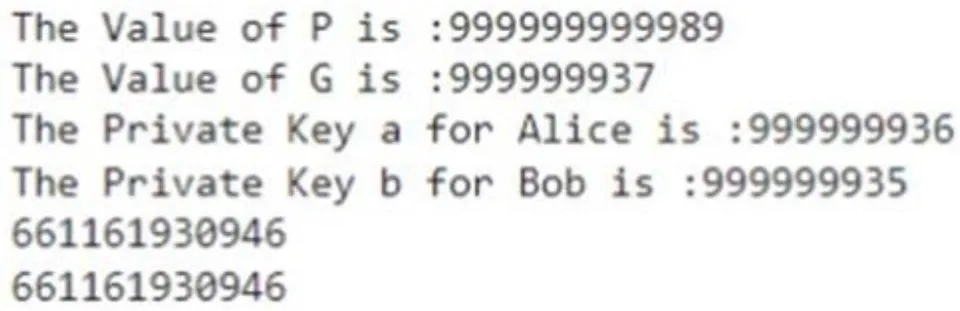
The NID server will send this concatenated information to the local server using the key and whirlpool encrypted message.
Fig. 3.7: Demo NID server
| No | Image | Name | NID | FathersName | MothersName | DateofBirth | MailID | MacValue |
| 1 | [BLOB - 6.2 KIB] | MD. SAJJAD HOSSAIN SAWRAN | 5183456902 | ABDUL MALEK | SOKINA KHATUN | 31-12-1998 | [email protected] | b'L'vX0x0e*PWy0x0GFPV0x0ingx15k03x03Px... |
| 2 | [BLOB - 13.3 KIB] | MD. MUMINUL BARI | 6184456708 | MANIK MIA | ASIA KHTUN | 13-09-1999 | [email protected] | b'z'f'x10'PinDX'SDQUB06v0x04R0x05a0eQQNx0x14x... |
| 3 | [BLOB - 66.8 KIB] | RAISA TAHSIN TASPIA | 5276209108 | MD. NURUL AFSAR | GULSHAN ARA KHANOM | 22-01-1999 | [email protected] | b'c'X'v10YPQAIjIqU15x11XJU03x01x05Sx03T... |
| 4 | [BLOB - 9.5 KIB] | TARANNUM TORI | 8184456708 | TAWHDUL ISLAM | AFROZA KHAN | 21-03-1998 | [email protected] | b'tEWW1x17lqY1x7V0x01x01x03V0x01x02... |
| 5 | [BLOB - 6.7 KIB] | EMRUL MINHAZ | 1844567087 | EMDADUL HAQUE | MONI AKTER | 19-10-1997 | [email protected] | b'Ux17x11Yx7frrnU1x1e0V0Vx06x03x01x0... |
| 6 | [BLOB - 9.5 KIB] | MAYESHA BINTE MIZAN | 5184785670 | MD. MOHUIDIN | MUKTA KHANAM | 30-01-1998 | [email protected] | b'WA1x10P0x07z08x16T*T*Rv0x0b4Sx00x05x... |
| 7 | [BLOB - 25.8 KIB] | SHADMAN SHAKIB | 5184356808 | SOFUIDDIN CHAWDHURY | MOMENA KHANAM | 31-12-1998 | [email protected] | b'7'x00P'x03x08x0eP2x0bQVS)Rv05x06x07x0... |
| 8 | [BLOB - 5.6 KIB] | FOYSAL AL GABID | 5151856708 | FORID HOSSAIN | ARUFA AKTER | 29-08-1998 | [email protected] | b'#_Mix16x07%xtx04Qx08Qx07x00x03x03x04n... |
| 9 | [BLOB - 12.1 KIB] | JULIA AFROSE | 5190516708 | MD. RAHIM | SCNIA AKTER | 02-12-1999 | [email protected] | b'zGZZPtx03XlDT5TxOEx05x0cx05x03UQx08Zx10... |
| 10 | [BLOB - 13.7 KIB] | JAKIR KHAN | 5187036708 | KAMAL KHAN | NAZIA BEGUM | 29-09-1998 | [email protected] | b'f'07v0x0b10rTf'x0x08Qx05UTx07SZXR*QAI... |
| 11 | [BLOB - 71.1 KIB] | MIR IMTIAZ TAREK | 6220768382 | RIDWAN HASAN | NAFISA ISLAM | 02-04-1997 | [email protected] | b'v'v17'oex15x0cx07TgRx14PRSx02QUVTx0ePL... |
| 12 | [BLOB - 10.5 KIB] | JUBIN KHAN | 4037285926 | MOHAMMAD ALAMIN | SHAHIN PARVIN | 16-11-1998 | [email protected] | b'L'vU0ZyRTUv07x03x02Wv0Ex01x00P_x13x0... |
| 13 | [BLOB - 12.2 KIB] | MEHEDI RIDOY | 7403275517 | NAHIYAN HOSSAIN | ANTORA ISLAM | 16-06-1998 | [email protected] | b'RQVSx08aWIXk07x0Vx074u0BRx07u0x06x... |
| 14 | [BLOB - 7.3 KIB] | ARSHA HABIB | 7184456708 | ASADUZZAMAN KHAN | SAHIDA AKKER | 16-12-1998 | [email protected] | b'f'Ex17Ii0x0Bx0q00T'UUX01x01Rx02x06x01UUX03... |
| 15 | [BLOB - 21.5 KIB] | MOHAIMINUL ISLAM | 6305284017 | RIDWAN SIDOIKI | ROWZA HOSSAIN | 05-04-1996 | [email protected] | b'zVQZx08x0fVx111D_L'x00Tx04V0x02Vx05Zx... |
| 16 | [BLOB - 14.9 KIB] | MD. SAKIB | 2835028173 | AZMAIN IKTIDAR | TANZILA ALAM | 20-09-1998 | [email protected] | b'f'x055x02Sx06x03x05v0x07VQx07x0eTeTx0e0x1... |
| 17 | [BLOB - 12.3 KIB] | MEHEDI HASAN MISHU | 4036492501 | TOWSIF HASAN | FARIHAANKA | 08-07-1999 | [email protected] | b'Wx0x04V0bx07YCx03_Fx0b@XCv04x02x0x2... |
| 18 | [BLOB - 132.5 KIB] | MD. NURUL AFSAR | 9381503792 | MD. ABU SAYED | ZAKIA KHATUN | 31-12-1965 | [email protected] | b')P-Ax11)PBSDVU*T'01QU0x03TTx05STTx15WK-SIL... |
| 19 | [BLOB - 118.8 KIB] | GULSHAN ARA | 7401395628 | A.B.M ISHAQ | ROKSAN ARA | 06-10-1974 | [email protected] | b'Wx17Ux10QVHx14Ox07x0x05x07x01x0x... |
| 20 | [BLOB - 8.6 KIB] | APPEL MAHNUO PRANTE | 7401395637 | MD. ILIAS MIA | PARUL AKTER | 29-12-1999 | [email protected] | b'f'Ex12)xzPv0b0bCv004Au03x0CA[00P0x01RR... |
| 21 | [BLOB - 33.1 KIB] | PRANTA BISWAS | 9382504792 | SHOILENDRA BISWAS | RINA BISWAS | 13-01-1999 | [email protected] | b'1D'v04xFcMQII15X11x16x02x12oE0jPWVv0... |
| 22 | [BLOB - 9.5 KIB] | K.A.Y Nuruddin Jahangir | 1969504792 | MD. NURUL HASAN | NILA BEGUM | 4-06-1990 | [email protected] | b'z'saw@gjx16Qw06ZyIv07"UZx02oV08Fx03m05x0b... |
| 23 | [BLOB - 10.1 KIB] | Mariam Akter | 1976504792 | MD. MOKBUL HASAN | MIM CHOWDHURY | 5-07-1994 | [email protected] | b')X10rx10x03uUdLv068v04v0x02x05x05x06... |
| 24 | [BLOB - 229.7 KIB] | Md. Asaduzzaman | 1962504792 | ABDUL KALAM | AMENA BEGUM | 2-02-1993 | [email protected] | b'u'TBSIMx18R*T'00X03x03Bx0Bx04x04x06Ux0CTS... |
| 25 | [BLOB - 312.2 KIB] | Sabeeha Khatun | 1970506892 | RAHIM KHAN | SALMA AKTER | 8-12-1998 | [email protected] | b'f'x07TPQ_W'U'x17u0v04Xv02T'00VQx06YXQ... |
| 26 | [BLOB - 274.0 KIB] | Sabik Zaman | 6970506892 | KARIM HASAN | JANNATUL FERDOUS | 6-05-1988 | [email protected] | b'cWIUPU_QZWfU'v00x00v01R1U00v0f0v0Cv12x05... |
| 27 | [BLOB - 178.5 KIB] | Sadia Afreen | 5090306855 | MID NUR UDDHIN | MASHIYAT TASNIM | 12-12-1995 | [email protected] | b'ax03QvSv11x01x06OVVIVnSUZTXp16x05x... |
| 28 | [BLOB - 105.8 KIB] | Shazrin Sultana | 6490576885 | RAHMAN CHOWDHURY | DALIA NOUSHIN | 23-04-1990 | [email protected] | b'v'vRL*L*dBv12x04v0v0Wv04XTu03TU*Tt17... |
| 29 | [BLOB - 199.5 KIB] | Ishrar Marran | 6546776065 | ABDUL MANMAN | SINTHIA KABIR | 16-10-1994 | [email protected] | b'zAQOWAJWnx08x03x04v0x00x03x05x06Wv06... |
| 30 | [BLOB - 3.6 KIB] | Md. Sujaur Rahman | 6454310268 | LUTFUR RAHMAN | AYESHAAYNAZ | 25-01-1996 | [email protected] | b'f'x021D'SBGDPZWXV'x06x06v0x01UUX08x03SUZU15AX... |
| 31 | [BLOB - 194.0 KIB] | MD. Abdul Goni | 1962310568 | ROHAN KHAN | NAMIRA RAHMAN | 27-06-1987 | [email protected] | b'f'#ux0UILv0e"WYQx03Xv00Wv05PxA15x05e0x00... |
| 32 | [BLOB - 260.0 KIB] | Zannatul Ferdous Tunny | 6456231446 | NAZMUL ISLAM | TANHA ISLAM | 20-11-1992 | [email protected] | b'QuxGdx0f05MMI-PGQx0eE16LVXOSStx10x04x0... |
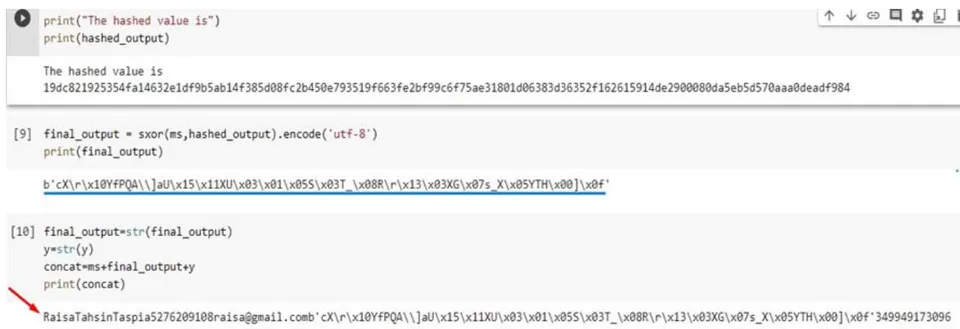
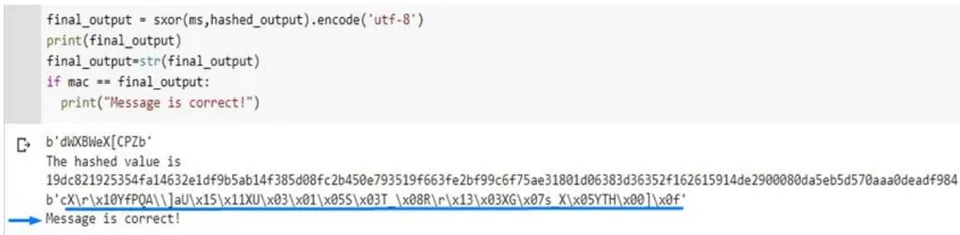
After accepting this concatenated message, the receiver will first distinguish between the message and its mac value.
{"code_caption":[],"code_content":[{"type":"text","content":"[email protected] b'cX\r\x10YfPQA\]\aU\x15\x11XU\x03\x01\x05S\x03T\_x08R\r\x13\x03XG\x07s_X\x05YTH\x00]\x0f' 349949173096 "}],"code_language":"javascript"}
Fig. 3.9: Differentiate message & MAC value
Additionally, when a message is received, the information is validated if the generated MAC and the receiver generates a MAC value. The message of received MAC are the same.
{"code_caption":[],"code_content":[{"type":"text","content":"enter receiver mail address:[email protected] "}],"code_language":"txt"}
VI. PROPOSED SYSTEM SECURITY DISCUSSION
Security analysis is the process of examining and evaluating a wide range of factors that can impact the overall security of a system. A system intruder or an unauthorized individual will not be able to access any of the system's components or data until and unless the task is completed. In other words, the system will be wholly protected from any acts that could be particularly disastrous. The tag is the primary provider of protection. The whirlpool algorithm is deployed to construct the tag in this context, with a key length of 512 bits and a tag range of 512 bits [16].
Due to a failed tag verification, any forging of the message, whether malicious or unintended because of transmission errors, will be detected by the destination and reported to the source. The MAC considers each element of the message to be critically important. The root of concern is the shared secret key, which is indeed transferred utilizing secure protocol called Diffe-Hellman. An arbitrary large prime figure with a value of at least 1024 bits is used in the system to offer strong security. The whirlpool algorithm, in addition, has a reliable overall structure operating on messages less than in length that is resistant to the traditional threats directed at block-cipher-based hashes. The collision resistance of this method is. Whirlpool seems to be more robust than most modern hashing algorithms, providing for large-scale component mapping simultaneous execution. Furthermore, it does not necessitate a significant quantity of storage space. As a result, it may be deployed effectively in various applications despite few resources. This could, meanwhile, take advantage of the larger memory space afforded on modern CPUs to gain even greater speed. Because of the hash's increased size, not only would it be more secure towards birthday attacks, yet it allows for a larger inner state for randomness containment, that is required with certain types of pseudo-random number generators [16]. Moreover, the construction adopted from PGV hash functions for generating the MAC is also collision resistant in an extraordinarily powerful way.
VII. CONCLUSION
The study concludes a secure mechanism against COVID-19 by detecting whether the public is wearing masks [17]. The study adopts MAC to safeguard the personal information of the user against any kind of alteration as it ensures transparency, security, and immutability. The proposed work is not only a compelling effort to reduce COVID-19 transmission through monitoring an individual's mask use but also an implementation protecting the individual's personal information. This research was inspired by a study conducted in Bangladesh to raise public knowledge about COVID transmission to minimize breakouts while also safeguarding personal information security. Higher authorities can adapt the system to preserve the authenticity of sensitive information, and manage security threats of high priority information such as the NID of citizens used for identification.