Publication of a Ramesside Stela fragment made of fine white limestone, with figure and remains of text engraved with a sunk inscription (figs. 1-2). The Stela is kept in Cairo Agricultural Museum and according to the museum register the stela bears identification no.
## I. INTRODUCTION
Among the collections of the Cairo Agricultural Museum Stela no. 4286 caught my eye when I saw it the first time because it has a large figural field of a deceased incised in sunk relief, with an offering table loaded with unusual offerings. This paper will study and classify this stela to determine the date of the stela, the owner of this stela and examine the offerings. The object in question was bought by the museum.
## II. DESCRIPTIONAND SCENE
A fragment of stela of unpainted limestone, the surface was carefully prepared and it is smooth. Its representations are carved with skill and care, the top and parts of the damaged. The principal point of damage is the text, where all of it was broken except some words. In its present state, the measurements of the fragment is: height 19.5cm, breadth 19.5 cm. On the surviving portion of the stela, there is a scene in sunk relief showing the deceased (a) seated on a chair(b) with legs in the shape of a lion's paws[^1]. The deceased legs are on a small platform without sandals. The deceased is shown, facing right, smelling a lotus flower[^2] held in his left hand[^3], while the right rests on his thigh and grasps a strip of cloth[^4]. The owner wears an ankle-length kilt(c) rising high at the back of the waist.[^5] He is adorned with a broad collar and a long wig (d) that is partly worn. There is also a break on the owner's head and chair. One can see also parts of the borderlines. The main points of interest are the offerings that are loaded on the offering table[^6] in front of him. It is loaded with, from top to bottom one pomegranate fruit[^7] has been depicted from the side (Cf. fig.3) on a vessel with a lid, perhaps the vessel was filled with pomegranate beverage[^8]. The vessel has a faucet which emphasizes that the pot contains liquid for lowering the beverage. Two
- [^1]Cf. Cruz-Uribe, Eugene, 1978, "The Father of Ramses I: Ol 11456", JNES, 37, No. 3, 238, Fig.1
- 2 The lotus-flower has a religious symbolism; it associates especially with 'life' and 'rebirth'. Griffin, K. 2007, "An zhikt n Ra Stela from the collection of the Egypt Centre, Swansea", in T. Schneider and K. Szpakowska (eds.), Egyptian Stories: A British Egyptological Tribute to Alan B. Lloyd, Ugarit-Verlag: Münster, 142, n.55; Lurker, M., 1996, An Illustrated Dictionary of The Gods and Symbols of Ancient Egypt, London, 52.
- 3 About the method of holding the stem of lotus-flower in the New Kingdom, which curves in an s-shape towards its holders' nose, see: Schäfer, H. 1980, Principles of Egyptian Art, Oxford, 41, fig.18(c); Cf. stela of Cincinnati Art Museum 1947.55, Early Nineteenth Dynasty Martin, Geoffrey T.1982, "Two Monuments of New Kingdom Date in North American Collections", JEA 68, 81-82, 84, Pl.IX (2); stela of Egyptian Museum 1/3/25/1
- = S.R. 1397 belongs to Roma r-m a, $19^{\text{th}}$ Dynasty, probably from Deir el-Medina. See: Demarée, R. J., 1983, The zhikrt n Ra Stelae on Ancestor Worship in Ancient Egypt, Leiden, 80, pl.VIII, A28. Stela of Pukentef, pw-kntw.f $19^{\text{th}}$ Dynasty Warsaw, National Museum MN 143341, from Deir elMedina. Demarée, R.J., 1983, 31, pls.III XIV, A8.[^15]
- 4 This style points to the late Eighteenth or more probably the early Nineteenth Dynasty, stela is known from Deir el-Medina: Stela of Semet, Cincinnati Art Museum 1947.55., see: Martin, Geoffrey T. 1982, 81, 4PI. IX (2). See also Affara, Manal, 2010, "A New Kingdom Stela in the National Museum of Antiquities, Leiden", JARCE 46, 151, fig.1.
- [^5] Cf. Leiden Museum Stela V 51, Affara, Manal, 2010, 151, fig.1; See also the stela of Cincinnati Art Museum I947.55. Martin, Geoffrey T., 1982, 81-82, 84, Pl.IX(2),[^25][^18] Glasgow Museum stela, 28au-13. Thomson, James K., 1997, "A Shield Bearer and Warrior of Ramesside Times ", JEA 83, 218-219, fig.1.
- The offering table consists of a stand with a tray. The style of the monument irresistibly points to the late Eighteenth or more probably the early Nineteenth Dynasty, stela is known from Deir el-Medina: Stela of Semet, Cincinnati Art Museum 1947.55., see: Martin, Geoffrey T., 1982, 81, 84, PI.IX2).
- [^7] Cf. the gold necklace, MFA, Inv. No. 48.59. See: Terrace, Edward L.B., Jul. 1963, Ancient Egyptian Jewelry in the Horace L. Mayer Collection, AJA67 No. 3,272, pl.56, fig.14, no.27.
- 8 Pomegranate wine was found in ancient Egypt throughout New Kingdom period. See: Williams, Ronald J., 1972, Scribal Training in Ancient Egypt", JAOS, 92.2, 218; P. Anast. IV, 2, IV,3 (which dates to the reign of Seti II, See Gardiner, A. H., 1937, Late Egyptian Miscellanies, Bruxelles, 37-38.;Cf. Lilyquist, C., Hill, M., Allen, S., Roehrig C. H., and Patch D.C., 2001, "Egyptian Art", BMMA, New Series, Vol. 59, No. 1, Ars Vitraria: Glass in the Metropolitan Museum of Art,14, fig.p.14. Other reference is from the New Kingdom love poetry P. Turin 1966, 1/2-4 refers to pomegranate wine. See: Thompson, Stephen E., Jan., 1994, "The Anointing of Officials in Ancient Egypt", JNES 53, No. 1, 19
pomegranate flowers were incised next to the vessel on each side $9$ (Cf. fig.4), taking into account the rules of perspective in the drawing so that one of the two flowers on each side hides a part of the other according to the rules of perspective. The perspective was also taken into account in the libation vessel which is located between the deceased and the altar where a part of the deceased's garment covered part of the vessel. The symmetry was also observed in the drawing of pomegranate flowers on each side. The word $\bigcirc \bigcirc \bigcirc$ nhh "eternity" is engraved at the top of the offering son both sides. It seems that the writer repeated the sign $(G N5)$ twice for the symmetry. All offerings are covered with an outer cover. The offering stand $^{10}$ stands to the right of offering table. Alibation vessel $^{11}$ on a wickerwork stand $^{12}$ is carved between the seated man and the altar.
## III. THE INSSCRIPTION
The text (figs. 1-2) has been composed over and between the head of the owner and the offering table, with vertical dividing lines. It runs right to left.

$r^c$.(3h)ikrt...m3c-hrw?hr
The text is broken except for a word at the end of the first line on the right. $\odot$ I $r^s$ "Re" which one would expect to be anteceded by $3h$ ihr ngiving a reading of "The able spirit of Re"; Cf. stela of Khamuy Pennub h3 mw(y), Pn-nwb, $19^{\mathrm{th}}$ Dynasty, Deir el-Medina $^{13}$ and stela of Panakht Panekhu $P_{3}-n h w$, $19\mathrm{th}-20^{\mathrm{th}}$ Dynasty from Deir el-Medina. $^{14}$ One would also expect to be anteceded by a $htp-di-nsw$ giving a reading of "A boon which the king gives (to) Re". Cf. limestone offering-table of Ahmose, the Late $18^{\mathrm{th}}$ or Early $19^{\mathrm{th}}$ Dynasty, Deir el-Medina. $^{15}$ The author prefers the second reading ( $htp-di-nsw$ ) because there is ( $3h$ ) ikrt was incised in another line on the stela and it is not common to find $3hikrt$ wice on a single stela in the same text of the deceased. One can also read $(3h)ikrt"$ the able spirit "16 which one would expect to be followed by the name of the deceased, cf. limestone offering table of Ahmose, the Late $18^{\text{th}}$ or Early $19^{\text{th}}$ Dynasty, Deir el-Medina $^{17}$, and stela of Semet from Deir el-Medina, Cincinnati Art Museum I947.55 $^{18}$. $(3h)ikrt$ can also be followed by $n r^{s}$ to give the full epithet $(3h)ikrt n r^{s}$ "the able spirit of Re ", cf. fragment of stela of Pa, from the collection of the Egypt Centre, Swansea, A232, $19^{\text{th}}$ Dynasty $^{19}$. On the extreme left of the stela, there are remains of hieroglyphic signs that can be read $(m3^{\prime} h w?)$, the Justified?20;
they are followed by $\widehat{\mathbf{cr}}$ "before" which one would expect to be followed by the name of the god Osiris giving a reading of 'the Justified before Osiris' and the inscription would thus give the name of the deceased followed by the words 'the Justified before Osiris'.[^21] Cf. Limestone offering-table of Ahmose, the Late $18^{\text{th}}$ or Early $19^{\text{th}}$ Dynasty, Deir el-Medina.[^22] It is possible too that the last signs could be read $tr$ and not $hr$. This could be interpreted as a part of the name of the deceased, namely, Tury[^23]. Cf. Fragment of stela of Pa, from the collection of the Egypt Centre, Swansea, A232, $19^{\text{th}}$ Dynasty[^24].
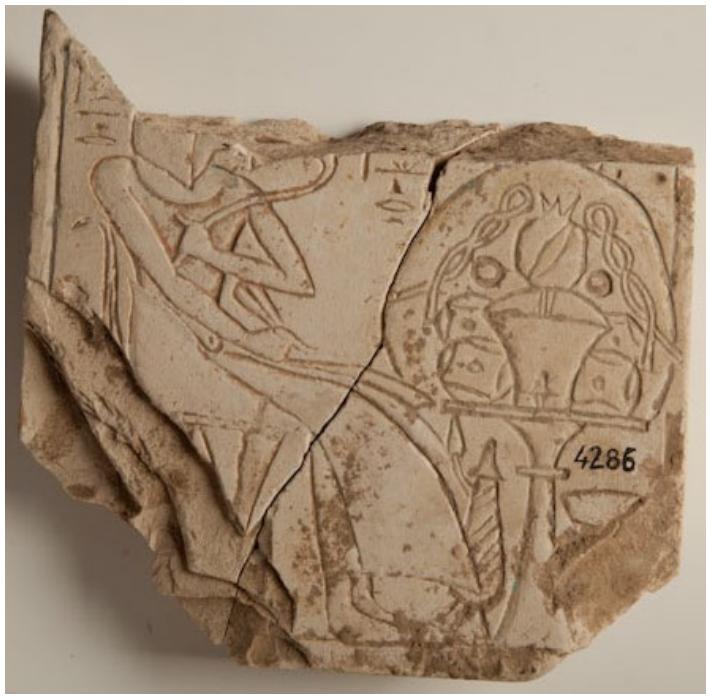
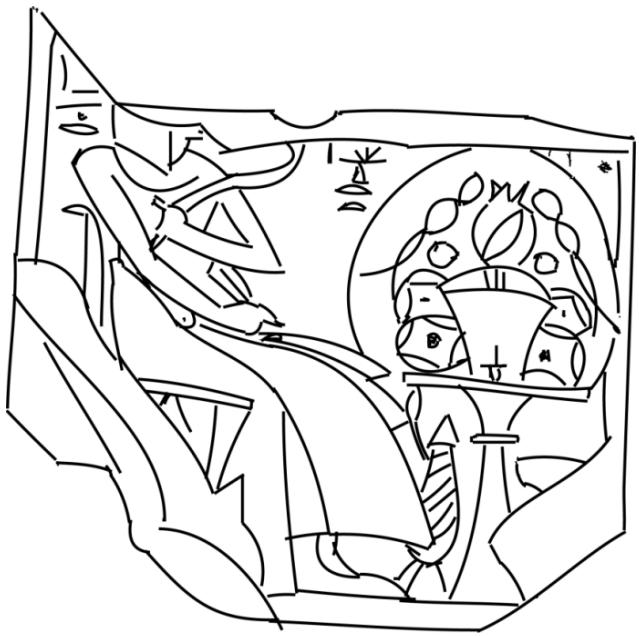
Fig.1: A Ramesside stela fragment No.4286 (photograph courtesy of Cairo Agricultural Museum)
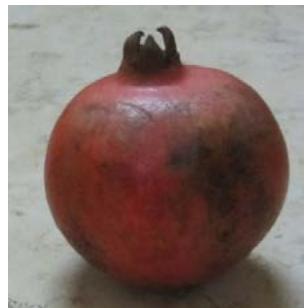
Fig. 2: A Ramesside stela fragment No. 4286 (line drawing by the author)
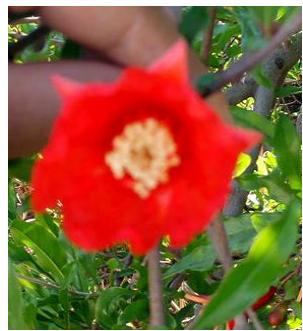
Fig. 3: A comparison between a pomegranate fruit with incised pomegranate in the fragment, (photograph by the author)
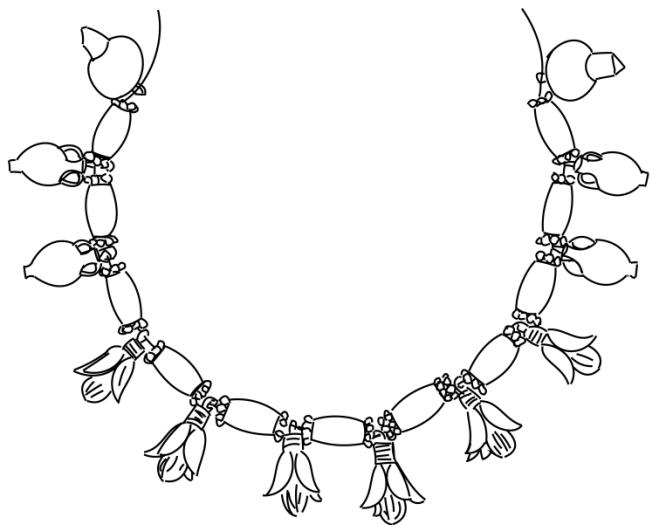
Fig. 4: A comparison between a pomegranate flower with incised pomegranate flower in fragment, (photograph by the author)
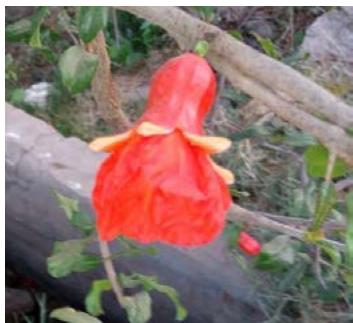
Fig. 5: Gold necklace, Horace L. Mayer Collection, MFA, Inv. No. 48.59, Egyptian Late Period 664-332 B.C. (line drawing by the author after Edward L.B. Terrace, Jul., 1963 "Ancient Egyptian Jewelry in the Horace L. Mayer Collection", AJA67 No. 3, pl.56, fig.14) Fig. 6: A comparison between a pomegranate flower with formed pomegranate flower in necklace, (photograph by the author)
## IV. REMARKS ON THE REPRESENTATIONS AND THE STYLE
- (a) The deceased is shown, his right-hand rests on his thigh and grasps a strip of cloth. This a style occurs in late $18^{\text{th}}$ or more probably the early $19^{\text{th}}$ Dynasty and onwards in Saqqara $^{25}$ and Deir el-Medina $^{26}$, see for example, Leiden Museum Stela V 51 belongs to the scribe and overseer of the cattle of Amun Dejhuty this stela is known from Saqqara $^{27}$ and stela is known from Deir el-Medina: Stela of Semet, Cincinnati Art Museum 1947. 55. $^{28}$
- (b) The style of this chair occurred during the New Kingdom period. See for examples; stela of the Troop Commander swty, Ol 11456 Cairo Museum (Late $18^{\text{th}}$ Dynasty), $^{29}$ Leiden Museum Stela V 51, belongs to the scribe and overseer of the cattle of Amun Djehwty. The stela is dated (end of the $18^{\text{th}}$ Dynasty or early $19^{\text{th}}$ Dynasty) $^{30}$, stela of Cincinnati Art Museum I947.55. Early $19^{\text{th}}$ Dynasty $^{31}$ stela of Egyptian Museum 1/3/25/1 = S.R. 13971, belongs to Roma r-m a, $19^{\text{th}}$ Dynasty, probably from Deir el-Medina $^{32}$ and stela of Puqentef, Pw-kntw.f $19^{\text{th}}$ Dynasty Warsaw, National Museum MN 143341, from Deir el-Medina $^{33}$.
- (c) The kilts rising high at the back of the waist is typical of the Ramesside Period[^34]. See for examples Leiden Museum Stela V 51, belongs to the scribe and overseer of the cattle of Amun Djehwty, the stela is dated (end of the $18^{\text{th}}$ Dynasty or early $19^{\text{th}}$ Dynasty)[^35]. See also the stela of Cincinnati Art Museum 1947.55, Early $19^{\text{th}}$ Dynasty[^36], stela of Egyptian Museum 1/3/25/1 = S.R. 13971, belongs to Roma r-m a, $19^{\text{th}}$ Dynasty, probably from Deir el-Medina[^37] stela ofa shield bearer and warrior of Ramesside times, Glasgow Museums, 28au-13[^38], and stela of Pukentef, pw-qntw.f $19^{\text{th}}$ Dynasty, Warsaw, National Museum MN 143341, from Deir el-Medina[^39].
- (d) The long wig is typical of the Ramesside Period style[^40]. This hairstyle was created under the reign of Amenhotep III. It became well attested only from the time of Tutankhamun and completely common from the reign of Seti I. It became the most usual during the Ramesside Period.[^41] See for examples: stela of shield bearer Hori and warrior Si of Ramesside times, Glasgow Museums, 28au-13[^42], the stela of the general of the Estate of Amun Any and His Notable Family, Cairo Museum (TN 10/6/24/11), Ramesside Period[^43], stela of Egyptian Museum 1/3/25/1 = S.R. 13971, belongs to Roma r-m a, $19^{\text{th}}$ Dynasty, probably from Deir el-Medina[^44] stela of Puqentef, Pw-kntw.f $19^{\text{th}}$ Dynasty, Warsaw National Museum MN 143341, from Deir el-Medina[^45]. Stela of Kaha region of Ramses II, Deir el-Medina[^46], and stela of Hori BM 588, $20^{\text{th}}$ Dynasty, reign of Ramesses IV[^47].
- (e) The big pomegranate fruit placed on the offering table issplit in its middle part to indicate that the fruit is ripe.
## V. DISCUSSION OF THE OFFERINGS
The pomegranate' Punica granatum L. 48
Punica granatum L. (Lythraceae), its name derives from the Latin word 'punicus': Pliny, an Ancient Roman writer, naturalist, and philosopher who lived in the 1st Century A.D., called it 'punicus' considering it originated from
Northern Africa, actually 'punicus' means 'from Carthage', today Tunis.[^49] The English word 'pomegranate' derives from the old French 'pomegranate' which derives from the Latin 'pomum' (apple) and 'granatus' (full of seeds), and so in Italian, 'melograno', and in German 'Granatapfel'.
In Ancient Egyptian language we find the following names for 'pomegranate':
inhmn50 ein Obstbaum und dessen Früchte iwnh3m33 111
P. Anastasi III, 2, 5 Kopt. āpMaN: ČpMaN: λεaMEn 'Granatapfel' (nammur), the Arab word for 'pomegranate' derives, from a common Semitic root.
inhmna tree and fruit (18th Dynasty) inhmny varr P.Ebers 19.19; (18th Dynasty)
nhym33 $\text{口}$ I P. Ebers 16.16; (18th Dynasty)
The different writings and spelling found for the words 'pomegranate' in the Ancient Egyptian language can be explained by the fact that this word was newly introduced to the Egyptian language.[^52]
Further variants of writing the word 'pomegranate':[^53] $nh_{3}m_{33}$ Med. P. Berlin 3038, 1-4; (19th Dynasty) $nh_{3}m_{33}$ Med. P. Berlin 3038, 1-7-1,8; (19th Dynasty) nh3m33 III Gebel el-Silsila Inscription, Ramesse II and Merneptha; (19th Dynasty) nh3m33 III Gebel el-Silsila Inscription, Ramesse II and Merneptha; (19th Dynasty)
iwnh3m33 P. Boulaq 19, 103,1,6,8; (19th Dynasty) iwnm33 P. Boulaq 19, 103,3; (19th Dynasty)
iwnhrrm33 11111 P.Anastasi IV,7,5; (19th Dynasty) iwnrhm33 1110 P.Anastasi IV, 14,5; (19th Dynasty)
iwnhr3m33 1111 I P.Anastasi IV, 14,7; (19th Dynasty) iwnrh3m33 P. Rainer 53,duplicate of P. Anastasi III; (19th Dynasty)
iwnh3m33 P.Chester Beatty V, recto, 8,10; (19th Dynasty) iwnrh3m33 P.Harris I, 16a, 10; 19b.13; 19b 14; 65b 10; 71b 1; (20th Dynasty)
iwnrh3m33 P. Harris I, 56a, 5; (20th Dynasty)
Wb. I, p.98 50
Faulkner, p. 24.51
Pomegranates originated in Mesopotamia, and appeared in Egypt during the Middle Bronze Age,[54] and were probably first introduced during the Middle Kingdom,[55] also, the earliest known archaeological evidence of pomegranates in Egypt dates to the Middle Kingdom or the Second Intermediate Period were used to make red wine and they frequently appear in bouquets and offering tables on walls paintings such tombs as Iineni (TT 81), Menna (TT69), Nakht (TT 52) and Sobekhotep (TT63) and in a scenes displaying kings and high officials while they were offering pomegranates.[56] The earliest complete large desiccated pomegranate fruit dated to the New Kingdom and was found in the tomb of Djehwty (TT110) the overseer of the treasure under Hatshepsut and Tuthmose III. The pomegranate trees decorated several Egyptian gardens in the palaces and houses of King, Queens, and the elite, and afterward, these gardens become an integral part of Egyptian houses, in particular of royalty and elite, and also the garden was an integral part of tombs, funerary and cult temples, and the groves of terraced gardens lined processional routes and temple paths. In Ancient Egypt, the garden is planted with a great variety of trees providing shade and fresh fruits. In a text dated to the reign of Merneptah, Ramesses II's son, (1213 - 1203 B.C.) we read about the beauty of the city of $Pr-R^{c}$ -msw and also how it was rich in apples, olives, figs, and pomegranates. Pomegranate was found in the foundation deposit of Tuthmose III in the Hathor shrine at Deir el-Bahari.[57] Pomegranate flowers and leaves were set in many garlands and collars used in religious and celebratory events, placed around the necks of the dead, worn at the funerary banquet, or draped around statuettes.[58]
Some important representations of pomegranates there are at Tell el-Amarna: in the tomb of Meryre, high priest of the Aten, we can admire representation of the Aten temple garden where are shown flowering pomegranates put among the trees; in the tomb of Huya (TA 01), the royal family has depicted in front of a table full of pomegranates, while Queen Ty is shown holding a pomegranate in her hand. In the daily life of Ancient Egypt, were manufactured pomegranate-shaped artifacts, such as containers and jewelry, and amulets. In the Amarna letters, the inventory of gifts lists one pomegranate of silver, 44 containers of oil decorated with apples, dates and pomegranates, and 6 knives of gold with pomegranate at the top.[59]
Seeds and skin fragments of pome- granatediscovered during an archeological excavation in Egypt indicates that pomegranates were primarily found by the aristocracy or priestly class during the 12th Dynasty $^{60}$. Pomegranate occurs frequently enough in Egypt from at least the New Kingdom onward $^{61}$. It is generally accepted that Thutmose I brought pomegranates back to Egypt after his military campaigns into central Asia $^{62}$. Pomegranate trees are mentioned in his funerary texts(about 1530 B.C.)and appear in tomb paintings of nearly a hundred years later $^{63}$. The inscriptions of the tomb of Sebkhotep show two men carrying pomegranates; one carries a basket, the other a string of fruits tied together $^{64}$. Pomegranate plants are shown on the walls of Thutmosell's Festival Hall at Karnak $^{65}$. Large dried pomegranate fruit was found in the tomb of Djehwty, the estate overseer of Queen Hatshepsut in the fifteenth century B.C. (Dynasty 18) $^{66}$. Ancient Egyptians had been imitating organic forms of pomegranate and its flowers in many artifacts of all materials; cf. nineteen votive faience pomegranates have been discovered in the tomb of Amenhotep II $^{67}$, a silver pomegranate-shaped vessel was included in the funerary offerings to Tutankhamun (1336-1327 ca. B.C.) $^{68}$ vase in the shape of a pomegranate, glass, The Metropolitan Museum of Art, Inv. No.
- 54 Immerwahr 1989:408; Jacomet 2002: 84; Torpey 2008: 1; Whitchurch and Griggs 2010: 223; Nigro and Spagnoli 2018:51.
- 55 According to some scholars, the pomegranates did not arrive in Egypt until the beginning of the New Kingdom, when it was probably brought back from western Asia during the military campaign (early 18th Dynasty). Initially, pomegranates have been available only as an imported product, and only later plants of pomegranates were planted in an Egyptian garden.
- 56 Additional representations of pomegranates in private tombs are found in Userhat's tomb (TT51), Tjanefer's tomb (TT158), Amenamhat's tomb (TT82), Userhat's tomb (TT150), Djeserkarenseneb's tomb (TT38), el-Kab tomb of Paheri Paheri (EK 3).
- 57 Nathalie Beaux, 'Botanical remains in Ancient Egyptian foundation deposits', Meeting on archaeobotanical research in Egypt organized by the Polish Center of Mediterranean Archaeology (PCMA) and the Institut Francais d'Archéologie Orientale (IFAO), Cairo, 26 September 2018).
- In the embalming cache known as KV63, a large number and variety of collars have been found and 17 species of associated plant remains have been identified; among these species of plants, ten were used in the production of floral collars as olive, willow, safflower, flowers of low cornflower, blue lotus, fruits of 'ashwagandha', date palm, papyrus, and leaves of pomegranate.
- 59 Moran 1992:27-34; Kaelin 2004: 108.
- See: Haldane, Cheryl Ward, (Mar., 1990)," Shipwrecked Plant Remains", The Biblical Archaeologist, 53, No. 1, An Underwater View of the Ancient World, 59;Whitchurch, David M., and Griggs, C. Wilfred,2010, 'Artifacts, Icons, And Pomegranates: Brigham Young University Egypt Excavation Project' JARCE, 225-226; Wilkinson, Alix,1998, The Garden in Ancient Egypt,London,39.
- See: Terrace, Edward L.B., Jul. 1963, 272, pl.56, fig.14, n.27.
- 62 Whitchurch, David M., and Griggs, C. Wilfred, 2010, 226; Lilyquist, C., Hill, M., Allen, S., Roehrig C. H., and Patch D. C., 2001, 14; Immerwahr, Sara, Oct. - Dec. 1989, "The Pompegranate Vase: Its Origins and Continuity," Hesperia: The Journal of the American School of Classical Studies at Athens, 58.4, 402; Shaw, I., and Nicholson, P., 2002, Dictionary of Ancient Egypt, The American University in Cairo Press, 108.
- 63 Haldane, Cheryl Ward, (Mar.1990) 59.
- 64 Haldane, Cheryl Ward, (Mar. 1990)59.
- 65 Whitchurch, David M., and Griggs, C. Wilfred, 2010, 226; Wilkinson, "The Garden in Ancient Egypt"138.
- 66 Whitchurch, David M., and Griggs, C. Wilfred, 2010, 226.
- 67 Immerwahr, Sara, Oct. - Dec.1989, 400.
- $^{68}$ Lilyquist, C., Hill, M., Allen, S., Roehrig C. H. and Patch D. C., 2001, 14; Immerwahr, Sara, Oct. - Dec. 1989, 401.
26.7.1180, New Kingdom, Dynasty 19th-20th, 1295-1070 ca. B.C. $^{69}$ This vase may have contained a precious oil or perfume, or perhaps a pomegranate beverage which was often added to wine, $^{70}$ pomegranate vessels from Hathor temple, Serabit el-Khadem, Sinai, Ashmolean Museum, Oxford(E4486) later $18^{\text{th}}$ -19th Dynasty date $^{71}$ four pomegranates are items of gold necklace, Museum of Fine Arts, Boston, Inv. No. 48.59, Late Period $^{72}$. Petals of pomegranate, part of a garland, Manchester Museum no. 6332, Roman Period $^{73}$, a small pomegranate tapestry (3.5 x 5.25 cm) with a cross-section view of fleshy seeds and pithy membranes that separate them, and a pomegranate tapestry of plain weave textile, discovered in the Fag el-Gamous necropolis, Fayum, during the 1987 dig season in different burials, used as shrouds, Graeco-Roman Egypt $^{74}$. In Ancient Egypt, "as an alternative to grape wine, there were date wine, fig wine which was very alcoholic, and also a pomegranate wine that is maybe to be identified with the drink called in Ancient Egyptian Language: 'scedeh' $^{75}$
s dh ein dem Wein, verwandtes Getränk,suss und berauschend auch bei der Herstellung der Osirisfigur (aus Sand, Weihrauch, Wein) auch
$$
\begin{array}{c} \text{xix} \\\text{xix} \end{array} = \begin{array}{c} \text{xix} \\\text{xix} \end{array}
$$
Auch als Opfer für Tote und Götter
$\check{s}d h^{77}$ - III'pomegranate wine
The labels on the pomegranate wine jars usually describe the $\check{sd}h$ wine with the adjectives $\updownarrow$ and $\updownarrow$ "good" and "very good".
Moreover, there is a debate about the real existence of a pomegranate wine: some scholars proposed that $\check{\mathsf{sd}}h$ was added as a flavoring of wine and recent studies[^78] have concluded that the $\check{\mathsf{sd}}h$ drink was made from red grapes.
The appearance of the pomegranate lying across the top of the pile of offerings, and its use as a main item in the offerings is unusual on offering tables. However, one can compare the offerings of this fragment with the gold necklace, MFA, Inv. No. 48.59[^79](fig.5) to interpret these offerings.
First. The arrangement of items of offerings on the offering table of the fragment (Agricultural Museum No.4286) from top to bottom is one pomegranate, a covered bowl filled with liquid $^{80}$, and four flowers are depicted from the face $^{81}$. The word $nhh$ is incised on the top of these offerings.
- $^{69}$ Lilyquist, C., Hill, M., Allen, S., Roehrig C. H. and Patch D.C., 2001, 14, fig.p.14.
- See: Lilyquist, C., Hill, M., Allen, S., Roehrig C. H. and Patch D. C., 2001, 14, fig. p.14; Another reference is from the New Kingdom love poetry;
P. Turin 1966, 1/2-4 refers to pomegranate wine. Thompson, Stephen E., Jan., 1994, 19; See also about pomegranate wine in ancient Egyptian love poem, from papyrus Harris500, New Kingdom, Lichtheim, Miriam, (without date), Ancient Egyptian Literature, II the New Kingdom192.
- 71 See: Simpson, P.1990, "Egyptian Core Glass Vessels from Sinai" JEA 76 185-186. Shaw and Nicholson mentioned that the pomegranate introduced in the New Kingdom, became a popular shrub, and its flowers were important in the garden. Shaw, I., and Nicholson, P., 2002, 108.
- 72 See: Terrace, Edward L. B., Jul. 1963, 272, pl.56, fig.14n.27. Necklace of flower and amphora-shaped pendants, www.mfa.org/ collections/object/necklace-of-flower-and-amphora-sh.
- 73 Germer, Renate, 1987,246
- 74 Whitchurch, David M., and Griggs, C. Wilfred, 2010, 222, Figs. 18, 19, 20.
- 75 (Edda Bresciani, "Serpente che mangia non ha veleno. Ricette e segreti alla mensa dei Faraoni." Maria Fazzi Editore, Lucca, 1993, p. XXVII).
- 76Wb. Vierter Band, p.568
- 77 Faulkner. p.274
- 78 (Guash-Janéet, 2006: 98)
- 79 See: Terrace, Edward L.B., Jul., 1963, 272, pl.56, fig.14, n.27; Necklace of flower and amphora-shaped pendants, www.mfa.org/ collections/object/necklace-of-flower-and-amphora-sh.
- 80 Demarée mentioned that they resemble vessels on an offering table full of grapes, but they are full of liquid. See the faucet at the lower part of the vessel. Cf. stela of Bukentef, pw-qntw. f, $19^{\text{th}}$ Dynasty, Warsaw, National Museum MN 143341, from Deir el-Medina Demarée, R.J., 1983, 31, pls.III, XIV, A8. Cf. also: a vessel on offering table, stela of Panakh(t)emwese, pAnxt m wAst, $19^{\text{th}}$ Dynasty, Turin, Museo Egizio 50020, from Deir el-Medina, stela of Egyptian Museum 1/3/25/1 = S.R. 13971, belongs to Roma r-m a, Nineteenth Dynasty, probably from Deir el-Medina and stela of Khamuy, xAmwy, $19^{\text{th}}$ Dynasty, Cannes, Musée Archéologique 7, from Deir el-Medina, Demarée, R.J. 1983, 47 80, 83, pls.V, A15, VIII, A28, IX, A33. See also: stela of Pahatia pA-HAty-a, $19^{\text{th}}-20^{\text{th}}$ dynasty, Turin, Museo Egizio 50015, from Deir el-Medina and stela of Mersakhmet, mry-sxmT $19^{\text{th}}$ Dynasty, Turin, Museo Egizio 50017, from Deir el-Medina. Demarée, R.J., 1983, 50, 65, pls.V, A16, VII, A22.
- 81 Demarée mentioned that the resemble inscriptions are ciDcular loaves, stela of Egyptian Museum 1/3/25/1 = S.R. 13971, belongs to Roma r-m a, Nineteenth Dynasty, probably from Deir el-Medina and stela of Khamuy, 13mwy, $19^{\mathrm{th}}$ Dynasty, Cannes, Musée Archéologique 7, from Deir elMedina. Demarée, R.J., 1983, 80, 83, pls.VIII, A28, IX, A33. But they are flowers Cf. fig.4 and the flowers are depicted from the face on head bandage of princess Nefert, Fourth Dynasty, Egyptian Museum, first floor, hall 32. Aldred, Cyril,1949, Old Kingdom Art In Ancient Egypt, (London, 1949),fig.10;Aldred,Cyril, 1971,Jewels of the Pharaohs, London,fig.18;See also the incised flowers on the crown of Princess Sit-Hathor-Yunet, from Lahun, Middle Kingdom,the incised flowers on circlet and achieved flowers on long head dress of a queen of Tuthmosis lll from Thebes. Aldred, Cyril 1971, figs. 39, 61, 62.
Second. The arrangement of items of the necklace is one pomegranate on each side (they are votive fruit and not a container in the shape of a pomegranate), two amphorae on each side, and six pomegranate flowers (Cf.fig.6). One can notice the same arrangement in both. The pomegranate, the vessels, and the flowers are items in both. Comparing the two objects, the flowers that are depicted on the offering table are pomegranate flowers. The vessel on the offering table may contain pomegranate beverages $^{82}$ compared to the vessels that formed the items of the necklace, which are supposed to refer to the pomegranate beverage according to necklace items. The gold necklace consists of two pomegranates, four two-handled amphorae, six floral pendants of pomegranate flowers, and eleven carinated barrel-shaped used as separators. All of which have a single row of beading at the ends. Only one of them has two rows of beading at each end which means they are two one is inside the other the total of separators is twelve. The total of other items of the necklace is twelve also.
The total of all items of the necklace is 24. Perhaps this number points to 24 hours of day and night, or the number 12 of both points to 12 months of the year according to the Ancient Egyptian calendar. This explains the word $nhh$ that was incised on the top of our offering table which means that the deceased will receive the offerings of pomegranate and its beverage in the other world during the night and day throughout the year. Probably, the pomegranate fruit indicates that the deceased is eating fresh pomegranates, the carinated barrel-shaped symbolizes the barrels where the pomegranate beverage is made, while pomegranate flowers point to the presence of pomegranates for the deceased in the future, the amphorae indicate that the deceased drinks pomegranate beverage in it. It means that the deceased is eating fresh pomegranate and pomegranate beverages and will also eat them in the future, due to the existence of pomegranate flowers. This also applies to the offerings of our fragment.
One can notice also that the table of offerings and the loaded offering on it with the outer cover[^83] of offerings look like a flowering and fruitful tree, perhaps a pomegranate tree was intended.
Numerous sources Egyptian, Graeco-Roman, Jewish, and Christian, illustrate the pomegranate as a symbol of life, death, prosperity, or the hope of regeneration in an afterlife. Because of pomegranates blood-red juice and many seeds, the Egyptians of the New Kingdom onwards recognized its suitability as a funeral offering, and they used the pomegranates as a symbol of life after death[84]. The red color of pomegranate seeds symbolizes blood and life[85]. Of importance for this study are two pomegranate amulets from the Osirian temple inscriptions at Denderah, where a connection between Osiris and resurrection has long been agreed[86]. Pomegranate was used also in Ancient Egyptian medicine.
## VI. CONCLUSIONS
This fragment of a stela sheds new light on the importance of pomegranate as the main funerary offering through Ramesside times. The right hand of the deceased rests on his thigh and grasps a strip of cloth is a style that occurs in the late Eighteenth or more probably the early Nineteenth dynasty and onwards in Saqqara $^{87}$ and Deir el-Medina. $^{88}$ The owner wears an ankle-length kilt rising high at the back of the waist a style that occurs in Saqqara $^{89}$ and Deir el-Medina $^{90}$ through Ramesside times. The fashion of dress and wig points to Ramesside times and Deir el-Medina $^{91}$. The long wig is typical of the Ramesside Period style $^{92}$. The style of the chair occurred during the Ramesside times in Deir el-Medina $^{93}$. The libation vessel on a wickerwork stand a style points to the late $18^{\text{th}}$ or more probably the early $19^{\text{th}}$ Dynasty and it occurs in Deir el-Medina $^{94}$. The epithets $\mathfrak{z}\mathfrak{h}$ ikrand $\mathfrak{z}\mathfrak{h}$ ikr n r were common
- 82 Pomegranate wine was found in Ancient Egypt throughout the New Kingdom period. See: Williams, Ronald J., 1972,218, P. Anast. IV, 2, IV 3 (which dates to the reign of Seti II, See Gardiner, A. H., 1937, 37-38;Cf. Lilyquist, C., Hill, M., Allen, S., Roehrig C. H. and Patch D. C., 2001,14,fig.p.14.Other reference is from the New Kingdom love poetry P. Turin 1966, 1/2-4 refers to pomegranate wine. See: Thompson, Stephen E., Jan., 1994, 19
- 83 See the cover on offerings, stela of Pahatia pA-HAty- a, $19^{\text{th}}$ -20th dynasty, Turin, Museo Egizio 50015, from Deir el-Medina and stela of Merysakhmet, mry- sxtM, $19^{\text{th}}$ Dynasty, Turin, Museo Egizio 50017, from Deir el-Medina. Demarée, R.J., 1983, 50, 65, pls.V, A16, VII, A22.
- 84 Seelmerwahr, Sara, Oct. - Dec. 1989, 405.
- 85The red color of pomegranate seeds has a religious symbolism; it associates with 'life' and 'rebirth'. See: -Lurker M. 1996,100.
- 86 Whitchurch, David M., and Griggs, C. Wilfred, 2010, 226.
- See: Leiden Museum Stela V 51 belongs to the scribe and overseer of the cattle of Amun Dejhuty, this stela is from Saqqara. Affara, Manal, 2010,147, 151, fig.1.
- See: stela is known from Deir el-Medina: Stela of Semet, Cincinnati Art Museum 1947.55. Martin, Geoffrey T., 182, 81, 4 Pl. IX (2).
- 89 Cf. Leiden Museum Stela V 51Affara, Manal, 2010, 151, fig.1.
- 90 See: stela is from Deir el-Medina: Stela of Semet, Cincinnati Art Museum I947.55. Martin, Geoffrey T., 1982, 81, 84 Pl. IX (2).
- 91 Cf. Stela of Kaha, region of Ramses II, Deir el-Medina Clere, J.J., 1929, 188, fig.2
- 92 Thomson, James K., 1997, 218-219, fig.1.
- 93 See: Cruz-Uribe, Eugene, 1978, 238, Fig.1; Martin, Geoffrey T., 1982, 81-82, 84, Pl.IX(2); Demarée, R.J., 1983, 31, pls.III, XIV, A8.
- 94 See: Martin, Geoffrey T., 1982, 81, 84, PI. IX (2).
throughout Ramesside times. The way of the writing m3<sup>f</sup> brw is the most commonly found on the monuments of Ramesside times in Deir el-Medina[^95]. Fruit offerings generally were common throughout New Kingdom Period.
Based on above mentioned iconographical, palaeographic, epigraphic, and stylistic features, the fragment of our stela is likely to date through Ramesside times (19thDynasty-20thDynasty), and perhaps its provenance is Deir el-Medina.
## ACKNOWLEDGMENTS
### Dictionaries
1. Erman A., Grapow H., 1971. 'Wörterbuch der ägyptischen Sprache', Berlin. Akademie Verlag.
2. Faulkner, Raymond O. 2006. 'A Concise Dictionary of Middle Egyptian', Oxford, Griffith Institute.
#### Web sites
1. http://cronfa.swan.ac.uk/Record/cronfa23790
2. www.mfa.org/collections/object/necklace-of-flower-and-amphora-sh;Necklace of flower and amphora-shaped pendants_
[^3]: Demarée, R.J., 1983,80,pl.VIII,A28. _(p.5)_
[^4]: Demarée, R.J., 1983, 80, pl. VIII, A28. _(p.5)_
[^21]: $^{21}$ Cf. Griffin, K. 2007, 144, figs.1-2; http://cronfa.swan.ac.uk/Record/cr onfa23790 _(p.3)_
[^22]: Demarée, R.J., 1983, 146. _(p.3)_
[^23]: Cf Griffin, K. 2007, 144, figs. 1-2; http://cronfa.swan.ac.uk/Record/cr onfa23790 _(p.3)_
[^24]: Griffin, K. 2007, 144, figs.1-2; http://cronfa.swan.ac.uk/Record/cron fa23790 _(p.3)_
[^34]: See: Glasgow Museum Stella, 28au-13.Thomson, James K., 1997, 218-219, fig.1. _(p.5)_
[^35]: See: Affara, Manal, 2010, Figs.1,2. _(p.5)_
[^36]: Martin, Geoffrey T., 1982, 81-82, 84, Pl.IX(2). _(p.5)_
[^38]: See: Glasgow Museum Stela, 28au-13.Thomson, James K., 1997, 218-219, fig.1. _(p.5)_
[^39]: Demarée, R.J., 1983, 31, pls.III, XIV, A8. _(p.5)_
[^40]: Thomson, James K., 1997, 218-219, fig.1. _(p.5)_
[^41]: Metawi, Rasha, 2009, "The "General of the Estate of Amun" Any and His Notable Family Cairo Museum Stela (TN 10/6/24/11)", JARCE45, 295, fig.1; Vandier, J. 1958, Manuel d'Archéologie 'Egyptienne. III, Les Grandes 'Epoques. La Statuaire Paris, 485-86(H). For further occurrences on Ramesside Stelae see also: Thomson, James K., 1997, 218, fig. 1; Martin, Geoffrey T., 1982, 81-82, 84, Pl. IX(1). _(p.5)_
[^42]: See: Glasgow Museum stela, 28au-13.Thomson, James K., 1997, 218-219, fig.1. _(p.5)_
[^43]: Metawi, Rasha, 2009, 295, figs1-2 _(p.5)_
[^45]: Demarée, R.J., 1983, 31, pls.III, XIV, A8. _(p.5)_
[^46]: Clere, J.J., 1929,188, fig.2. _(p.5)_
[^47]: Janssen, Jac. J. Dec., 1963, "An Unusual Donation Stela of the Twentieth Dynasty", JEA 49, 65, Pl.IX. _(p.5)_
[^49]: The pomegranate is a citrus fruit belonging to the 'Lythraceae' family and it is a native plant from Asia Minor, Persia, and Afghanistan; pomegranate is today widely cultivated throughout the Mediterranean basin, both for the production of fruits and for ornamental purposes. The Phoenicians imported the pomegranate plant from Iran and they were probably the first growers in Carthage, so the Romans believed it originated from this country, and Pliny, presumably misunderstanding its origin, called the plant 'malum punicum' i.e. "Cathaginian apple". It is believed that the word can also derive from the Latin word 'puniceus' i.e. "purple, "scarlet", with allusion to the fruit, flowers, and seeds' color. _(p.6)_
[^52]: Klotz (2010: _(p.6)_
[^95]: Cf. stela of Kaha, region of Ramses II, Deir el-Medina Clere, J.J., 1929188, fig.1. _(p.10)_
[^1]: Demarée, R.J., 1983, 145.
[^2]: Demarée, R.J., 1983, 145.
[^5]: Demarée, R.J., 1983, 145.
[^6]: Demarée, R.J., 1983, 145.
[^7]: Demarée, R.J., 1983, 145.
[^37]: Demarée, R.J., 1983, 145.
[^83]: Demarée, R.J., 1983, 145.
[^12]: This style of the wickerwork stand points to the late Eighteenth or more probably the early $19^{\text{th}}$ dynasty, stela is known from Deir el-Medina: Stela of Semet, Cincinnati Art Museum I947.55., see: Martin, Geoffrey T., 1982, 81, 84, Pl. IX (2). _(p.2)_
[^13]: $^{13}$ Demarée, R.J., 1983, 102, pl.X, B38. _(p.2)_
[^14]: $^{14}$ Demarée, R.J., 1983, 46, pl.V A14. _(p.2)_
[^15]: Demarée, R.J., 1983, 146. _(p.2)_
[^17]: Demarée, R.J., 1983, 145. _(p.2)_
[^18]: See: Martin, Geoffrey T., 1982, 81, 84, Pl. IX (2). _(p.2)_
[^20]: The inscription of m3c-hrw in our fragment is typical of the Ramesside Period and Deir el-Medina style. Cf. stela of Kaha, region of Ramses II, Deir el-Medina. Clere, J.J.1929, 'Monuments Inéredits des Serviteurs dans la Place de Verité', BIFAO 28, 188, fig. 2; Demarée, R.J., 1983, 185. _(p.2)_
[^25]: Affara, Manal, 2010, 147, 151, fig.1. _(p.5)_
[^26]: See a stela from Deir el-Medina: Stela of Semet, Cincinnati Art Museum I947.55. Martin, Geoffrey T., 1982, 81, 84, Pl. IX (2). _(p.5)_
[^27]: Affara, Manal, 2010,147, 151, fig.1. _(p.5)_
[^28]: Martin, Geoffrey T., 1982, 81, 84, Pl. IX (2). _(p.5)_
[^29]: See: Cruz-Uribe,Eugene, 1978, 238, Fig.1. _(p.5)_
[^30]: See: Affara, Manal, 2010, Figs.1, 2. _(p.5)_
[^31]: Martin, Geoffrey T., 1982, 81-82, 84, PI.IX(2). _(p.5)_
[^32]: Demarée, R.J., 1983, 80, pl.VIII, A28. _(p.5)_
[^33]: Demarée, R.J., 1983, 31, pls.III, XIV, A8. _(p.5)_
[^48]: Germer, Renate, 1987, "Ancient Egyptian Plant-Remains in the Manchester Museum", JEA 73, 246. _(p.5)_
[^225]: states that the Egyptian word for 'pomegranate' is a loan word that corresponds to the Sumerian 'Nuzinurumu'. _(p.6)_
Generating HTML Viewer...
References
73 Cites in Article
Manal Affara (2010). Society Memberships.
Nora Scott (1962). A Stela and an Ostracon: Two Acquisitions from Deir el Medineh.
Geoffrey Martin (1982). Unknown Title.
Manal Affara (2010). Society Memberships.
Geoffrey Martin (1982). Normen, Richtlinien, Vorschriften.
Manal Affara (2010). Unknown Title.
Geoffrey Martin (1982). Unknown Title.
R Demarée (1983). Unknown Title.
R Demarée (1983). Acknowledgements.
James Thomson (1997). About the Author.
Manal Affara (2010). Supplemental Information 12: Pedal digit proportions for selected ornithischians (see Figs S6–S7)..
Geoffrey Martin (1982). Unknown Title.
R Demarée (1983). Unknown Title.
James Thomson (1997). About the Author.
R Demarée (1983). Unknown Title.
James Thomson (1997). About the Author.
Rasha Metawi (2009). The Stela of the Outline Draftsman <i>Ṯnr</i> and His Family (Cairo Museum JE 18924).
J Vandier (1958). Manuel d'Archeólogie 'Egyptienne. III, Les Grandes 'Epoques.
James Thomson (1997). About the Author.
Rasha Metawi (2009). Mery-Maat, an Eighteenth Dynasty iry ‘3 n pr ptḥ from Memphis and His Hypothetical Family.
R Demarée (1983). Sustaining Members.
R Demarée (1983). Unknown Title.
J Clére (1929). Unknown Title.
Jac. Janssen,Dec (1963). An Unusual Donation Stela of the Twentieth Dynasty.
Renate Germer (1987). Ancient Egyptian Plant-Remains in the Manchester Museum.
Explore published articles in an immersive Augmented Reality environment. Our platform converts research papers into interactive 3D books, allowing readers to view and interact with content using AR and VR compatible devices.
Your published article is automatically converted into a realistic 3D book. Flip through pages and read research papers in a more engaging and interactive format.
Publication of a Ramesside Stela fragment made of fine white limestone, with figure and remains of text engraved with a sunk inscription (figs. 1-2). The Stela is kept in Cairo Agricultural Museum and according to the museum register the stela bears identification no.
Our website is actively being updated, and changes may occur frequently. Please clear your browser cache if needed. For feedback or error reporting, please email [email protected]
Thank you for connecting with us. We will respond to you shortly.