## I. INTRODUCTION
"Let China sleep; when she wakes, she will shake the world." Two centuries ago, Napoleon warned.
In several cases, US-China ties would be the most complicated and critical part of American foreign policy planning. With a population four times that of the U.S. (1.3 billion), China is the largest trade country and the second-largest economy, its economy has expanded rapidly and is now second only to that of the U.S. and it would only need to grow quietly to exceed the GDP of the U.S. by 2035 at the latest in 2040. Furthermore, China has established a military that - while not as advanced as the U.S. is second in the world, and is highly proficient in deploying resources and creating allies along with the globe in ways that will challenge America's ability to react directly to events in the escalation regions. Based on this, the U.S. administration of late has started to concentrate to rival China. And moving to the stage of accepting the reality of the amazing competition and the possibility of a strong war.
In his published book a political scientist Graham Allison - Harvard Kennedy School warned if China and the U.S. persist on their current routes, "war... in the decades ahead is not only probable but also more likely than commonly recognized... They would almost definitely end up at war." And what the author contained frightening and benevolent news in his book: With the emergence of great power (Athens or China) disrupts the approach of the formerly strong state (Sparta or U.S.), And this "transitional friction" pushes the old power to initiate crises that eventually lead to war. In Allison's case studies, twelve (12) of the sixteen (16) events over the last 500 years have ended in war (Allison, 2015).
This paper argues that the U.S. hidden agenda to increase the demonization of China follows the colonialism approach of U.S. imperialism, including Washington's selective use of "human rights" to restrain China from growing stronger. The authors endeavor to put forth a persuading defense to enhance the overall arguments that conflict between the U.S and China isn't unavoidable. By responding to the fundamental question, Will Biden's strategy turn from into policy of competition and confrontation to a real fight?
## II. AMERICAN IMPERIALISM APPROACHES
During the last years of the Obama administration, senior authorities like secretary of Defense Ash Carter started openly talking about incredible force competition, and the Joint Chiefs of Staff presented a possibility developed that incorporated the need to get ready to challenge China and the rising power of Russia. However, The Trump administration's National Security Strategy in 2017 and the National Defense Strategy in 2018 assumed the multidimensional nature of competition between China and Russia on the one hand and the U.S on the other (Mahnken, 2020, P, 4). In this regard, according to the Council on Foreign Relation (2021) report, former President Trump expanded his campaign against Chinese companies in the last weeks of his position (Nov. 2020 to Dec. 2020). former director of National Intelligence of the U.S John Ratcliffe designated China "the greatest threat to America today". At a time when the U.S Ministry of Commerce listed a number of Chinese organizations and companies, among them, the largest country chipmaker, Semiconductor Manufacturing International Corporation (SMIC), On the trade sanctions list. Moreover, the Ministry of Foreign Affairs has tightened the visa issuance procedure for nearly ninety million people of the Communist Party of China. It is sanctioning other officials of china too, including fourteen members of the Chinese legislature, for the abuses in Hong Kong and Xinjiang, and elsewhere. Moreover, the White House prohibits the U.S investment in companies of China that it says are linked to the Chinese People's Liberation Army.
In contrast, the Chinese officials have not delayed opposing these and other measures. And the acts went into effect immediately. According to Bloomberg News - published on January 12, 2021, China also continued in its response to the U.S sanctions, it has enacted new laws to protect its companies from unreasonable U.S laws, which came to allow Chinese courts to punish international companies that adhere to foreign restrictions. Based on the Ministry of Commerce regulations, contrasting unreasonable extraterritorial application rules in foreign law, Chinese authorities allow issuing orders exempting companies or individuals in China from external restrictions. The law allows Chinese citizens, and Chinese companies to seek reparations from Chinese courts if their interests are harmed and if foreign laws are enforced. In addition, China imposed sanctions on twenty-eight (28) US citizens during the same period, among them are former Secretary of State Pompeo and other Trump-era officials.
Wong, B, (2021) depicts that it was an act of retaliation by China following a year of sanctions from both sides of the Pacific. And under the Uyghur Human Rights Policy Act, in July 2020, the US subdued senior Chinese officials with sanctions imposed. Amid condemnation from the Chinese government the instruction President Trump signed up for in August 2020 regarding the ruling Autonomy in Hong Kong. China rebuked the allegations of the U.S and directly targeted U.S senators with sanctions - including Ted Cruz and Marco Rubio.
As part of their ongoing attempts to pressure China, President Biden also hosted the first virtual summit of the Quartet (the U.S. Japan, Australia, and India) on March 12, Telis (2021) argues that indeed the meeting that had taken indicates that the Quartet was not doing as it should institutionalize itself, it will potentially become the main institution in combining America's democratic allies "In the Indo-Pacific" to work on solving the complex problems with China. In other words, act to thwart China's ambitions and increase its aggressiveness by further intensifying cooperation. In early March, however, The Japanese service Nikkei New published a few instructions from the Pentagon's Pacific Deterrence Initiative, ordering the deployment of offensive missiles, previously prohibited on populous islands including Japan, Taiwan, and the Philippines, under its Intermediate-Range Nuclear Forces (INF) Treaty. The Pentagon had requested an annual Pacific budget of nearly $4.7 billion to fund this initiative, according to the Nikkei, more than double the $2.2 billion allocated to the region in the fiscal year 2021 (Damon, 2021). In the same regard, based on the White House Website on APRIL 05, 2022 Australia Prime Minister Scott Morrison, P.M of the United Kingdom Boris Johnson, and U.S President Biden announced a partnership agreement. so-called (AUKUS). The presidents demonstrated their obligation to a free and open Indo-Pacific, as well as a global system that upholds human rights, the rule of law, and non-coercive dispute resolution. This new coalition, though, is plainly aimed at China.
However, figure (1) below shows the Indian and Pacific Oceans area map.
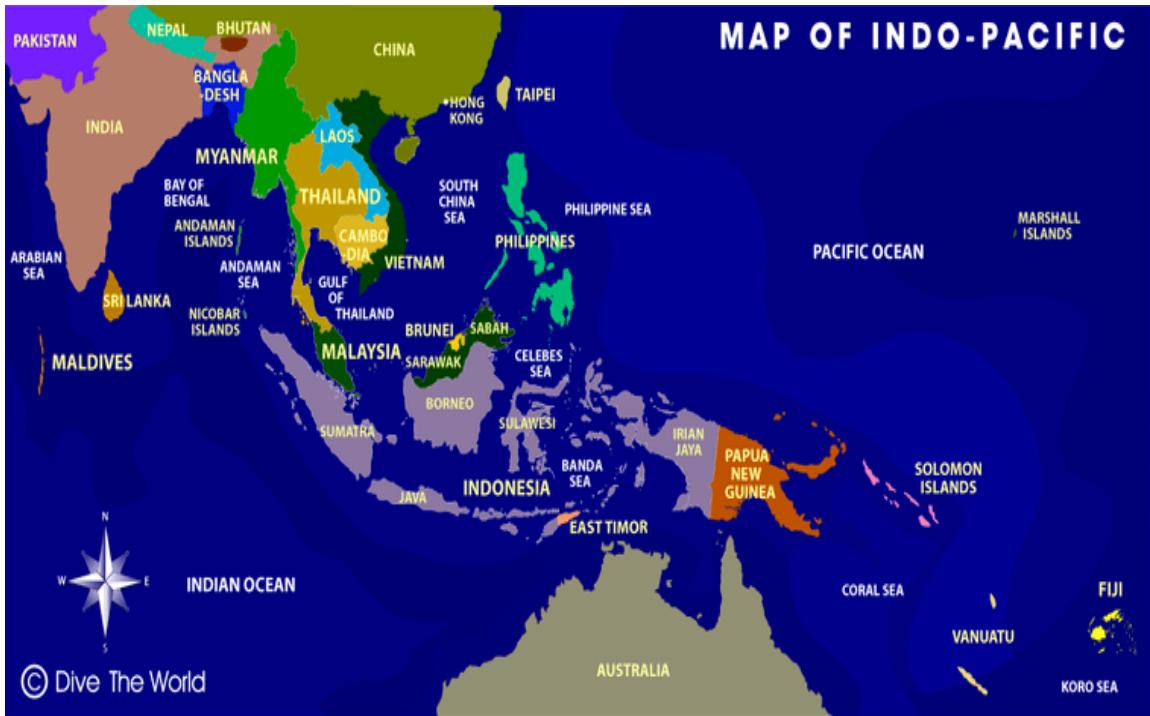 Source: The Conservation Web Figure 1: The Indian and Pacific Oceans area map.
With Its imperial policies, the U.S and its allies (EU, Canada, and the UK) prepared the ground for confrontation in Alaska on March 22, 2021, by sanctioning Chinese officials over a newly introduced tightening of the law (The voting System in Hong Kong). they also targeted Communist Party Secretary of China Wang Jincheng, Xinjiang Production and Construction, and Chen Minguo, director of the Xinjiang Public Security Bureau. for "gross human rights violations" against Uyghur Muslims: the imposition of asset freezes and travel restrictions (Symonds2, 2021).
In this situation, Gaouette and Frater wrote on CNN, on March 23, 2021, A series of carefully coordinated statements (regarding the U.S and its allies present in Europe, North America, and the Asia-Pacific region, united and made a unified show of force for them). announcing sanctions aimed at isolating and putting pressure on Beijing. As for the so-called "Smart Five Eyes" coalition, which was defined by a nomination from the U.S and a joint statement by the US Secretary of State, Anthony Blinken, and the Secretary of State, which consists of (the U.S the UK, Australia, Canada, and New Zealand). Nonetheless, Sidhu (2021) asserts that the Five Eyes joint statement states, "The evidence, including the Chinese government's documents, satellite imagery, and witness testimony, is overwhelming. China's comprehensive offensive program includes severe restrictions on religious freedom, the use of forced labor, and detention in detention centers. Forced sterilizations and the planned destruction of Uighur heritage, While the Chinese government has made it clear that any involvement in their "internal affairs" is not welcome, and they will continue to dispute the charges. Therefore, in April 2021 China's ambassador to Australia, Cheng Jingye, summoned journalists to the Chinese embassy, the ambassador was determined to send a strong message to Australian journalists that China is determined to face what it sees as a massive mountain of lies publicity surrounding its treatment of the Uyghur minority (Walker, 2021). From the perspective of the Chinese Communist Party (CCP) and other Chinese media, Western promotion of "universal values", democracy and the promotion of human rights is a part of a deliberate strategy of "peaceful evolution" (Hépíng yǎnbian). This means, in the Chinese sense, a Western conspiracy to change the internal social, cultural, and normative composition of socialist states to bring about regime change (Oudenaren, 2015). However, from his side, the chief Chinese diplomat Yang Jiechi stated: "We hope that the U.S will do better on human rights... The fact is that there are many problems within the U.S regarding human rights, which is admitted by the US itself," "We believe that it is important for the U.S to change its image and to stop advancing its democracy in the rest of the world," he said. "Many people within the U.S have little confidence in the democracy of the US." Jiechi said. (McCurry, 2021).
## III. THE CHALLENGES
On March 23, 2021, Richard Haass and Charles Kupchan wrote in Foreign Affairs Magazine, that there will be two competitors: The U.S and China. However, the U.S and its democratic allies will not stop criticizing liberalism in China, Russia, or anywhere else, and will do their best to spread democratic values and practices. therefore, China and the others are free to attack the policies of liberal states and publicly disseminate their views. In a related context, Dollar and Hass (2021) pointed out that one of the main problems between the U.S and China is the setting of trade, and Investment measures outside advanced economic standards: including extensive non-tariff barriers such as arbitrary and variable rules. Moreover, In many sectors, restrictions on foreign investment, and protection of intellectual property rights have been imposed (IPRs), besides, technology transfer through various means, a colossal role of SOEs the economy with cheap access to land and finance and subsidies to develop specific technology. Whereas Wong, A. (2021) referred that much of the horror also center Among the projects was a broad-based, Chinese-funded infrastructure project, from railways to ports, dubbed the "Belt and Road Initiative" (BRI), and critics described it as a contemporary imperial project. US officials also accused China of engaging in the Belt and Road Initiative, "debt diplomacy," allegedly wearying beneficiary states with substantial loans and then extracting strategic concessions from them while they may not be able to repay.
In an attempt to illustrate the background of the conflict, however, Russonello (2021) pointed out that the relationship between the two countries is as complicated as it is important. The challenges have recently arisen over the Trump administration's trade war, as well as the issue of Hong Kong, Uighur Muslims, and the Chinese alleged role in cyber-attacks against the U.S. Meanwhile, Lohman and Walters (2020) argued that it was the increase in the Chinese economy that caused increased tension between Beijing and Washington. In addition, China defied the rules-based international system regarding shipping lanes along the Pacific coast and defied half of the world's trade that passes through these waters. China had long-threatened Taiwan, arguing that China had the right to use any way necessary. Like using her power to force the return of the Dissident Province.
In addition to the aforementioned problems, however, there is another important challenge facing the U.S namely China's activities in the Arctic. According to the report published in April 2021 by Brookings Institution, the authors argue that China wants to become a "major polar power" by 2030. based on the military texts in China, it considered the arctic a military competence for the future. The report revealed that
China had sent senior persons to the territory during the two past decades around 33 times, associated with some of the major Arctic institutions, as well targeted half a dozen scientific institutions in the Arctic, and also created some likely economic projects of dual-use. In addition, worked on expanding its navy of icebreakers, and it also sent its warships to the region. It also classified (Canada, Denmark, Finland, Iceland, Norway, Russia, Sweden, and the U.S) as the eight sovereign states in the Arctic. have greatly influenced the Arctic and its geography of strategic value, that's why China aspires to be one of them (Doshi, et al. 2021). To counter these activities, the US and Germany seek to go back to the close navy cooperation. This desire seemed clear in the pledge made via the U.S Defense minister Lloyd Austin and Annegret Kramp-Karrenbauer defense minister of German which was held in Berlin. Instead of reducing the U.S troop deployment in Germany by 12,000, as was said in President Trump's plan, Austin promised to increase the number of troops to 500. Then Schwartz (2021) added that the truth is that the overt strong wobble between the U.S and Germany had nothing to do with freedom, democracy, and human rights, but rather from the conflict arrangement toward China when the Biden administration had been pressing with the remarkable force of since he became president.
Additionally, Bandow noted in a 2018 article, perhaps even additional problematic for America, to recruit American companies and make them part of the political campaign of the People's China, Beijing had worked to use its economic influence. Although China had long negotiated to connect its market to Western technology, President Xi Jinping threatens to punish foreign companies that ignore to help isolate Taiwan by Treating the island as an independent region, and this behavior had added a new dimension to China's reaching to its goal. For this point, Wu Xinbo (2011) argues that China has insisted on protecting its core interests, while the U.S had insisted on maintaining its expansive foreign policy approach. This difference had created collision and opportunity for significant challenges, but China's common interests with Taiwan, Tibet, and Xinjiang were China's greatest national and security concerns. While the U.S continues to engage in these issues to challenge China's core interests.
Interestingly, the Biden administration is stronger than many expected when it came to China. Trade Representative Catherine Tay, in her first videotreamed address to the National Foreign Trade Council - a business advocacy group, said the new administration's policy priorities included confronting China over its trade practices and enforcing the U.S.-Mexico and Canada Agreement signed by President Trump in 2020 (Hayashi, 2021). Russonello (2021), however, believes that it is not surprising when Republicans talk about Biden giving the tent to the Chinese during the election campaign. Indeed, the chronicle of Biden and his key foreign policy advisers, Blinken and Sullivan, took a very different approach, focusing on the technological competition with China, the threat of constant cyber-attacks, and new forms of military competition. Within this frame, President Biden and his government is conquering the Asian diplomatic scene on a large scale, starting with the first meeting of the Quad Group leaders, followed by Ministerial Meetings on defense and Foreign Relations (two + two) in Meeting with Secretary of State Anthony Blinken and Defense Secretary Lloyd Austin on one side and Tokyo and Seoul on the other side. However, Schoff (2021) insists that the four-partners meeting came due to sharing concerns about China's policies of economic and military compulsion, and wanting to take regular steps at times to counterbalance China. For the same purpose, Blinken and Austin visited South Korea after they visited japan with a well-thought-out plan of their anti-China program for talks with their South Korean counterparts. While two of President Biden's senior officials were on their first foreign trip to visit the two military allies of the U.S. Blinken and Austin visited South Korea. imperialism in Northeast Asia underscores the new administration's determination to escalate the confrontation with China that started with Obama and escalated with Trump (Symonds1, 2021).
Along with a complex of issues facing America to counter China, Grant (2021) revealed a new fundamental challenge, that the relationships among Quad members themselves are very complex, on one hand, Japan is closely aligned with the U.S. While India clashed with China in 2020 along their disputed border, with casualties on each side. India faces a nuclear-armed hostile neighbor, Pakistan which has close ties with China. On the other hand, India and Japan pursue their international relationships and have close ties to countries hostile to the US. (Delhi has kept a relationship with Moscow and, Japan has maintained strong relations with Iran and China). Paradoxically, India faces rather more immediate and dangerous threats than Australia a member of the Quad. In other words, every country has priority interests with China, including the U.S itself.
## IV. COMMON INTERESTS BETWEEN ENEMIES
According to the U.S-China, Business Council document posted on Jan 2021, The U.S has benefited from trading and funding flows with China. The combination of bilateral trade, financing, and supply series integration has supported money-equipping growth, purchase preference and business creation. Exports supported China with 1.2 million jobs in the U.S in 2019. And in 2018, around 197,000 employees were in the U.S with the aid of using Chinese multinational firms. Additionally, U.S groups had invested around 100.5 USD billion in China in 2019, thus, the income from those investments and the contributions will support the competitiveness of U.S firms assist, as well as, the U.S financial system through studies, development, home funding, and dividend payments. Bearing that in mind, it is expected that over the next decade, China will lead a third of global growth. due to the continuation of the trade battle in the term of President Trump. Therefore, the tariffs on Chinese goods affected both the American and Chinese economies, which mainly led to the imposition of retaliatory tariffs on American goods, which caused to rein in Chinese goods (GDP growth and business dwindling). And in the "first phase" agreement that the two countries reached in January 2020. unfortunately, the agreement did not stay but rather deteriorated before the end of the year. Trump also announced in July that the coronavirus pandemic had caused damage to relations between the two countries. According to CNN, the U.S had imposed tariffs on nearly $66\%$ of Chinese exports and had increased tariffs on everything from baseball caps and luggage to televisions and sneakers (Ponciano, 2021).
Based on the U.S Census Bureau/Foreign Trade, in 2020, the U.S trade deficit with China was USD 310,800.5 million, Because the U.S. exports to China were only USD 124,648.5 million while imports from China were USD 435,449.0 million.
Table (1) shows the U.S-China trade in 2020 (The following table indicates only the months in which the trade took place).
Note: All figures are in millions of USD.
<table><tr><td>Month</td><td>Exports</td><td>Imports</td><td>Balance</td></tr><tr><td>January 2020</td><td>7,215.3</td><td>33,280.6</td><td>-26,065.3</td></tr><tr><td>February 2020</td><td>6,815.0</td><td>22,813.1</td><td>-15,998.1</td></tr><tr><td>March 2020</td><td>7,971.9</td><td>19,805.4</td><td>-11,833.5</td></tr><tr><td>April 2020</td><td>8,604.7</td><td>31,070.8</td><td>-22,466.1</td></tr><tr><td>May 2020</td><td>9,641.7</td><td>36,598.2</td><td>-26,956.5</td></tr><tr><td>June 2020</td><td>9,242.2</td><td>37,639.5</td><td>-28,397.2</td></tr><tr><td>July 2020</td><td>9,037.0</td><td>40,657.3</td><td>-31,620.2</td></tr><tr><td>August 2020</td><td>11,036.1</td><td>40,816.4</td><td>-29,780.4</td></tr><tr><td>September 2020</td><td>11,536.8</td><td>41,208.3</td><td>-29,671.6</td></tr><tr><td>October 2020</td><td>14,723.0</td><td>44,828.0</td><td>-30,105.0</td></tr><tr><td>November 2020</td><td>14,179.3</td><td>44,855.5</td><td>-30,676.2</td></tr><tr><td>December 2020</td><td>14,645.5</td><td>41,875.9</td><td>-27,230.4</td></tr><tr><td>TOTAL 2020</td><td>124,648.5</td><td>435,449.0</td><td>-310,800.5</td></tr></table>
Figure (2) Present U.S. trade deficit with China for 2020.
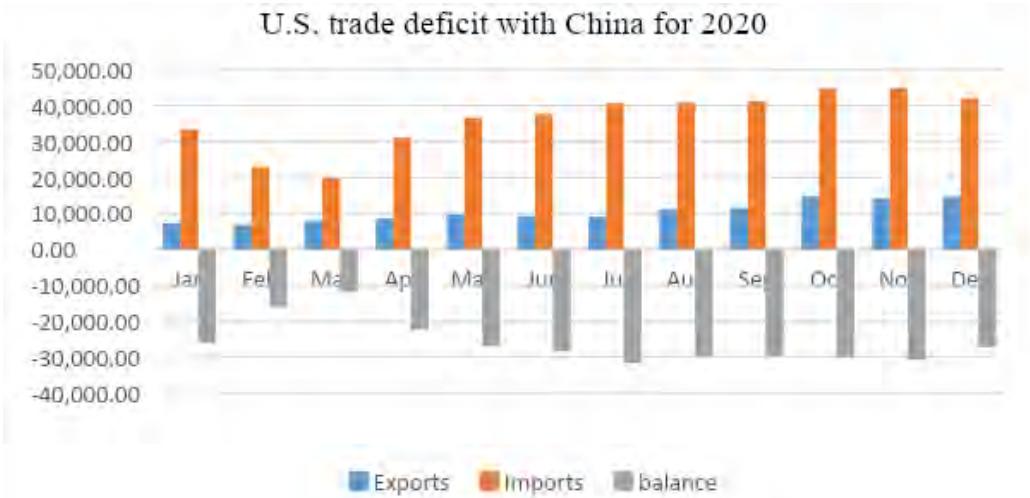 Figure 2
Source: US Census Bureau Diagram by the authors
According to Kimberly Amadeo, an expert on the U.S global economies and investment, the largest categories of U.S imports from China in 2020, for instance, computers, mobile phones, clothing, dolls, toys, and sports equipment. Plus, a lot of those imports were from U.S makers that sent raw materials to China for assembly at reasonable prices. Meanwhile, China's imports were greater than those of the U.S such as industrial aircraft, soybeans, automobiles, and semiconductors.
In the view of Lester and Zhou (2017), If the U.S wants the Chinese market to be liberalized, it must seek greater participation and a deeper negotiating capacity. For this purpose, the two countries should sit and discuss tariff and non-tariff issues, exchange views, and search for compromise, however, some countries like Brazil, Australia, Uruguay, New Zealand, and others have already done this with China. When it involves trading deals, American companies will be better, not on the sidelines. So far, as for determining the future of its zero scores for Asia, attempts by Beijing and Washington to reach this result had failed. While the U.S continues its approach to the geopolitical competition it imposed export controls on high-tech chip makers to prevent sales to a subsidiary of leading Chinese telecoms company Huawei, according to a Financial Time report on April 27. In 2022. While, China punished South Korean companies when Washington worked to placate leaders in Seoul by installing a high-altitude defense missile system (THAAD), which Beijing opposed (Kim, 2020). However, Needham (2020) argues that Chinaed a de facto boycott of Australian goods because of Canberra's reiterated demand for Washington to investigate the origins of the coronavirus. Within these complex circumstances.
Amid this sweeping competition between Beijing and Washington, it seems that Asian countries do not want to be tied to a Chinese or American-made boat, Lester and Zhou said. simultaneously, Lipscy (2003) agrees with Lester and Zhou and anticipated that each country might lose its allies, and consequently, the self-interests of different nations may lean closer to independence. For instance, the Japanese economic government suggested the idea of the Asian Monetary Fund (AMF) at the peak of the Asian financial crisis in 1997. The intrepid proposal for a local opportunity alternative to the International Monetary Fund (IMF) triggers strong objections from the (IMF) and American Treasury. In other words, this idea can also additionally seem again.
# V. A SWEEPING COMPETITION, NOT A SUPERPOWER WAR
"No matter how far it develops, China will never seek hegemony, expand, seek spheres of influence or engage in an arms race," Chinese President Xi Jinping (NBC News, 2021).
China's republic has the most powerful army in the world, according to research released on 21 March by the defense website Military Direct. The U.S regardless of their massive army budgets, came in the second location with seventy-four (74) points, Russia rating 69, while India at 61 points, after which France with 58. However, the UK placed with a score of Top 10, coming in the ninth location with a rating of 43. Yet, in addition to what the research found, the Maximum Military Strength Index was calculated using several parameters including budgets, the combination of active and inactive military personnel, total air force, naval force, territory space, nuclear weapons, average salaries, and the weight of equipment (Business Inside Web. India TV News, the Economic Times-News. 2021).
However, the controversy back again between those who believe the sound of war is being heard around the corner and, those who argue that the war is not inevitable including the Authors.
Historically, on March 7, 1996, U.S Defense Secretary William Perry delivered a threat to go to war (Gellman, 1998). China sought to intimidate voters in Taiwan by firing missiles and conducting large-scale military exercises off its coast (Garver, 1997). However, the U.S Air Force's RC-135 exploration ship and the cruiser USS Bunker Hill spotted three Chinese M-9 ballistic missiles as they were rapidly firing from China's Huanan Mountains, scattering them within shipping lanes near two major ports in Taiwan. (Gillman, 1998). The U.S. Immediately sent two aircraft carriers to Taiwan. The reputation of both sides is completely damaged, although local interests require a firm and strict stance. But in the end, China took a more cautious stance, and the crisis passed. However, China's first nuclear compulsion on the U.S gave new reliability to the "China threat" to the U.S and other Asian countries (Garver, 1997). At the climax of the 1996 Taiwan Strait disaster, Xiong Guangkai, deputy chief of the General Staff of the People's Liberation Army, told Ambassador Chas W. Freeman, a former Pentagon official, that "China will study the use of nuclear weapons in the Taiwan conflict." Mr. Freeman also quoted Mr. Xiong as saying that "Americans should worry more about Los Angeles than about Taiwan" (Kahn, 2005). However, such incidents show that Beijing usually draws red lines on issues it considers to be of paramount importance to its well-being. It is also a cautionary tale about taking Chinese statements at face value.
China repeatedly dropped high-quality ballistic missiles in August 2020 - dubbed "carrier killer missiles" by the media - in the South China Sea. Presumably, the DF-21D and DF-26B missiles were equipped with "ultimate maneuvering capabilities that allow them to blow up running ships", and had been depicted as a "carrier killer". It can simply bump an aircraft carrier touring at Thirty (30) knots, also it taking evasive action, accomplishing strong jamming, as well as heavy shooting fire. Related to that events, Babones (2020) commented that the Hi-tech details may not matter, because indeed the U.S aircraft carrier will never be used to infringe on China, therefore, China will never have a reason to sink the U.S aircraft carrier, and the assumption that rockets can sink the aircraft carrier meaninglessly without cause why the missile was launched. Moreover, the Commander of the U.S Pacific Command, Admiral Robert Willard limited those concerns. The admiral did not see China's high-tech missiles as a major threat to the U.S and Allied forces, but in his view, Japan, the Philippines, and Vietnam are among the Asian countries that can be threatened, which fall under the A2/AD framework. "We know it is concerning", "This is why it affects Southeast Asia and it remains concerning to the U.S", the admiral said (Gertz, 2010).
In a related issue, In the last month of 2020, the Brookings Institution hosted the 20th Chairman of the Joint Chiefs of Staff, US General Mark Milley. The general said that relations were still difficult and complex with Russia and China. However, he did not expect the outbreak of war and did not see the war as an acceptable outcome. Milley said:
"We want to stay in the great-power competition. You're going to have a great power competition. That's the nature of the world... Great powers are going to compete against each other in a lot of different spaces. So that's okay. There's nothing necessarily wrong with that. But make sure it stays a great-power competition and it doesn't shift to great-power conflict or great-power war." (O'Hanlon, 2020).
At his first official press conference as U.S president on March 25, 2021, following what China did in Taiwan, Hong Kong, and the South China Sea, and its treatment of the Uighur minority, Biden decided that he would work with U.S allies to hold China accountable for its actions. Also pushing Beijing to abide by the rules of international trade." (Renshaw. et al., 2021). At the same time, the president asks China for more transparency in all matters, but he seeks to completely distance himself from any factor that calls for war between the two countries because the American president is expected to face difficult situations at the local level - such as high unemployment rates and lack of economic development. polarized society, the coronavirus pandemic, the ability to fund a major war with China, etc. However, Bhardwaj (2021) shows that turbulence and instability will dominate the discourse in relations between America and China, but the economic interdependence and common interests of the capitalist class will prevent any major outbreak as the case may be. He also adds that Biden's policy will put additional pressure on allies. for example, India stands face to face with China. However, Lieggi (2015) argued that there was no doubt in Taiwan, was still the main source of concern for the national security of the leaders of China and Beijing was willing to risk a conflict of the military with the U.S to prevent Taiwan from being broken down in the end, but this position was not Beijing tied the rejection since doctrines of contracts, such as "no first use" (NFU). Chinese political leaders, and many military leaders, and we knew that China had nothing to achieve during the conflict with the U.S Especially if it turned into a nuclear exchange. On this dangerous scale, China quickly would lose any ability to manage conflict. In the event that Beijing intends that it will fight initially with nuclear weapons, even if the result for Taiwan is a loss, there is no way to know Washington's retaliation from the Chinese leadership. The current leadership in Beijing is likely to collapse because of this step. In the end, Taiwan in both cases will reap the loss. To avoid this shocking scenario, Chinese Vice Premier Wang Yang said, "It is the U.S that leads the world." While a senior Chinese official told the U.S-China Trade Forum in Chicago in January 2015, "we have a clear understanding of this." "China does not have any ideas or capabilities to challenge the leading role of the U.S" (Ford, 2015).
From Doherty's (2020) perspective, China did not pose a real military threat, while U.S companies benefited greatly from the Exploitation of intellectual low-wage, non-syndicalist Chinese workers. At the time, China was far from challenging the U.S Simply because, all potential problems between China and the West embrace either internal human rights problems or areas of conflict that had historically been under China's control: Tibet, Taiwan, Hong Kong, the Uyghurs in the Xinjiang region, and the islands in southern China Sea (Hare, 2021). Currently, adopting aggressive policies to punish China for the policy it pursued in Hong Kong and Xinjiang will not help suppress the Chinese state. Increasing pressure will cause Beijing to treat domestic opponents as proxies of the U.S or its allies. Of course, in this case, a war, would be painful, badly hurting the two major economies of the world, and might even lead to the unthinkable - nuclear war, argues Hallinan (2021) that China does not want to lead the world, but seeks to be the dominant power in its territory, marketing and selling in a variety of areas, from electric cars to solar panels. Ultimately, this does not pose any military threat to the U.S unless Washington decides to challenge China, which the Americans neither want nor can afford. It is expected that if a war breaks out between China and the U.S. it will be a terrible clash between the world's most powerful armies. Since China has the advantage of being in its own region, this is reason enough to expect the United States to lose.
In a doomsday scenario, a world-renowned defense expert, Daniel Goure - a Senior Vice President at the Lexington Institute warned that the stocks of US army instruments and supplies in Europe are sure to be closely attacked at the outset of hostilities. He delivered that; the US Army has no widespread bases outside the Republic of South Korea. Therefore, soldiers, additional supplies, and surely all substances for forward-deployed forces will come from the U.S. At the same time, we expect both air and sea lines of communications will be under continuous attack, as will ports of debarkation (Kazianis, 2020). The U.S Army runs into and out of the woods, through the surf of the ocean, through smoke, and fire, ready to die for nothing. However, in his speech, At the Aspen Security Forum in July 2019, Admiral Philip Davidson, the superintendent of US military forces in Asia. Described China as "the greatest long-term strategic threat to the U.S and thus the rules-based international order." He also said that China has its rapid military buildup in all fields - air, sea, land, space, and electronic - as he said although China's capabilities do not exceed America's capabilities within the region, at the moment it may surpass the United States within the next five years. Either way, there are no justifications for pushing the U.S president into a devastating war against China (Gilsianan, 2019).
Based on these terrifying facts for both parties, the authors are of the view that direct conflict remains unlikely, with the reason of the enormous costs of lives and resources. Moreover, nuclear weapons on both sides certainly make leaders more cautious. However, the geostrategic competition between the U.S and China may intensify without a direct war between peers.
## VI. CONCLUSION
It is seen neither America nor China seeks to war that would be destructive for both sides or will be developing into a nuclear exchange, Ultimately, no one really wins, of course, both countries would seek to maintain control of the escalation ladder, but the U.S would not engage in waging a dangerous nuclear war. And if nuclear weapons cause any real and inevitable interaction and tension between the U.S and China - even well below the nuclear threshold. However, the U.S will be less likely than China to retreat for fear of escalation. Therefore, Also, working on the design of a new set of bases with China in the Indo-Pacific region could give an important advantage to the U.S. In addition, on other related issues of conflict.
One of the biggest challenges facing the U.S is that its allies do not see eye to eye in their relations with China, the disagreement and discordance with Washington are still searching for the best ways to manage China's behavior in many cases. Therefore, concerning international and local divisions in the alliance network, China always seeks to exploit its economic power in this regard. Thus, dealing with coalition management problems would be a challenge for America under the best of circumstances. In addition, the repercussions of the coronavirus pandemic, as well as many internal (High inflation, high prices of most types of goods, erratic supply chains), and external challenges (Russia's army operations in Ukraine) make the situation even more difficult for the Biden administration.
Eventually, there are many measures that both countries can keep to control the situation according to the declared strategic objectives of either side. For example, guidance and counseling for both countries by developing a common approach to their relationship. Also, they can use summits to revive the traditional practice to achieve effective results and activities, and this is not from the perspective of greatness. And They can revive the "no surprises" practice of actions affecting bilateral relations to reduce the risk of one party misinterpreting the other's intentions. They can also revive long-term risk mitigation courses of action, to avoid unintended incidents that could lead to rapid escalation. They can also work on effective measures to better manage acute points of discomfort, such as commerce, electronic issues, Taiwan, and North Korea so that the frictional points do not overwhelm the relationship and push it into a powerful antagonistic way.
As the main result of this paper is, that the U.S-China administrator may have red lines for their strategic interests, but they will never allow competition to turn into an all-out war because the range and influence of this war could be much broader than the scope of fighting planning for such a war. The world economy would be shaken, and international order, such as it is, could be destroyed.
Generating HTML Viewer...
References
55 Cites in Article
G Allison (2015). The Thucydides Trap: Are the U.S. and China Headed for War? Harvard Kennedy School.
A Tellis (2021). India, Russia, and the Quad: Russia's Place in the Indo-Pacific.
G Allison (2017). Graham Allison Destined for War, Can America and China Escape Thucydides’s Trap ? , Houghton Mifflin Harcourt, Boston, 2017, 364 pages.
K Gilsianan (2019). How the U.S. Could Lose a War with China.
T Mahnken (2020). Strategy 2.0: Great power competition in an era of technological revolution.
E Hale (2022). Biden says US would defend Taiwan if attacked by China. Al-Jazeera Website.
A Wong (2021). Techno-geopolitics.
Mark Beeson (2014). The rise of the Indo-Pacific.
(2022). The Alliance Initiative: RAND's Support for the Australia–United Kingdom–United States (AUKUS) Partnership.
J Mccurry (2021). US and China publicly rebuke each other in first major talks of Biden era.
A Damon (2021). US-China Rivalry.
D Dollar,R Hass (2021). Getting the China challenge right.
C Hallinan (2021). Joe Biden's top foreign policy challenge is to avoid a cold war with China.
No ethics committee approval was required for this article type.
Data Availability
Not applicable for this article.
How to Cite This Article
Dr. Awad Slimia. 2026. \u201cA Rising Shudders: America’s Against the Growing Challenge of China\u201d. Global Journal of Human-Social Science - H: Interdisciplinary GJHSS-H Volume 22 (GJHSS Volume 22 Issue H5).
Explore published articles in an immersive Augmented Reality environment. Our platform converts research papers into interactive 3D books, allowing readers to view and interact with content using AR and VR compatible devices.
Your published article is automatically converted into a realistic 3D book. Flip through pages and read research papers in a more engaging and interactive format.
Our website is actively being updated, and changes may occur frequently. Please clear your browser cache if needed. For feedback or error reporting, please email [email protected]
Thank you for connecting with us. We will respond to you shortly.