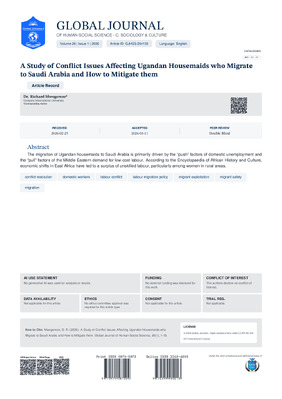
The migration of Ugandan housemaids to Saudi Arabia is primarily driven by the “push” factors of domestic unemployment and the “pull” factors of the Middle Eastern demand for low-cost labour.
According to the Encyclopaedia of African History and Culture, economic shifts in East Africa have led to a surplus of unskilled labour, particularly among women in rural areas.
# Introduction
This study aims to comprehensively analyse the complex interplay between the perceived economic benefits and the actual risks faced by Ugandan housemaids migrating to Saudi Arabia. The primary objectives are to understand the motivations behind migration, identify the specific conflict issues encountered, assess the effectiveness of current mitigation strategies, and propose actionable recommendations for improving the safety and well-being of these migrant workers. This research is crucial given the increasing number of Ugandan women seeking employment abroad, particularly in the Middle East, and the documented challenges they often face which no other researcher has addressed.
## Key Objectives of the Study
The key objectives of the study are:
- To understand the motivations behind the migration of housemaids to Saudi Arabia to be employed as housemaids.
- To identify the specific conflict issues encountered.
- To assess the effectiveness of current mitigation strategies, and propose actionable recommendations for improving the safety and well-being of these migrant workers, including adopting a conflict management strategy to be used by the housemaids in Saudi Arabia.
## The Problem
- Despite the purported juicy economic opportunities Ugandan housemaids seek to perform in Saudi Arabia, a growing number of Ugandans continue to suffer the silent pandemic of conflict as an invisible element of their work.
- The inevitability of conflicts in human interactions has left many Ugandan housemaids in Saudi Arabia speechless in terms of the conflicts they face and how they impact their work and health as well.
- Thus, this paper presents a review of the available literature regarding conflicts faced by Ugandan housemaids working in Saudi Arabia and what should be done to overcome these conflicts and improve the working environment for Ugandan housemaids in Saudi Arabia.
<!-- -->
- Balikuddembe (2023) posits that whereas, there are threatening stories of enslavement, torture, and discrimination from those who have suffered and survived, many Ugandan Women continue to migrate to the Middle East to work there as housemaids.
- Statistics from Uganda’s Ministry of Gender, Labour and Social Development indicate that over 2,000 citizens leave the Country for domestic work in the Middle East each month with the majority being women going to Saudi Arabia to work as housemaids.
- This is done through recruiting companies and Uganda has licensed over 300 companies facilitating labour migration from Uganda and reports indicate that Uganda’s economy benefits significantly through remittances but also some Ugandans have been able to improve on their living conditions, pay school fees for their children, and acquire some capital to start some businesses and make a better living.
# METHODOLOGY
This study was carried out by using secondary data listed in different databases about domestic workers in Saudi Arabia, Google Scholar, and online papers, and research articles published by different scholars and for respect and recognition of the authors of the different literature reviewed, a list of them is attached.
## Key Findings
In 2022 alone, 77,914 Ugandan migrant workers went to Saudi Arabia, with 55,643 employed as housemaids and these contributed to \$600 million in annual remittances (Chinedu, 2023). Thus, the study focused on female Ugandan migrant domestic workers employed as housemaids in Saudi Arabia.
The study revealed that contracts of the housemaids often cover free accommodation, free meals, free medical care, work visa and air ticket but some of these offers are just juicy promises that are not always guaranteed and these unfulfilled rosy promises have turned the perceived economic opportunity into a nightmare, leaving the housemaids in conflicts with their employers.
Behind the beautiful homes with tall fences of Mbarara City in Uganda, a report by a concerned neighbour revealed that domestic workers are often overworked, underpaid, and subjected to abuse and that something should be done to bring justice to these young girls who work as Housemaids in these homes that hide behind beautiful high fences.
“I have worked in different households, and while some treat you with respect, others see you as nothing more than a servant,” shared Ruth Namatovu, a domestic worker reflecting on her experiences.
Edgar Buryahika, an activist with Youth for Peace and Development Uganda (YPDU), expressed concern over the persistent mistreatment of maids, stating, “Domestic workers deserve the same respect and legal protection as any other employee. They should not be treated as second-class citizens.”
## Case Study of Martha
While in Saudi Arabia, whenever I would clean the house, the household head would grab me by force and always tried to rape me but I would fight until after three months when I filed a case with my agency to either take me to another home or back to Uganda and they told me that without evidence, I couldn’t leave. One day, I found my passport and snuck out of the house through the garage. That is how I escaped from Saudi Arabia. Martha narrated (Published in the promised paradise turned into a nightmare for the Ugandan maids, January 31, 2023).
# CONCLUSION
While the perceived economic opportunity for Ugandan housemaids migrating to Saudi Arabia is a powerful motivator, the reality is often characterized by severe risks and exploitation, necessitating a multi-faceted approach to mitigation that addresses pre-departure preparation, in-country support, and robust regulatory frameworks in both Uganda and Saudi Arabia that seek to address all issues including the management of conflicts that arise between the housemaids and their employers.
## Recommendations
- Strengthen Pre-Departure Information and Training.
- Enhance Regulatory Oversight of Recruitment Agencies.
- Improve Bilateral Agreements and Legal Frameworks.
- Address Root Causes of Vulnerability in Uganda.
- Enhance Data Collection and Research.
Lastly; Advise Ugandans that; The pursuit of economic opportunity MUST NOT come at the cost of anyone’s safety and dignity.
Generating HTML Viewer...
References
2 Cites in Article
Ugandan women trafficked to Saudi Arabia for domestic work.
"My Sleep is My Break": Exploitation of Migrant Domestic Workers in Saudi Arabia.
No ethics committee approval was required for this article type.
Data Availability
Not applicable for this article.
How to Cite This Article
Dr. Richard Mwogereze. 2026. \u201cA Study of Conflict Issues Affecting Ugandan Housemaids who Migrate to Saudi Arabia and How to Mitigate them\u201d. Global Journal of Human-Social Science, Global Journal of Human-Social Science - C: Sociology & Culture GJHSS-C Volume 26 (GJHSS Volume 26 Issue C1).
Explore published articles in an immersive Augmented Reality environment. Our platform converts research papers into interactive 3D books, allowing readers to view and interact with content using AR and VR compatible devices.
Your published article is automatically converted into a realistic 3D book. Flip through pages and read research papers in a more engaging and interactive format.
Our website is actively being updated, and changes may occur frequently. Please clear your browser cache if needed. For feedback or error reporting, please email [email protected]
Thank you for connecting with us. We will respond to you shortly.