### a) Background of the Study
the Ministry of Finance, and the State Administration of Radio and Television issued "Opinions on Vigorously Strengthening the Construction and Application of Online Educational Teaching Resources in Primary and Secondary Schools", and during the epidemic, "classes were suspended without stopping school", and primary and secondary schools nationwide carried out a "The "unprecedented" "unprecedented" large-scale online education practice. With the ravages of Newcastle Pneumonia, all schools in China have turned on online teaching, which has been going on for some time in all provinces and cities across the country, and primary and secondary school educators are really racking their brains to make sure that students can study on time while the teaching schedule and quality of teaching are not lost. "Online teaching" is a new concept arising from the application of modern information technology in education, that is, the use of network technology and the environment to carry out education. Online education is also called distance education, in the Ministry of Education has issued some documents, also called modern distance education for network education, is a kind of online education in adult education degree, so for higher education, vocational training field may not be a new thing, but for every day in the classroom and the teacher meet primary and secondary school students, now can only see each other across the screen, this is an unprecedented challenge, even in Even in areas where resources are scarce, chatting along the Internet line has become difficult. Even in resource-poor areas, chatting over the Internet has become a challenge. Teachers have a passion for teaching, but they struggle to implement it successfully.
### b) Purpose and Significance of the Study
English as a foreign language, compared to other subjects, there are some difficulties, unlike language and mathematics from childhood, and now the education to examine the comprehensive learning ability, not a particular outstanding can be, must listen to read and write go hand in hand, so as to meet the For the feasibility and effectiveness of online teaching under the epidemic, and based on the research in this educational region, this paper aims to optimize the mode of online teaching in junior high school English, improve students' motivation and autonomy in learning, solve some of the above-mentioned problems, make the online classroom teaching work fully and effectively implemented, and also provide some reference meaning for future online teaching work.
### c) Main Research Content and Ideas
What is online teaching? What is the effectiveness of online teaching? What is the actual situation of the application of online English classroom teaching in junior high school?[^6] What are the advantages of online teaching in junior high school English? What are the hindering factors and the reasons? What are the strategies for the effective use of online teaching in junior high school English classroom?[^8][^7] This is the basic idea of this study. In this paper, based on the extensive collection of information on China Knowledge Network and other sources, and the careful reading of journals and master theses related to online teaching in junior high school English, the general framework of this research is sorted out. Secondly, literature research, questionnaire survey and personal interview are used to systematically and effectively discuss the effect of online teaching in junior high school English teaching in the post-epidemic context. The main research contents and ideas are shown in Figure1.1.
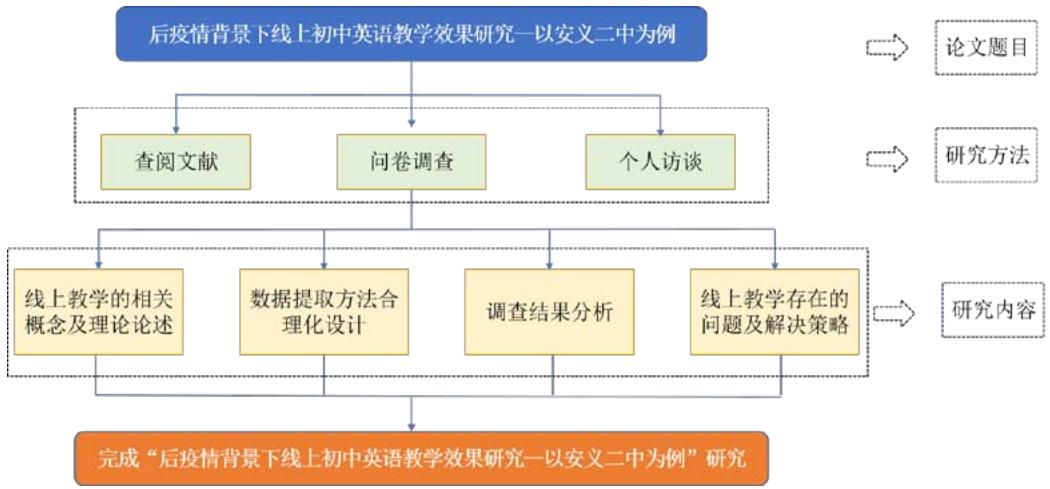
Figure 1.1: Research content and ideas
## II. CHAPTER 2: LITERATURE REVIEW
### a) Key concepts
This paper examines the main concepts of online teaching and online junior high school English teaching as for, and elaborates on domestic and international research on the effectiveness of online junior high school English teaching in the context of the epidemic.
## i. Online Teaching
Online education is web-based and has two forms of expression: live and recorded, which are different from offline education. Online education tests students' self-motivation more because the teacher is not with the students during the class, and the teaching is done through video. Online education is more time-saving more convenient, teach as you go, while offline education needs to be concentrated in a class, or a place in order to administer education, but to be able to face the course plus the reasonable, more intuitive. The concept of online education, E-Learning, was introduced about 10 years ago, and Xiao Gang, the learning coach of Zhiyang Tang, defined E-Learning as a method of content dissemination and rapid learning through the application of information technology and Internet technology. The "E" in E-Learning stands for e-learning, effective learning, exploratory learning, experiential learning, extended learning, extended learning, easy-touse learning, and enhanced learning. The U.S. is the birthplace of e-Learning, with $60\%$ of companies conducting employee training through the Internet.
Lin Hongzhen (2020) $^{2}$ proposed the following characteristics of online teaching practices during the epidemic prevention and control:
(1) Backwardness: The outbreak of the epidemic forced primary and secondary school teachers to teach students through live webcasting.
(2) Interactivity: Online interaction requires the support of software, such as nailing and Tencent conference, and teachers realize teacher-student interaction with the help of software.
(3) Cooperation: Online teaching cannot be done without the Parents' help, i.e. home-school co-education. Parents and teachers should supervise students together and escort students' learning.
(4) Technical: Online teaching requires teachers to use online technology to show teaching content, such as the production of PPT, the flexible use of interactive software, responding to network emergencies and so on.
## ii. Online Middle School English Teaching
- Through extensive reading of the literature on online middle school English teaching, the author lists the advantages of online middle school English teaching as follows:
(1) Flexibility in time and place: Students can study and preview new lessons independently under the guidance of teachers. In the online classroom, students log on to the teacher's designated platform through the Internet to study, and they can follow the teacher's explanation or watch videos to learn new lessons, as well as complete the assigned class assignments. Students can do self-study or pre-study according to their own schedule, which can realize "teaching by learning".
(2) Cost saving: Online English education is less expensive than traditional offline English classes because online learning does not require you to go to a specific classroom location and study at a specific classroom time, which reduces the cost of transportation, time, and human resources.
(3) Rich resources: Online English, there is a wealth of teaching resources. One-on-one English tutors provide excellent listening resources for all teens on the internet. English is a language and it is very beneficial for students to fully immerse themselves in the English environment to learn English.
(4) Rich interaction: Teachers and students can interact with each other through the online platform. Teachers can create classes, group groups or have real-time Q&A interactions, etc. on the online platform. In group groups, teachers can answer students' questions about an issue in a timely manner; while students can demonstrate their understanding and application of new knowledge through group communication. Online teaching can also increase opportunities for teacher-student interaction and communication.
b) Studies on the Effect of Online Junior High School English
There are many researches on online teaching, especially in the context of the epidemic, there are many researches on online teaching. By searching the Chinese Internet with keywords such as "epidemic", "English teaching" and "junior high school English teaching", I found that there were 273 studies on online teaching of English subjects, but only 26 studies on online teaching of junior high school English, which also shows the necessity of the author's research on online education of junior high school English. Several aspects.
## i. Domestic Studies on the Effect of Online Junior High School English Teaching
The impact and research of online middle school English teaching. Based on constructivist learning theory, interactive learning theory and ubiquitous learning theory, Zhang Yuan (2020)[^3] used questionnaire method, literature review and interview method to understand the English teaching in online live classroom, and suggested that while online live broadcast assists English input learning in its unique way, there are also some problems, and Zhang Yuan also gave her suggestions. There are many other studies like this practical investigation, such as Zhang Quanhong's (2021)[^4] "The Case of Middle School English
Teaching in the Context of the Epidemic"; Hu Juan and Wu Weiping's "The Influence of Online Teaching on Middle School English Teachers' Teaching in Special Period" (2021) $^{5}$; Huyan Yiqi's "Investigation and Research on Middle School English Online Teaching in the Context of the Epidemic" (2021) $^{6}$; Yang Shaobing (2020) $^{7}$; Zhao Talent and Lv Yan (2020) $^{8}$.
A study of students' autonomy under online teaching. While online learning brings convenience to students, it also brings challenges. Whether adolescents can plan, monitor, reflect and regulate their own learning independently during online learning, while not being disturbed by the external environment, irrelevant information on the Internet and overcoming the effects of psychological changes when studying alone, largely depends on whether students can self-regulate their online learning. Numerous studies have found that the ability to self-regulate learning is the key to learners' ability to achieve good learning outcomes in learning Sun Ao (2021)[^9] explored the autonomy of online English learning of junior high school students in Hohhot Experimental Middle School during the new crown pneumonia and asked the following questions: (1) What is the status of students' online independent learning in Hohhot Middle School during the new crown epidemic? (2) What are the main factors that affect the autonomy of online learning of students in Hohhot Middle School? The study showed that students' subjective initiative, students' self-management ability, network equipment and teaching platform were the main factors affecting students' autonomy under the New Crown epidemic, and also gave solutions to the problem; Zhang Xinyuan (2021)[^10] pointed out that the personality development of middle school students was in a turbulent and unstable period, and it was difficult not to be disturbed by the external environment and network irrelevant information, and it was learned through the interview survey method that the problem was mainly in internal and external aspects: students' own interests and learning motivation; the influence of the network environment, teachers, parents, etc.
Online and offline hybrid teaching. Chen Yingying (2020)[^11] points out in "Research on the application of online and offline blended learning mode in junior high school English listening teaching" that the blended mode is a combination of "online teaching" and "offline face-to-face teaching", which combines the unique advantages of online and offline in one The study also pointed out that the hybrid model is a combination of "online teaching" and "offline face-to-face teaching", which combines the unique advantages of online and offline teaching to maximize the effectiveness of teaching. Kuang Yijun (2021) $^{12}$ proposed that hybrid online and offline teaching will become an inevitable trend in the development of education in the context of normalization of epidemic prevention and control, and it is especially important to study and explore the "city-wide" and "systematic" teaching and research system of online and offline.
## ii. Overseas studies on the Effect of Online Junior High School English Teaching
Teachers' informational teaching level. Not only domestic scholars conduct research in this field, but also some foreign scholars define the concept of information-based teaching ability mainly from the aspect of information technology support. The famous American psychologist Shulman (1986) $^{13}$ proposed that teachers must not only have pedagogical knowledge Content Knowledge (CK) but also have the ability to teach a professional subject knowledge, that is, pedagogical and the subject knowledge is the intersection of pedagogy and subject knowledge. Improving teachers' information technology teaching ability is the key to promoting education informatization 2.0 and realizing changes in the learning environment and methods in the context of new technologies. Foreign researchers Punya Mishra and Matthew J. Koehler (2005) $^{14}$ jointly proposed Technology Pedagogical Content Knowledge (TPCK), which means that a teacher should be a person who integrates modern technology and subject knowledge. Teachers need to improve their information technology teaching ability with the goal of integrating independent information technology teaching ability, and adopt the training mode of design-based learning to support teachers to explore the reconstruction and redesign of teaching mode supported by information technology, through the continuous and systematic process of "observation-experience-design-reflection-practice". Through the continuous and systematic process of "observationexperience-design-reflection-practice", teachers are helped to truly realize the integration of IT and teaching, the mutual transformation of theoretical and practical knowledge, and the spiral rise of teachers' IT teaching ability. This view corresponds to Schulman (1986)[^15], who believes that teachers should improve their IT teaching ability.
From the above studies, we can see scholars at home and abroad have conducted research on online English teaching and found new problems and triggered new exploration. The author's study will synthesize the previous studies and further launch a questionnaire survey to analyze the effect of online teaching of English in junior high school in the post-epidemic context, analyze the problems and solve them.
## III. CHAPTER 3: THEORETICAL BASIS
### a) Interactive Learning Theory
The concept of "interactive learning" was introduced by American cognitive psychologist Bruner (1967)[^16], which refers to the interactive and cooperative learning process between learners and teachers. Bruner proposed that teachers should strive to provide students with a "participatory, mutually influential" learning environment in which each student can develop his or her own abilities and achieve appropriate results. From the above two experts' discussion of interactive learning theory, it can be seen that there are many problems in "joint participation" and "mutual influence" between teachers and students in the offline teaching classroom in the post-epidemic context, especially in the online teaching classroom where teachers cannot effectively In particular, teachers are unable to play their role effectively in online classrooms.
First, due to the large differences in the level of socio-economic development in which different regions and ethnic groups are located, there is a large gap in economic and cultural levels among ethnic groups. Secondly, students cannot be guaranteed sufficient time and space for offline teaching during the epidemic. Therefore, what and how teachers teach online is also a question worthy of consideration and exploration. At the same time, the concept of "learner" has brought a new perspective to students' learning English as a language. Traditional teaching emphasizes the "teacher-led" approach, which places students in a passive position of receiving knowledge. In contrast, "learner" is a different approach to the teaching process, in which the student is the main subject. Therefore, the effect of learning under such a teacher-student relationship is the effect of teacher-led learning - the teacher teaches according to the level of knowledge acquired by the students. In the current teaching mode of the epidemic, there are many problems in the areas of "joint participation" and "mutual influence" between teachers and students. This also requires us to think about and explore how teachers can play a greater role to make up for these shortcomings, so as to improve the level and efficiency of communication and interaction between teachers and students and between students in offline English teaching (M. J. Hannafin. 2019)[^17].
### b) Independent Learning Theory
Self-directed learning is active and positive learning by students under the guidance of teachers and includes the following four aspects: 1. knowledge;
2. skills;
3. attitudes; and 4. emotions. Knowledge: i.e., information such as various facts and phenomena that students already possess. Skills: include the ability to apply what has been learned to solve emerging problems and to change the knowledge and skills learned according to the context. Attitude: i.e., the ability to respond positively to self, others, or the environment and to adapt to these changes.[18] Emotion: The ability to develop positive emotions and emotional states toward people, events, or objects. This includes the degree of emotional engagement and enthusiasm, and the ability to make it more conducive to the achievement of goals, etc. The above four aspects are the knowledge, skills and attitudes that students acquire through independent learning, as well as what they emotionally experience and feel about that knowledge, skills or attitudes, thus bringing learning to a higher level, that is, to the level and extent of acquiring more knowledge and skills.
Self-directed learning can improve learning efficiency, promote student development, develop students' independent learning ability and facilitate the achievement of teaching goals. In the context of the normalization of the prevention and control of the new crown epidemic, how can students carry out independent learning in English when they cannot return to school? Anyi No. 2 Middle School adopts a combined online and offline teaching model, with teachers and students participating in online English teaching. In the offline English class, activities are carried out in the form of group work; online homework is assigned and checked using platforms such as nails, QQ and WeChat; online feedback on homework is given in a timely manner through WeChat homework groups and voice interaction, etc. To a certain extent, these activities promote the formation of students' core literacy skills such as independent exploration, active thinking and cooperative inquiry, and also cultivate students' interests and habits.
## IV. CHAPTER 4: RESEARCH METHODOLOGY
### a) Investigation Object
According to the purpose of this survey, and combined with the actual situation, the object selected for this survey is the eighth-grade students of the second middle school of Anyi County, Nanchang City, where the author is located. Anyi Second Middle School is a school with a long history, deep cultural heritage and excellent teaching quality. In recent years, the school continues to develop, education and teaching has achieved promising results. The school has been ranked first in the county for many years in the middle school examinations, and has been awarded "Advanced School of Jiangxi Province" by the Department of Education of Jiangxi Province.
The survey included all eighth-grade students enrolled in online classes, 504 of them, and six English teachers who were implementing online teaching. There were 10 classes in this grade, and the students' test scores were divided into three categories: A, B, and C. Category A students had solid basic English skills, good study habits, and strong independent learning ability; category B students knew some basic knowledge but were not comprehensive, had blind spots in their knowledge, and did not study solidly and independently; category C students did not master the correct study methods and study habits at all. They only have a half-understanding of the knowledge points, and their learning initiative is extremely poor. Among the six teachers who participated in the online class, there were novice young teachers and veteran teachers with 20 years of teaching experience, and the ratio was 1:1.
### b) Survey Tools
## i. Questionnaire Survey
Questionnaire Survey method can also be called the questionnaire method, written survey method or fill in the form method, it is the investigator to use a unified design of the questionnaire to the selected respondents to understand the situation or to solicit suggestions and opinions of a written survey method. The author prepared a questionnaire by fieldwork research in Anyi II, with reference to the relevant literature, the presentation of the survey and the sequence of questions, as well as the answers given are fixed and are expressed in writing, which is easy to quantify. The questionnaire was divided into two main parts. The first part of the questionnaire is about the students' basic personal information; the second part is the main part of the questionnaire, which contains the investigation of teachers' online teaching methods, students' online learning attitudes and habits, students' satisfaction with online teaching and the effectiveness of online teaching, which is also the focus of this study. The questionnaire was divided into "not completed at all", "completed well" and "basically completed" according to students' completion status.
## ii. Personal Interview
Interview method, which is a research conversation, is a working method to understand some situations by collecting objective and unbiased factual materials based on the respondents' responses in face-to-face form or other forms.
In order to make the research results more convincing, the author conducted face-to-face interviews with six English teachers who participated in online teaching in this Anyi Second Middle School. The interviews covered the teachers' experience of online teaching, the interaction of online teaching, the assignment and completion of online homework, and the teachers' satisfaction of online teaching.
### c) Research Process and Data Collection
The questionnaire is combined with offline questionnaire and online survey, which is filled out and analyzed. 504 copies of this questionnaire were sent out, and the number of valid questionnaires collected was 486, of which 14 people did not answer at all, accounting for $27.2\%$ of the total number; 3 people partially answered, accounting for $0.6\%$ of the total number; and 1 person did not fill in. The sample was the eighth-grade students of Anyi Second Middle School.
The author interviewed six junior high school English teachers through a personal field trip to Anyi Second Middle School, and carried interview forms made in advance to record the teachers' interview results at any time. The interviews went very smoothly, and the author organized and classified the interview results after the interviews, which is a supplement to the questionnaire method and an analytical method to make the research results more scientific, objective and credible.
## V. CHAPTER 5: ANALYSIS OF SURVEY
### RESULTS AND SUMMARY REFINEMENT
### a) Analysis of the Pattern of Survey Results
According to the data obtained from the author's personal field trip to Anyi No. 2 Middle School and the analysis of the results of the questionnaire, the survey pattern analysis is as follows:
The questionnaire is mainly divided into two parts, the first part of the students' personal basic information including name, age and gender; the second part of the questionnaire is divided into teachers' online teaching methods, students' online learning attitudes and study habits, students' satisfaction with online teaching and the effect of using online teaching.
## i. Results and Analysis of the Student Survey
### (1) Students' personal basic situation
The students' personal basic situation mainly includes name, gender, and usual stable English performance level, as shown in Figure 5-1, the ratio of male to female in Grade 8 students in Anyi No.2 Middle
School is 2:3; most of the students' usual English performance is above 90-110, a small number of students' usual English performance is at 110-120 this Most of the students' usual English scores are above 90-
110, a small number of students' usual English scores are at the level of 110-120, and a small number of students' usual English scores are below 90.
#### 1. What's your name?
#### 2. Your gender?
A.Male B.Female
3. Your assessment for your English performance?
A.Excellent B.Good C.Not bad
Figure 5.1: The students' personal basic situation
(2) Teachers' online teaching methods
Regarding teachers' online teaching style, according to the standard of "integrating educational resources and building a good online education platform", $56.5\%$ of the students think it is fully in line with the standard, $33.2\%$ think it is basically in line with the standard, and $11.3\%$ think it is not in line with the standard at all; according to the data, there are still some teachers who do not have the information technology teaching means, but overall teachers' online teaching is more in line with the standard. According to the data, there are still some teachers who are not equipped with information technology, but overall, teachers' online teaching is more in line with the standard., the specific survey is shown in Table 5.1.
Table 5.1: Teachers' online teaching methods
<table><tr><td rowspan="4">Teachers' online teaching methods</td><td>Standard</td><td>Percentage</td></tr><tr><td>Fully in line with the standard</td><td>56.5%</td></tr><tr><td>Basically in line with the standard</td><td>33.2%</td></tr><tr><td>Not in line with the standard at all</td><td>11.3%</td></tr></table>
(3) Students' online learning attitudes and study habits
Regarding whether students would pre-study before online classes, $25.6\%$ of students said they would pre-study before class, among which there were students who always had the habit of pre-studying, and some students would pre-study in advance because of the fast pace of the live broadcast and were afraid of not being able to keep up with the teacher's pace in class, $32.6\%$ of students said they would basically pre-study before class, and $41.8\%$ students said they would never pre-study. The results are shown in Table 5.2.
Table 5.2: Students' online learning attitudes and study habits
<table><tr><td rowspan="4">Whether students will preview before going to class online</td><td>Standard</td><td>Percentage</td></tr><tr><td>Can</td><td>25.6%</td></tr><tr><td>Basically can</td><td>32.6%</td></tr><tr><td>Can't</td><td>41.8%</td></tr></table>
Regarding whether students are distracted by electronic facilities such as cell phones and computers during class, $44.3\%$ of students said they are often distracted by electronic facilities, while $34.5\%$ and $16.7\%$ of students said they occasionally and basically do not, respectively. As developing people, junior high school students are still in an immature stage of mind, and there are many things on cell phones that are more interesting than classes, all of which can easily distract junior high school students. The survey results are shown in Table 5.3.
Table 5.3: Students' online learning attitudes and study habits
<table><tr><td rowspan="4">Whether students are distracted during class</td><td>Standard</td><td>Percentage</td></tr><tr><td>Often</td><td>44.3%</td></tr><tr><td>Occasionally</td><td>34.5%</td></tr><tr><td>Basically not</td><td>16.7%</td></tr></table>
Regarding the completion of after-school homework, $90.5\%$ of the students can completely complete the homework assigned by teachers on time, in quantity and with high quality, and only $9.5\%$ of the students said they are not quite able and cannot complete it. These students are not able to keep up with the progress of homework because they lack supervision when studying at home, their self-discipline is deviated, and their parents are busy with their work, and they do not check the completion of homework in time. The completion of after-school homework is an important stage for consolidating and applying newly taught knowledge and internalizing it into students' own knowledge, which should attract the attention of parents and teachers, as shown in Table 5.4.
Table 5.4: Students' online learning attitudes and study habits
<table><tr><td rowspan="3">Whether students will complete their homework on time</td><td>Standard</td><td>Percentage</td></tr><tr><td>Can</td><td>90.5%</td></tr><tr><td>Basically not and not at all</td><td>9.5%</td></tr></table>
#### (4) Students' satisfaction with online teaching
Satisfaction refers to an individual's subjective evaluation of an event or a person. When the subject's needs are satisfied, the subject's mood will reach a certain degree of pleasure, and the subject's satisfaction is higher.
Regarding the survey of students' satisfaction with online teaching, the options are "completely satisfied", "basically satisfied", "not very satisfied" and "not at all" Among them, $34.6\%$ of students were completely satisfied with online teaching, $54.5\%$ were basically satisfied, $8.8\%$ were not very satisfied, and only $2.1\%$ were not satisfied at all. According to Table 5.5, it can be seen that students' overall satisfaction with online teaching is still relatively high.
Table 5.5: Students' satisfaction with online teaching
<table><tr><td rowspan="5">Students' satisfaction for online teaching</td><td>Standard</td><td>Percentage</td></tr><tr><td>Completely satisfied</td><td>34.6%</td></tr><tr><td>Basically satisfied</td><td>54.5%</td></tr><tr><td>Not very satisfied</td><td>8.8%</td></tr><tr><td>Not at all</td><td>2.1%</td></tr></table>
#### (5) Effectiveness of online teaching
Because of the existence of the Internet, online teaching can be diversified, and it can stimulate students' enthusiasm for learning while training their basic skills of listening, speaking, reading, writing and using. At the same time, compared with the traditional offline teaching mode of "a blackboard and a chalk", the constantly changing knowledge background in online live teaching can stimulate the schema in students' minds, As to whether online teaching can arouse their interest in learning English, $54\%$ of students said they can, $23.6\%$ said they basically can, and $23.4\%$ said they can't, as shown in Table 5.6
Table 5.6: Effectiveness of online teaching
<table><tr><td rowspan="4">Whether online teaching can stimulate interest in learning English</td><td>Standard</td><td>Percentage</td></tr><tr><td>Can</td><td>54%</td></tr><tr><td>Basically can</td><td>23.6%</td></tr><tr><td>Can't</td><td>23.4%</td></tr></table>
## i. Results and Analysis of the Teacher Survey
### (1) Do you have the experience of live teaching?
Three of the English teachers said they had experience in live web teaching, two teachers said they had been trained in the relevant teaching steps but had not actually operated them, and one teacher with longer teaching experience said he was relatively unfamiliar with the Internet and was not familiar with the technical operation of live streaming, which led to wasting a long time in building the web teaching platform in every class, thus showing that it is important to strengthen teachers' information technology teaching.
Two teachers said that they would interact with students from time to time. They would do video or voice link to encourage students to speak bravely, and two teachers said they would interact with students when teaching difficult points to get their attention, but not many times.
(3) Do you assign homework to students at the end of class like in a traditional classroom? Do you check students' completion in time?
- Four teachers said they assign students a certain amount of homework after each class and let them upload it through nails, and they will comment on students' homework and give feedback accordingly. 2 teachers said they will assign homework occasionally, but the main training is still in the classroom because they are afraid of increasing students' burden after class.
(4) Are you satisfied with the online teaching method?
Three teachers said they were very satisfied because of the convenience of live web teaching, which allows teachers to teach students at home and also tutor their children's homework at the same time. Three teachers said they were not very satisfied because the special nature of the online teaching method makes them not feel the actual students, their enthusiasm for teaching is greatly diminished, and the preparation time increases, which affects their normal life.
## VI. CHAPTER 6: PROBLEMS OF ONLINE
### TEACHING AND STRATEGIES TO SOLVE
#### THEM
According to the combination of questionnaire method and interview method, the author investigates the subjects of teaching and learning on line, and the analysis of the findings is summarized as follows:
### a) Existing Problems
Although teachers and students are more satisfied with online teaching, on the whole, due to the special nature of the network, it brings great challenges to teaching, and the teaching effect is still far from offline teaching. Based on the analysis of the survey results, the problems that exist in online teaching are summarized as follows:
(1) Teachers' informatization teaching level is not high enough
- Online teaching is a very new thing for many older teachers, because they are used to the offline teaching mode, it is difficult to change over for a while, and the acceptance level of information technology teaching is lower than that of younger teachers, so they cannot see the teaching screen or hear the sound during the class, and what is more terrible is that the "silent classroom The phenomenon of "silent classroom" lasts for one class period.
(2) Students' self-discipline in Internet classes at home is poor
Most of the students said that although they were happy with the online class, they were worried
- about the test, so what triggered the students' concern? Because online teaching across the screen, I can't see you, you can't see me, students' self-discipline will become poor, will be easily attracted to things other than learning, some of the more egregious students even put the live broadcast there, people have long since done something else, which makes educators really pinch a cold sweat.
(3) The interaction of online teaching does not meet the needs of the English subject
Although online English teaching has many advantages, it also has some disadvantages. Firstly, it may have a negative impact on learners' English proficiency because it does not have the right teaching methods and the right teaching contents. Secondly, due to the lack of direct human contact, students may experience loneliness or boredom, which greatly affects their English learning. As we all know, the ultimate goal of learning English is to speak it, not dumb English, which is also not in line with the requirements of our national education policy. Moreover, the singularity of online teaching interaction will make students lack the opportunity to express themselves, making it difficult for them to internalize their knowledge, and therefore they will not be able to improve their English.
(4) Teaching and learning activities cannot be carried out smoothly
After-school homework is a necessary supplement to teaching and learning, and the purpose of after-school homework for them is to improve their self-learning skills as a way to be able to improve their grades for a semester. After-school homework plays a big role, so it must be completed properly and not missed, otherwise it will affect the usual learning and the whole teaching activities. What should I do for after-school homework? Based on class notes, homework summaries, prep review and revision exercises, it is important to pay attention to both class notes and quality completion of homework. Homework should be done properly and completed, otherwise it will definitely affect the final exam results. The online teaching can only take photos and upload photos, which leads to students not paying much attention to homework, and there is even a situation that students use other people's homework to cope with the teacher. Regarding the teacher's feedback, it is not convenient to annotate directly on the homework because it is a photo, which leads to students not receiving good feedback to get improvement, which also brings a challenge to the teacher to correct the homework.
### b) Strategies to Solve
Combining the survey and the actual situation, the author proposes the following solution strategies for the above problems:
(1) Strengthen the technology training for teachers and test them regularly
The teacher's level of information technology teaching directly affects the quality of students' classes, and the new era has put forward new requirements for teachers, and the mission and responsibility of teachers have new contents. Becoming a good teacher who leads education and teaching in the new era requires the efforts of every teacher, but what is more important is whether the efforts are in the right, scientific and meaningful direction. In my opinion, the quest of teachers in the new era should be to be able to become a truly all-round professional teacher. Schools can regularly provide teachers with technology training, which should include two aspects: the first aspect mainly addresses teachers' computer knowledge, skills and attitudes, and operating computers, so that teachers can use computers proficiently and really use them as tools for their own lesson preparation, teaching, and organizing student activities; the second aspect is mainly for teachers to learn to integrate and adapt to multimedia, not to give their The second aspect is mainly for teachers to learn to adapt to multimedia integration, rather than adding a burden to their work. The most important thing is to make the level of information technology teaching as one of the assessment criteria and launch regular tests in order to improve teachers' technology concepts.
(2) Establishing online learning support groups
Group cooperative learning not only changes the association of individual students' learning competition into the association of "intra-group cooperation" and "inter-group competition", but also changes the one-way or two-way communication between teachers and students in traditional teaching into multi-way communication between teachers and students and students, so that students have more opportunities to express their own views and improve each other. Students have more opportunities to express their opinions and promote each other's improvement, and bring them a learning platform to monitor each other, which improves students' motivation and self-discipline, and also extends students' in-class learning outside of class, so that they can collaborate with each other in class to learn what they don't understand in class. The establishment of online study groups allows students to monitor each other and help students with poor self-discipline to establish the right learning concepts. One can help one another or one can help many, or one can promote one or one can promote many
Teachers can teach students through other channels, such as playing audio and dictation in class, combining with other APPs to exercise students' speaking ability, and setting homework every day and requiring them to punch cards to complete it. In addition, students should also pay attention to the ability to improve, some knowledge is not learned in the classroom.
(4) Implement the "three-step approach" for efficient implementation of homework
First, the school should strengthen the audit and implement the "double reduction". In each year, there are leaders in charge of each class to check the online teaching work and students' homework at any time, to strictly set aside time for homework, and to regularly check students' homework.
Secondly, homework categories and forms should be diversified to stimulate students' interest, with basic homework and improvement homework; homework forms are rich, with writing homework, reading aloud homework, practical homework, and creative homework. Through different ways, students' comprehensive ability level can be improved.
Finally, students' homework should be understood, supported and assisted by parents, and teachers and parents should co-parent scientifically and work closely together to escort students' growth.
#### CHAPTER 7: CONCLUSION
Through the study and investigation of the effect of online middle school English teaching in Anyi Erzhong, the author summarizes the advantages and disadvantages of online teaching. The advantages about online teaching include: First, teachers work from home, which is extremely convenient, and they can also take care of their families while going to work, balancing work and life, and providing students with rich teaching resources. Second, teachers and students save on commuting costs. Going to work and school requires transportation, and safety hazards also raise parental concerns, so through online teaching you can save some costs and alleviate parental concerns. Third, online teaching is available in various forms, such as live and recorded, so students can choose to attend classes live or listen to the playback after class when they have something to do.
However, there are still many problems with online English teaching, such as a few teachers lack experience in online teaching and do not make good use of the online platform to promote teaching; students' autonomy and motivation when they are unsupervised also need to be improved; teaching activities are not as convenient and efficient as traditional classrooms.
In response to these problems, the author also gives his own suggestions. First, the level of teachers' technology and information teaching should be improved, an assessment system should be implemented for teachers, and schools should also raise the threshold of teachers in order to improve the core strength of the teaching team. Second, the establishment of online learning support group, build a good mutual supervision, common progress learning platform, to create a good atmosphere for students to learn. The school should also enrich the teaching path and improve the homework supervision mechanism to escort the students' learning.
This paper uses literature reading, questionnaires, and interviews to investigate the effect of online English learning for eighth grade students in Anyi Second Middle School in the post-epidemic period, and with the help of the principal of Anyi Second Middle School, field surveys were conducted in the school.
#### 二、参考文献
[^3]: 张媛. 新冠肺炎疫情背景下的初中英语网络直播教学个案研究 [D]. 西南大学, 2020. _(p.3)_
[^4]: 张全虹.疫情背景下初中英语线上教学案例[C]//.2021 教育科学网络研讨会论文集(七).[出版者不详],2021:1166-1168. _(p.3)_
[^9]: 孙傲.新冠疫情期间初中生线上英语学习自主性调查研究[D].内蒙古师范大学,2021. _(p.4)_
[^10]: 张鑫源.新冠期间高中生线上英语学习自律性问题研究[D].四川外国语大学,2021. _(p.4)_
[^11]: 陈莹莹. 线上线下混合式学习模式在初中英语听力教学中的应用研究[D]. 上海师范大学, 2020. _(p.4)_
[^15]: $^{15}$ Youm Julie, Corral Janet. Technological Pedagogical Content Knowledge Among Medical Educators: What Is Our Readiness to Teach with Technology? Academic medicine: journal of the Association of American Medical Colleges, 2019(13), p94 _(p.5)_
[^16]: $^{16}$ K. Hartley. Educational Research in the Internet Age: Examining the Role of Individual Characteristics[J]. Educational Researcher, 2001, 30(9), pp.22-26. _(p.5)_
[^17]: J. R. Hill, M. J. Hannafin. Cognitive strategies and learning from the world wide web[J]. Educational Technology Research and Development, 1997, 45(4), pp. 37-64. _(p.5)_
[^2]: 林红贞. 线上教学在初中英语教学中的运用[J]. 英语教师, 2020, 20(21): 109-110. _(p.3)_
[^5]: 胡娟,吴伟萍.特殊时期线上教学对中学英语教师教学的影响[J].统计与管,2021,36(03):32-36. _(p.4)_
[^6]: 呼延一琪.疫情背景下初中英语网络教学调查研究[D].延安大学,2021. _(p.4)_
[^7]: 7汤少冰.疫情期间初中英语线上即时互动反馈有效教学模式的构建与实践探索[J].中国教育信息化,2020(21):76-80. _(p.4)_
[^8]: 赵才华,吕岩.新冠疫情期间大学英语线上教学的问题与对策[J].江苏外语教学研究,2020(03):1-3+86. _(p.4)_
[^12]: 匡轶君. 混合式教学助力初中英语教研[J]. 现代教学, 2021(Z1): 55-56. _(p.4)_
[^13]: Angeli C., & Valanides N, Epistemological and methodological issues for the conceptualization, development, and assessment of ICT-TPCK: Advances in technological pedagogical content knowledge (TPCK). Computers and Education, 2009(52), p154-168. _(p.4)_
[^14]: $^{14}$ Tseng, Jun-Jie, et al. A critical review of research on technological pedagogical and content knowledge (TPACK) in language teaching. Computer Assisted Language Learning 2020 p 22-24. _(p.4)_
Generating HTML Viewer...
References
59 Cites in Article
Charoula Angeli,Nicos Valanides (2009). Epistemological and methodological issues for the conceptualization, development, and assessment of ICT–TPCK: Advances in technological pedagogical content knowledge (TPCK).
J Hill,M Hannafin (1997). Cognitive strategies and learning from the world wide web.
Kendall Hartley,Lisa Bendixen (2001). Educational Research in the Internet Age: Examining the Role of Individual Characteristics.
Youm Julie,Janet Corral (2019). Technological Pedagogical Content Knowledge Among Medical Educators: What Is Our Readiness to Teach with Technology? Academic medicine.
Tella Adeyinka,S Mutula (2010). A proposed model for evaluating the success of WebCT course content management system.
Jun-Jie Tseng,Ching Chai,Lynde Tan,Moonyoung Park (2020). A critical review of research on technological pedagogical and content knowledge (TPACK) in language teaching.
陈莹莹 (2020). 线上线下混合式学习模式在初 中英 语听力教学中的应用研究.
D 上海师范大学 Unknown Title.
吴伟萍 胡娟 (2021). 特殊时期线上教学对中学英语教 师教学的影响.
J 统计与管 Unknown Title.
呼延一琪 (2021). 疫情背景下初中英语网络教学调 查研究.
D (2021). 教育部等五部门联合发布《关于大力加强中小学线 上教育教学资源建设与应用的意见》中国民族教育.
Tella Adeyinka,S Mutula (2010). A proposed model for evaluating the success of WebCT course content management system.
Kendall Hartley,Lisa Bendixen (2001). Educational Research in the Internet Age: Examining the Role of Individual Characteristics.
Janette Hill,Michael Hannafin (1997). Cognitive strategies and learning from the world wide web.
孙傲 (2021). 新冠疫情期间初中生线上英语学习自主性调 查研究.
张鑫源 (2021). 新冠期间高中生线上英语学习自律性问题 研究[D.
陈莹莹 (2020). 线上线下混合式学习模式在初中英语听力教 学中的应用研究.
匡轶君,混合式教学助力初中英语教研 (2021). Unknown Title.
C Angeli,N Valanides (2009). Epistemological and methodological issues for the conceptualization, development, and assessment of ICT-TPCK: Advances in technological pedagogical content knowledge (TPCK).
Jun-Jie Tseng,Ching Chai,Lynde Tan,Moonyoung Park (2020). A critical review of research on technological pedagogical and content knowledge (TPACK) in language teaching.
Youm Julie,Janet Corral (2019). Technological Pedagogical Content Knowledge Among Medical Educators: What Is Our Readiness to Teach With Technology?.
林红贞,线上教学在初中英语教学中的运用 (2020). Unknown Title.
(2021). Unknown Title.
张媛 (2020). 新冠肺炎疫情背景下的初中英语网络直播教学 个案研究.
张全虹 C]//.202 1教育科学网络研讨会论文集(七).
吴伟萍 胡娟 (2021). 特殊时期线上教学对中学英语教师教学 的影响.
呼延一琪 (2021). 疫情背景下初中英语网络教学调查研究.
汤少冰 (2020). 疫情期间初中英语线上即时互动反馈有效教 学模式的构建与实践探索.
吕岩 赵才华 (2020). 新冠疫情期间大学英语线上教学的问题 与对策[J].
Tella Adeyinka,S Mutula (2010). A proposed model for evaluating the success of WebCT course content management system.
K Hartley (2001). Educational Research in the Internet Age: Examining the Role of Individual Characteristics.
Janette Hill,Michael Hannafin (1997). Cognitive strategies and learning from the world wide web.
孙傲 (2021). 新冠疫情期间初中生线上英语学习自主性调查 研究[D].
张鑫源 (2021). 新冠期间高中生线上英语学习自律性问题研 究[D.
陈莹莹 (2020). 线上线下混合式学习模式在初中英语听力教 学中的应用研究.
匡轶君,混合式教学助力初中英语教研 (2021). Unknown Title.
Charoula Angeli,Nicos Valanides (2009). Epistemological and methodological issues for the conceptualization, development, and assessment of ICT–TPCK: Advances in technological pedagogical content knowledge (TPCK).
Jun-Jie Tseng (2020). A critical review of research on technological pedagogical and content knowledge (TPACK) in language teaching.
Youm Julie,Janet Corral (2019). Technological Pedagogical Content Knowledge Among Medical Educators: What Is Our Readiness to Teach With Technology?.
No ethics committee approval was required for this article type.
Data Availability
Not applicable for this article.
How to Cite This Article
Dr. Jie John Seaver Zhou. 2026. \u201cA Study on the Effectiveness of Online Middle School English Teaching in Post-Epidemic Context: An Example from Anyi Second Middle School\u201d. Global Journal of Human-Social Science - G: Linguistics & Education GJHSS-G Volume 23 (GJHSS Volume 23 Issue G7): .
Explore published articles in an immersive Augmented Reality environment. Our platform converts research papers into interactive 3D books, allowing readers to view and interact with content using AR and VR compatible devices.
Your published article is automatically converted into a realistic 3D book. Flip through pages and read research papers in a more engaging and interactive format.
Our website is actively being updated, and changes may occur frequently. Please clear your browser cache if needed. For feedback or error reporting, please email [email protected]
Thank you for connecting with us. We will respond to you shortly.