## I. INTRODUCTION AND BACKGROUND
Historically, in the pre-independence of Uganda, educational opportunities were limited and only a few lucky ones were able to take the advantage of them. Public universities in Uganda dated back to the pre-colonial era when Makerere University was established in 1922 as a technical college to train public servants for civil service, teaching and parastatals (Kasozi, 2003). In 1937, the College metamorphosed into an institution of higher education and subsequently became a constituent College of the University of London in 1949. Makerere College served the students from other British colonial territories of Kenya, Tanganyika and Zanzibar (Owoeye & Oyebade, 2009).
Makerere University was the first and only public university in Uganda until 1987 and was initially a college and later changed to a university in 1949. Islamic University in Uganda (IUIU) was the first private university in Uganda and was established in 1988. To regulate higher education, and to guide the establishment of institutions of higher learning as well as ensure that quality and relevant education is delivered, the National Council for Higher Education (NCHE) was established by an Act of Parliament "the Universities and Other Tertiary Institutions Act, 2001". It supervises all universities and accredits academic programs.
Higher education is becoming increasingly competitive in terms of students, staff and resources. Because of the increasing demand for access to it by the masses, it has shifted from being the service of elite that it was, to a service open to the masses of walks of life. Until 1987, for instance, there was only one public University in Uganda with about 10,000 students; today there are Eight public and about 24 private Universities with a total of over 300,000 students that offer both undergraduate and postgraduate courses on day, evening, weekend, and long-distance sessions (Okwakol, 2009).
The National Council of Higher Education under the Ministry of Education and Sports (MoES) is responsible for the monitoring and supervision of the activities of all the institutions of higher learning. According to the profile of the MoES, the goals of the National Council Higher Education in the Ministry are to 'supervise, coordinate and guide the admission, training and teaching at all institutions of higher learning' in Uganda (MoES, 2002). The Higher Education Department has two distinct sub-sectors: the universities and other tertiary institutions.
Before Uganda announced a partial lockdown and the closing of schools and learning institutions due to COVID-19, for most of the public and private universities, the mode of teaching was the traditional "Lecturer-centered" type of teaching where the lecturer stands in front of the class and passes on knowledge to the students. In this type of mode, students are often seen to be passive recipients of knowledge. Moreover, the lecturer often delivers the lectures through "chalk and talk". In this day and age, with advance in technology given that, there is a need to supplement or even replace the chalk and talk mode of teaching and learning with new technologies where Information and Communication Technologies (ICTs) play a fundamental role in the lecture delivery, teaching and learning process. One of the modes of teaching and learning that can facilitate these using ICTs is the E-Learning mode. However, the adoption of E-Learning in most of the higher institutions of learning is influenced by the learning culture and any institution that adopts E-Learning is likely to have a competitive advantage. However, this requires availability of, and access to, an enabling environment, i.e., the ICT infrastructure.
### a) Statement of the Problem
Globally the market registers a massive spike of the adoption of e-learning by 36. $3\%$ as majority of schools migrate to e-learning and massively adopt e-learning technologies in an attempt to keep learning and education alive amid the COVID-19 crisis. (Report Linker, 2020). Arfan et al. (2020) report that in Malaysia, the Government is providing many resources to higher education" and based on the news reports, the
Malaysian universities, colleges; polytechnics are using Massive Open Online Courses (MOOCs).
Selira et. al, (2015) indicate that though people in sub Saharan Africa have access to the internet, the online education in universities is still not perfect enough and most students prefer traditional systems to e-education. Most of the higher educational institutions in sub Saharan Africa have started exploring e-learning and adopting the system but still lack resources which makes it difficult for them to use the program to its fullest (Selira et al., 2015).
Olema et al. (2020) state that in Uganda many universities have developed and implemented e-learning platforms to meet the increasing demand for higher education. Unfortunately, despite the enormous benefits of e-Learning systems and colossal sums of money spent in installing electronic learning platforms by institutions of higher learning in the sub Saharan Africa in a bid to improve learning and alleviate space challenges due to increasing demand for education (Mtebe, 2015), e-learning systems have failed to pick up to date and virtually no serious activity takes place on the e-learning platforms despite the high maintenance cost incurred to keep them running. Student rate of use has remained as low as $15\%$ (Guma et al., 2019). In addition, student adoption rate seems to decline from university to university, country to county as lamented by the Principal Makerere University Business School, Kampala, Uganda (Olema et al., 2020).
In order to remain competitive in these unprecedented times of COVID-19 and in this generation of corporate universities worldwide, universities in Uganda need to improve their learning culture and realize that E-Learning is shaped by the contexts in which it is adopted. In this environment, technology plays a significant role in the improvement of performance, knowledge sharing, development of student's cognitive skills and support to a broad. Much as outside countries have used E-Learning, African countries still have problems like the culture of both lecturers and students that they still have to come to campus and learn, the low self-discipline of students studying on their own, and the giving of online feedback from lecturers.
The problem that this research tries to address is the low levels of E-Learning adoption in higher institutions of learning in Uganda. The research intends to explore the factors that hinder the adoption of E-Learning and the researcher hypothesizes that the learning culture, attitude to change, and lack of a proper ICT infrastructure may be some of these factors.
### b) Objectives of the study
The following were the objectives of the study i). To examine the effect of learning culture on e-learning adoption in higher institutions of learning in Uganda.
ii). To determine the factors that attribute to the level of e-learning adoption in higher institutions of learning.
### c) Research Questions and hypothesis
## i. The study answered the following research questions
a. What is the effect of learning culture on e-learning adoption in higher institutions of learning in Uganda
b. What are the factors that attribute to the level of e-learning adoption in higher institutions of learning?
## ii. Research hypothesis
H0: There is no significant relationship between learning culture and e-learning adoption in higher institutions of learning in Uganda.
H1: There is a significant relationship between learning culture and e-learning adoption in higher institutions of learning in Uganda
## II. LITERATURE REVIEW
### a) Theoretical Review
i. Models and Theories of Technology Use, Acceptance and Adoption
Several models proposed in the literature to understand adoption of Information Technology (IT) tally with E-Learning adoption in the education sector. The theories that are commonly used to enumerate adoption approach include the Technology Acceptance Model (TAM) (Davis, 1989; Davis et al., 1989), the Theory of Reasoned Action (TRA) (Fishbein, 1967; Ajzen, 1980; Fishbein & Ajzen, 1975) and the Theory of Planned Behaviour (TPB) (Ajzen, 1980; Pedersen, 2003).
Technology Acceptance Model (TAM) (Davis, 1989; Davis et al., 1989) derived from the Theory of Reasoned Action (TRA) (Fishbein & Ajzen, 1975) offers a powerful explanation for user acceptance and usage behavior of information technology. TAM is one of the most influential models widely used in the studies of the determinant of IS/IT acceptance. Many previous studies have adopted and expanded this model which was empirically proven to have high validity (Chau, 1996; Davis, 1989; Mathieson, 1991; Adams et al., 1992; Igbaria, 1992, 1995; Igbaria et al., 1997; Jantan et al., 2001; Ramayah et al., 2002).
TAM theorizes that an individual's behavioral intention to adopt a system is determined by two beliefs, perceived usefulness and perceived ease of use. Perceived usefulness is defined as "the degree to which an individual believes that using a particular system would enhance his or her productivity" while perceived ease of use is defined as " the degree an individual believes that using a particular system would be free of effort" (Davis, 1989). Between these two, perceived ease of use has a direct effect on both perceived usefulness and technology usage (Adams et al., 1992; Davis, 1989).
Davis (1989) has also found that there is a relationship between users' beliefs about a technology's usefulness and the attitude and the intention to use the technology. However, perceived usefulness exhibits stronger and more consistent relationship with usage than did other variables reported in the literature. In addition, an individual may adopt a technology if he or she perceives it as convenient, useful and socially desirable even though they do not enjoy using the technology (Saga & Zmud, 1994). Thus, there might be a possibility of a direct relationship between beliefs and intentions.
Subsequent research by Venkatesh and Davis (1996) refined the TAM suggesting that the mediating effect of attitude could be excluded as empirical evidence found that the attitude element did not fully mediate the effect of perceived usefulness on intention to use.
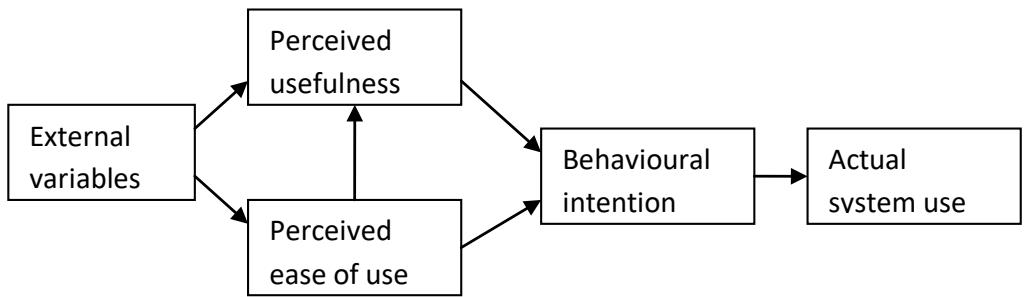
Figure 2.1: Refined Technology Acceptance Model (Venkatesh & Davis, 1996) From the Refined Technology Acceptance model above, two fundamental measures namely Perceived Usefulness and Perceived Ease of Use were employed and five additional measures were added into TAM, experience (Parthasarathy & Bhattacherjee, 1998; Cho & Kim; 2002), computer anxiety and computer knowledge (Venkatash & Bala, 2008; Rovai and Childress, 2002; Delcourt & Kinzie, 1993), normative pressure (Nysveen et al., 2005), and management support (Chatterjee et al., 2002; Liang et al. 2007), which all have proven to be important factors that influence users behavioural intentions toward adopting E-Learning. However, this research will use, Perceived usefulness, and Management support as attributes of E-Learning Adoption. In Venkatesh and Davis (2000) and Venkatesh et al. (2003) a Unified Theory of Acceptance and Use of Technology (UTAUT) is described. UTAUT combines eight models and theories of technology use, acceptance and adoption. In this research, the researcher zeros in on one of the models, namely the Technology Acceptance Model (TAM) of Davis (1989) that will be used to study E-Learning adoption in Higher Institutions.
## ii. Models and Theories of E-Learning
### a. Holistic Development Model
The holistic mode (Collis & Moonen, 2001) is a model of flexible learning establishment. It considers individual factors nested within a complex structure that includes: institution, implementation, pedagogy and technology. This holistic view, as argued by Meredith and Newton (2003), "offers much in each individual factor (institution, implementation, pedagogy and technology), however, some providers fail to aim at the idea it proposes". For example: Institutions look at more flexible learning formats, e.g. developing market share, and may need to provide, an underlying technology for its members to use. It is, however, noted that implementation is not yet mature and development of pedagogical approaches often remain in the domain of individual faculty members.
### b. Institutional Policy and Support
In the institutional policy and support model (Collis, 1997), institutional strategy and support for E-Learning are said to have a role in the evolving practice with the institution. Collis presents this in form of a bottom-up model that "tolerates the pioneers, supports the volunteers and lets the 1000 flowers bloom prior to policy formulation" (Collis, 1997). This may be looked at as form of a bottom-up management style. The opposite of this, as observed by Meredith and Newton (2003), is the top-down management style where a clear strategic aim is formed to move into the E-Learning arena with the provision of technologies and support to make E-Learning happen.
## c. Pedagogic Evolution Model
The Pedagogic Evolution Model (Mason, 1998) proposes an "evolution framework for consideration of distance-based online courses which reflects learner interaction with content, other learners, and the extent to which pedagogic re-engineering has taken place" (Meredith & Newton, 2003). Mason presents a mechanism against which to measure and evaluate pedagogic evolution of the learners' engagement in E-Learning environment. Although this model was developed for distance learning, Meredith and Newton (2003) observe that this is a useful framework that seeks to establish how the pedagogy has evolved in relation to E-Learning.
### b) Learning Culture
Culture is defined as the patterns of thinking, feeling, and acting that people display as mental programs (Hofstede, 1997). Culture affects how a person learns (Smith, et al., 2004).
Geertz (1993) describes culture as a shared, learned, symbolic system of values, beliefs and attitudes that shapes and influences perception and behavior. Learning means different things to different people. Conceptions of learning are explored mainly in terms of "cognitive process", "motivation", and "behavior change" (Dahlin & Watkins, 2000). Previous studies suggest that students' conceptions of learning are derived from and influenced by the individual beliefs about the nature of knowledge and knowledge acquisition (Chan & Elliott, 2004).
Sedibe (2006) in researching the concept "Learning Culture" concludes that "no uniformity exists as to its actual meaning". A literature review reveals a diversity of definitions as to the concept and its attributes. Zulu et al. (2004), suggests that the term Learning Culture refers to the attitude of educators and learners towards teaching and learning and the spirit of dedication and commitment in a school which arises through the joint effort of school management, the input of educators, the personal characteristics of learners, factors in the family life of students, school-related factors as well as social factors.
Learning Culture in higher education institutions encompasses all the aspects that impact on students' learning processes and as a consequence, also influence their learning outcomes. The term Learning Culture is limited to the prevalent teaching and learning methods (Jenert et al., 2009) with regard to E-Learning. Learning Culture as a construct encompasses different institutional levels of higher education institutions, ranging from the individual members (i.e. teachers and students) to teaching and learning processes within and outside the classroom to institution-wide strategic aspects which impact on teaching and learning (Euler et al., 2006). The attributes of Learning Culture are given below.
## III. METHODOLOGY
This section gives a detailed methodology approach, where the design principle is based on the response rates especially, where the whole country is involved like the presidential elections, the referendum over a key decision within the state. The design suitable for this study is analytical giving the details of the results based on the analysis.
The study adopted a simple one spot survey and analytical designs taking a case study of five higher institutions of which two are public Universities and three are private Universities across the country. The study employed both quantitative and qualitative approaches. The study further, adopted a mixed of purposive approach of key informants in higher learning and a simple survey interview method for data collection.
### a) Sample Size determination
i. Methods of data collection, Tools and Techniques
Data was collected using online mobile survey approaches, interviews and focus group discussions.
## ii. Interview Method
The different stakeholders of National Council for Higher Education (NCHE), public institutions and private Universities were engaged into simple but comprehensive interactive interviews where their views and experiences were sought regarding the subject under study. In total of 78 interviews in all were conducted in the two categories of higher learning institutions and NCHE which is the higher learning governing body.
## iii. Survey Method
a. Groups Discussions
Focus groups discussions were conducted between the different key respondents such as the university chancellors, heads of IT department, Dean of IT faculties. In total 5 Focus group discussion conducted in the five higher learning institutions with students.
b. Review of documents and reports
A number of reports and documentaries including journals, books and periodicals were reviewed with a purpose of linking the problem to the literatures.
### b) Data Collection Tools
## i. Interview Guides
Interview guides were the tools used to collect data from the different categories of respondents. Interviews were administered and free and fair responses were collected from the targeted categories of respondents.
## ii. Questionnaires
Questionnaires with mainly closed ended questions were administered with a view of collecting specified responses in an easy way. The questionnaires were administered by the researchers and responses recorded as required. These questionnaires were generated by the researchers based on the problem and objectives of the study
## iii. Focus groups discussions Guides
Focus group discussions with were conducted with selected groups of 5 people from the different learning institutions.
## iv. Tests for validity and reliability of data collection instruments
The data collection instruments were subjected to validity and reliability analysis tests and the tools were proved fit for purpose to collect the required data for the study (For all attributes the results were over and above 0.7).
## IV. DATA PRESENTATION, FINDINGS AND ANALYSIS
Data was analyzed using Statistical Package for social Sciences (SPSS), Microsoft Excel and STATA especially for quantitative data, descriptive statistics and inferential statistics.
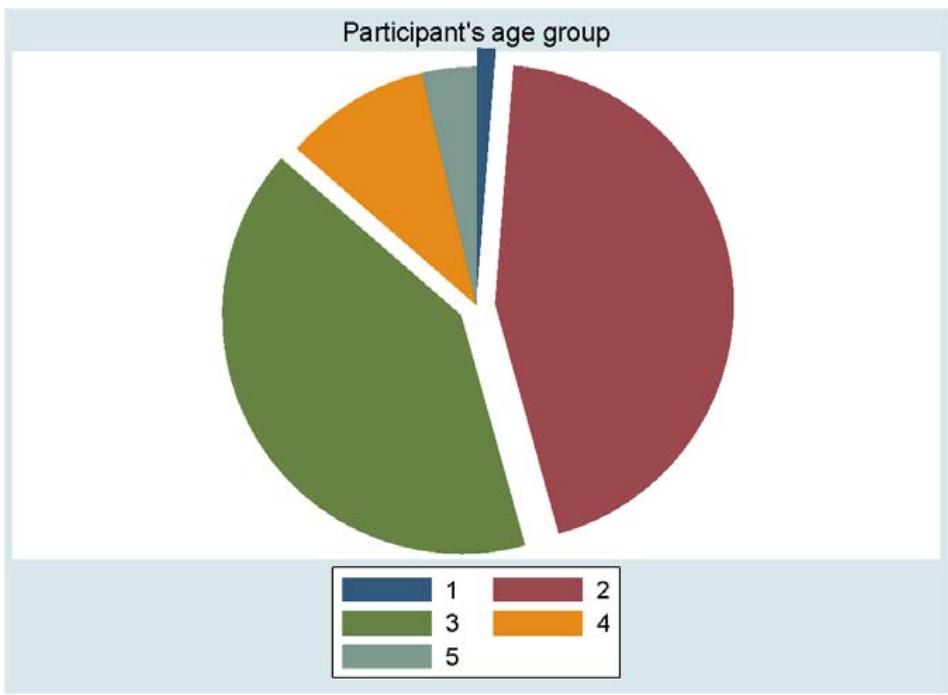 Fig. 01
### a) Measurement of Variables
Quality of forecasting and decision making on key indicators as indicated in the tools.
A Likert scale tool of Level of satisfaction in decisions made, with 5 Points was used 1: Strongly Agree; 2: Agree; 3: Not Sure; 4: Disagree; 5: Strongly Disagree
## V. STUDY FINDINGS AND DISCUSSIONS
### ACCORDING TO THE VARIABLES UNDER
#### THE STUDY
### a) Interpretation of research findings
The researcher majorly looked at e-learning culture and e-learning adoption in academic institutions across the country. These research variables were categorized into different indicators to provide a meaningful insight to the researcher. 78 respondents that included staff and students from both public and private institutions in Uganda participated in the study over through responding to the researcher's online questionnaire. Of all the respondents 49 of them were male constituting 63 percent and 37 percent were female.
In this study qualitative data was collected using online approach and then analyzed using statistical
Package for Social Science (SPSS). From the surveyed participants, it is evident that over 75 percent find it easy to use University e-learning systems despite the 19 percent who are either not sure or disagree that they can use the University e-learning system. The charts below further illustrate this narrative.

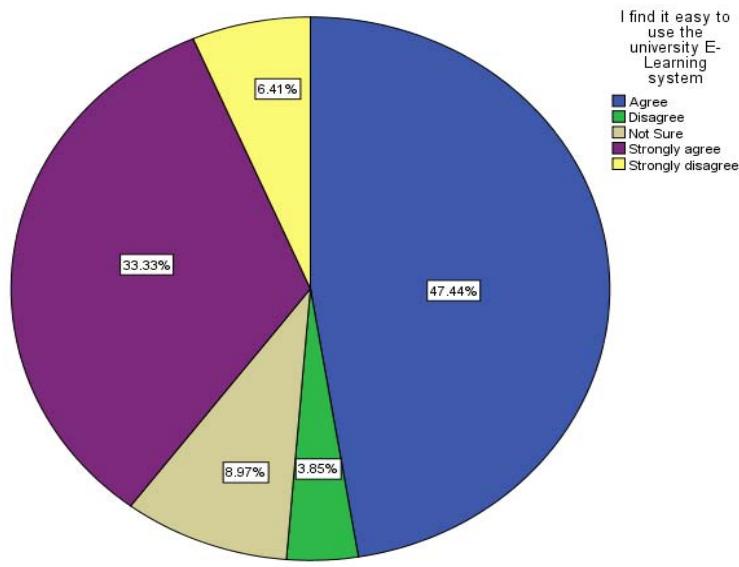 Fig. 02
From the study, the researcher discovered that majority of the respondents aged between 20 years to 39 years preferred acquiring knowledge through face-to- face approach despite their readiness to adopt the e-learning culture.
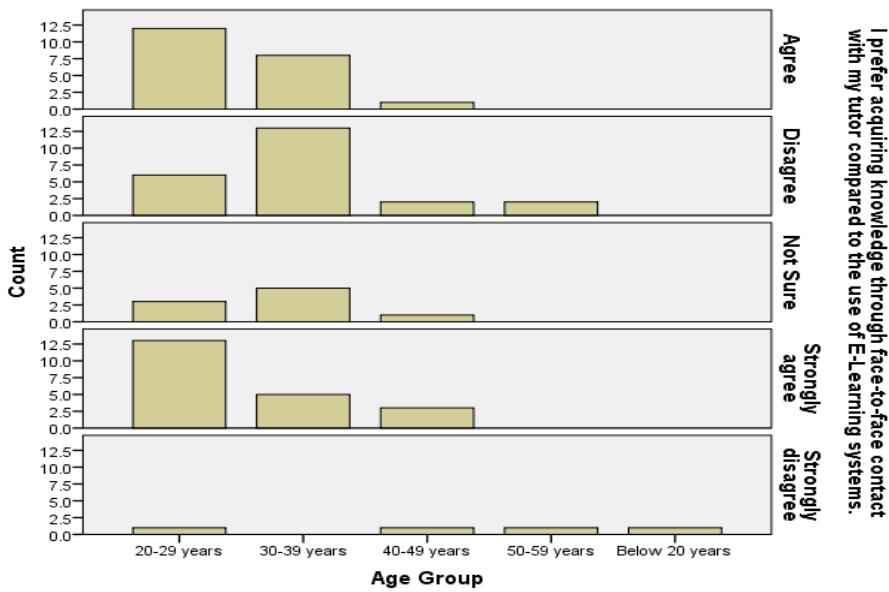 Fig. 04 Fig. 03
From the study, the researcher observed that majority of the respondents about 80.77 percent agreed that their institutes were ready for the implementation of e-learning systems. From the analysis, it is also noted that majority of those who agreed, believe that e-learning system are easy to implement and this was statistically confirmed as indicated in the table below.
Chi-Square Tests
<table><tr><td></td><td>Value</td><td>df</td><td>Asymp. Sig. (2-sided)</td></tr><tr><td>Pearson Chi-Square</td><td>27.401a</td><td>4</td><td>.000</td></tr><tr><td>Likelihood Ratio</td><td>17.604</td><td>4</td><td>.001</td></tr><tr><td>N of Valid Cases</td><td>78</td><td></td><td></td></tr></table>
a. 6 cells (60.0%) have expected count less than 5. The minimum expected count is.36.
The survey also indicated that age categories below 40 but above 20 years agreed that their academic institutions were ready for the implementation of e-learning system, however 66 respondents believed that their institution lacked the conducive environment that would enable them set and realize their set goals in regard to the adoption of electronic system.
Of all the participants, 90 percent of the male respondents below 40 years preferred acquiring knowledge through face-to-face contact with a tutor compared to the use of E-Learning systems vis-à-vis 76 percent female respondents in the same age bracket with the same preference.
b) Relationship between eLearning culture and eLearning adoption.
The researcher found out that even though training that aids the adoption of E-learning is availed, participants believed that goals are better set in the formal learning mode (face - to - face) than in the E-learning environment. This assertion was proved by the chi-square test that showed a p-value of 0.093 which was above 5 percent threshold and thus the researcher failed to accept the null hypothesis and concluded that there was no significant relationship between the variables.
Chi-Square Tests
<table><tr><td></td><td>Value</td><td>df</td><td>Asymp. Sig. (2-sided)</td></tr><tr><td>Pearson Chi-Square</td><td>23.829a</td><td>16</td><td>.093</td></tr><tr><td>Likelihood Ratio</td><td>22.170</td><td>16</td><td>.138</td></tr><tr><td>N of Valid Cases</td><td>78</td><td></td><td></td></tr></table>
Fig. 05
### c) Qualitative findings according to interviews and focus groups discussions
According to the personal interviews with the different categories of respondents about the future of elearning adoption basing on levels of satisfaction, the following were observed.
i. Views by Heads of Department, management and Staff
This category pointed out their readiness to adopt the elearning management system in their respective higher learning institutions amidst negative perception by other stakeholders especially the students.
In general, the respondents confirmed that, elearning adoption is likely to take off successfully despite the various challenges though with diverging assumptions.
## ii. Levels of Satisfaction: Views by Respondents
On the issues of elearning adoption systems in higher learning institutions, the different views were gathered.
Majority of the respondents (fig:03) preferred to acquire knowledge through the traditional face-to-face approach with the tutor before them.
A significant number of respondents believed that their academic institutions were ready to implement the elearning management system despite the funding and perspective challenges.
## VI. CONCLUSIONS AND RECOMMENDATIONS
Learning Culture in higher education institutions encompasses all the aspects that impact on students' learning processes and as a consequence, also influence their learning outcomes. Therefore, basing on our findings for this learning to take place a conducive environment is required. We believe that it elearning is a convenient approach for learning though with high level of self-motivation from the learners.
Basing on the employers' requirement of employees who are able to perform under minimum supervision, it is our professional belief that elearning approach is a better way of preparing students to execute their roles without motivation from other colleagues.
### a) Recommendations
From the study findings, I wish to recommend the following:
1) For eLearning adoption to be implemented in higher learning institution, more aware sensitization is needed to charge the stakeholder's mindset toward online learning.
2) University and other higher learning top management should pay keen interest on elearning approach and appropriate a reasonable budget for its implementation and adoption.
3) Governments and education ministry should also appropriate some budget to support elearning adoption in higher learning institution.
4) Higher learning institutions should always a contingency fund to support elearning particularly in challenging situation like during the ongoing COVID19 pandemic.
#### ARTICLE DEFICIENCIES
Article Cited by the authors
Generating HTML Viewer...
Funding
No external funding was declared for this work.
Conflict of Interest
The authors declare no conflict of interest.
Ethical Approval
No ethics committee approval was required for this article type.
Data Availability
Not applicable for this article.
How to Cite This Article
Olivia Damalie Najjemba. 2026. \u201cA Study to Examine the Effect of Learning Culture on E-Learning Adoption in Selected Higher Institutions of Learning in Uganda\u201d. Global Journal of Human-Social Science - G: Linguistics & Education GJHSS-G Volume 22 (GJHSS Volume 22 Issue G6).
Explore published articles in an immersive Augmented Reality environment. Our platform converts research papers into interactive 3D books, allowing readers to view and interact with content using AR and VR compatible devices.
Your published article is automatically converted into a realistic 3D book. Flip through pages and read research papers in a more engaging and interactive format.
Our website is actively being updated, and changes may occur frequently. Please clear your browser cache if needed. For feedback or error reporting, please email [email protected]
Thank you for connecting with us. We will respond to you shortly.