A Study to find out the Efficacy of Strip Immunoassay Test for Insulin Like Growth Factor Binding Protein -1 in Amniotic Fluid for Detection of Premature Rupture of Membranes
## I. INTRODUCTION
Premature rupture of membranes (PROM) refers to rupture of fetal membranes prior to the onset of labour, regardless of the gestational age. It is seen in $10\%$ of term pregnancies and $2 - 4\%$ of preterm pregnancies ${ }^{(1)}$.
Diagnosis of rupture of membranes depends on documentation of three clinical signs on sterile speculum examination: - 1) Visual pooling of fluid in the posterior fornix of vagina or leakage of fluid from the cervical os; (2) An alkaline pH of the cervicovaginal discharge; and (3) Microscopic ferning pattern of the cervicovaginal discharge on drying (fern test) $^{(2)}$.
Because of the limitations with the current gold standard for the diagnosis of premature rupture of membranes such as- 1)invasiveness 2)risk of chorioamnionitis and 3)pregnancy loss with intra amniotic dye instillation, 4)long duration of leaking leading to non-visualization of pooling of fluid in the vagina and 5)alkaline pH of the cervicovaginal fluid in conditions other than leaking, investigators have long been searching for an alternative and more objective test with a good diagnostic accuracy which are primarily based on the identification of one or more biochemical markers in the cervicovaginal discharge like Insulin like growth factor binding protein-1 (IGFBP-1), Alpha FetoProtein, Placental Alpha Microglobulin(PAMG-1), prolactin, HCG, Urea and creatinine etc. that are present in the setting of rupture of membranes, but absent in women with intact membranes.
The present study has been perpetrated to find out the efficiency of strip immunoassay test for insulin like growth factor binding protein-1 in amniotic fluid so that timely obstetric intervention can be done to minimise the feto-maternal risk, especially in a low resource setting.
## II. AIM AND OBJECTIVES
The aim of the study is to know the efficacy of detection of premature rupture of membranes by strip immunoassay test by detecting insulin like growth factor binding protein-1 (IGFBP-1) in amniotic fluid.
The objective of the present study is to assess the sensitivity, specificity, positive predictive value (PPV) and negative predictive value (NPV) of strip immunoassay test on amniotic fluid to diagnose PROM.
## III. MATERIAL AND METHODS
the study with written informed consent. A detailed history and thorough examination and routine investigations were done. Sterile per speculum examination to detect amniotic fluid pooling through cervical canal was done. In all cases both Strip immunoassay test for insulin like growth factor binding protein-1 test and Fern test were performed. Strip immunoassay test for insulin like growth factor binding protein-1- sample of leaking fluid was taken by speculum examination by keeping a polyester swab stick in posterior vaginal fornix for about 10 second and swab was then rinsed in a buffered solution for about 5 seconds, yellow area of the dipstick provided in the kit was placed in the tube for 20 seconds then removed and placed on a flat surface. The stick contains monoclonal antibodies to insulin like growth factor binding protein-1 and absorbs the extracted specimen. If the extracted sample contains insulin like growth factor binding protein-1 in the extracted sample, two blue lines appeared on the stick. It meant test was positive, if no blue line was seen up to 5 min then test was negative. Fern test- sample of leaking fluid taken by speculum examination with a swab placed in posterior vaginal fornix and spread on a slide. Then the slide was dried and examined under low power microscope for crystallization of amniotic fluid to form fern like pattern which was considered as positive test.
The diagnostic values of the tests were determined by calculating sensitivity, specificity, positive predictive value, negative predictive value and diagnostic accuracy.
## IV. STATISTICAL ANALYSIS
Data was summarized and entered in MS Excel sheet. Continuous variables were summarized as mean and standard deviation were analyzed by using unpaired t test. Nominal/categorical variables were summarized as proportions and were analyzed by using chi-square/ Fischer exact test, p-value $< 0.05$ was taken as significant. The diagnostic value of the tests will be determined by calculating sensitivity, specificity, positive predictive value and negative predictive value and diagnostic accuracy and comparisons made. p-value $< 0.05$ will be taken as significant.
## V. OBSERVATIONS AND DISCUSSIONS
In present study, among women who had complaints of leaking PV (n=60) on examination, 35 of the participants had leaking Per vaginum and 25 did not have leaking per vaginum. On further examination, it was found that out of 25, 3 had membranes ruptured (PROM-Present) and 22 had membranes intact (PROM-absent). So, 38 participants had ruptured membranes and the rest 22 had intact membranes. Out of these 38, 34 were diagnosed by Strip immunoassay test for insulin like growth factor binding protein-1 and only 18 were ferring Positive.
Table 1
<table><tr><td>Age</td><td>Ruptured membranes</td><td>Membranes intact</td><td>p value- 0.563</td></tr><tr><td>18-25 yrs</td><td>20 (52.6%)</td><td>13 (59.1%)</td><td></td></tr><tr><td>26-30 yrs</td><td>15 (39.5%)</td><td>9 (40.9%)</td><td></td></tr><tr><td>>30 yrs</td><td>3 (7.9%)</td><td>0(0.0%)</td><td></td></tr><tr><td>Residence</td><td>Ruptured membranes</td><td>Membranes intact</td><td>p value- 0.554</td></tr><tr><td>Urban</td><td>16 (42.1%)</td><td>11 (50.0%)</td><td></td></tr><tr><td>Rural</td><td>22 (57.9%)</td><td>11 (50.0%)</td><td></td></tr><tr><td>Socioeconomic status</td><td>Ruptured membranes</td><td>Membranes intact</td><td>p value- 0.014</td></tr><tr><td>Upper</td><td>3 (7.9%)</td><td>1 (4.5%)</td><td></td></tr><tr><td>Middle</td><td>7 (18.4%)</td><td>12 (54.5%)</td><td></td></tr><tr><td>Lower</td><td>28 (73.7%)</td><td>9 (40.9%)</td><td></td></tr></table>
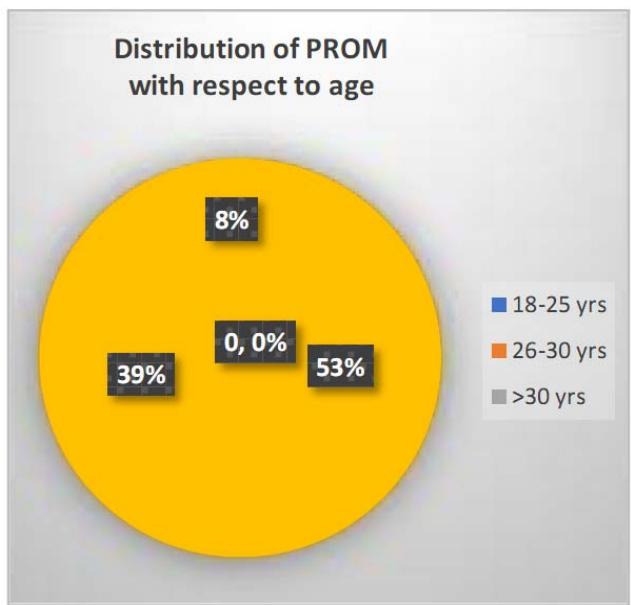
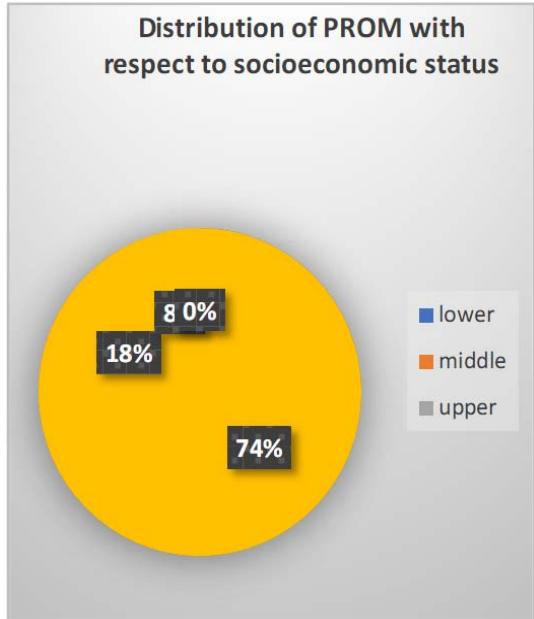
In present study, the mean age (years) in PROM cases was $25.66 \pm 4.31$. In a similar study by Evrim Erdemoglu et al and Abdelazim et al the mean age of participants with PROM was $25.6 \pm 5.5$ years and $31.5 \pm 9.52$ years respectively. There was no statistically significant difference between women with ruptured membranes and intact membranes with respect to age group. $42.1\%$ of women with PROM were from rural areas and $57.9\%$ were from urban areas. There was no significant difference between the two groups in terms of distribution of residence ( $p = 0.554$ ). Further studies are required to investigate the common occurrence of PROM in rural population. Majority (73.7%) of the participants who had ruptured membranes belonged to lower Socioeconomic Status and the majority (54.5%) of them who had intact membranes belonged to middle socioeconomic status. The present study suggested that occurrence of PROM was more common in women belonging to lower socioeconomic status and it was statistically significant $(p = 0.014)$. In a study by Spinillo et al[^5], low social class was a significant risk factor for preterm PROM.
Table 2: Association between 'Ferning' and 'Duration Of Leaking (Hours):
<table><tr><td rowspan="2">Duration of Leaking (Hours)</td><td colspan="2">Ferning</td><td>P value</td></tr><tr><td>Positive</td><td>Negative</td><td rowspan="2">0.022</td></tr><tr><td>Mean (SD)</td><td>4.72</td><td>7.64</td></tr><tr><td rowspan="2">Duration of Leaking (Hours)</td><td colspan="2">Strip immunoassay test</td><td>P value</td></tr><tr><td>Positive</td><td>Negative</td><td rowspan="2">0.010</td></tr><tr><td>Mean (SD)</td><td>5.53</td><td>8.62</td></tr></table>
In Table 2, The mean (SD) of duration of leaking in hours in the Strip immunoassay test for insulin like growth factor binding protein-1 Positive Group was 5.53, Strip immunoassay test for insulin like growth factor binding protein-1 negative group was 8.62 whereas that in the Ferning Positive group was 4.72 and Ferning Negative Group was 7.64. Both values were significant but Strip immunoassay test for insulin like growth factor binding protein-1 can detect ruptured membranes of longer duration than Ferning.IGFBP-1 has been shown to be degraded by proteases in the vagina and it has been reported as being unreliable if $>12$ hours have elapsed from the time of membrane rupture $^{6}$, however, In the present study Strip immunoassay test for insulin like growth factor binding protein-1 could even diagnose 2 cases who had leaking of more than 12 hours.
Table 3: Effect of Colour of liqor on Ferning and Strip immunoassay test for insulin like growth factor binding protein-1:
<table><tr><td rowspan="2">Ferning</td><td colspan="3">Colour of Liqor</td></tr><tr><td>Clear</td><td>Meconium</td><td>Blood Stained</td></tr><tr><td>Positive</td><td>12</td><td>5</td><td>0</td></tr><tr><td>Negative</td><td>11</td><td>5</td><td>2</td></tr><tr><td rowspan="2">Actim
PROM</td><td colspan="3">Colour of Liqor</td></tr><tr><td>Clear</td><td>Meconium</td><td>Blood Stained</td></tr><tr><td>Positive</td><td>20</td><td>9</td><td>2</td></tr><tr><td>Negative</td><td>3</td><td>1</td><td>0</td></tr></table>
Upon performing both the tests on all the participants, the following results were obtained:
a. Among the participants who had clear liquor, Ferning test was Positive in $52.2\%$ whereas $87.0\%$ of the participants had STRIP IMMUNOASSAY TEST FOR INSULIN LIKE GROWTH FACTOR BINDING PROTEIN-1 Positive. b. Among the participants who had liquor meconium stained, $50.0\%$ of the participants gave positive ferning whereas $90.0\%$ of the participants had Strip immunoassay test for insulin like growth factor binding protein-1 Positive.
c. Among those who had liquor blood stained no participants had positive ferning whereas all the participants had positive Strip immunoassay test for insulin like growth factor binding protein-1 test.
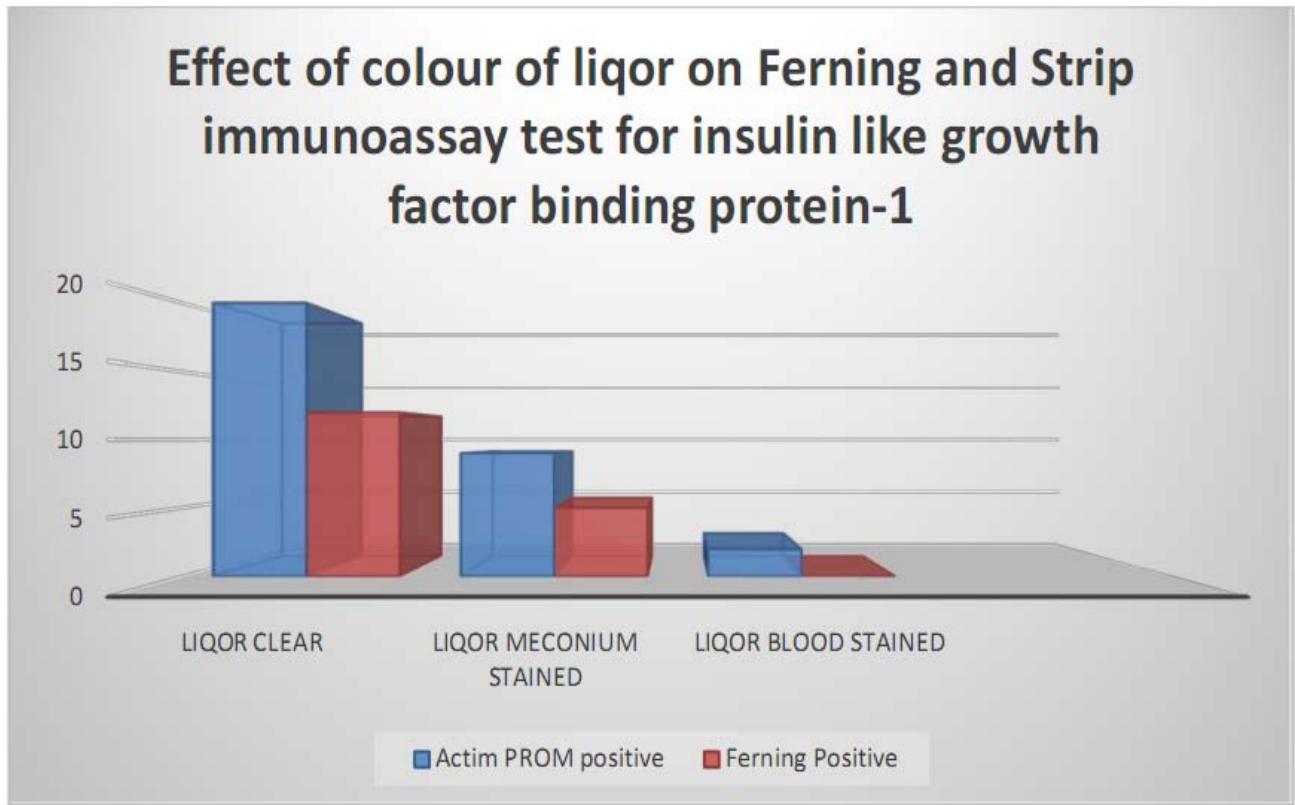
To demonstrate the presence of amniotic fluid in the vagina, test results should not be influenced by the contamination of blood, urine, seminal fluid or cervical mucus and meconium. Rutanen et al[^7] have reported that the IGFBP1 concentration in urine and seminal fluid are significantly lower than that in serum. And even if amniotic fluid is contaminated by blood, the contamination is negligible, because the serum: amniotic fluid ratio of IGFBP-1 concentration is substantially high. Also, ferning may give false-positive results due to fingerprints, contamination with semen and cervical mucus as well as false negative results due to technical error where a dry swab is used to collect the sample or contamination with blood $^{8,9,10}$.
Table 4: Association between Amniotic Fluid Index with Ferning and Strip immunoassay test for insulin like growth factor binding protein-1:
<table><tr><td rowspan="2">Ferning</td><td colspan="3">AFI</td></tr><tr><td><5 cm</td><td>5-20 cm</td><td>P value- 0.004</td></tr><tr><td>Positive</td><td>15</td><td>3</td><td></td></tr><tr><td>Negative</td><td>18</td><td>24</td><td></td></tr><tr><td colspan="4">Strip immunoassay test for insulin like growth factor binding protein-1 p value <0.001</td></tr><tr><td>Positive</td><td>30</td><td>6</td><td></td></tr><tr><td>Negative</td><td>3</td><td>21</td><td></td></tr></table>
In present study, mean AFI (cms) in women with PROM and without PROM were 2.74 (1.46) and $8.91 \pm 2.14$, respectively. AFI $< 5$ cm was seen in $84.2\%$ women with ruptured membranes and $4.5\%$ of the participants with intact membranes. Our study observed that women with PROM had a decreased AFI, which was statistically highly significant $(p < 0.001)$. Similar findings were observed in a study by Erdemoglu E et al[^3].
Also, in this study, it was found that the participants who had AFI $< 5$ cm, Strip immunoassay test for insulin like growth factor binding protein-1 was found to be positive in 30 cases whereas, Ferning was positive only in 15 cases (p value-0.004) which was significant with both the testing methods but more significant with Strip immunoassay test for insulin like growth factor binding protein-1.
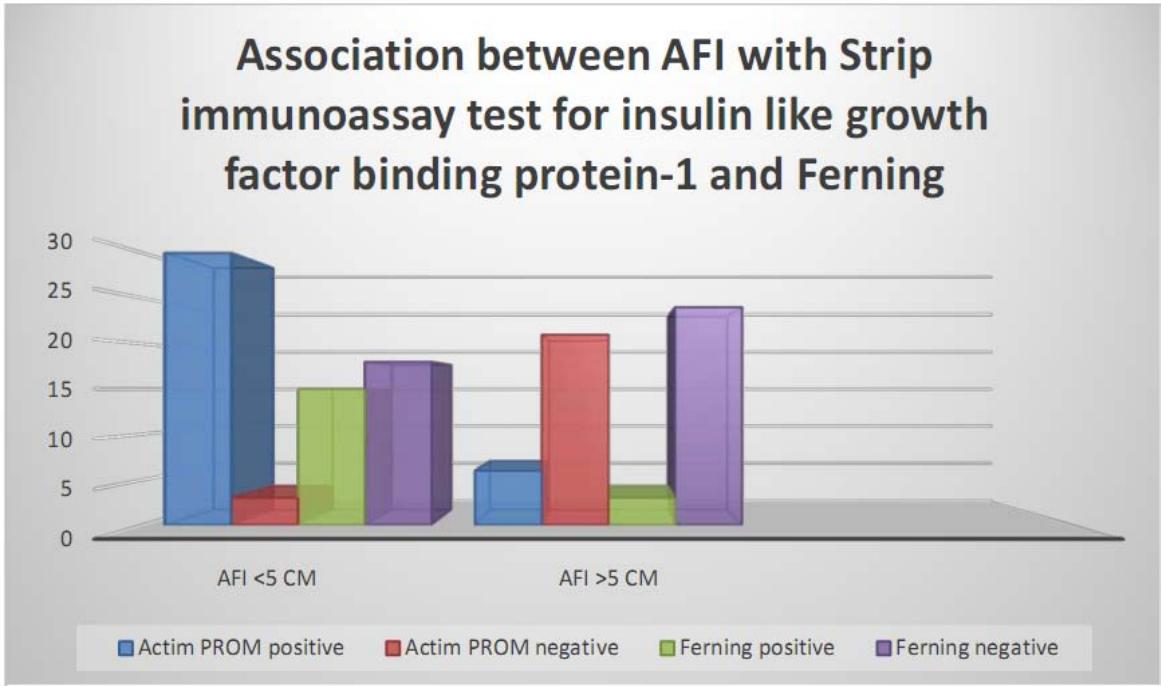
Table 5: The comparison between efficacies of both the tests in our study
<table><tr><td>VARIABLE</td><td>STRIP IMMUNOASSAY TEST</td><td>FERNING</td></tr><tr><td>Sensitivity</td><td>90%</td><td>47%</td></tr><tr><td>Specificity</td><td>91%</td><td>100%</td></tr><tr><td>Positive Predictive Value</td><td>94%</td><td>100%</td></tr><tr><td>Negative Predictive value</td><td>83%</td><td>52%</td></tr><tr><td>Diagnostic Accuracy</td><td>90%</td><td>67%</td></tr></table>
## VI. CONCLUSIONS AND RECOMMENDATIONS
PROM is one of the most troublesome issues in today's obstetrics. Our data shows that IGFBP-1 is an ideal marker of Amniotic fluid and that rapid, simple test for the measurement of this protein in vaginal secretion by a dipstick method has a diagnostic potential in the diagnosis or exclusion of rupture of fetal membranes. The high sensitivity, specificity, PPV, NPV of strip immunoassay test using IGFBP-1 (Strip immunoassay test for insulin like growth factor binding protein-1) makes it a useful test when in doubt of PROM. It is easily performed in clinical setting and no extra staff is required.
The correct diagnosis of PROM is critical for both maternal and foetal concerns, it's high sensitivity and specificity will not only protect the mother from the deleterious effects of intraamniotic infections, postpartum infections and endometritis, but will also prevent the preterm birth by unnecessary induction of labor or cesarean section thus decreasing the burden of neonatal ICU admissions, thereby reducing the maternal morbidity and neonatal mortality and morbidity.
Informed Consent Statement: All subjects here were already informed and gave consent.
Provenance and Peer Review: not commissioned, externally peer-reviewed.
Declaration of Competing Interest: None.
### ACKNOWLEDGEMENT
The authors would like to thank everyone who supported and assisted throughout all aspects of our study and for their help in writing the manuscript.
Generating HTML Viewer...
References
10 Cites in Article
Brian Mercer,Robert Goldenberg,Paul Meis,Atef Moawad,Cynthia Shellhaas,Anita Das,M Menard,Steve Caritis,Gary Thurnau,Mitchell Dombrowski,Menachem Miodovnik,James Roberts,Donald Mcnellis (2000). The Preterm Prediction Study: Prediction of preterm premature rupture of membranes through clinical findings and ancillary testing.
A Caughey,J Robinson,E Norwitz (2008). Contemporary diagnosis and management of preterm premature rupture of membranes.
E Erdemoglu,T Mungan (2004). Significance of detecting insulin like growth factor binding protein-1 in cervicovaginal secretions: comparison with nitrazine test and amniotic fluid volume assessment.
Ibrahim Abdelazim (2014). Insulin-like growth factor binding protein-1 (Strip immunoassay test for insulin like growth factor binding protein-1 test) for detection of premature rupture of fetal membranes.
A Spinillo,S Nicola,G Piazzi,K Ghazal,L Colonna,F Baltaro (1994). Epidemiological correlates of preterm premature rupture of membranes.
(1998). American College of Obstetricians and Gynecologists (ACOG).
Hanna Kallioniemi,Leena Rahkonen,Oskari Heikinheimo,Vedran Stefanovic,Jorma Paavonen (2014). Usefulness of the insulin‐like growth factor binding protein‐1 bedside test for ruptured fetal membranes.
Michael Friedman,Thomas Mcelin (1969). Diagnosis of ruptured fetal membranes.
R Rosemond,S Lombardi,F Boehm (1990). Ferning of amniotic fluid contaminated with blood.
Brian Mercer (2004). Preterm premature rupture of the membranes: diagnosis and management.
No ethics committee approval was required for this article type.
Data Availability
Not applicable for this article.
How to Cite This Article
Dr Akansha Kumawat. 2026. \u201cA Study to find out the Efficacy of Strip Immunoassay Test for Insulin Like Growth Factor Binding Protein -1 in Amniotic Fluid for Detection of Premature Rupture of Membranes\u201d. Global Journal of Medical Research - E: Gynecology & Obstetrics GJMR-E Volume 23 (GJMR Volume 23 Issue E1): .
Explore published articles in an immersive Augmented Reality environment. Our platform converts research papers into interactive 3D books, allowing readers to view and interact with content using AR and VR compatible devices.
Your published article is automatically converted into a realistic 3D book. Flip through pages and read research papers in a more engaging and interactive format.
Our website is actively being updated, and changes may occur frequently. Please clear your browser cache if needed. For feedback or error reporting, please email [email protected]
Thank you for connecting with us. We will respond to you shortly.
Lorem ipsum dolor sit amet, consectetur adipiscing elit. Ut elit tellus, luctus nec ullamcorper mattis, pulvinar dapibus leo.
A Study to find out the Efficacy of Strip Immunoassay Test for Insulin Like Growth Factor Binding Protein -1 in Amniotic Fluid for Detection of Premature Rupture of Membranes