This survey paper traverses the field of website-based solutions from the outlook of enhancing the work efficiency of any organization or institution, particularly establishment with less technically skilled workforce. The paper provides a comprehensive overview on web development in a great way spanning from the state of the field, current trends, important technologies and evaluating data across the sub domains of the paramount technological footprints. Discussion on hurdles faced by developers in creating solutions using optimal tech pool. We have provided context and motivation for future developers by compiling summaries for various research work that has been documented in formal of articles, journals, conference papers, etc. Both the aspects of frontend and backend are being taken into consideration as well as their integration for the build out of a working real-world project. We have also discussed the key bottleneck areas that may become hinderance for the beginners in this field, while also assisting the experts on points further research and exploration.
## I. INTRODUCTION
The effective administration of locomotive sheds is essential to the successful operation of railway systems. In order to maintain the operating preparedness and safety of locomotives, locomotive sheds are essential centers for their maintenance, repair, and upkeep. Locomotives are subjected to strict schedules, strenuous maintenance procedures, and a wide range of repairs because they constitute the foundation of railway operations. [20] The timely and efficient administration of these locomotive sheds is crucial for maximizing resource allocation, reducing operating downtime, and ensuring service reliability.
The field of shed management has undergone a transformation in recent years due to the introduction of digital technologies and data-driven solutions. Modern shed management systems that make use of real-time tracking, sophisticated analytics, and automation are progressively replacing conventional manual operations. These systems give railway administrators and shed managers the power to properly allocate resources, managers the power to properly allocate resources, monitor locomotive positions, and streamline repair operations. [40] Modern shed management systems also include role-based access control methods to make sure that various authorities have access to the information and activities of the shed at the proper levels. [40]
This survey report starts an investigation of the current state of locomotive shed management. It goes into the many facets of shed administration, covering everything from workflow optimization to role-based access control and locomotive location tracking and monitoring. This survey seeks to provide a complete overview of the cutting-edge shed management systems and their impact on the railway sector by a thorough analysis of pertinent literature, research papers, and best practices.
The paper's organization aims to provide insights into the shed management components, such as real-time location tracking, assigning locomotives to maintenance departments, access control, data integration, and security issues. We want to pinpoint trends, obstacles, and possibilities in the area of locomotive shed management by reviewing the body of research and case studies.
This report also acknowledges the crucial part shed management plays in improving operational performance, cost-effectiveness, and customer satisfaction in railway operations. We will highlight significant findings, new technologies, and future directions as we read through the literature since they have the potential to influence how shed management systems develop in the future.
In conclusion, this survey article offers shed managers, railway authorities, and scholars' useful insights into shed management for locomotive sheds. It aims to provide a deeper comprehension of shed management concepts, best practices, and the industry-changing effects of technology.
## II. LITERATURE SURVEY
Effective shed management is essential for locomotive sheds because it guarantees the best upkeep and repair of locomotives while minimizing downtime and operating expenses. The historical evolution of shed management techniques highlights its significance and gradual growth. Complexity in resource distribution and the requirement for effective coordination of repairs are obstacles. [27] Real-time position tracking, workflow optimization, role-based access control, data integration, and security are just a few of the elements that make up shed management. Real-time locomotive monitoring is made possible by tracking technology like GPS and RFID, which improves resource allocation. Lean and Six Sigma workflow optimization approaches are used to speed up the repair process. Access control using roles protects shed operations. [40] For the railway sector to establish efficient shed management systems that promote efficiency and dependability, it is crucial to understand these components.
The modern world depends on complex systems operating effectively, whether in the fields of transportation, online development, or maintenance optimization. Our reliance on complex networks, technologies, and infrastructure grows along with society. Researchers and practitioners must conduct research and develop techniques to improve the performance, dependability, and overall efficacy of these systems to manage this always changing environment.
This survey study launches a thorough investigation of a variety of research publications, each of which offers unique insights into specific topics. Despite their apparent differences, these studies all share the same objective: to improve system administration and optimization. These articles, which span a variety of fields including web development, logistics in transportation, and maintenance planning, jointly shed light on complex problems and creative solutions. It delves into a diverse array of subjects, including the latest web technologies, innovative design approaches, user-centric design principles, accessibility standards, search engine optimization strategies, and emerging development tools.
### a) Web Development and Technologies
Web design and development is a key component of technological advancement in the digital era. The article "A Survey on Current Technologies for Web Development" explores the web applications' continuing value while highlighting the rise of progressive web apps (PWAs). [1], [12] The significance of technology stacks in web development and their impact on market penetration and performance are emphasized in the article. [21] In this situation, choosing the right technology stacks becomes crucial, and making the wrong option could spell project failure.[17], [19] The report examines various technologies, including Node.js, MongoDB, and JavaScript, outlining their benefits and drawbacks.[22] Also discussed are the ramifications of the developing field of computer vision for material handling and 3D parcel processing. Therefore Web-applications provide a good solution for Shed management. [25]-[27]
### b) Shed Management for Locomotive Sheds
The smooth running of transportation systems depends on the efficient management of locomotive sheds. [16] An innovative idea is presented in the research paper "Shed Management for Locomotive Shed"- a web-based platform for tracking and coordinating locomotive repair among various departments inside a locomotive shed. [20] This system, which is created to give various authorities different levels of access, is a viable option for streamlining maintenance tasks and enhancing shed management in general. [18] It serves as evidence of the integration of digital technology with transportation logistics, showing the possibility for increased productivity in a long-established sector. [37]- [40].
### c) Template Engine for Web Backend
The creation of a web backend template is a complex operation that is essential for the development of web applications. Modularity is king in this process because it promotes the separation of concerns and the maintainability of the code. [19] REST ful APIs, which follow the REST principles, guarantee consistent frontend and backend communication. [10] Node.js and the Go language provide strong alternatives for authentication and authorization, which is crucial because of security. [2]-[6] Known for its asynchronous capabilities, Node.js is frequently used for real-time applications, and Go is a great option for high-performance backends due to its efficiency. Thorough documentation, [28] middleware for functions like error handling and input validation, and a well-structured database schema are necessary. [7]-[15]
### d) Load Balancing in Computing Systems
For distributed computing systems to operate at their best, effective load balancing is essential. [32] The article "Comparative Studies of Load Balancing with Control and Optimization Techniques" provides insightful information about load balancing in database memory management. The paper compares and analyzes optimization n-based and control-based methods for database memory load balancing, highlighting their similarities and differences. [33] The paper improves our knowledge of performance optimization in computing systems by presenting load balancing as a restricted optimization problem. This study emphasizes the crucial function of load balancing in distributed computing, particularly in relation to database systems. [34], [35]
### e) Measuring Website Quality of Indian Railways
In a time where digital interfaces predominate, the caliber of websites can have a big impact on user pleasure. "Measuring Website Quality of the Indian Railways" investigates the website's quality through a thorough evaluation. Using characteristics developed from a literature analysis, user interviews, and observations, the study contrasts the website's quality with that of an idealized counterpart. [20] The findings show a significant discrepancy between user expectations and the functioning of the website. The importance of a high-quality website in increasing user happiness is emphasized, as is the possibility for cost savings and better customer service with effective web-based ticketing.
### f) Role-Based Access Control (RBAC)
A key component of system security is access control, and RBAC provides a strong framework for controlling access to resources. The article "Research and Application of Role-Based Access Control Framework" investigates the value of the RBAC framework in ensuring secure access to system resources. The study digs into the fundamental ideas behind RBAC, highlighting the crucial part that roles play in mediating user access. Additionally, it covers the usage of RBAC outside of conventional Active Directory setups, providing details on dynamic changes to user capabilities and database independence.[36] The significance of access control in protecting sensitive systems and data is highlighted by this study and hence RBAC can be used in a web application for shed management. [30], [31]
### g) Maintenance Optimization in Transportation
The proper maintenance of vital parts, like diesel locomotives, is essential for the efficient running of transportation systems. A thorough study on the optimization of maintenance procedures to improve performance and reliability is presented in "Maintenance Optimization in Transportation Systems". Preventive, condition-based, and corrective maintenance are some of the different maintenance strategies that are examined in the study report. The complex links between maintenance procedures and system performance are captured using mathematical models. [38] The success of the suggested maintenance optimization solutions is validated by case studies and simulations, which show considerable improvements in locomotive availability, reliability, and overall performance.
It quickly becomes clear that the search for excellence in system management is a multidisciplinary undertaking as we start this study of various research articles. We get a deeper grasp of the complex dynamics that propel advancement in our increasingly convoluted and linked world by examining the primary results, techniques, and consequences of these works. [39] Hence, a web application for Shed management will lead to a better Maintenance Optimization in Transportation.
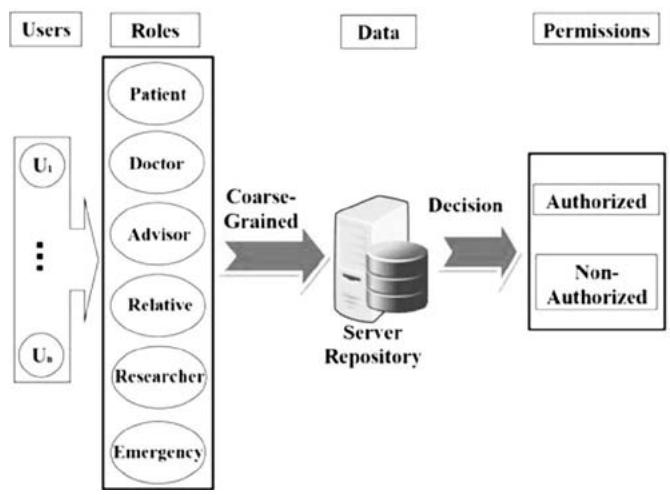 Figure 1: Role Based Access Control
Here is a comparison of 25 research articles that are relevant to our study, displaying the various technologies utilized, their various implementations, and brief summaries for each.
Table 1: Summary of Referenced Research Papers
<table><tr><td>Sr. No.</td><td>Work/Paper Title</td><td>Author</td><td>Main Tech Domain</td><td>Sub Tech Domain</td><td>Features</td><td>Summary</td></tr><tr><td>1.</td><td>A Survey on Current Technologies for Web Development (2020) [1]</td><td>A.
V. Akhil Krishna & Dr. Padmashree T</td><td>Web Technology</td><td>Languages, Frameworks, Techstack</td><td>- Scalability - Optimal performance</td><td>This paper examines various technologies used in web development, with a particular focus on Node.js, MongoDB, and JavaScript.</td></tr><tr><td>2.</td><td>Research and Application of Template Engine for Web Backend Based on My Batis-Plus (2019) [2]</td><td>Yao Zhang et al.</td><td>Backend Technology</td><td>Template engine</td><td>- MVC pattern - SSM framework - RESTful coding</td><td>This paper discusses software development, specifically focusing on back-end web service development using Java Web & separation of front-end and back-end development, with different professionals handling each part.</td></tr><tr><td>3.</td><td>Comparative Studies of Load Balancing with Control and Optimization Techniques (2005) [33]</td><td>Yixin Diao et al.</td><td>Backend Development</td><td>Load Balancing, Database, Server, Feedback controlling</td><td>- DB2 Universal Database Server - constrained optimization - marginal gains</td><td>It presents load balancing as a constrained optimization problem and explores two load balancing controllers developed using feedback control and optimization theory.</td></tr><tr><td>4.</td><td>Design and Development of Backend Application for Public Complaint Systems Using Microservice Spring Boot(2017) [19]</td><td>Hatma Suryotrisongko et al.</td><td>Backend Development</td><td>Microservice technology, microservice architecture</td><td>- Springboot framework</td><td>The paper discusses a research study that developed a public complaint application using a microservice architecture and the Spring boot framework, which was deployed in the cloud.</td></tr><tr><td>5.</td><td>Enhancing the Performance of the Website through Web Log Analysis and Improvement (2012) [24]</td><td>Arvind K Sharma, & PC Gupta</td><td>Monitorin g and Logging</td><td>Web traffic, Web log files</td><td>- Webalizer - Web log analysis - Volume analysis</td><td>The paper is organized into different sections, including a description of web logs, related work, experiments and results, and a conclusion with future work. The paper also discusses the analysis of daily activity statistics from a web server to enhance website and business performance.</td></tr><tr><td>6.</td><td>Web Load Balance and Cache Optimization Design based Nginx Under HighConcurrency Environment (2012) [35]</td><td>Xiaoni Chi</td><td>Backend Development</td><td>Load balancing, Caching, Concurrence</td><td>- Nginx - cluster environment - Web caching optimization</td><td>Paper result indicated that an Nginx-based program is not only viable but also highly effective, making it ideal for high concurrency environments that rely on load balancing and caching</td></tr><tr><td>7.</td><td>Secure Access to the Network Infrastructure(2019)[32]</td><td>Jeff Hayes & Alcatel Ind</td><td>Web Security</td><td>Network security, authentication</td><td>- Kerberos - multiple-factor authentication - firewalls</td><td>This paper discusses the importance of robust network security measures, with a particular focus on authentication techniques.</td></tr><tr><td>8.</td><td>Light-weight Authentication & Authorization Protocol for Seamless Video Services Application (2011) [31]</td><td>Jia-Yin Tian et al.</td><td>Web Security</td><td>Authentication & Authorization Protocol</td><td>- SVSAAP - EAP-TLS - HB series protocols</td><td>The authors outline the structure and functionality of SVSAAS and present SVSAAP, an associated protocol based on Challenge Response Handshake Authentication Protocol and lightweight certificates.</td></tr><tr><td>9.</td><td>Authentication and Authorization in microservices Architecture: A Systematic Literature review (2022) [30]</td><td>Murilo Almeida & Edna Canedo</td><td>Web Security</td><td>Microservices, Authentication and authorization, API Gateway</td><td>- O Auth 2.0 - JWT - Open ID Connect</td><td>The paper highlights a significant gap in research related to security in microservices architecture, particularly concerning authenti-cation and authorization. Several mechanisms, such as OAuth 2.0, Json Token (JWT), and API Gateway, can mitigate security risks, but more practical implementations are needed.</td></tr><tr><td>10.</td><td>A Performance Comparison of Cloud-based Container</td><td>Yao Pan et al.</td><td>Cloud</td><td>Infrastructure-as-a-Service, Virtual</td><td>- Docker Swarm - Kubernetes</td><td>In this paper we compare the benefits and overheads incurred by the most popular open-source container</td></tr><tr><td></td><td>Orchestration Tools (2015) [15]</td><td></td><td></td><td>Machines (VMs) and containers, leading container orchestration</td><td></td><td>orchestration tools currently available, namely: Kubernetes and Docker in Swarm mode. We undertake a number of benchmarking exercises from well-known benchmarking tools to evaluate the performance overheads of container orchestration tools and identify their pros and cons more generally.</td></tr><tr><td>11.</td><td>IoT for sustainable railway transportation: Past, present, and Future (2022) [16]</td><td>Prasant Singh et al.</td><td>Web technology</td><td>IoT, Green tech</td><td>- WSN - LTE - LPWAN - Fog nodes</td><td>This paper summarizes the impact of IoT in railways and the overall supply chain having rail transport as its part. Further case studies are discussed over inclusion of other modern tech like RFID, NFC tags, etc.</td></tr><tr><td>12.</td><td>Measuring website quality of the Indian Railways (2015) [20]</td><td>Rajesh Kumar Jain & Santosh Rangnekar</td><td>Frontend</td><td>UI/UX</td><td>- Data Collection - Single factor ANOVA</td><td>This paper discusses the benefits of having websites in public sector taking Indian railways as a case study and evaluated its outcome over tens of parameters and suggests implementation future advancements.</td></tr><tr><td>13.</td><td>A comparative study on internet application development tools (2010) [22]</td><td>Lavanya Rajendran et al.</td><td>Web technology</td><td>Development tools</td><td>- AJAX - ASP - ASP DOT</td><td>This paper shows web development technique that allows for asynchronous communication between a web browser and server, enabling dynamic content updates without requiring a full page reload. Evaluates AJAX, ASP, ASP DOT framework, etc.</td></tr><tr><td>14.</td><td>Go Programming Language: Overview (2022) [23]</td><td>Meky Nurwina A. Quirante et al.</td><td>Program ming language</td><td>Golang</td><td>- Scalability - Concurrency - Open-source</td><td>The article provides an overview of the Go programming language (Golang), highlighting its simplicity, efficiency, and suitability for concurrent and scalable applications. It discusses Go's key features, including goroutines, channels, and its standard library, making it an appealing choice for modern software development. The article emphasizes Go's role in web development, cloud services, and microservices architecture.</td></tr><tr><td>15.</td><td>Research and application of Node.js core technology (2020) [24]</td><td>Xiaoping Huang et al</td><td>Program ming language</td><td>Javascript</td><td>- Runtime environment - Threading - Event driven</td><td>This paper provides an overview to Node.js, highlighting its event-driven, non-blocking architecture for building fast and scalable server-side applications. It emphasizes its popularity in web development due to its performance and large ecosystem of modules.</td></tr><tr><td>16.</td><td>Usability evaluation of web support frameworks (2015) [27]</td><td>Marcela Constanzo & Sandra Casas</td><td>Web technology</td><td>Framework</td><td>- Documentation - Quality Attributes - Quality Metrics</td><td>The article discusses the assessment of web support frameworks in terms of usability. It explores methods and criteria for evaluating the user-friendliness and effectiveness of these frameworks, aiming to aid developers in making informed choices when selecting web support tools. The article may provide valuable insights into the usability landscape of such frameworks.</td></tr><tr><td>17.</td><td>A performance comparison of SQL and No SQL databases (2015) [6]</td><td>Yishan Li & Sathiamoorthy Manoharan</td><td>Database</td><td>DBMS</td><td>- Queries - Data models - CRUD model</td><td>This paper discusses the fundamental differences between NoSQL and SQL databases, highlighting how NoSQL databases excel in handling unstructured data and providing horizontal scalability. It also emphasizes that SQL databases remain a strong choice for structured data and complex querying, making the choice between the two depends on specific project requirements.</td></tr><tr><td>18.</td><td>Choosing the right NoSQL database for the job: a quality attribute evaluation (2015) [4]</td><td>Joao Ricardo Lourenco et al.</td><td>Database</td><td>NoSQL</td><td>- Key-value
- Graph
- ACID</td><td>This paper explores the rise of NoSQL databases, highlighting their flexibility and scalability in handling unstructured data. It discusses their increasing adoption in various industries and their role in reshaping modern 188data management strategies. Various attributes are evaluated, and performance is articulated.</td></tr><tr><td>19.</td><td>A case study of web API evolution (2015) [9]</td><td>S. M. Sohan et al.</td><td>API</td><td>-</td><td>- RESTful
- SOAP
- WSDL
- JSON</td><td>This case study explores the challenges, changes, and strategies employed during the API's development and evolution. The study provides valuable insights into best practices for managing and adapting web APIs over time.</td></tr><tr><td>20.</td><td>Optimizing Vehicle Repairs Scheduling Using Mixed Integer Linear Programming: A Case Study in the Portuguese Automobile Sector (2023) [40]</td><td>Fátima Pilar et al.</td><td>Job scheduling</td><td>-</td><td>- MILP
- Mathematical optimization</td><td>It focuses on improving efficiency and resource allocation in repair shops. The study presents a case study demonstrating the effectiveness of MILP in reducing repair times and increasing service quality. The approach offers a practical solution for managing repair scheduling challenges in the automotive industry.</td></tr><tr><td>21.</td><td>Analysis of the popularity of programming languages in open-source software community (2020) [25]</td><td>Dougdong Lu et al.</td><td>Program ming languages</td><td>-</td><td>- Gitee
- Cluster Analysis
- Binary matching</td><td>The article examines the popularity of programming languages within the open source software community. It analyzes data and trends to identify the most widely used languages, highlighting Python and JavaScript as dominant choices. The study sheds light on the preferences of open-source developers, informing decisions related to language selection and collaboration within the community.</td></tr><tr><td>22.</td><td>Survey on server-less computing (2021) [3]</td><td>Hassan B. Hassan et al.</td><td>Cloud</td><td>Cloud computing</td><td>- Serverless computing
- Edge computing
- FaaS</td><td>The paper explores how serverless computing, exemplified by platforms like AWS Lambda and Azure Functions, streamlines development by abstracting infrastructure management, offering cost savings, and auto-scaling capabilities, while also touching on potential challenges such as vendor lock-in and security.</td></tr><tr><td>23.</td><td>Use chaos engineering to assess application reliability (2009)[41]</td><td>Robert Barron</td><td>DevOps</td><td>CI/CD pipeline</td><td>- Static analysis
- Test automation</td><td>This article showcases Chaos engineering is a practice of intentionally introducing controlled failures and disruptions in a system to uncover vulnerabilities and weaknesses, ultimately improving its resilience and reliability.</td></tr><tr><td>24.</td><td>How companies are benefiting from Web 2.0 (2009) [32]</td><td>Jacques Bughin</td><td>Web technology</td><td>Marketing</td><td>-</td><td>A report from McKinsey Quarterly, on how companies across the global benefitted from implementation of web-based solution</td></tr><tr><td>25.</td><td>A survey paper on Role Based Access Control (2013) [36]</td><td>Dipmala Salunke</td><td>Application security</td><td>IAM</td><td>- Hierarchical structure
- ACLs
- Permissions and privileges</td><td>This survey explores RBAC significance in managing permissions by assigning roles to users, enhancing security, and simplifying administration. It reviews RBAC models, implementation methods, and evolving trends, highlighting its widespread adoption.</td></tr></table>

## III. CONCLUSION
An essential part of the railway system, locomotive shed management has changed significantly in recent years. This survey article has offered a thorough review of locomotive shed management, examining several aspects that contribute to the effective operation and upkeep of locomotives within these crucial facilities.
Despite clear advancements in shed management systems, difficulties persist. The complexity of railroad operations, the requirement for system compatibility, and the constantly growing nature of technology necessitate constant adaptation and innovation. Strong techniques for data protection and system integrity are required due to security concerns, especially in a time of rising cyber threats.
Future developments in shed management systems are anticipated thanks to rising technologies including the Internet of Things (IoT), predictive maintenance, and advanced analytics. The railway sector could undergo a revolution if these technologies are adopted and a commitment to data-driven decision-making is made.
In conclusion, managing sheds for locomotives is a strategic necessity as well as a logistical one. The operational dependability, prices, safety, and customer satisfaction all increase with effective shed management systems. To ensure the sustained effectiveness of shed management techniques as the railway industry embraces digital transformation, it is imperative to exercise caution, adapt to new technology, and work together throughout the ecosystem. Hence, we propose digitization of shed management using technologies like web developments is necessary to fully utilize shed management systems and move the railway sector toward a more sustainable and efficient future, shed managers, railway authorities, and researchers must collaborate.
Generating HTML Viewer...
References
41 Cites in Article
A V Akhil Krishna (2020). A Survey on Current Technologies for Web Development.
Yao Zhang,Li,Sheng Gao,Jing Pan,Bi Feng Guo,Pei Xie (2019). Research and Application of Template Engine for Web Back-end based on My Batis-Plus.
Hassan Hassan,Saman Barakat,Qusay Sarhan (2021). Survey on serverless computing.
Ricardo João,Bruno Lourenço,Paulo Cabral,Marco Carreiro,Jorge Vieira,Bernardino (2015). Choosing the right NoSQL database for the job: a quality attribute evaluation.
Hao Zhong,Hong Mei (2015). An Empirical Study on API Usages.
Yishan Li,Sathiamoorthy Manoharan (2015). A performance comparison of SQL and NoSQL databases.
Qi Shen,Shijun Wu,Yanzhen Zou,Bing Xie (2021). Comprehensive Integration of API Usage Patterns.
Frank S M Sohan,Craig Maurer,Martin Ansiow,Robillard (2017). A Study of the Effectiveness of Usage Examples in REST API Documentation.
Craig S M Sohan,Frank Anslow,Maurer (2015). A Case Study of Web API Evolution.
Florian Haupt,Frank Leymann,Anton Scherer,Karolina Vukojevic-Haupt (2017). A Framework for the Structural Analysis of REST APIs.
Lauren Murphy,Mary Beth Kery,Oluwatosin Alliyu,Andrew Macvean (2018). API Designers in the Field: Design Practices and Challenges for Creating Usable APIs.
Arun Ramamurthy,Saket Saurabh,Mangesh Gharote,Sachin Lodha (2020). Selection of Cloud Service Providers for Hosting Web Applications in a Multi-cloud Environment.
Hassan Hassan1,Saman Barakat2,Qusay Sarhan2 Survey on serverless computing.
Jakuh Lithosmercl,Pavlik (2014). Preprint repository arXiv achieves milestone million uploads.
Yao Panl,Ian Chen,',Francisco Brasileiro2,Glenn Jayaputeral,Richard Sinnottl (2015). A Performance Comparison of Cloud-based Container Orchestration Tools.
Prashant Singh A,Zeinab Elmi,Krishna Vamshi,Junayed Meriga A,Maxim Pasha B,Dulebenets (2022). Internet of Things for sustainable railway transportation: Past, present, and future.
Sanja Delcev,Drazen Draskovic (2018). Modern JavaScript frameworks: A Survey Study.
Yao Zhang,Li,Sheng Gaol,'* Jing Pane,Feng Bi,Pei Guol,Xie (2019). Research and Application of Template Engine for Web Back-end Based on My Batis-Plus.
Hatma Suryotrisongko,Dedy Jayanto,Aris Tjahyanto (2017). Design and Development of Backend Application for Public Complaint Systems Using Microservice Spring Boot.
Rajesh Kumar,Jain (2015). Measuring Website Quality of Indian Railways.
Darniano Distante (2014). Evolution of Web Systems" researchgate pubiication.
Lavanya Rajendran (2010). A Comparative Study on Internet Application Development Tools.
Darltaine Lincopinis Go Programming Language: Overview.
Xiaoping Huang (2020). Research and Application of Node.js Core Technology.
Jic Dongdong,Yongxiang Wul,Mengmeng Shengt,Yang2 Analysis of the popularity of programming languages in open-source software communities.
V Okanovic (2014). Web Application Development with Component Frameworks.
Marcela Alejandra Constanzo (2015). Usability Evaluation of Web Support Frameworks.
Manisha Agarwal,Sej Al Samaiya REAL TIME DATABASE MANAGEMENT SYSTEM.
Innocent Mapanga (2013). International Journal of Modern Communication Technologies & Research (IJMCTR).
Murilo De Almeida,Edna Canedo (2022). Authentication and Authorization in Microservices Architecture: A Systematic Literature Review.
J.-Y Tian,C Yang,Y.-C Zhang,J.-B Liu (2011). Light-Weight Authentication & Authorization Protocol for Seamless Video Services Application.
Jacques Bughin How companies are benefiting from Web 2.
Yixin Diao,Wah Chai,Wu,J Hellerstein,A Storm,M Surendra,S Lightstone,J Colaco,(n.D (2005). Comparative studies of load balancing with control and optimization techniques.
Arvind Sharma,P Gupta (2012). Enhancing the Performance of the Website through Web Log Analysis and Improvement.
Xiaoni Chi,Bichuan Liu,Qi Niu,Qiuxuan Wu (2012). Web Load Balance and Cache Optimization Design Based Nginx under High-Concurrency Environment.
Dipmala Salunke (2013). A survey paper on Role Based Access Control.
(2003). Development of industrial information systems on the Web using business components.
Rodrigo Pita Rolle; Vinícius De,O Martucci,Eduardo Godoy (2019). Digitalization of Manufacturing Processes: Proposal and Experimental Results.
H Ng,P Tan,Y Lim (2018). Methodology for Digitalization -A Conceptual Model.
Pilar Fátima,Eliana Costa E Silva 2,Ana Borges Optimizing Vehicle Repairs Scheduling Using Mixed Integer Linear Programming: A Case Study in the Portuguese Automobile Sector.
Robert Barron (2018). Application of polynomial chaos expansion to reliability analysis of prestressed concrete roof girders.
No ethics committee approval was required for this article type.
Data Availability
Not applicable for this article.
How to Cite This Article
Gyanprakash Narayan. 2026. \u201cA Survey on Digitization of Shed Management for Indian Railways\u201d. Global Journal of Management and Business Research - A: Administration & Management GJMBR-A Volume 23 (GJMBR Volume 23 Issue A10): .
Explore published articles in an immersive Augmented Reality environment. Our platform converts research papers into interactive 3D books, allowing readers to view and interact with content using AR and VR compatible devices.
Your published article is automatically converted into a realistic 3D book. Flip through pages and read research papers in a more engaging and interactive format.
This survey paper traverses the field of website-based solutions from the outlook of enhancing the work efficiency of any organization or institution, particularly establishment with less technically skilled workforce. The paper provides a comprehensive overview on web development in a great way spanning from the state of the field, current trends, important technologies and evaluating data across the sub domains of the paramount technological footprints. Discussion on hurdles faced by developers in creating solutions using optimal tech pool. We have provided context and motivation for future developers by compiling summaries for various research work that has been documented in formal of articles, journals, conference papers, etc. Both the aspects of frontend and backend are being taken into consideration as well as their integration for the build out of a working real-world project. We have also discussed the key bottleneck areas that may become hinderance for the beginners in this field, while also assisting the experts on points further research and exploration.
Our website is actively being updated, and changes may occur frequently. Please clear your browser cache if needed. For feedback or error reporting, please email [email protected]
Thank you for connecting with us. We will respond to you shortly.