I. INTRODUCTION
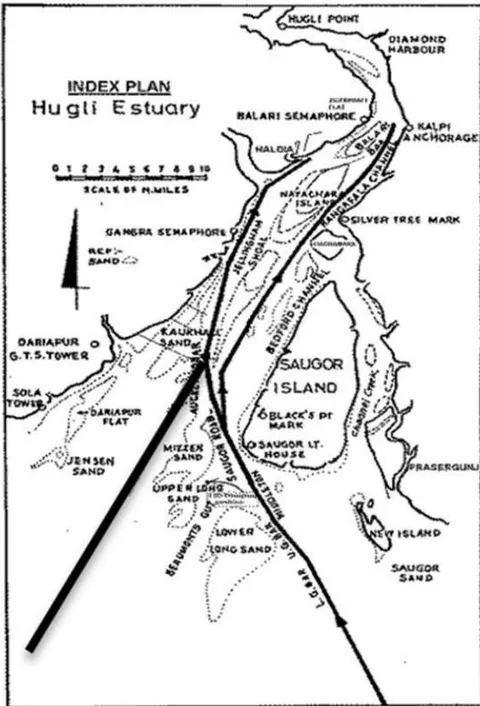
Maintenance Dredging is essential for Kolkata Port for safe and smooth navigation [1] to its dock systems. Dredged material arising out of such dredging activity has been suitably disposed of as open river disposal at deep pockets depending upon the proximity of dredging location as well as availability of land for onshore disposal [2]. Over the decades Kolkata Port Trust (KoPT) is planning to undertake a project of Silt Trap Dredging at Haldi river confluence near one of its dock system i.e Haldia Dock Complex (HDC) at Haldia [3]. The Index Plan of Hugli Estuary showing Navigation channel encompassing two Dock Systems i.e. Khidirpur Dock System (KDS) and HDC of KoPT is referred at Fig.1. The entire dredged material of the Silt Trap Dredging project is proposed to be disposed at shore [4].
In order to keep a comfort level of depth in the shipping channel, maintenance dredging by Trailer Suction Hopper Dredgers (TSHD) is carried out every day throughout the year [5]. The approximate annual dredging volume is . The dredged material is disposed in open river i.e., in the estuary at deeper locations, situated at the entrance of Bay of Bengal. Thus, the dredgers need to travel quite a significant distance for dumping and lose substantial amount of dredging time resulting longer dredging cycle time as well as yielding low efficiency [6] in putting the dredged material in the river for its re-circulation. Sometimes, side castings, over flow methods are also adopted. The shore disposal of dredged materials have been tried in very few occasions, those, compared to the total annual volume, remained to be very insignificant. The main reasons of non-implementation of shore disposal may be attributed to the following points:
- Non-availability of adequate land near the dredging locations and
- Inability by the dredging contractor to undertake the shore disposal.
In the context of above dredging-disposal scenario, an innovative synergic dredging, disposal and treatment plan has been conceptualized, during ongoing Maintenance Dredging, which will not only substitute Silt Trap Dredging but also permit the Authority an opportunity to re-use the dredged material by extracting sand through the plants installed on barges and there after transport it through waiting barges for its commercial use to Industry.
This paper deals the methodology involved in each step of the entire chain of events i.e., dredging by THSD disposal through barges-transport of dredged materials to installed sand washing plants accommodated over another big barge-extraction of sand-transfer to waiting barges-supply for industrial use in geotechnical engineering. The methodology, apart from justifying the reuse of dredged materials, giving boost to other industry, increases the efficiency of dredging by removing the material entirely from the system, reducing recirculation, enhancing the probability of decreasing annual dredging volume.
II. GEO-HYDROMORPHOLOGY OF HUGLI ESTUARY
a) Tides
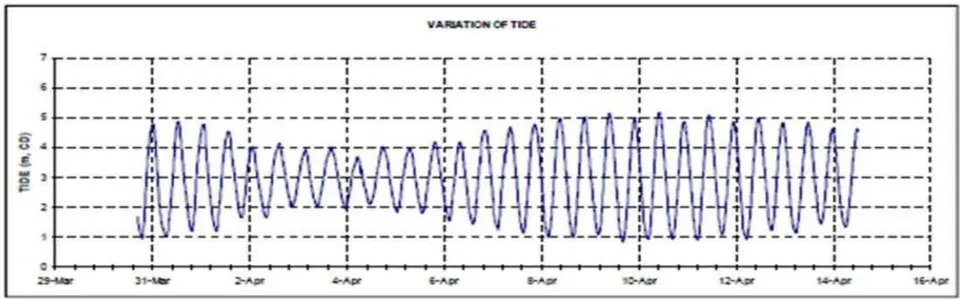
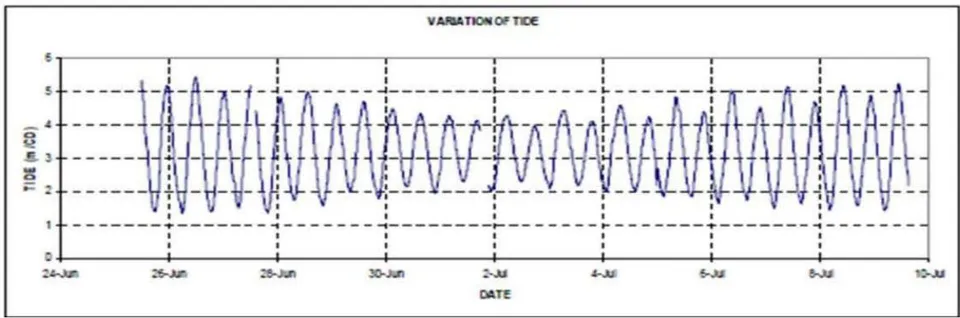
The tide, current and salinity measurements were made at the western fringe of the Sagar Island close to the Auckland Bar, one of the prime dredging stretches over the Navigational Channel leading to Haldia Dock Complex (HDC). While formulating Shore disposal scheme. It is proposed to dredge the river bed material from the Auckland Bar and dispose of along the western coast of Sagar Island within Dykes. Tide levels of three tide gauges viz., Sagar, Gangra and Haldia, relevant to the study area are given in Table 1. Tides of Hooghly estuary at Auckland Bar near Sagar Island during pre-monsoon season are shown in Fig 2, whereas those during monsoon season are shown in Fig 3. The spring tidal range is with as high water and as Low water. Neap tidal range is with as high water and as low water. The Mean Sea Level (MSL) is stated to be in this area. Tides are recorded at Sagar tidal station and are used for prediction of tides at Sagar Island. The predicted tides as usually available in published Tide tables by Survey of India, have also been analyzed to understand the overall tidal behaviour in a year. The analysis was carried for flood and ebb ranges as well for low and high waters [7]. It is understood that approx. of time the range is less than while of time the tidal range is more than . The analysis of low and high waters is also carried out. It can be seen that of time high water is higher than while of time low water is more than .
| Tide Gauge | Lat (N) | Long (E) | Height in meter above datum | ||||
| MHWS | MHWN | MLWN | MLWS | MSL | |||
| Sagar | 21039' | 88003' | 5.2 | 3.9 | 2.2 | 0.9 | 3.0 |
| Gangra | 21057' | 88001' | 5.6 | 4.1 | 2.1 | 0.8 | 3.2 |
| Haldia | 22002' | 88006' | 5.7 | 4.3 | 2.1 | 0.8 | 3.2 |
b) Currents
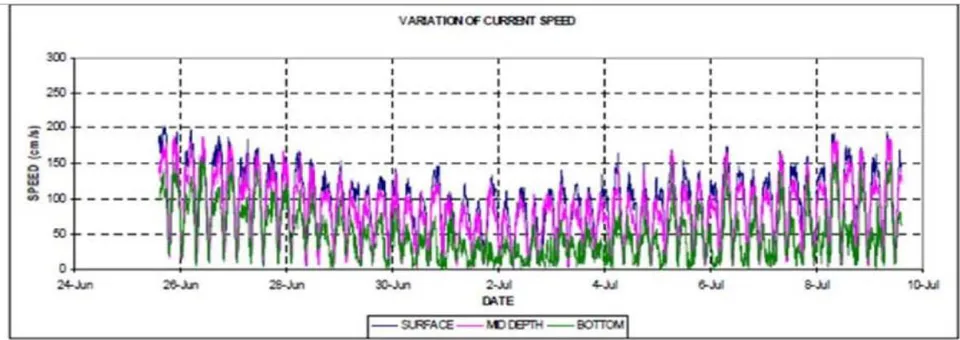
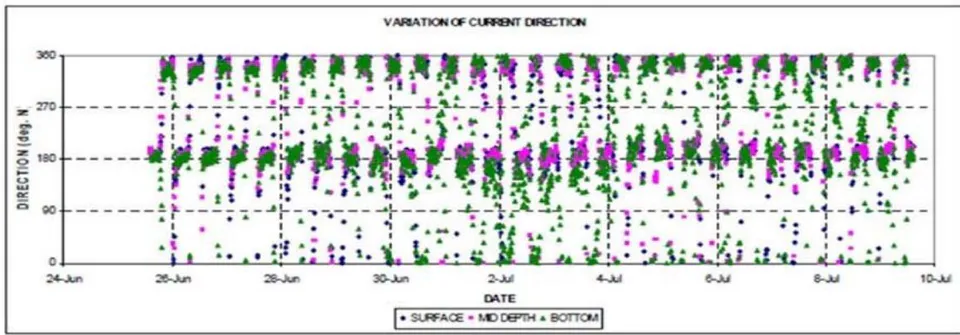
The typical time series plot of the current speed and direction observation for 15 days during monsoon season at Auckland Bar near Sagar Island are presented in Fig 4 and Fig 5. The variation of currents at various levels can easily be observed from the figure.
c) Wind and Wave
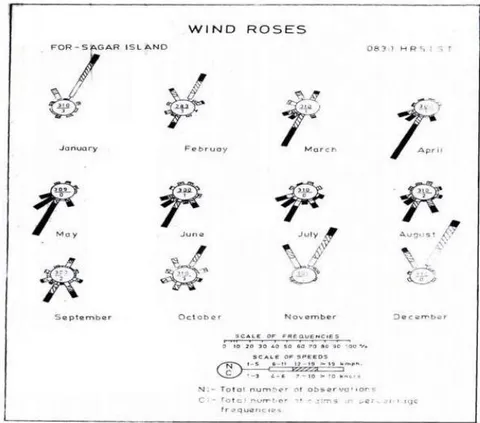
Surface waves in the coastal zone of West Bengal are mainly due to wind. Sea waves in this region rarely become destructive except during cyclonic storm. A one year typical wind rose diagram is shown in Fig 6. During South West Monsoon the wind speed rises above and is usually accompanied by spring tides. When cyclonic incidences coincide with spring tides, wave height can rise over . Ripple waves also appear in the month of October, November and December when wind generated wave height varies approximately from to . In the months of April to August, comparatively larger waves form in the shelf region and they start breaking, when they approach coastal margins. During this period wave height raises to , which causes maximum scouring on land masses. Wave action, micro and macro tidal cycles and long shore currents are recorded in most of Islands in this ecosystem. During cyclone, the water depth over tidal flats exceeds which will allow 5.0 m waves to touch the Sagar Island.
d) Grain Size of Dredged Material
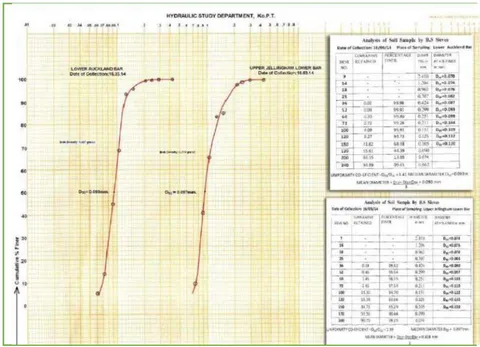
The material dredged during Maintenance Dredging in the Hugli estuary, has been tested and found that natural river bed sediment is constituted of mainly fine sand mixed with less quantity of silt and clay. Sieve analysis of Bed Soil samples, collected over Jellinghum and Auckland Bar are shown in Fig 7. Such materials can be treated as well washed in sand extraction plant and be beneficially used in the Construction and other Industries.
e) Chemical Properties of the Dredged Material
The Sample analysis of chemical properties of the Dredge materials collected from Jellinghum and Auckland areas are presented in Table 2.
III. DREDGING AND DUMPING LOCATION
Maintenance dredging by Trailer Suction Hopper Dredgers (THSD) is carried out every day throughout the year over the critical stretches of Navigational Channel (known as Governing Bars) to keep a comfort level of depth in the shipping channel [8]. Of late the maintenance dredging is carried out over three areas namely, Jelligham, Haldia Anchorage and Eden Channel. Since, Maintenance Dredging commenced in Eden Channel, after it's opening, bypassing Auckland Channel (severely siltation prone area), the use vis-à-vis, maintenance dredging over the Auckland area was stopped. The annual dredging volume thus became reducing from 14-15 . Silt Trap Dredging was planned near a location close to Jellingham and Haldia Anchorage, so that the effect of this dredging gets imparted to both the prime dredging locations and in turn, those area remain healthy and their dredging requirements get reduced in the long run. The area, thus planned for Silt Trap Dredging was the confluence of Haldia River with Hugli River, commonly known as Haldia River confluence. The Silt Trap Dredging was planned for execution for at least 2-3 years in continuum in conjunction with annual maintenance dredging. Again, this was required to be undertaken through a separate dredging contract requiring deployment of Cutter Suction Dredger and disposal of dredged materials on shore through a combination of floating and shore pipe lines, requiring substantial additional resources and cost, apart from operational and environmental hazards. The daily dredging volume, taken together from Jellingham and Haldia Anchorage, located around 12-14 km. and 5-6 km. respectively from Haldia dock usually remained around 7-8 loads, whereas in Eden area (located around 40-45 km. from HDC), 3-4 dredge loads are taken every day. Hence, the total annual maintenance dredging volume over Jellingham and Haldia Anchorage stands around whereas the same over Eden area is required around for maintaining comfort level of Navigable depths over the Governing Bars facilitating safe navigation [9]. The dredged material is disposed of in open-river in the estuary at deeper locations at the entrance of Bay of Bengal by the THSDs through opening of hopper doors [10].
IV. PROBLEM
Due to the long distance of the dumping ground, the dredgers have to spend idle time in travelling only. Dredger is not able to dredge to attend the critical stretches where depths remained minimum for most of the days in a month. The available tidal window and the required draft of the dredger also plays critical role in deciding the dredging time. Hence, the contact time of dredger i.e. the actual dredging period gets reduced due to long travel time of the dredger for travelling from dredging spot to the dumping ground and back. Hence, the shore disposal has been thought of so that entire material gets out of the system without losing any more time than the prevailing dredging cycle. The prevailing dredging cycle for open-river dumping is nearly 4 to 5 hrs ((for dredgers dredging over Jelligham and Haldia Anchorage). The silt trap dredging, equipped with one of the disposals of the material in shore, is thus conceptualized, which will have following activities:
- Identification of the location: by mathematical modelling where a cutter section dredger will be deployed. The floating pipe line of around length, attached with another shore pipe line will take the dredged material out of system and put in a Confined Detention Area (CDA) comprising compartments and sluices so that water will come out and dredged material can settle over the compartments.
Transportation of the settled material from compartments to other Industrial spots (directly, if gets reasonably dried, which of course, will be disrupted during monsoon, thus adversely affecting yield of Silt
Trap Dredging time or even causing stoppage) and/or use of this dredged material for sand extraction.
| No | Sample No. 1 Auckland | Sample No. 2 Auckland | Sample No. 3 Auckland | Sample No. 4 Auckland | Sample No. 5 Jellinghum |
| Al2O3(%) | 17.87 | 15.68 | 15.91 | 17.90 | 21.87 |
| Fe2O3(%) | 5.90 | 4.80 | 5.00 | 6.20 | 8.70 |
| MgO(%) | 1.20 | 1.12 | 1.20 | 1.50 | 1.90 |
| CaO(%) | 1.65 | 1.30 | 2.17 | 1.96 | 2.10 |
| MnO(%) | 0.11 | 0.07 | 0.05 | 0.05 | 0.06 |
| Na2O(%) | 1.30 | 1.25 | 1.20 | 1.40 | 1.30 |
| K2O (%) | 2.10 | 2.57 | 2.28 | 2.14 | 1.80 |
| TiO2(%) | 0.38 | 0.47 | 0.35 | 0.36 | 0.44 |
| P2O5(%) | .14 | .16 | .09 | .09 | .11 |
| Cu (ppm) | 10 | 15 | 10 | 15 | 20 |
| Pb (ppm) | 20 | 15 | 15 | 20 | 30 |
| Zn (ppm) | 120 | 100 | 80 | 110 | 120 |
| Ni (ppm) | 15 | 20 | 15 | 15 | 15 |
| Co (ppm) | 15 | 10 | 15 | 15 | 25 |
| Cd (ppm) | <5 | <5 | <5 | <5 | <5 |
| Ba (ppm) | 460 | 430 | 400 | 410 | 490 |
| Sr (ppm) | 5 | 10 | 10 | 15 | 20 |
| Cr (ppm) | 25 | 30 | 15 | 20 | 50 |
| V (ppm) | 60 | 50 | 40 | 50 | 45 |
| Mo (ppm) | 10 | 10 | 15 | 10 | 20 |
This entire method as explained above will require deployment of additional cutter section dredger, floating as well shore pipeline and/or setting of sand extraction plant over land for further transportation of the extracted sand. This will be a continuous process and require sufficient land for the stacking and its disposal. This scheme will require two separate contracts also which will have following constraints:
i. Maintenance of an additional dredger i.e. cutter section dredger and floating as well shore pipeline apart from dredgers (THSDs) deployed for maintenance dredging.
ii. Maintenance of the silt trap and sand washing plant.
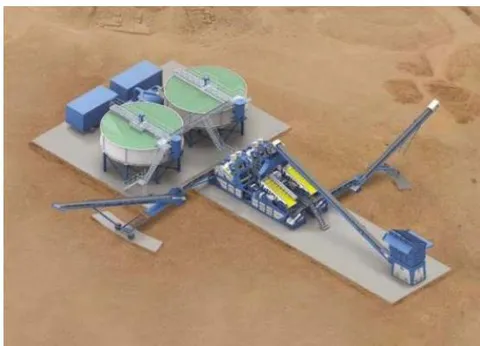
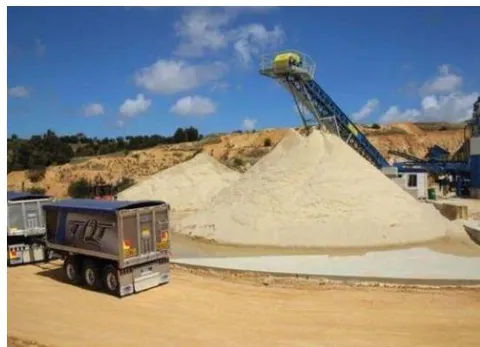
The Fig 8 and Fig 9 show the sand extraction plant and processed sand ready for use. Due to paucity of land, significant number of trucks/dumpers will have to move through residential area which will pose a significant concern of Environmental pollution. The above activities will thus create a very complex chain of events and any shortfall or disruption of activities in this chain will make the entire package vulnerable even ending up in failure.
So, this scheme (Silt Trap Dredging) has not been encouraged and didn't get much response. Rather, the explorations of other alternatives were continued. Finally, an innovative synergic dredging cum disposal technology has been conceptualized through ongoing annual maintenance dredging contract, yielding the result of Shore disposal.
V. APPROACH
Entire dredging cum disposal operation will be on water. Assembled barge, dredger, pump and sand extraction plant will be utilized to wash the sand, which may be used for industrial purpose. This will be pollution free, cheap, user friendly, eco-friendly and hazardous. The scheme has been planned for operationalization in two ways:
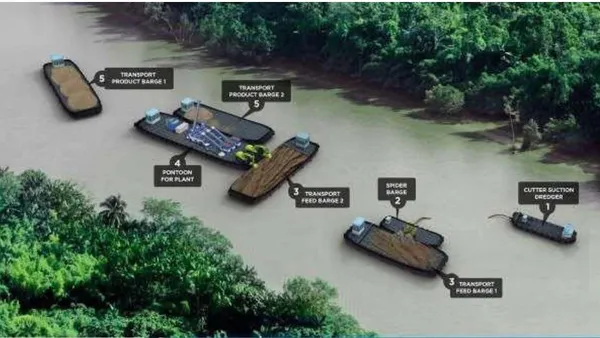
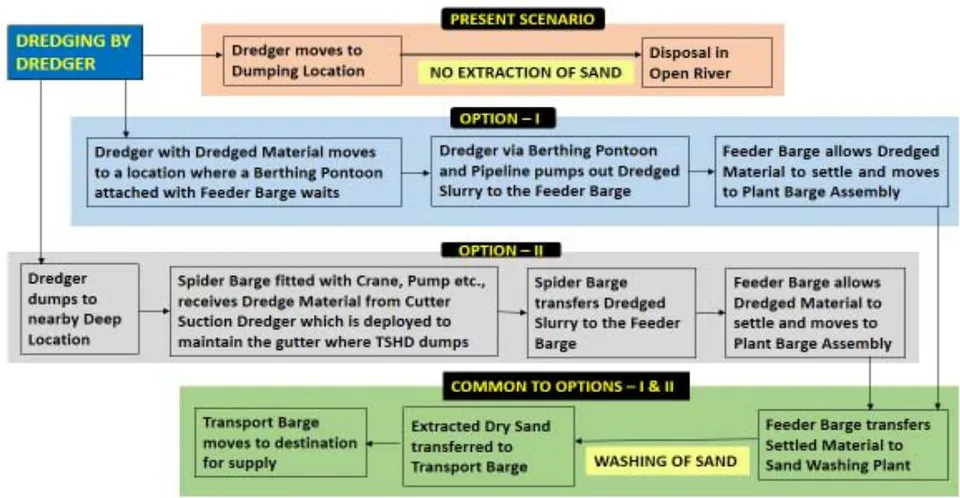
Option 1: Combination of THSD, berthing pontoon, settling barge, feeder barge, plant barge, washing plant, transport barge.
Option 2: Combination of THSD, cutter suction dredger, spider barge, feeder barge, extraction plant and product cum transport barge.
Under Option 1 following activities shall follow:
Jellingham and Eden Load taken by TSHD in hopper.
Transferred and pumped by pipeline via berthing pontoon into a settling tank accommodating in an assembled barge.
Settled material from storage tank transferred to the feeder barge.
Feeder barge moved to assembled barge accommodating the plant.
Settled solid transferred from the feeder barge to main sand washing plant.
Sand washed, extracted and transferred to transport barge.
Transport barge sailed to destination.
Under Option 2 following activities shall follow:
- Jellingham and Eden load dumped at deep locations.
- Lifting of dumped spoil by slurry pumps from spider barge.
- Maintenance of the deep gutter by cutter suction dredger.
- Spider barge transferring the material to feeder barge.
- Feeder barge moves to washing plant accommodating barge.
- Processing online by sand washing plant.
- Transferring sand to product barge.
- Releasing washed silt into river.
- Sailing to destination by product barge.
The schematic diagram of dredging cum disposal operational procedures and a typical view of Site Operation are shown in Figs.10 and 11 respectively.
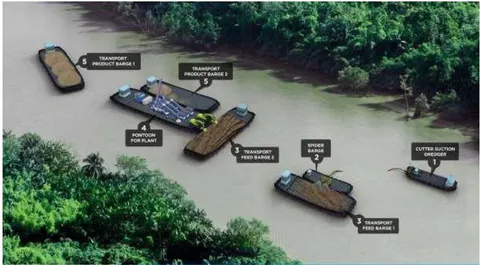
The entire operation will be on the barges and this will be unique innovative concept applicable for Hugli Estuary where the mode of shore disposal could not be taken up due to paucity of land and other occupational hazard.
VI. BENEFITS
Environmental benefits:
- 100% removal of sediment from the system.
- Reduce the recirculation as well as re-siltation resulting less requirement of maintenance dredging in the long run.
- Reduce per unit cost of the dredging.
- No land acquisition.
- Synergy of different engineering approaches.
- Green field activities generating useful sand for engineering works.
Anticipated benefits:
- No land area is required for plant & dredge material disposal.
- Commencement of long awaited synergy green field actions.
- Reuse of dredged material.
- Reduction of annual dredging volume vis-a-vis cost in the long run say after 5 years.
- Operationalization of the process at a lesser cost than the proposed shore disposal.
- Maintenance of only one contract without disrupting on-going maintenance dredging vis-à-vis contract.
VII. DISCUSSION AND INFERENCES
It is evident from above options that Option 1 is best one and this will be economical, eco-friendly and user friendly also. This will not require developing and/or deployment of any special dredger i.e. cutter suction dredger and its continuous removal of slurry from deeper gutter. In case of Option 2, the material is dumped in deeper gutter which will have some dispersion effect in its vicinity. This location has to be pre-identified for its safe operationalization towards uninterrupted supply of bed material and sustenance of depth of the deep gutter.
The Option 1 in other hand is not at all interfering with maintenance dredging schedule and the dredgers utilized during maintenance dredging operations, could be applied for pumping the dredged material in to the sand extraction plant holding barge (via feeder barge), which entirely wash the sand and transfer it to transport barge for ultimately, feeding the construction industry.
The physical property of the material is as followed:
- Bulk density of dredged material is 1.65 gms/cc
- Specific Gravity is 2.65
At least one load from Jellingham could be utilized for sand extraction; the total yield can be estimated as:
- Volume of one hop per load of TSHD is approx. 4500 m3.
- Settled solid will be of the order of .
- Extracted sand would be of at least i.e. 1350 m3.
- Expected operation days are 300 per year. So, the total sand extraction will be of the order of .
Assuming Rs 500/- per cubic meter as the selling price of dry washed sand, the expected annual revenue generation would be of the order of Rs. 20 Cr by this effort of installing a moderate size plant having capacity around 150 ton/hour. Ultimately in the long run, this environment friendly, synergic green effort will lead to decrease the annual volume of maintenance dredging, since the entire dredged volume, transferred for washing, is removed from system.
ACKNOWLEDGEMENTS
The authors sincerely acknowledge the competent authority of Kolkata Port Trust and WAPCOS
Ltd for their constant encouragement, guidance and suggestion during the preparation of this technical paper.