The proposal discusses about the information technology and information systems infrastructure underpinning the organisation for this project, Courts Megastore, Singapore. Courts Singapore is a retail outlet that is a one-stop retail and furnishing solution that offers different household and electronic products in various locations in Singapore. It is a listed company that is owned by the Courts Group International Limited, Singapore. It has released, according to its press announcements, approximately 57.09% of the shares to Singapore Retail Group Ltd. as the main owner. The new format of Courts resulted in a ‘Big Box’ Courts Megastore solution, which is unlike the previously silos-formatted retail shops. The said megastore was opened on 16 December 2006, and focused on key elements such as the combination of a traditional focus on value with a more experiential and service-orientated layout. In 2007, the group sales increased by 8.1% from S$308.3 m to S$333.4 m from 2006 due to having placed vital products at the forefront of the retail stores as well as the gradual cessation of many non-performing retail outlets in other parts of Singapore (Courts Singapore Limited, 2008).
## I. CURRENT SYSTEM AND PROBLEMS
With the completion of Courts Megastore in December, it now joins many of the other giant hypermarkets such as Giant and Carrefour. This infers based on preliminary data that there would be more competition within a very fire-tight market that is already tightening its belt. The per usual problem with Courts's mediocre performance is that it does not entice heavy traffic or sales to their shops. With an unpredictable yet reliable local Singapore economy and housing market, it is cardinal to implement stronger portfolios and strengthen Courts's position in the market. This would require developing an information systems strategy through integrating - information technology, information systems and operation systems - to produce an enhancement solution, and the main focus of this solution is to manage the consumer credit offering using a suite of information technology and systems to help offset the decline of gross profit margins. With the nation employing different modes of electronic payment in recent years, more electronic payment options such as e-wallets, digital cards, as well as other contactless and online payment solutions including PayNow, GrabPay, DBS PayLah!, Apple Pay, Google Pay, and Buy Now, Pay Later (BNPL) services. Such operations would increase administrative and service charges, targeting consumer credit options to wait-out the costs issue. By avoiding or removing electronic payment options due to higher administrative and service costs is not feasible. Obsolete business and information systems would also see an adjustment and upgrade to take advantage of the development of fourth generation internet that welcomes debit and credit purchases over the network coverage offered to retail clusters in Singapore. Additionally, there is also a global emphasis on shopping online where Courts and large-format stores have enjoyed region-wide success. For example, in Thailand, Courts is now focused on the strategic choices within the information technology environment to develop regional Asian businesses.
Currently, Courts uses the normal type of network operating systems (NOS) which support a variety of networking elements such as protocols, files, hardware, and internet applications with popular choices including Novell, UNIX, Linux, and Windows. The older model of operating system used in Courts merchandising website is Microsoft Windows NT 3.0 which supports the 32-bit version of networking. It introduced features like preemptive multitasking, protected memory, and multiprocessing support (Chakraborty, 2014). Many of the connected items include a router, multiplexer, switches and bridges that offer users full networking functionality such as good bandwidth and multiplexed services such as text, voice, media and other forms of data. However, there are some disadvantages of this current system:
- Users are not able to run application programs and get shared access to data. This would hamper the efficiency of information update.
- Failure of primary server with no back-ups. Many peripherals may disrupt the network and NOS.
- Depends on systems manager and parts of computer. A badly run network may allow external users with little protection. Damage could also be caused by non-experts, such as deleting important files.
- Some of the software and hardware parts are not compatible with the newer 64-bit version.
- Speed rate of this network has grown with little improvements to increase traffic and protection.
- It is getting more difficult to manage with several attacks towards the confidentiality and integrity of stored data.
Based on my research of the networked Windows NT 3.0 system with Service Pack 3 (SP3), it was found to be installed on standard PCs in Courts's I.T. department. According to Lindskog, Hedbom and Jonsson (1999), both server and workstation versions of the operating system were used. The analysis uncovered a number of vulnerabilities, most of which were also demonstrated in practice using so-called exploit scripts (ibid). This exploit script is a program designed by a skilled hacker to undermine the system and the code can be downloaded easily from the website (Lindskog et al., 1999). Other attacks can include extracting encrypted passwords from the SAM database, mounting and reading an NTFS volume, allowing anonymous logon, cracking and capturing passwords with executable codes.
## II. PROPOSED SYSTEM
### a) Advantages of New System and Objectives
Courts would require extra servers to provide high-end computing features to the business due to the sophistication of the internet. Courts's local area network (LAN) system employs better built-in protection from the internet, which is something that businesses have control over. It is a network of several bandwidths connected with several server applications. Courts possesses a central server of a single PC with other tens or hundreds of computers and equipment in each office and retail store. But it is not entirely a workstation since it hardly specialises in any important tasks such as recording vital transfers. But workstations offer a higher level of robustness and durability in processing data. Courts's current network typology is rather obsolete, which is a ring network configuration. This is a type of network in which each of the nodes of the network is connected to other nodes in the network forming a ring. All data transmitted between nodes travel from one node to the next node in a circular manner. This could be enhanced into a star which reduces the probability of a network failure by connecting all of the peripheral nodes to a central node (Groth and Skandier, 2005).
More importantly, a server network involves running a program on a computer somewhere which connects via a network to another computer, called a server (Walia and Divyanshu Sinha, 2018). This computer could be an end-user customer wishing to procure products online, and the server would have to facilitate this transaction. Computers or terminals running similar or non-similar operating systems cannot participate in a common network for sharing resources. These resources include elements such as computers, printers, monitors, files, scanners or wireless access tools (ibid). Thus, there is also a need to bring in a new type of network that can essentially allow a computer's operating system to connect with the other resources or computing equipment regardless of the location. This can involve using hubs, gateways to share files for vital communication, updating of data and information once a sale transaction has been completed online, or connecting with a supplier's terminal to inform of new supplies or purchases. A LAN is still preferred as a start since it can later be connected with more megastores to form a Wide Area Network (WAN).
Consider the case of Microsoft Management Console (MMC). MMC is one of the primary administrative tools used to manage Windows and many of the network services provided by Windows (Gambrel and Weinstein, 2011). It provides a standard method to create, save, and open the various administrative tools provided by Windows lets system administrators create much more flexible user interfaces and customize administration tools and as when there are new staff or customers. File systems are different from local and network ones and if there are any unnecessary files on the network, they can be deleted without being restored. There are also ways to synchronize files between ordinary windows and window network. This would maintain and update tasks if the computer is likely to remain idle for long periods in the personal mode.
Based on 8 users work requirements in a division or department of staff, a proper network system running the NT 5.0 can be created to access even remote files or folders connected to loyal suppliers, which may be grouped in this category, and to be able to access certain category of product data. Still, this would limit access to network, and also provide more discipline and organisation to the users, as to who should be able to see what information, such as a company salary spreadsheet, or a proposal meant only for the director, CEO, and chairman. This would create vital communication and foster relationship. Lower group divisions would also mean ownership of data and freedom to disseminate information that is relevant. The internal policies of allowing staffs to use terminals at any remote points are applicable. Win 2000 Professional shares its own resources and provide network services. There is at least one protocol in common for language sharing. There is peer-to-peer file sharing that allows strict security codes for each individual. Thus, if the information was not designated for the particular personnel, a legal warning of file stop sharing option is available. But policies should be written by Courts I.T./I.S. management not to disrupt or stop anybody from file sharing where appropriate. To access the network, there is a requirement to understand the protocols and the provision of access dial up code, modem number or username/passports to get into the network, or otherwise the user would not be entitled access into the network. This would deter the abuse of users by indefinite logging since IP/TCP addresses on networks can be changed. Data encryption is also used to scramble data that is sent out which cannot be tracked by cookies or other internet viruses (Oduroye and Sarumi, 2024).
Courts's many vendors of I.T. appliances have provided both hardware and software solutions to gain remote access to various types of networked information in Courts's servers. This revolves around the concept of Remote Access Services (RAS). According to Allen, Hunter, and Dinerman (2006), RAS refers to any combination of hardware and software to enable the remote access to tools or information that typically reside on a network. It can be installed during the initial setup phase or after. To connect a remote site from the office, the workstation must have a LAN manager network driver to access the network from the office, and the RAS drivers to access the network from a remote site (Hewlett Packard, 2008). Some of the required equipment include adapter cards, modems, multiport cards, smart cards etcetera. These devices must be chosen carefully depending on compatibility and costs. On an evaluative hindsight, these advantages would satisfy the corporate objectives: to upgrade an older networking model to a newer ubiquitous one; to multitask more efficiently and better manage processes to support creation, execution and stoppage of commands; to allow efficient usage, retrieval and storage of information of processes; to increase and allocate more memory by data compression and fragmentation.
## III. TARGETED AUDIENCE
The users include non-IT experts and also include:
- Top level management
- All senior and junior staff that are authorized
- External vendors
- Loyal Customers
- Other stakeholders
### a) Peer-to-Peer Model
The network to be employed is the peer-to-peer configurative model. This network allows communication between every computer on the network with granted rights to access. Any computer on the peer-to-peer network is considered a server, as long as it shares a printer, folder, drive or some other resources. According to Mueller (2003), there is no limit to the size of computers although Win 2000 Pro allows only 8 stations, but this would be sufficient requirement for Courts megastore and the head office. The advantage is in its flexibility to interchange between a workstation and server as well as relatively low costs of client software. Due to the architecture design of this network, the only problem is that it is more susceptible to security breaches since the folders, datafiles and other code files are subjected to a common password. Being essentially the offshoot of e-commerce systems, the upgrading of information technology and services engaged in Courts retail allows new forms of partnership, online products and services to evolve, overriding the worries of boundaries and cost issues.
### b) The Rise of E-Commerce
As I consider the rise of e-commerce and mobile solutions, I must relate the possibilities of Courts's peer-to-peer network technology against other participants sharing a part of their own hardware resources through Courts's distributed network architecture, accessible only by other peers without passing through market intermediary entities (Kellerer, 1998). The chosen file sharing website is a domain hosted under courts.com.sg. The value proposition for most internet buyers is that Courts website is an open-source, digital platform to register details, upload requests, share product or service problems, make price comparisons, single out product popularity, review customer reviews, exchange payment details and enjoy the shopping and delivery process without risking any stolen details. E-commerce systems do not induce trust and confidence any more than the face-to-face approach does. Internet channels acting as gobetweens, suppliers may not guarantee quality and delivery of foreign sourced products to the customers. Since much of the purchases on the web are funded by credit cards or money wiring, this seriously enhances risk and cost of customers being hacked of credit card details, whether with or without the provision of digital security protocols to prevent phishing and tracking cookies. In an article, Frishberg (2000) has indicated that some 18 million people who have done shopping on the Net professed that they would have bought more if security was not an issue. He reiterated that another 20 million have avoided buying on the Web altogether because of security or privacy concerns. Finally, the implications would mean a further technological gap in appreciating and comprehending more advanced purchasing systems between mainstream have-gots and have-nots.
## IV. HARDWARE AND SOFTWARE REQUIREMENT FOR THE NEW SYSTEM(S)
Courts would need to upgrade from an obsolete Windows NT system built in 1993 to Windows 2000 Professional, which is a mix of old and new. It carries on the legacy of Windows NT 3.0, 32-bit version, including most of NT's strengths and architecture, but it adds many new features (Windows 2000 Professional Basics, N.D.). Windows 2000 Professional is also known as Windows NT 5.0. It represents the convergence of technologies from Windows 95/98 and Windows NT
Workstation. Nearly all the functionality of NT 4.0 Workstation has been preserved with many of the tools having new locations and looks in Windows 2000 Professional (ibid). The most obvious changes lie in the consolidation of the administration tools into the MMC, a one-stop shopping place for Courts's management needs. The MMC lets the administrator manage the entire computer from one toolbar.
The following hardware and software requirements for 8 typical users in a division through the new installation of Windows NT-5.0:
<table><tr><td colspan="3">WINDOWS 2000 Professional NT-5.0
Released 2000</td></tr><tr><td rowspan="7">Hardware
Requirements</td><td>Speed:</td><td>166 MHz or faster</td></tr><tr><td>Hard Disk:</td><td>8 GB or higher</td></tr><tr><td>Memory:</td><td>Intel Architecture-64/512 MB RAM or higher</td></tr><tr><td>Drives:</td><td>DVD-ROM or better</td></tr><tr><td>Sound:</td><td>Sound Blaster Live! Value card (circa 2000).
Peripheral Component Interconnect (PCI) sound card</td></tr><tr><td>Video:</td><td>XGA-IBM (1280 x 768) or higher-resolution monitor</td></tr><tr><td>Controls:</td><td>100% compatible Microsoft keyboard/Mouse/NetBIOS ports/COM & LPT</td></tr><tr><td>Software
Requirements</td><td>Operating System:</td><td>Windows 2000 Professional/Windows NT Kernel /NTFS 3.0/Windows Shell/Windows API</td></tr></table>
## V. DELIVERY OF SOLUTIONS
The Schedule for Delivery of Windows 2000 Professional.
The schedule for computer system as shown below;
<table><tr><td>Step</td><td colspan="2">May</td><td colspan="2">June</td><td colspan="2">July</td><td colspan="2">August</td></tr><tr><td>1</td><td rowspan="10" colspan="2">10</td><td rowspan="10" colspan="2">30</td><td rowspan="10" colspan="2">5</td><td rowspan="10"></td><td rowspan="10"></td></tr><tr><td>2</td></tr><tr><td>3</td></tr><tr><td>4</td></tr><tr><td>5</td></tr><tr><td>6</td></tr><tr><td>7</td></tr><tr><td>8</td></tr><tr><td>9</td></tr><tr><td>10</td></tr></table>

a) Discussions
1. It will take 4 days for sales manager to provide requisition details to the Purchasing Order department and Purchasing Order department will take 6 days to process the order electronically and get it to Microsoft supplier. {Please check with warehouse to determine availability of stocks before ordering from Microsoft}.
2. Delivery of the computer system will take 30 days upon receipt of purchase order with pay option of instalments ranging from 30/60/90 days. Determine mode of shipment. Once the delivery has reached Courts head office, delivery order form has to be signed to acknowledge receipt of Windows 2000 Professional. All of the forms including purchase requisition, purchase order, delivery order, proforma invoice, sales invoice and relevant documents have to be disseminated to the warehouse, finance, purchase, sales and marketing departments for filing.
3. The Microsoft supplier needs 3 days to install the Windows 2000 Professional system.
4. It will take 3 days to train the department managers to use the system. Specialised training manuals are provided to staff.
5. Explaining the plans to the staff will take 3 days.
6. A rotation schedule must be produced for the staffs' training programme. This should take a day to
produce, with the training programme taking 5 days to complete.
7. Details of service options i.e., Service Packs (SP1, SP2, SP3, Administration Tools Pack etc...) will have to be entered onto the system and will take 4 days.
8. Electrical sockets and LAN access points will need to be fitted around the buildings and this will take 7 working days.
9. It will take the computer supplier 3 days to finally check the system.
10. It will take the Microsoft supplier 3 days to finally check the system component costs and labour rates, such as removal rate, run-out time, number of dressing passes, dressing feed rate, and by number of parts/dress. This will take 2 days to be inputted into the system.
b) Rate Analysis (Dressing Feed Rate)
Rate analysis is the process of accessing rates for unit of work or supply according to Chakraborti (1992). He expounds it as breaking down the activity into its fundamental components such as labour, overheads, taxes, agency profit and basic rate of individual material. Labour cost per part $C_1$ is the product of labour rate $c_1$ and the total cycle time $t_t$. Multiplying the total cycle time by the labour rate gives the labour cost/part. See formula below (Rowe, 2013- for latest edition).
$$
C _ {1} = c _ {1}. t _ {\mathrm {t}} = c _ {1}. \left[ \frac {\left(d _ {\mathrm {w w}} + d _ {\mathrm {s s}}\right) \pi d _ {\mathrm {w}}}{Q _ {\mathrm {w}} ^ {\prime}} + t _ {\mathrm {s o}} + \frac {b _ {s} n _ {\mathrm {d}}}{v _ {\mathrm {f d}} N _ {\mathrm {d}}} \right] \quad \mathrm {L a b o u r c o s t / p a r t}
$$
Source: W. Brian Rowe (2009). Principles of Modern Grinding Technology
The provided equation calculates the labour cost per part:
$$
C _ {1} = c _ {1} * t t = c _ {1} * \left[ (d w w + d s s) \pi d w / Q w + t s o + (b s n d) / (V f d N d) \right]
$$
Where:
{"algorithm_caption":[],"algorithm_content":[{"type":"text","content":"- "},{"type":"equation_inline","content":"C_1"},{"type":"text","content":" = I.T. labour cost per part\n- "},{"type":"equation_inline","content":"c_1"},{"type":"text","content":" = I.T. labour cost per unit time\n- "},{"type":"equation_inline","content":"t_t"},{"type":"text","content":" = Total time taken for installation\n- dww = Wire diameter\n- dss = Spot diameter\n- π = Mathematical constant pi (approximately 3.14159)\n- dw = Diameter of the wire\n- Qw = Setup speed\n- tso = Setup time\n- bs = Length of the seam\n- nd = Number of drops\n- Vfd = Feeding speed\n- Nd= Number of hardware parts "}]}
I.T. labour cost/part is affected by the total cycle time. It therefore depends on hardware and software removal rate, run-out time, number of network dressing passes, "dressing feed rate", and by number of
parts/dress. The above analysis shows the importance of network dressing frequency and dressing time in cost per part. With many network parts/dress, the last term of Eqn (9.7) becomes negligible. With several network dressing operations per part, the last term becomes large. This underlying principle of optimising processes and achieving desired results can be applied to the computer industry perspective. This might relate to the speed of software updates or hardware releases. In this case, the ideal network "dressing feed rate" is to achieve a balance between the desired outcome (e.g., less rundown time, user satisfaction, faster executable files, better security patches etc...) while reducing negative complications (e.g., wastage of harddisk space, program errors, external attacks). If the network "dressing feed rate" is too fast, such as programming faster executable files, the system might crash due to lack of capacity. In a slow network "dressing feed rate", for example, if there are too infrequent update of security patches, the system might run a risk of intrusion from program bugs resulting in unstable performances. For hardware releases, this can include problematic issues such as hardware failures, driver issues and compatibility problems. This concept of rate analysis is perceived from the perspective of manufacturing, but its theoretical concepts can be adapted towards a computing situation.
Consider Example A: I.T. labour cost includes an overhead element of £75/h. The total cycle time is 100s.
$$
I.T. labour cost per part is C1 = (£75 / 60×60) × 100 = £2.08
$$
Figure A. below shows the effect of removal rates using I.T. labour rate with overheads based on an increased rate of $\mathbf{£}75 / \mathbf{h}$. It can be seen that high removal rates reduce the I.T. labour cost per part. It also shows the effect of material removal rate (computer hardware waste and redundant software applications reduction) (Q'w) on I.T. labour cost per part for alumina (operation codename for computer network materials) and CBN (operation codename for computer network materials) grinding (grinding here means churning out executable files, codes, programs etc...). The data indicates that as Q'w increases, the I.T. labour cost per part decreases for both alumina and CBN. The x-axis of the graph represents both the hardware and software material removal rate (Q'w) in mm $^3$ /mm $\cdot$ s, while the y-axis represents the I.T. labour cost per part in £. The graph shows two lines, one for alumina and one for CBN. Both lines show a decreasing trend, indicating that as the hardware and software material removal rate increases, the I.T. labour cost per part decreases.
- Alumina: The I.T. labour cost for alumina grinding starts at approximately £0.30/part at a Q'w of 0 mm3/mm·s and decreases to approximately £0.05/part at a Q'w of 40 mm3/mm·s.
- CBN: The I.T. labour cost for CBN grinding starts at approximately £0.30/part at a Q'w of 0 mm3/mm·s and decreases to approximately £0.05/part at a Q'w of 40 mm3/mm·s.
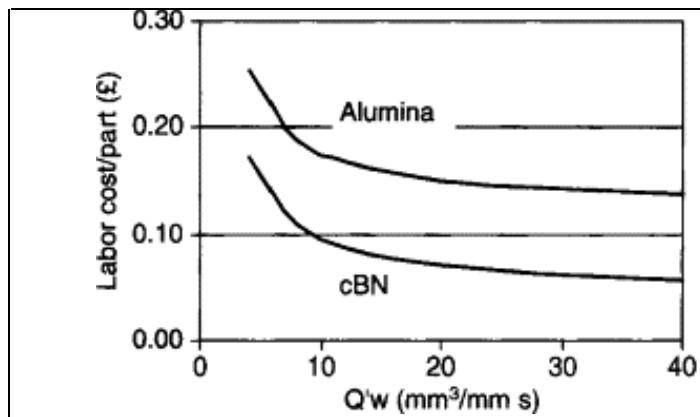
Fig. A: Effect of Hardware and Software Removal Rate on I.T. Labour Cost Per Part
<table><tr><td></td><td>Alumina</td><td>cBN</td></tr><tr><td>\(c_i \)</td><td>£75/h</td><td>£75/h</td></tr><tr><td>\(d_{ww} + d_{ss} \)</td><td>200 μm</td><td>200 μm</td></tr><tr><td>\(d_s \)</td><td>450 mm</td><td>250 mm</td></tr><tr><td>\(t_{so} \)</td><td>2 s</td><td>2 s</td></tr><tr><td>\(b_s \)</td><td>20 mm</td><td>20 mm</td></tr><tr><td>\(n_d \)</td><td>2</td><td>2</td></tr><tr><td>\(v_d \)</td><td>2 mm/s</td><td>3 mm/s</td></tr><tr><td>\(N_d \)</td><td>5</td><td>100</td></tr></table>
- Figure B. below shows that re-dress life can have an affect I.T. labour cost per part. In this case re-dress life is represented by network parts per dress. In this example, network dressing cost/part becomes negligible for more than 3 parts/dress. The figure shows the relationship between the network number of parts per dress and the I.T. labour cost per part for both alumina and CBN materials. The data points indicate an inverse relationship exists, as the number of network parts per dress increases, the
I.T. labour cost per part decreases for both materials, albeit the threshold of I.T. labour costs per part becomes quite irrelevant as the number of network parts per dress keeps increasing. This suggests a potential cost-saving opportunity through batch processing of security patches and increased efficiency as more network parts are processed at once until a certain threshold is reached.
- Computer Network Material: The figure compares two operation codenames that represent computer network materials: alumina and CBN.
- Network Number of Parts/Dress: The x-axis represents the number of I.T. network parts that can be processed in a single network "dress" (likely referring to software updates or hardware releases in batches).
- I.T. Labour Cost/Part: The y-axis represents the I.T. labour cost per part, measured in British pounds (£).
- Trend: The graph shows a clear inverse relationship: as the number of software updates or security patches increases, the I.T. labour cost per part decreases.
- Implications: The rate analysis implies that increasing the number of security updates processed in a single batch can lead to lower I.T. labour costs per part. This could be due to factors like reduced setup computer network time per part or increased efficiency with larger batches in coding executable files or security patches.
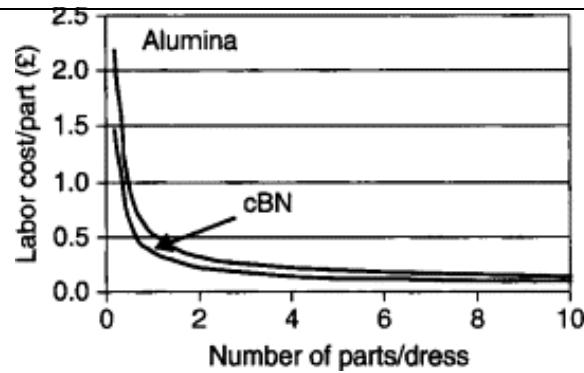
Fig. B: Effect of the Number of Network Parts Per Dress on I.T. labour Cost Per Part
<table><tr><td></td><td>Alumina</td><td>cBN</td></tr><tr><td>\(c_1 \)</td><td>\£75/h</td><td>\£75/h</td></tr><tr><td>\(d_{ww} + d_{ss} \)</td><td>200 \,\mu\text{m}</td><td>200 \,\mu\text{m}</td></tr><tr><td>\(d_s \)</td><td>450 \,\text{mm}</td><td>250 \,\text{mm}</td></tr><tr><td>\(t_{so} \)</td><td>2 \,\text{s}</td><td>2 \,\text{s}</td></tr><tr><td>\(b_s \)</td><td>20 \,\text{mm}</td><td>20 \,\text{mm}</td></tr><tr><td>\(n_d \)</td><td>2</td><td>2</td></tr><tr><td>\(v_{fd} \)</td><td>2 \,\text{mm/s}</td><td>3 \,\text{mm/s}</td></tr><tr><td>\(Q'_w \)</td><td>8 \,\text{mm}^3/\text{mm} \cdot \text{s}</td><td>16 \,\text{mm}^3/\text{mm} \cdot \text{s}</td></tr></table>
<table><tr><td></td><td>Alumina</td><td>cBN</td></tr><tr><td>\(c_1 \)</td><td>\£75/h</td><td>\£75/h</td></tr><tr><td>\(d_{ww} + d_{ss} \)</td><td>200 \,\mu\text{m}</td><td>200 \,\mu\text{m}</td></tr><tr><td>\(d_s \)</td><td>450 \,\text{mm}</td><td>250 \,\text{mm}</td></tr><tr><td>\(t_{so} \)</td><td>2 \,\text{s}</td><td>2 \,\text{s}</td></tr><tr><td>\(b_s \)</td><td>20 \,\text{mm}</td><td>20 \,\text{mm}</td></tr><tr><td>\(n_d \)</td><td>2</td><td>2</td></tr><tr><td>\(v_{fd} \)</td><td>2 \,\text{mm/s}</td><td>3 \,\text{mm/s}</td></tr><tr><td>\(Q'_w \)</td><td>8 \,\text{mm}^3/\text{mm} \cdot \text{s}</td><td>16 \,\text{mm}^3/\text{mm} \cdot \text{s}</td></tr></table>
Assuming Courts starts this plan in the middle of May, it can be completed by the beginning of July.
## VI. CONCLUSION
Due to the intensity of competition and the changes of payment modes in a local and global context, there is a need to revamp the network system and improve the efficiency of the electronic and online transactions that go with it. The analysis uncovered a number of vulnerabilities, most of which were also demonstrated in practice using so-called exploit scripts. The network to be employed is the peer-to-peer configurative model. This network allows communication between every computer on the network with granted rights to access. Delivery for the Windows 2000 Professional NT 5.0 will be scheduled including checking the system component costs and doing a rate analysis, such as computing removal rate, run-out time, number of dressing passes, dressing feed rate, and by number of network parts/dress. Finally, many nations and organisations still face limitations and barriers to e-commerce. A substantial investment of resources towards know-how and technology awareness in e-commerce related issues such as cybercrime, and especially ethical and legal practices across international boundaries are essential.
Generating HTML Viewer...
References
16 Cites in Article
R Allen,L Hunter,B Dinerman (2006). Routing and Remote Access Service (Routing).
M Chakraborti (1992). Estimating Costing Specification and Valuation In Civil Engineering.
A Chakraborty (2014). Novell NetWare 4.X Security.
(2008). Annual report 2007, Courts Website.
M Frishberg (2000). Web privacy, security weighed.
B Gambrel,K Kerry Weinstein (2011). Managing Windows Server 2016.
D Groth,T Skandier (2005). Network+ Study Guide.
Hewlett Packard (2008). Installing RAS.
(2000). Introducing Windows Vista.
N (2022). Analysing and Carving MS Word and PDF Files from RAM Images on Windows.
W Kellerer (1998). Dienstarchitekturen in der telekommunikation.
S Lindskog,H Hedbom,E Jonsson (1999). An analysis of the security of Windows NT.
S Mueller (2003). Repairing and Upgrading of a Heavy-Duty R/C Slab.
A Oduroye,J Sarumi (2024). Chapter 17: Encryption.
W Rowe (2014). Principles of Modern Grinding Technology.
D Walia,P Divyanshu Sinha (2018). A Survey of client server protocol implementation.
No ethics committee approval was required for this article type.
Data Availability
Not applicable for this article.
How to Cite This Article
Patrick Sim Puay-I. 2026. \u201cA Technical Report on Rate Analysis and Dressing Feed Rate of Courts Megastore’s Information Technology Processes\u201d. Global Journal of Management and Business Research - A: Administration & Management GJMBR A Volume 25 (GJMBR Volume 25 Issue A2): .
Explore published articles in an immersive Augmented Reality environment. Our platform converts research papers into interactive 3D books, allowing readers to view and interact with content using AR and VR compatible devices.
Your published article is automatically converted into a realistic 3D book. Flip through pages and read research papers in a more engaging and interactive format.
The proposal discusses about the information technology and information systems infrastructure underpinning the organisation for this project, Courts Megastore, Singapore. Courts Singapore is a retail outlet that is a one-stop retail and furnishing solution that offers different household and electronic products in various locations in Singapore. It is a listed company that is owned by the Courts Group International Limited, Singapore. It has released, according to its press announcements, approximately 57.09% of the shares to Singapore Retail Group Ltd. as the main owner. The new format of Courts resulted in a ‘Big Box’ Courts Megastore solution, which is unlike the previously silos-formatted retail shops. The said megastore was opened on 16 December 2006, and focused on key elements such as the combination of a traditional focus on value with a more experiential and service-orientated layout. In 2007, the group sales increased by 8.1% from S$308.3 m to S$333.4 m from 2006 due to having placed vital products at the forefront of the retail stores as well as the gradual cessation of many non-performing retail outlets in other parts of Singapore (Courts Singapore Limited, 2008).
Our website is actively being updated, and changes may occur frequently. Please clear your browser cache if needed. For feedback or error reporting, please email [email protected]
Thank you for connecting with us. We will respond to you shortly.