Accounting, FRQ, Emerging Countries Transition: How can a Country Implement an IFRS Standard Change Successfully?

Dr. Najeb Masoud
Dr. Najeb Masoud
Middle East University

Send Message

To: Author

Accounting, FRQ, Emerging Countries Transition: How can a Country Implement an IFRS Standard Change Successfully?

Article Fingerprint

ReserarchID

R4U72

Accounting, FRQ, Emerging Countries Transition: How can a Country Implement an IFRS Standard Change Successfully? Banner

AI TAKEAWAY

Connecting with the Eternal Ground
  • English
  • Afrikaans
  • Albanian
  • Amharic
  • Arabic
  • Armenian
  • Azerbaijani
  • Basque
  • Belarusian
  • Bengali
  • Bosnian
  • Bulgarian
  • Catalan
  • Cebuano
  • Chichewa
  • Chinese (Simplified)
  • Chinese (Traditional)
  • Corsican
  • Croatian
  • Czech
  • Danish
  • Dutch
  • Esperanto
  • Estonian
  • Filipino
  • Finnish
  • French
  • Frisian
  • Galician
  • Georgian
  • German
  • Greek
  • Gujarati
  • Haitian Creole
  • Hausa
  • Hawaiian
  • Hebrew
  • Hindi
  • Hmong
  • Hungarian
  • Icelandic
  • Igbo
  • Indonesian
  • Irish
  • Italian
  • Japanese
  • Javanese
  • Kannada
  • Kazakh
  • Khmer
  • Korean
  • Kurdish (Kurmanji)
  • Kyrgyz
  • Lao
  • Latin
  • Latvian
  • Lithuanian
  • Luxembourgish
  • Macedonian
  • Malagasy
  • Malay
  • Malayalam
  • Maltese
  • Maori
  • Marathi
  • Mongolian
  • Myanmar (Burmese)
  • Nepali
  • Norwegian
  • Pashto
  • Persian
  • Polish
  • Portuguese
  • Punjabi
  • Romanian
  • Russian
  • Samoan
  • Scots Gaelic
  • Serbian
  • Sesotho
  • Shona
  • Sindhi
  • Sinhala
  • Slovak
  • Slovenian
  • Somali
  • Spanish
  • Sundanese
  • Swahili
  • Swedish
  • Tajik
  • Tamil
  • Telugu
  • Thai
  • Turkish
  • Ukrainian
  • Urdu
  • Uzbek
  • Vietnamese
  • Welsh
  • Xhosa
  • Yiddish
  • Yoruba
  • Zulu
Font Type
Font Size
Font Size
Bedground

Abstract

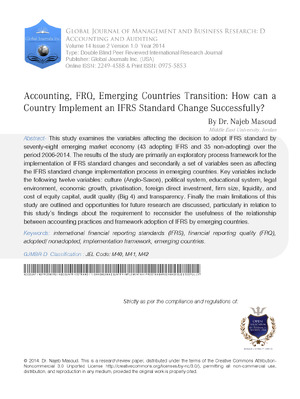
This study examines the variables affecting the decision to adopt IFRS standard by seventy-eight emerging market economy (43 adopting IFRS and 35 non-adopting) over the period 2006-2014. The results of the study are primarily an exploratory process framework for the implementation of IFRS standard changes and secondarily a set of variables seen as affecting the IFRS standard change implementation process in emerging countries. Key variables include the following twelve variables: culture (Anglo-Saxon), political system, educational system, legal environment, economic growth, privatisation, foreign direct investment, firm size, liquidity, and cost of equity capital, audit quality (Big 4) and transparency. Finally the main limitations of this study are outlined and opportunities for future research are discussed, particularly in relation to this study’s findings about the requirement to reconsider the usefulness of the relationship between accounting practices and framework adoption of IFRS by emerging countries.

References

123 Cites in Article
  1. O Abd-Elsalam,P Weetman (2003). Introducing international accounting standards to an emerging capital market: Relative familiarity and language effect in Egypt.
  2. Omneya Abdelsalam,Pauline Weetman (2007). Measuring Accounting Disclosure in a Period of Complex Changes: The Case of Egypt.
  3. (2014). IFRS FAQs.
  4. Mahmoud Al-Akra,Muhammad Jahangir Ali,Omar Marashdeh (2009). Development of accounting regulation in Jordan.
  5. T Al-Hayale (2010). Financial reporting on the internet in the Middle East: the case of Jordanian industrial companies.
  6. K Al-Htaybat,C Napier (2006). Online corporate financial reporting in developing countries: The case of Jordan.
  7. Malek Alsharairi,Riyadh Al-Abdullah (2009). The Reflections of the International Accounting Harmonization on Emerging Economies: Jordan as an Example.
  8. D Aly,S Jon,K Hussainey (2010). Determinants of corporate internet reporting: evidence from Egypt.
  9. Christopher Armstrong,Wayne Guay,Joseph Weber (2010). The role of information and financial reporting in corporate governance and debt contracting.
  10. R Ball,L Shivakumar (2005). Earnings quality in U.K. private firms: comparative loss recognition timeliness.
  11. R Ball,S Kothari,R Ashok (2000). The effect of international institutional factors on properties of accounting earnings.
  12. R Ball,A Robin,J Wu (2003). Incentives versus standards: Properties of accounting income in four East Asian countries and implications for acceptance of IAS.
  13. Mary Barth,Wayne Landsman,Mark Lang (2006). International Accounting Standards and Accounting Quality.
  14. M Barth,W Landsman,M Lang (2008). International accounting standards and accounting quality.
  15. M Barth,W Landsman,M Lang,C Williams (2012). Are IFRS based and US GAAPbased accounting amounts comparable?.
  16. G Bekaert,C Harvey (2003). Research in emerging market finance: Looking to the future.
  17. Geert Bekaert,Claude Erb,Campbell Harvey,Tadas Viskanta (1998). Distributional Characteristics of Emerging Market Returns and Asset Allocation.
  18. G Bekaert,C Harvey,C Lundblad (2007). Liquidity and expected returns: Lessons from emerging Markets.
  19. Messod Beneish,Brian Miller,Teri Yohn (2012). The Impact of Financial Reporting on Equity versus Debt Markets: Macroeconomic Evidence from Mandatory IFRS Adoption.
  20. S Bhagat,B Bolton (2006). Board ownership and corporate governance indices.
  21. S Biobele,I Igbeng,E John (2013). The significance of international corporate governance disclosure on financial reporting in Nigeria.
  22. Sanjay Bissessur,Allan Hodgson (2012). Stock market synchronicity – an alternative approach to assessing the information impact of Australian IFRS.
  23. E Borensztein,J Gregorio,De,J Lee (1998). How does foreign direct investment affect economic growth?.
  24. V Borooah,M Paldam (2007). Why is the world short of democracy? A cross-country analysis of barriers to representative government.
  25. B Bowerman,R O'connell (1990). Linear Approach.
  26. S Bowles,H Gintis (1993). The revenge of homo economicus: Contested exchange and the revival of political economy.
  27. Mark Bradshaw,Brian Bushee,Gregory Miller (2004). Accounting Choice, Home Bias, and U.S. Investment in Non‐U.S. Firms.
  28. Ulf Brüggemann,Holger Daske,Carsten Homburg,Peter Pope (2009). How do Individual Investors React to Global IFRS Adoption?.
  29. David Burgstahler,Luzi Hail,Christian Leuz (2006). The Importance of Reporting Incentives: Earnings Management in European Private and Public Firms.
  30. Edward Chamisa (2000). The Relevance and Observance of the IASC Standards in Developing Countries and the Particular Case of Zimbabwe.
  31. Parmod Chand,Chris Patel (2008). Convergence and harmonization of accounting standards in the South Pacific region.
  32. F Choi,R Levich (1991). Behavioural effect of international accounting diversity.
  33. C Chow,G Harrison,J Mckinnon,A Wu (2002). The organizational culture of public accounting firms: Evidence from Taiwanese local and US affiliated firms.
  34. John Christensen (2010). Conceptual frameworks of accounting from an information perspective.
  35. P Clarkson,Y Li,G Richardson,F Vasivari (2011). Does it really pay to be green? Determinants and consequences of proactive environmental strategies.
  36. T Cooke (1993). Disclosure in Japanese corporate annual reports.
  37. Christine Cooper,Dean Neu,Glen Lehman (2003). Globalisation and its Discontents: A Concern about Growth and Globalization.
  38. V Covrig,M Defond,M Hung (2007). Home bias, foreign mutual fund holdings, and the voluntary adoption of the International Financial Reporting Standards.
  39. Allen Craswell,Jere Francis,Stephen Taylor (1995). Auditor brand name reputations and industry specializations.
  40. Rick Cuijpers,Willem Buijink (2005). Voluntary adoption of non-local GAAP in the European Union: A study of determinants and consequences.
  41. H Daske (2006). Economic benefits of adopting IFRS or US-GAAP -have the expected cost of equity capital really decreased?.
  42. Holger Daske,Luzi Hail,Christian Leuz,Rodrigo Verdi (2008). Mandatory IFRS Reporting around the World: Early Evidence on the Economic Consequences.
  43. Srikant Datar,Gerald Feltham,John Hughes (1991). The role of audits and audit quality in valuing new issues.
  44. K Davidson,E Roberts,A Wilson,E Mithchell (2005). The role of prey nutritional status in governing protozoan nitrogen regeneration efficiency.
  45. L Deangelo (1981). Auditor size and audit quality.
  46. P Dechow,R Sloan,A Sweeney (1995). Detecting earnings management.
  47. M Defond,J Jiambalvo (1994). Debt covenant violation and manipulation of accruals: Accounting choice in troubled companies.
  48. Mark Defond,Xuesong Hu,Mingyi Hung,Siqi Li (2011). The impact of mandatory IFRS adoption on foreign mutual fund ownership: The role of comparability.
  49. (2011). Resources for First-time IFRS Adopters.
  50. (2013). IFRS Teaching Resources: Available and Rapidly Growing.
  51. (2014). Use of IFRS by jurisdiction.
  52. A Desoky (2009). Company characteristics as determinants of Internet Financial Reporting in emerging markets: The case of Egypt.
  53. Douglas Diamond,Robert Verrecchia (1991). Disclosure, Liquidity, and the Cost of Capital.
  54. T Doupnik,S Salter (1995). External environment, culture and accounting practice: a preliminary test of a general model of international accounting development.
  55. Pascal Dumontier,Bernard Raffournier (1998). Why Firms Comply Voluntarily with IAS: an Empirical Analysis with Swiss Data.
  56. Peter Easton (2004). PE Ratios, PEG Ratios, and Estimating the Implied Expected Rate of Return on Equity Capital.
  57. M Elsayed,Z Hoque (2010). Perceived international environmental factors and corporate voluntary disclosure practices: An empirical study.
  58. (2010). Financial accounting series exposure draft: Proposed accounting standards update.
  59. A Field (2006). Discovering Statistics Using SPSS.
  60. Annita Florou,Peter Pope (2012). Mandatory IFRS Adoption and Institutional Investment Decisions.
  61. Jennifer Francis,Dhananjay Nanda,Per Olsson (2008). Voluntary Disclosure, Earnings Quality, and Cost of Capital.
  62. J Gassen,T Sellhorn (2006). Applying IFRS in Germany-Determinants and consequences.
  63. S Gaston,C Garcia,J Jarne,J Gadea (2010). IFRS adoption in Spain and the United Kingdom: Effects on accounting numbers and relevance.
  64. I Goldstein,A Razin (2006). An informationbased trade-off between foreign direct investment and foreign portfolio investment.
  65. E Gordon,B Jorgensen,C Linthicum (2008). Could IFRS replace US GAAP? a comparison of earnings attributes 174 and in formativeness in the US Market.
  66. S Gray (1988). Towards a Theory of Cultural Influence on the Development of Accounting Systems Internationally.
  67. G Guggiola (2010). IFRS Adoption in the E.U., accounting harmonisation and market efficiency: A review.
  68. J Hair,R Anderson,R Tatham,W Black (1998). Multivariate Data Analysis.
  69. Jr Hair,Mary Wolfinbarger,Arthur Money,Phillip Samouel,Michael Page (2005). Essentials of Business Research Methods.
  70. G Hofstede (1980). Review Article : Geert Hofstede: Culture's Consequences: International Differences in Work Related Values.
  71. O Hope,J Jin,T Kang (2006). Empirical evidence on jurisdictions that adopt IFRS.
  72. M Hove (1986). The Anglo-American influence on international accounting standards: The case of the Disclosure standards of the international accounting standards committee.
  73. Mingyi Hung,K Subramanyam (2007). Financial statement effects of adopting international accounting standards: the case of Germany.
  74. Mostaque Hussain,Mazhar Islam,A Gunasekaran,Kooros Maskooki (2002). Accounting standards and practices of financial institutions in GCC countries.
  75. (2006). Use of IFRSs for reporting by domestic listed companies by country and region.
  76. (1989). IASB Framework for the Preparation and Presentation of Financial Statements.
  77. Carla Klein (2006). UMA ANÁLISE CRÍTICA DO DISCUSSION PAPER: PRINCIPLES OF DISCLOSURE DO INTERNATIONAL ACCOUNTING STANDARDS BOARD (IASB).
  78. (2010). International Accounting Standard 7: Statement of cash flows.
  79. H Irvine,N Lucas (2006). The globalization of accounting standards: The case of the United Arab Emirates, faculty of commerce.
  80. K Jamal,R Colson,R Bloomfield,T Christensen,S Moehrle,J Ohlson,S Penman,G Previts,L Stober,S Sunder,R Watts (2010). Research based perspective on SEC"s proposed rule on ROADMAP for potential use of financial statements prepared in accordance with International Financial Reporting Standards (IFRS) by.
  81. Henry Jarva,Anna-Maija Lantto (2012). Information Content of IFRS versus Domestic Accounting Standards: Evidence from Finland.
  82. Eva Jermakowicz,Sylwia Gornik-Tomaszewski (2006). Implementing IFRS from the perspective of EU publicly traded companies.
  83. E Jermacowicz,J Prather,I Wulf (2007). The value relevance of accounting income reported by DAX-30 German companies.
  84. N Jenkins (2002). Auditor independence, audit committee effectiveness, and earnings management.
  85. P Joshi,Jawaher Al‐modhahki (2003). Financial reporting on the internet: Empirical evidence from Bahrain and Kuwait.
  86. P Joshi,S Ramadhan (2002). The adoption of international accounting standards by small and closely held companies: Evidence from Bahrain.
  87. P Joshi,Wayne Bremser,Jasim Al-Ajmi (2008). Perceptions of accounting professionals in the adoption and implementation of a single set of global accounting standards: Evidence from Bahrain.
  88. William Judge,Shaomin Li,Robert Pinsker (2010). National Adoption of International Accounting Standards: An Institutional Perspective.
  89. Jeffrey Kantor,Clare Roberts,Stephen Salter (1995). Financial Reporting Practices in Selected Arab Countries.
  90. I Karamanou,G Nishiotis (2009). Disclosure and the cost of capital: Evidence from the Market's reaction to firm voluntary adoption of IAS.
  91. R Karim (2001). International accounting harmonization, banking regulation, and Islamic banks.
  92. Pamela Kent,James Routledge,Jenny Stewart (2010). Innate and discretionary accruals quality and corporate governance.
  93. L King (2003). Shock privatization: The effects of rapid large scale privatization on enterprise restructuring.
  94. K Kinkela,P Harris,J Malidretos (2010). Introducing IFRS in introductory financial accounting courses.
  95. W Kwok,D Sharp (2005). Power and international accounting standard setting: Evidence from segment reporting and intangible assets projects.
  96. Gerald Lander,Kathleen Auger (2008). The need for transparency in financial reporting.
  97. R Larson (1993). International accounting standards and economic growth: An empirical investigation of their relationship in Africa.
  98. M Lewis (2001). Islam and accounting.
  99. P Lopes,R Viana (2007). The transition to IFRS: Disclosures by Portuguese listed companies.
  100. G Maddala (1991). Disequilibrium models.
  101. N Masoud (2009). Libya's economic reform programme and the case for a stock market.
  102. N Masoud (2014). Libya's IAS/IFRS adoption and accounting quality: What lessons from the European Union experience.
  103. S Mcleay,D Ordelheide,S Young (2000). Constituent lobbying and its impact on the development of financial reporting regulations: Evidence from Germany.
  104. W Megginson,J Netter (2001). From state to market: A survey of empirical studies on privatization.
  105. S Menard (1995). Applied logistic regression analysis of qualitative chouce behaviour.
  106. R Myers (1990). Classical and modern regression with applications.
  107. C Nobes (1998). Towards a general model of the reasons for international differences in financial reporting.
  108. O Abd-Elsalam,P Weetman (2003). Introducing International Accounting Standards to an emerging capital market: Relative familiarity and language effect in Egypt.
  109. Mohammed Omran,Ali Bolbol,Ayten Fatheldin (2008). Corporate governance and firm performance in Arab equity markets: Does ownership concentration matter?.
  110. Krishna Palepu (1986). Predicting takeover targets.
  111. M Perera (1989). Accounting in developing countries: A case of localized uniformity.
  112. P Platikanova,J Perramon (2009). Economic consequences of the first-time IFRS introduction in Europe.
  113. K Ramanna,E Sletten (2005). Cultural influence on Perceived usefulness of Islamic corporate reporting model.
  114. Lúcia Rodrigues,Russell Craig (2007). Assessing international accounting harmonization using Hegelian dialectic, isomorphism and Foucault.
  115. K Samaha,P Stapleton (2000). Compliance with international accounting standards in a national context: Some empirical evidence from the Cairo and Alexandria stock exchanges.
  116. A Sedaghat,T Sagafi-Nejadb,G Wright (1994). Economic development and securities markets in developing countries: Implications for international accounting.
  117. D Street (2002). GAAP 2001 benchmarking national accounting standards against IAS: Summary of results.
  118. A Tarca (2004). International convergence of accounting practices: Choosing between IAS and US GAAP.
  119. (2013). UN and UNDP strategic response.
  120. (2014). Countries and Economies.
  121. G Yu (2009). Accounting standards and international portfolio holdings: Analysis of crossborder holdings following mandatory adoption of IFRS.
  122. S Zeff (2007). Some obstacles to global financial reporting comparability and convergence at a high level of quality.
  123. Daniel Zeghal,Karim Mhedhbi (2006). An analysis of the factors affecting the adoption of international accounting standards by developing countries.

Funding

No external funding was declared for this work.

Conflict of Interest

The authors declare no conflict of interest.

Ethical Approval

No ethics committee approval was required for this article type.

Data Availability

Not applicable for this article.

How to Cite This Article

Dr. Najeb Masoud. 2014. \u201cAccounting, FRQ, Emerging Countries Transition: How can a Country Implement an IFRS Standard Change Successfully?\u201d. Global Journal of Management and Business Research - D: Accounting & Auditing GJMBR-D Volume 14 (GJMBR Volume 14 Issue D2).
Download Citation

Journal Specifications

Crossref Journal DOI 10.17406/GJMBR

Print ISSN 0975-5853

e-ISSN 2249-4588

Version of record

v1.2

Issue date
June 25, 2014

Language
en
Experiance in AR

Explore published articles in an immersive Augmented Reality environment. Our platform converts research papers into interactive 3D books, allowing readers to view and interact with content using AR and VR compatible devices.

Read in 3D

Your published article is automatically converted into a realistic 3D book. Flip through pages and read research papers in a more engaging and interactive format.

Article Matrices
Total Views: 4559
Total Downloads: 2360
2026 Trends
Related Research
Our website is actively being updated, and changes may occur frequently. Please clear your browser cache if needed. For feedback or error reporting, please email [email protected]

Request Access

Please fill out the form below to request access to this research paper. Your request will be reviewed by the editorial or author team.
X

Quote and Order Details

Contact Person

Invoice Address

Notes or Comments

This is the heading

Lorem ipsum dolor sit amet, consectetur adipiscing elit. Ut elit tellus, luctus nec ullamcorper mattis, pulvinar dapibus leo.


High-quality academic research articles on global topics and journals.

Accounting, FRQ, Emerging Countries Transition: How can a Country Implement an IFRS Standard Change Successfully?

Dr. Najeb Masoud
Dr. Najeb Masoud <p>Middle East University</p>

Research Journals