
I. INTRODUCTION
Motivation is the basic drive for all of our actions. Motivation refers to the dynamics of our behaviour, which involves our needs, desires, and ambitions in life. Motivation can be defined as the driving force behind all the actions of an individual. The influence of an individual's needs and desires both have a strong impact on the direction of his behaviour. Motivation is based on one's emotions and achievement-related goals. Individuals satisfy their needs through different means, and are driven to succeed for varying reasons both internal and external.
Achievement motivation is based on reaching success and achieving all of our aspirations in life. Achievement goals can affect the way a person performs a task and represent a desire to show competence (Harackiewicz, et al. 1997). These basic physiological motivational drives affect one's natural behaviour in different environments. Most of the goals are incentive-based and can vary from basic hunger to the need for love and the establishment of mature sexual relationships. Motives for achievement can range from biological needs to satisfying creative desires or realizing success in competitive ventures. Motivation is important because it affects one's lives every day. All of our behaviours, actions, thoughts, and beliefs are influenced by our inner drive to succeed.
Achievement motivation, referred to as the need for achievement (and abbreviated n-Ach), is an important determinant of aspiration, effort, and persistence when an individual expects that his performance will be evaluated in relation to some standard of excellence. Such behaviour is called achievement-oriented. Achievement Motivation can be defined as the need for success or the attainment of excellence
Motivation to achieve is instigated when an individual knows that he is responsible for the outcome of some venture, when he anticipates explicit knowledge of results that will define his success or failure, and when there is some degree of risk, i.e., some uncertainty about the outcome of his effort. The goal of achievement-oriented activity is to succeed, to perform well in relation to a standard of excellence or in comparison with others who are competitors (McClelland, 1961 & Atkinson, 1964).
Individuals differ in their strength of motive to achieve, and various activities differ in the challenge they pose and the opportunity they offer for expression of this motive. Thus, both personality and environmental factors must be considered in accounting for the strength of motivation to achieve in a particular person facing a particular challenge in a particular situation. The very same person may be more strongly motivated at one time than at another time, even though in most situations he may generally tend to be more interested in achieving than other people.
McClelland firmly believed that achievement-motivated people are generally the ones who make things happen and get results, and that this extends to getting results through the organisation of other people and resources, although as stated earlier, they often demand too much of their staff because they prioritise achieving the goal above the many varied interests and needs of their people.
The present study is the pioneer attempt in India to study:
The significance of difference between executives and technocrats on achievement motivation.
The extent of difference that exist between male and female employees on achievement motivation.
The interaction effect of profession and gender.
II. METHODOLOGY
a) Participants
The target sample of the study were 200 executives and 200 technocrats with equal number of both the genders employed in various Multi National Companies, based in Delhi and Gurugram. The population taken for the study aged between 25-40 years, by using random sampling technique.
b) Tool Used
Achievement Motivation Scale (Deo Mohan, 1985)
Data were collected with a questionnaire named Achievement Motivation scale by Deo Mohan (1985). The scale consisted of 50 items, out of which 13 were negative and 37 were positive items. Responses were made on a 5 point likert scale. A positive item carries the weights of 4,3,2,1 & 0 respectively for the categories of always, frequently, sometimes, rarely and never. The negative items were scored reversely i.e. 0,1,2,3 & 4 for the same categories. Test- retest reliability of the scale is 0.69. The coefficient of correlation between the scale and the projective test is 0.54. The coefficient of correlation between the scale and Aberdeen Academic Motivation Inventory is 0.75.
III. RESULTS
Analysis of variance was conducted to see the significance of difference and interaction effect of job/profession and gender on achievement motivation. Results of ANOVA have revealed the following findings:-
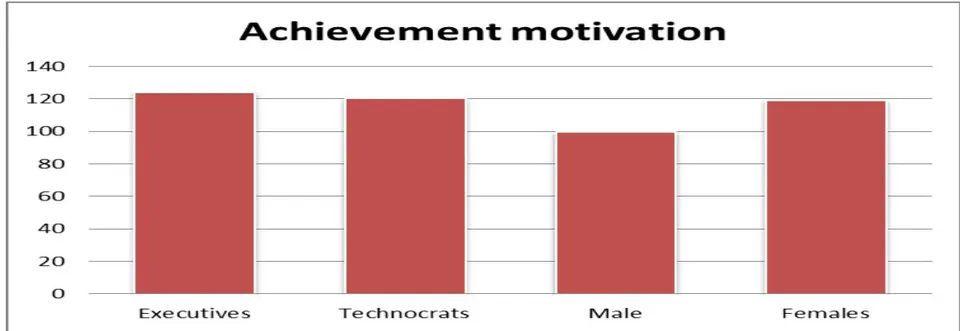
The main effect of profession has been found to be significant with F- ratio being 6.28, p <.05, indicating that executives scored significantly higher ( ) than technocrats ( ).
The main effect of gender has also been found to be significant with F- ratio being 17.840, p <.01, indicating females ( ) scoring higher than males ( ).
The two factor interaction effect of profession and gender has found to be insignificant.
| Ss | df | Ms | F | Sig. | |
| Job/profession (p) | 1303.210 | 1 | 1303.21 | 6.23* | .05 |
| Gender (g) | 3733.210 | 1 | 3733.21 | 17.84** | .01 |
| P×G | 334.890 | 1 | 334.89 | 1.60 | N.S. |
| 82867.400 | 396 | 209.26 | |||
| Total | 88238.710 | 399 |
| Variable | Executives | Technocrats | Males | Females |
| Achievement Motivation | 124.17 | 120.56 | 99.84 | 119.31 |
IV. Discussion
Achievement motivation is a theoretical model intended to explain "how the motive to achieve and motive to avoid failure influence behaviour in a situation where performance is evaluated against some standard of excellence" (Atkinson, 1958). Both Mc Clleland (1953) and Atkinson's (1964) achievement and motivation theory was based on a personality characteristics that manifested as a dispositional need to improve and perform well according to certain standard of excellence.
Motivation is what causes people to behave as they do. Motivation outlines the achievement and pursuit of goals (Denhardt, 2008). Campbell and Pitchard (1976) stated that motivation is the set of psychological processes that cause the initiation, direction, intensity and persistence of behaviour.
Results of the present study show a significant difference on achievement motivation between executives and technocrats, and between both the genders. Though both the professionals are high on achievement motivation but executives step ahead from their technocrat counterparts. Executives are the distinctive part of an organization, they are the ones who plan and make sure that the plans are executed well in the organization. They set the target in organization and achieve their goals through other employees. Also they have greater opportunities to make all important decisions because of their position in the organization leading them to higher in achievement motivation. They are trained in a way that they have to achieve the target at any cost. Executives are externally motivated; work for external rewards, like money, grades and have fear for punishment. They are encouraged to perform to win and beat others, they believe in crowd cheering and trophies which boosts their motivation to achieve.
To the contrary, though technocrats are also high but significantly less than executives (see table 2.) In case of technocrats, it is because of the internal motivation that they achieve the goal, though they receive orders from higher level. Technocrats are internally motivated; they are driven by an interest or enjoyment in the task itself. They take pleasure in any activity at their work. They work to improve their work skills which increase their capabilities, as execution of the plans in the organization is their responsibility. They attribute their educational results to factors under their own control. They believe that they have the skills that allow them to be effective agents in reaching the desired goals (i.e., the results are not determined by luck). Thus, it can be said that without the attainment of achievement motivation, success might not have been gotten. Achievement motivated people are more concerned with personal achievement than with the rewards of the success. They do not reject rewards but the rewards are not essential as the accomplishment itself (Argyris, 2010) is a great reward.
On gender, analysis of variance indicates that females are significantly higher on achievement motivation than males. It depicts that females are more motivated than males. In the present scenario, females are constantly encouraged by their parents to do great things and achieve their goals. But it is to be noted that only selected females are high in achievement motivation (Jerath 1979). It is the skewed sample in the population who possess high achievement motivation and reaches higher level in the organizations. Such females' sense of belief is defined through their ability to achieve results through success and accomplishment. These women achieve goals and prove their competence and feel good about them. These are the out scorer females who make maximal use of their efforts as a causal factor of their achievement. Females at this level are generally success oriented as they strive for more rewards, praise and social acceptance which in turn enhances their achievement motivation. The high achievement motivation is born out of their higher academic achievement in the stream profession.
V. CONCLUSION
In a nut shell, it can be concluded that both the professionals i.e. executives and technocrats are higher on the average mean of achievement motivation, indicating that achievement motivation plays a key role in meeting the targets and hence improves satisfaction of the employees and organization too. Achievement motivation increases the willingness of the workers to work thus increasing effectiveness of the organization and productivity. It can be said that achievement motivation can be used fruitfully for encouraging workers to make positive contribution for achieving organizational objectives. It facilitates the employees to perform better, increases employee commitment, productivity and also handles personal life well.