Advances in Medical Physics for Regenerative Medicine

ยง East European University

Send Message

To: Author

Advances in Medical Physics for Regenerative Medicine

Article Fingerprint

ReserarchID

QES83

Advances in Medical Physics for Regenerative Medicine Banner

AI TAKEAWAY

Connecting with the Eternal Ground
  • English
  • Afrikaans
  • Albanian
  • Amharic
  • Arabic
  • Armenian
  • Azerbaijani
  • Basque
  • Belarusian
  • Bengali
  • Bosnian
  • Bulgarian
  • Catalan
  • Cebuano
  • Chichewa
  • Chinese (Simplified)
  • Chinese (Traditional)
  • Corsican
  • Croatian
  • Czech
  • Danish
  • Dutch
  • Esperanto
  • Estonian
  • Filipino
  • Finnish
  • French
  • Frisian
  • Galician
  • Georgian
  • German
  • Greek
  • Gujarati
  • Haitian Creole
  • Hausa
  • Hawaiian
  • Hebrew
  • Hindi
  • Hmong
  • Hungarian
  • Icelandic
  • Igbo
  • Indonesian
  • Irish
  • Italian
  • Japanese
  • Javanese
  • Kannada
  • Kazakh
  • Khmer
  • Korean
  • Kurdish (Kurmanji)
  • Kyrgyz
  • Lao
  • Latin
  • Latvian
  • Lithuanian
  • Luxembourgish
  • Macedonian
  • Malagasy
  • Malay
  • Malayalam
  • Maltese
  • Maori
  • Marathi
  • Mongolian
  • Myanmar (Burmese)
  • Nepali
  • Norwegian
  • Pashto
  • Persian
  • Polish
  • Portuguese
  • Punjabi
  • Romanian
  • Russian
  • Samoan
  • Scots Gaelic
  • Serbian
  • Sesotho
  • Shona
  • Sindhi
  • Sinhala
  • Slovak
  • Slovenian
  • Somali
  • Spanish
  • Sundanese
  • Swahili
  • Swedish
  • Tajik
  • Tamil
  • Telugu
  • Thai
  • Turkish
  • Ukrainian
  • Urdu
  • Uzbek
  • Vietnamese
  • Welsh
  • Xhosa
  • Yiddish
  • Yoruba
  • Zulu
Font Type
Font Size
Font Size
Bedground

Abstract

Globally, the cost of hard tissue repair and regeneration is in the hundreds of billions of dollars every year, and as the population ages, this demand has grown significantly. Structures made of calcium phosphate minerals, such as bone and teeth, are considered to be hard tissues. Techniques for regenerative medicine and smart biomaterial-based tissue engineering have the exciting potential to fill this critical need. By engineering the materialโ€™s responsiveness to internal or external stimuli, smart biomaterials and constructs can have instructive/inductive, triggering/stimulating, or stimulating effects on cells and tissues. They can also have intelligently tailored properties and functions that can encourage tissue repair and regeneration. Smart scaffolds and stem cell constructs for bone tissue engineering, intelligent medication delivery systems to improve bone regeneration and intelligent dental resins.

I. INTRODUCTION

This research study, which focuses on recent developments in the fields of tissue engineering and regenerative medicine, offers a useful overview of biomaterial approaches to regenerating tissues and organs by using various bio-fabrication strategies and materials. The design of in vivo and in vitro biomaterials and devices, as well as a variety of subjects relating to stem cell biology, biomaterials, and technical techniques, are all covered in the papers. The development of innovative functional liver substitutes, advancements in bone regeneration, the synthesis of neural tissue, a ground-breaking model of cardiac fibrosis and the development.

II. METHODOLOGY

In order to better human health and wellbeing, medical physics[1] focuses on using physics principles and techniques in the detection, diagnosis, and treatment of human disorders. [2] According to the International Labour Organization's International Standard Classification of Occupations, medical physics has been classified as a health profession since 2008.

[3]"Medical physicist" is specifically a health professional[4]with specialised education and training in the concepts and techniques of applying physics in medicine, and is competent to practise independently in one or more of the subfields of medical physics. Medical physics may also occasionally be referred to as biomedical physics, medical biophysics, applied physics in medicine, physics applications in medical science, radiological physics, or hospital radio-physics.

III. RESULTS & DISCUSSION

Sl. NoAcceleration Voltage (KV)Wavelength (nm) 10-3
1208.588
2218.377
3228.180
4237.997
5247.825

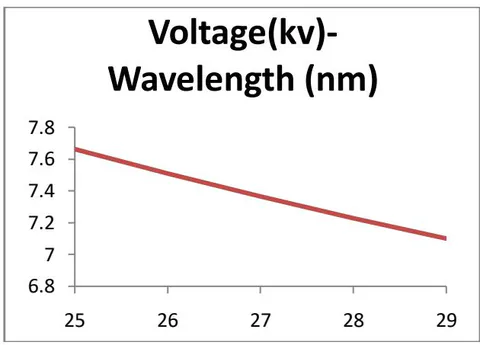
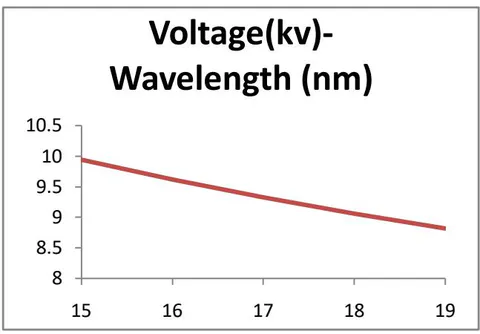
Voltage(kv)-Wavelength (nm)
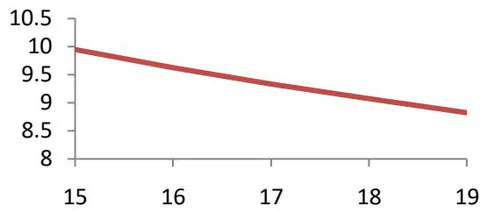
Sl. NoAcceleration Voltage (KV)Wavelength (nm) 10-3
1159.941
2169.620
3179.328
4189.061
5198.815
Sl. NoAcceleration Voltage (KV)Wavelength (nm) 10-3
1257.663
2267.511
3277.367
4287.230
5297.101

Figure

The very large Voltage-wavelength variations in the dielectric constant and loss factor, the requirement to measure these properties as a function of temperature, and the requirement to measure tissue properties in vivo all pose challenges for electrical property measurements of biological materials. The authors discuss the equipment and measuring techniques they created and employed at frequencies ranging from 10 kHz to 10 GHz for in-vivo and in-vitro biological materials. Both the sensors and the equipment for time-domain and frequency-domain measurements are discussed. Included is a general summary of the work done at different laboratories.

Using the principles of biomimetics, nano-assembly technology, and additive manufacturing techniques, smart artificial bone scaffolds have recently been created to match the composition and structural features of genuine bone. 25 On the scaffold, particular molecular recognition signals including peptides, growth factors, and genes were immobilised. To create biomimetic settings for tissue engineering, peptides were combined with porous poly(lactide-co-glycolide, or PLGA) microspheres. 26 The surface morphology and pore size distribution of the bone microstructure might be described using computer-aided porous scaffold design for tissue engineering based on the examination of the porous structures of trabecular bone. 27 The smart scaffold.

Materials that can react to pH are one significant smart stimulus-responsive strategy used in dentistry to safeguard tooth structures. Dental caries is a widespread condition that costs a lot of money and is one of the most prevalent bacterial diseases in people. 122,123.

IV. CONCLUSION

Demineralization caused by bacterial acid assault is the fundamental cause of caries. 123,124,125 Organic acids like lactic, formic, acetic, and propionic acids are produced by oral acidogenic bacteria.
References

9 Cites in Article
  1. S Basu (2006). Scanning electron microscopy in forensic science.
  2. K Carr (1971). Applications of Scanning Electron Microscopy in Biology.
  3. X Chen,L Ren,B Zheng,H Liu (2013). Physics and engineering aspects of cell and tissue imaging systems: microscopic devices and computer-assisted diagnosis.
  4. T Cushnie,Noรซlle Oโ€™driscoll,Andrew Lamb (2016). Morphological and ultrastructural changes in bacterial cells as an indicator of antibacterial mechanism of action.
  5. Gabor Hornyak,H Tibbals,Joydeep Dutta,John Moore (2008). Introduction to Nanoscience and Nanotechnology.
  6. G Morris,Martha Goodrich,Elizabeth Acton,Fernanda Fonseca (2006). The high viscosity encountered during freezing in glycerol solutions: Effects on cryopreservation.
  7. G Perkins (2014). The use of miniSOG in the localization of mitochondrial proteins.
  8. G Wu,E Choi,P Chu,G Dinescu,R Jung,Y Zhao (2018). Recent Applications of Scanning Microscopy in Surface Engineering.
  9. Alla Dr,Srivani,Alla Dr,Srivani Investigation of Optical Polarizability, Absorption coefficient and Energy Gap in AlxGa1-xAs Ternary Semiconductor Alloy.

Funding

No external funding was declared for this work.

Conflict of Interest

The authors declare no conflict of interest.

Ethical Approval

No ethics committee approval was required for this article type.

Data Availability

Not applicable for this article.

How to Cite This Article

Dr. Srivani, Gurram Vasanth, M. Rao. 2026. "Advances in Medical Physics for Regenerative Medicine". Global Journal of Science Frontier Research - I: Interdisciplinary GJSFR-I Volume 23 (GJSFR Volume 23 Issue I1).

More Citation Formats

Download Citation

High-quality image of research article on regenerative medicine from Global Journals.
Journal Specifications

Crossref Journal DOI 10.17406/GJSFR

Print ISSN 0975-5896

e-ISSN 2249-4626

Keywords
Classification
GJSFR-I Classification DDC Code: 571.835 LCC Code: QH587
Version of record

v1.2

Issue date
June 30, 2023

Language
English
Experiance in AR

Explore published articles in an immersive Augmented Reality environment. Our platform converts research papers into interactive 3D books, allowing readers to view and interact with content using AR and VR compatible devices.

Read in 3D

Your published article is automatically converted into a realistic 3D book. Flip through pages and read research papers in a more engaging and interactive format.

Article Matrices
Total Views: 453
Total Downloads: 20
All Trends

Request Access

Please fill out the form below to request access to this research paper. Your request will be reviewed by the editorial or author team.
X

This is the heading

Lorem ipsum dolor sit amet, consectetur adipiscing elit. Ut elit tellus, luctus nec ullamcorper mattis, pulvinar dapibus leo.

High-quality academic research articles on global topics and journals.

Advances in Medical Physics for Regenerative Medicine

Dr. Srivani
Dr. Srivani <p>East European University</p>
Gurram Vasanth
Gurram Vasanth
M. Rao
M. Rao