

Neural Networks and Rules-based Systems used to Find Rational and Scientific Correlations between being Here and Now with Afterlife Conditions
Neural Networks and Rules-based Systems used to Find Rational and

Article Fingerprint
ReserarchID
64AG3
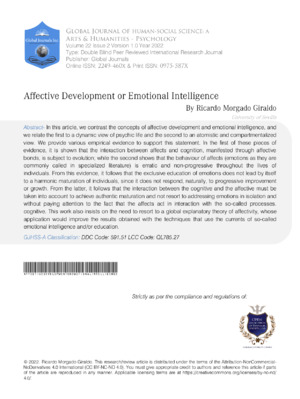
In this article, we contrast the concepts of affective development and emotional intelligence, and we relate the first to a dynamic view of psychic life and the second to an atomistic and compartmentalized view. We provide various empirical evidence to support this statement. In the first of these pieces of evidence, it is shown that the interaction between affects and cognition, manifested through affective bonds, is subject to evolution; while the second shows that the behaviour of affects (emotions as they are commonly called in specialized literature) is erratic and non-progressive throughout the lives of individuals. From this evidence, it follows that the exclusive education of emotions does not lead by itself to a harmonic maturation of individuals, since it does not respond, naturally, to progressive improvement or growth. From the latter, it follows that the interaction between the cognitive and the affective must be taken into account to achieve authentic maturation and not resort to addressing emotions in isolation and without paying attention to the fact that the affects act in interaction with the so-called processes. cognitive. This work also insists on the need to resort to a global explanatory theory of affectivity, whose application would improve the results obtained with the techniques that use the currents of so-called emotional intelligence and/or education.
Ricardo Morgado Giraldo. 2026. \u201cAffective Development or Emotional Intelligence\u201d. Global Journal of Human-Social Science - A: Arts & Humanities GJHSS-A Volume 22 (GJHSS Volume 22 Issue A2): .
Crossref Journal DOI 10.17406/GJHSS
Print ISSN 0975-587X
e-ISSN 2249-460X
The methods for personal identification and authentication are no exception.
Total Score: 101
Country: Spain
Subject: Global Journal of Human-Social Science - A: Arts & Humanities
Authors: Ricardo Morgado Giraldo (PhD/Dr. count: 0)
View Count (all-time): 130
Total Views (Real + Logic): 1926
Total Downloads (simulated): 20
Publish Date: 2026 01, Fri
Monthly Totals (Real + Logic):
Neural Networks and Rules-based Systems used to Find Rational and
A Comparative Study of the Effeect of Promotion on Employee
The Problem Managing Bicycling Mobility in Latin American Cities: Ciclovias
Impact of Capillarity-Induced Rising Damp on the Energy Performance of
In this article, we contrast the concepts of affective development and emotional intelligence, and we relate the first to a dynamic view of psychic life and the second to an atomistic and compartmentalized view. We provide various empirical evidence to support this statement. In the first of these pieces of evidence, it is shown that the interaction between affects and cognition, manifested through affective bonds, is subject to evolution; while the second shows that the behaviour of affects (emotions as they are commonly called in specialized literature) is erratic and non-progressive throughout the lives of individuals. From this evidence, it follows that the exclusive education of emotions does not lead by itself to a harmonic maturation of individuals, since it does not respond, naturally, to progressive improvement or growth. From the latter, it follows that the interaction between the cognitive and the affective must be taken into account to achieve authentic maturation and not resort to addressing emotions in isolation and without paying attention to the fact that the affects act in interaction with the so-called processes. cognitive. This work also insists on the need to resort to a global explanatory theory of affectivity, whose application would improve the results obtained with the techniques that use the currents of so-called emotional intelligence and/or education.
We are currently updating this article page for a better experience.

Lorem ipsum dolor sit amet, consectetur adipiscing elit. Ut elit tellus, luctus nec ullamcorper mattis, pulvinar dapibus leo.































































