
1. Introduction
Coping abilities pertain to people's capacity to adjust to adversities and to resume functionality as they have done before the challenge has occurred (Bonanno, 2005). Researchers emphasize the major contribution of personality attributes, such as ego resilience or positive self-concept for maintaining positive outcomes in face of various sources of stress (Luthar & Brown, 2007; Masten, 2001). Additional research examining the role of demographic variables in strengthening coping abilities has found that family income, political attitudes, level of religiosity and gender contribute to enhancing public resilience (Marciano, Kimhi, & Eshel, 2019).
Age as a determinant of coping and resilience has been studied in the past mainly as a characteristic of children and adolescents (Garmezy, 1987; Masten & Coatsworth, 1998), and more recently as a beneficial characteristic of older people (Ong, Bergeman, & Boker, 2009). The association of age with coping has been studied more rarely. Available studies suggest that people's resilience grow with age, and increases their ability to cope with adverse experiences (Marciano et al., 2019; Laird et al., 2018). A number of reasons may support the contention that age of adults will positively correlate with coping with adversities and threats of disasters, i.e., with a higher level of resilience. Older adults are more likely to have a higher emotional maturity compared with younger individuals. Most probably their vaster experiences have taught many of them that they are capable of coping with difficulties and risky situations, increased their personal and social capitals, and enhanced their belief that they are able to survive the next adversity as well (Li & Mutchler, 2019). Over time they have had a chance to develop higher emotional maturity and a realization that most adversities will end eventually. Consequently, their life experience has helped them develop a substantial degree of psychological fortitude. Furthermore, greater maturity is associated with acceptance of their social position, making peace with their life course, and with a sense of wellbeing (Charles, 2010). A study of coping with type 2 diabetes mellitus (Hara et al., 2014) has indicated similarly that coping with this chronic illness has enhanced with age. The role of age as a predictor of coping with adversity has been studied in the present research in the context of the COVID-19 pandemic.
a) Gender and Coping
The role of gender in successful coping with hardship has been discussed by several researchers. A large scale study has found that men have coped significantly better than women following the September 11th terror attack, in terms of posttraumatic stress symptoms (Bonanno, Galea, Bucciarelli, & Vlahov, 2006). Another large scale research has shown that women have displayed a higher level of somatic symptoms and psychological distress compared to men (Matud, 2004). Similar findings have demonstrated that a non-clinical sample of women under stress expressed significantly more subclinical depressive and anxiety symptoms than men (Kelly, Tyrka, & Carpenter, 2008). Another research on coping strategies throughout lifespan has found that women more often use emotional coping and social support seeking coping strategies, whereas men cope more often by problem solving strategies (Meléndez, Mayordomo, Sancho, & Tomás, 2013). Thus it appears that overall, previous studies on the variance between men and women submit that men tend to demonstrate less stress symptoms, and appear more resilient in comparison to women.
The COVID-19 pandemic is an emerging infectious disease caused by the most recently discovered coronavirus. Since no vaccines have been found to date, the length of the pandemic and its final global impacts are as yet unknown. The COVID-19 pandemic is more dangerous for older rather than younger individuals, while its perceived threats concern people of all ages. Two emotional responses constitute indicators of the level of the psychological stress caused by this pandemic. First, the strength of anxiety and depression symptoms, and second, the sense of danger of this endemic and its potential hazardous health, social, and economic consequences. A recent review of COVID-19 studies (Rajkumar, 2020) concludes that anxiety and depression are indeed the commonest individual mental health symptoms of this virulent disease. Furthermore, similar to the Ebola outbreak (Pier, 2019), a high sense of danger, which accompanies COVID-19, is further enhanced by media reports and internet communication, causing havoc, raising the alarm, and spreading panic.
b) Distress Symptoms
Highly threatening and painful events, such as the COVID-19 pandemic, undermine people's basic sense of security and increase psychopathological distress symptoms of anxiety. These symptoms which include depression, anxiety, and grief, cause continuous emotional and behavioral problems (Hadi, Llabre, & Spitzer, 2006; Soffer-Dudek, 2016). Distress symptoms that are associated with COVID-19 constitute one indicator of the negative emotional effect of this pandemic in the current study.
c) Sense of Danger
Disastrous events are likely to enhance a continuous sense of danger that strongly and negatively influences the reaction to these adversities (Scott, Poulin & Cohen Silver, 2012). A high sense of danger is positively correlated with distress symptoms (Braun-Lewensohn & Al-Sayed, 2018), and negatively correlated with individual resilience (Kimhi & Eshel, 2016). The extent to which the COVID-19 pandemic is perceived as dangerous constitutes a second measure for the distress caused by it in the current study.
d) Psychological Resilience
Many studies that focus on the function of resilience as a predictor of mental health indicators support the contention that resilience is negatively correlated with anxiety and depression symptom levels (e.g., Goldstein, Faulkner, & Wekerle, 2013; Satici, 2016; Poole, Dobson, & Pusch 2017; Shapero et al., 2019). The following three main modes of resilience have been studied more extensively: individual, community, and national resilience.
e) Individual Resilience
The American Psychological Association defines individual resilience as a process of bouncing back from difficult experiences and adapting well in the face of adversity, trauma, tragedy, threats, or significant sources of stress (APA.org, 2014), whereas Masten (2015) defines it as "the potential of manifested capacity of a dynamic system to adapt successfully to disturbances that threaten the function, survival, or development of the system" (p. 187). Research shows that individual resilience is negatively associated with depression, apathy, and anxiety, and positively associated with quality of life (Laird et al., 2018). Under threats of terror, resilience has been positively correlated with a sense of coherence and self-efficacy, and negatively correlated with a sense of danger and exposure to terror acts (Kimhi, Eshel, Leykin & Lahad, 2017). Another recent meta-analysis of 55 studies involving a total of 15,003 sick patients (Färber & Rosendahl, 2018) reports a strong association between individual resilience, as a resource for successful coping, and mental health among the somatically ill. Hjemdal, Vogel, Solem, Hagen and Stiles (2011) report, by the same token, that higher resilience scores have predicted lower scores of depression, anxiety, stress, and obsessive–compulsive symptoms after controlling for age and gender.
f) Community Resilience
Community resilience reflects the interaction between individuals and their community, and refers to the members' belief that their community will provide for their needs in difficult times (Bonanno, Romero, & Klein, 2015). Carri (2013) defines community resilience as the community's "capability to anticipate risk, limit impact, and bounce back rapidly through survival, adaptability, evolution, and growth in the face of turbulent change" (p. 10). Research shows that community resilience has negatively correlated with decreased miscommunication and positively correlated with increased local effectiveness, resources, and social support (Patel, Rogers, Amlôt, & Rubin, 2017), as well as with sense of coherence, self-efficacy, and social support (Kimhi et al., 2017). Several studies indicate that age of adults is positively correlated with measures of public resilience (Eshel, Marciano, & Kimhi, 2019; Marciano et al., 2019; Cohen et al., 2016).
g) National Resilience
National resilience is defined as "the nation's ability to cope successfully with its adversities (whether terrorism, corruption or poverty), while keeping its social fabric intact" (Canetti, Waismel-Manor, Cohen & Rapaport, 2014, p. 10). Ben-Dor, Pedahzur, Canetti-Nisim, & Zaidise (2002) have claimed that this mode of addressing issues of societal sustainability and strength includes three factors: a. trust in the integrity of the government, the parliament and other national institutions; b. belief in social solidarity; and c. patriotism.
Research has shown that the level of national resilience is associated with psychological as well as demographic variables. This resilience has positively correlated with a sense of coherence and community resilience, and has negatively correlated with a sense of danger and level of anxiety symptoms. Simultaneously, it has been found that national resilience is positively correlated with religious devotion and right-wing political attitudes (Kimhi & Eshel, 2019). National resilience is most probably the least researched aspect of the resilience domain, and the development of national resilience theories has not gone much beyond attempts to determine what factors constitute the basis of this resilience (e.g. Ben-Dor et al., 2002; Marciano et al., 2019).
h) Wellbeing
Psychological wellbeing is defined as the subjective experience of positive feelings or cognitive appraisals including lower activation affects such as being calm or satisfied, as well as higher activation affects such as being excited or thrilled (Hernandez et al., 2018). DuBois et al. (2015) have found that psychological wellbeing is related to improved prognosis and slower disease progression in patients with chronic cardiovascular disease.
The current study examines the associations of age and gender with coping suppressing and supporting factors. In face of this unfamiliar COVID-19 threat, the present study examines whether the pattern of associations that have been found in other contexts would also emerge in the present circumstances. Namely, do these indicators of coping increase or decrease with age, and how do they manifest with respect to gender.
In light of previous findings, the following hypotheses have been examined:
- Age of the participants will negatively correlate with levels of distress symptoms and a sense of danger, and will positively correlate with individual, community and national resilience, as well as sense of wellbeing. Older adults will cope better than younger ones with the psychological adversities of the COVID-19 pandemic, and will score higher than them on coping supporting factors.
- Men will cope better than women with the COVID-19 threat in terms of the investigated variables.
2. Method
a) Sample
The present study combined two samples: (a) an internet sample of 605 Jews derived at random from the Israeli population. This sample included similar numbers of males and females (299 females), who agreed to participate in this research (for the reliability and validity of an on-line questionnaire, see Vallejo et al., 2007). (b) A second internet sample of 741 respondents (535 females and 206 males). A snowball sampling was employed in which participants were invited to participate in an online survey and were later asked to invite other potential participants by forwarding the study online link.
The similarity of these two samples was assessed by examining the impact of each of them on level of distress symptoms, using group analysis (Amos 2011). This analysis revealed no significant differences between these samples. Tel Aviv University Ethics Committee approved this study (No. 0001150-1, April 1st, 2020). All data were gathered anonymously, following an approval of the IRB of the Tel Aviv University. All participants signed an informed consent before filling out the questionnaires.
The demographic characteristics of the investigated sample are presented in Table 1. These participants tend to be non-religious or traditional, with a wide range of family incomes, and center to right political attitudes. Most of them are married and have children. Their responses to our questions indicate the behavioral responses of these healthy participants to the COVID-19 pandemic: a. the vast majority of them (89.8%) have reported a failure to stay in isolation as requested by the Ministry of Health; b. most of them (75.7%) have claimed that their family members failed to stay in such isolation; and c. 62.0% of them have not believed that a member of their community has been infected by the Coronavirus.
An empirical study which concentrates on the "ugly side" of the Israeli character claims that Israelis tend to describe their fellow Israelis, in this context, by two major characteristics: proneness to violation of social norms, and a know-all presumptuousness. The misbehaving of the present sample, as far as keeping the COVID-19 pandemic precaution rules is concerned, seems to show that this sample represents, most likely, the general Israeli public.
Table 1: Distribution of demographic attributes of the present sample
| Variable | Rating Scale | Number of Respondents | Percent | Mean (S.D.) |
|---|---|---|---|---|
| Age groups | 1. 18-30 | 449 | 33.4% | 2.26 (1.56) |
| 2. 31-40 | 253 | 18.3% | ||
| 3. 41-50 | 210 | 15.6% | ||
| 4. 51-60 | 207 | 15.4% | ||
| 5. 61-70 | 160 | 11.9% | ||
| 6. 71+ | 58 | 4.3% | ||
| Gender | 1. Males | 512 | 38.0% | |
| 2. Female | 834 | 62.0% | ||
| Level of religiosity | 1. Non religious | 798 | 59.3% | 1.63 (0.87) |
| 2. Traditional | 305 | 22.7% | ||
| 3. Religious | 186 | 13.8% | ||
| 4. Very religious | 57 | 4.2% | ||
| Family income | 1. Much lower | 258 | 19.2% | 2.82 (1.23) |
| (compared to national average) | 2. Lower | 289 | 21.5% | |
| 3. Average | 344 | 25.6% | ||
| 4. Higher | 352 | 26.2% | ||
| 5. Much higher | 103 | 7.7% | ||
| Political attitude | 1. Extreme left | 57 | 4.2% | 3.20 (1.01) |
| 2. Left | 284 | 21.1% | ||
| 3. Center | 452 | 33.6% | ||
| 4. Right | 435 | 32.3% | ||
| 5. Extreme right | 118 | 8.8% | ||
| Education | 1. Elementary | 5 | 0.4% | 3.59 (1.03) |
| 2. High school | 230 | 17.1% | ||
| 3. High school+ | 179 | 28.2% | ||
| 4. Bachelor degree | 430 | 31.9% | ||
| 5. Master degree+ | 302 | 22.4% | ||
| Familial status | 1. Single | 383 | 28.5% | |
| 2. Married | 728 | 54.1% | ||
| 3. Divorced | 98 | 7.3% | ||
| 4. Widow | 15 | 1.1% | ||
| 5. Partnerhood | 122 | 9.1% | ||
| Number of children | 1. No children | 533 | 39.6% | 1.76 (1.84) |
| 2. One child | 113 | 8.4% | ||
| 3. 2-3 children | 511 | 38.0% | ||
| 4. 4-5 children | 139 | 10.3% | ||
| 5. 6+ children | 59 | 3.7% | ||
| Stayed in isolation | 1. Yes | 137 | 10.2% | |
| 2. No | 1209 | 89.8% | ||
| Family in isolation | 1. Yes | 327 | 24.3% | |
| 2. No | 1019 | 75.7% | ||
| Sick person in home place | 1. Yes | 512 | 38.0% | |
| 2. Doesn't know | 457 | 34.0% | ||
| 3. No | 377 | 28.0% |
b) Instruments and Measures
1. Individual Resilience
Individual resilience was measured by the 10-item Connor-Davidson scale (CD-RISC 10) (Campbell-Sills & Stein, 2007) portraying individual feelings of ability and power in the face of difficulties. This scale was rated by a 5-point response scale ranging from 1 = not true at all, to 5 = generally true. Significant correlations were found between this scale and emotional intelligence, life satisfaction, self-esteem, and positive affect; and a negative significant correlation was found with negative affect (Alarcón, Cerezo, Hevilla, & Blanca, 2020). Cronbach's alpha reliability of this scale in the present sample was α = .85.
2. Community Resilience
Community resilience was assessed by a short version of 10 items of the CCRAM scale (CCRAM10; Leykin, Lahad, Cohen, Goldberg, & Aharonson-Daniel, 2013). For this study, we changed the scale each time the word 'security crisis' emerged to 'COVID-19 crisis'. This tool covered five main issues: social trust, social support, leadership, emergency preparedness, and attachment to place (e.g., "I trust the decision-makers in my community"). Items of this scale were rated by a 5-point scale ranging from 1 (does not agree at all) to 5 (totally agree). The Cronbach alpha reliability of this scale in the present sample was α = .93.
3. National Resilience
A short version of the National Resilience Scale was employed (Kimhi & Eshel, 2019). This 12-item tool pertained to trust in national leadership, patriotism, and trust in major national institutions (e.g., "I love Israel and am proud of it"). The 6-point response scale ranged from 1 (very strongly disagree) to 6 (very strongly agree). Cronbach's alpha reliability in the present sample was α = .92.
4. Sense of Danger
A seven-item Sense of Danger Scale, based on the Solomon and Prager (1992) scale, referred to a lingering sense of danger in the context of security threats, was employed. In the current study we modified the threat from security to the COVID-19 pandemic threat (e.g., "To what extent are you worried about the increase of the COVID-19 global crisis?"). In addition, we included the item "To what extent are you worried that we will not be able to overcome the COVID-19 crisis before many citizens in our country will die from this disease?". Responses were rated by a Likert-like scale ranging from 1 (not at all) to 5 (very much). The Cronbach alpha reliability of this scale in the present sample was α = .82.
5. Distress Symptoms
The level of individual distress symptoms, in the context of the COVID-19 pandemic, was assessed by the Brief Symptom Inventory (BSI; Derogatis & Savitz, 2000). The current scale included 9 items: 4 anxiety items, 4 depression items, and one somatic symptom. This inventory was scored by a Likert scale ranging from 1 (not suffering at all) to 5 (suffering very much) (e.g., "How much do you suffer from feelings of a sudden fear with no reason?"). Due to ethical considerations, we did not include the item concerning suicidal thoughts. Cronbach's alpha for this sample was α = .86.
6. Wellbeing
Psychological wellbeing was assessed by a 9-item scale based on Campbell et al. (1976). Responses were rated on a 6-point scale ranging from 1 (very dissatisfied) to 6 (very satisfied). Cronbach's alpha in this sample was α = .91.
3. Results
Table 2 presenting the Pearson correlations between the investigated variables shows that, as hypothesized, higher age is negatively and significantly correlated with level of distress symptoms and extent of perceived danger, and positively correlated with wellbeing, individual and community resilience. Being a woman compared to being a man is positively correlated with levels of distress and sense of danger, and negatively correlated with individual and national resilience. Individual, community and national resilience, as well as wellbeing are positively correlated with each other. Distress level is positively correlated with sense of danger, and negatively correlated with wellbeing and each of the resilience scores, whereas sense of danger is negatively correlated with these positive indices of coping except for national resilience.
Table 2: Pearson Correlations between the investigated variables
| Variable | Age | Gender | Distress Symptoms | Sense of Danger | Wellbeing | Individual Resilience | Community Resilience | National Resilience |
|---|---|---|---|---|---|---|---|---|
| Age | 1 | |||||||
| Gender | -.015 | 1 | ||||||
| Distress symptoms | -.151** | .133** | 1 | |||||
| Sense of danger | -.147** | .198** | .563** | 1 | ||||
| Wellbeing | .199** | .019 | -.544** | -.255** | 1 | |||
| Individual resilience | .072** | -.088** | -.398** | -.220** | .415** | 1 | ||
| Community resilience | .079** | .051 | -.176** | -.117** | .318** | .256** | 1 | |
| National resilience | .015 | -.065* | -.149** | .006 | .253** | .156** | .378** | 1 |
*p < .05, **p < .01
Table 3 presenting these results indicates the following: significant effects have been found for mean distress scores [F(1334, 5)=10.908, p<.000, ηp²=.040], mean sense of danger [F(1334, 5)=8.574, p<.000, ηp²=.031], and mean wellbeing scores [F(1334, 5)=10.291, p<.000, ηp²=.037]. Lower, but significant age group effects have been found as well for community resilience [F(1334, 5)=2.464, p<.031, ηp²=.009] and national resilience [F(1334, 5)=2.359, p<.038, ηp²=.009]. No significant age group effect has been found for individual resilience score.
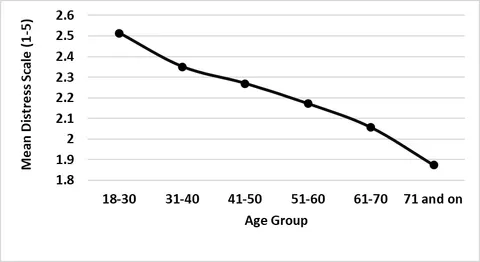
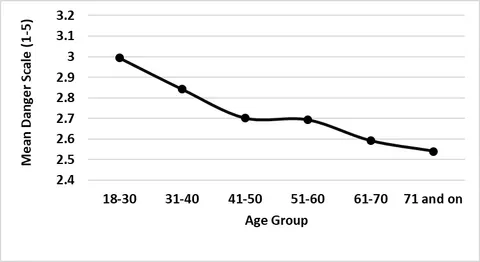
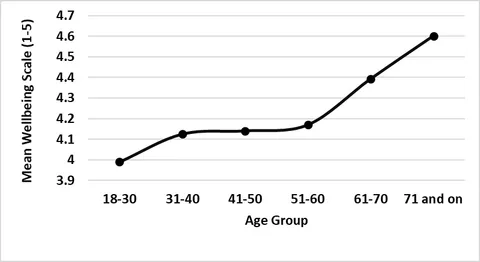
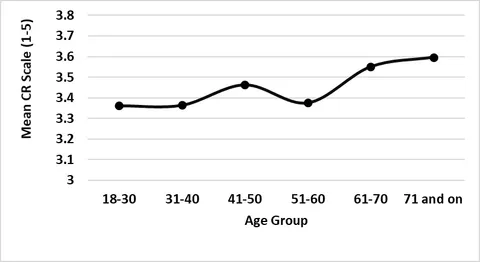
These age groups main effects were further analyzed with least significant differences (LSD) post hoc analysis. Figures 1, 2, 3 and 4 show the associations of these four variables with age group; an asterisk represents significant difference between two adjacent age groups, though more significant differences have been found between non-adjacent groups.
A further examination of these results shows that mean distress symptoms scores have consistently decreased with age group. The decreasing slope of sense of danger with age group seems to stop between the 41-50 and 51-60 age groups before resuming its decline in the higher age groups. Similarly, the increase of wellbeing scores with age group is slowed between age groups 31-40 and 51-60 but continues in the higher age groups, and the increase of the community resilience scores with age group is interrupted by a substantial decline at the age group of 51-60, and resumes its incline in the higher age groups.
Table 3: MANOVAs for the Effects of Age Groups and Gender on Indicators of Coping Tests of Between Subjects
| Source | Dependent Variable | Type III Sum of Squares | df | Mean Square | F | Sig. | Partial Eta Squared |
|---|---|---|---|---|---|---|---|
| Age groups | Distress symptoms | 30.686 | 5 | 6.137 | 10.908 | .000 | .040 |
| Sense of danger | 20.354 | 5 | 4.071 | 8.574 | .000 | .031 | |
| Wellbeing | 32.748 | 5 | 6.550 | 10.291 | .000 | .037 | |
| Individual resilience | 2.585 | 5 | .517 | 1.385 | .227 | .005 | |
| Community resilience | 8.271 | 5 | 1.654 | 2.464 | .031 | .009 | |
| National resilience | 11.238 | 5 | 2.248 | 2.359 | .038 | .009 | |
| Gender | Distress symptoms | 13.916 | 1 | 13.916 | 24.735 | .000 | .018 |
| Sense of danger | 27.671 | 1 | 27.671 | 58.279 | .000 | .042 | |
| Wellbeing | .707 | 1 | .707 | 1.111 | .292 | .001 | |
| Individual resilience | 3.518 | 1 | 3.518 | 9.423 | .002 | .007 | |
| Community resilience | .239 | 1 | .239 | .356 | .551 | .000 | |
| National resilience | 6.177 | 1 | 6.177 | 6.481 | .011 | .005 | |
| Age × Gender | Distress symptoms | 3.585 | 5 | .717 | 1.274 | .272 | .005 |
| Sense of danger | 1.836 | 5 | .367 | .774 | .569 | .003 | |
| Wellbeing | 8.127 | 5 | 1.625 | 2.554 | .026 | .009 | |
| Individual resilience | 1.488 | 5 | .298 | .797 | .552 | .003 | |
| Community resilience | 3.013 | 5 | .603 | .898 | .481 | .003 | |
| National resilience | 8.528 | 5 | 1.706 | 1.790 | .112 | .007 |
Table 3 which pertains as well to the effects of gender on the investigated variables shows the following: men have scored significantly lower than women on distress symptoms (M=2.179, s.d.=.736 and M=2.387, s.d.=.791 respectively), sense of danger (M=2.625, s.d.=.696 and M=2.912, s.d.=.720 respectively), wellbeing (M=4.126, s.d.=.841 and M=4.158, s.d.=.796 respectively) as well as community resilience (M=3.366, s.d.=.842 and M=3.453, s.d.=.815 respectively). Men have scored higher than women on individual resilience (M=3.662, s.d.=.621 and M=3.550, s.d.=.609 respectively) and national resilience (M=3.986, s.d.=.996 and M=3.855, s.d.=.975 respectively). Table 3 indicates that all these differences are significant (p < 0.05), apart from the difference of the community resilience (p = 0.56).
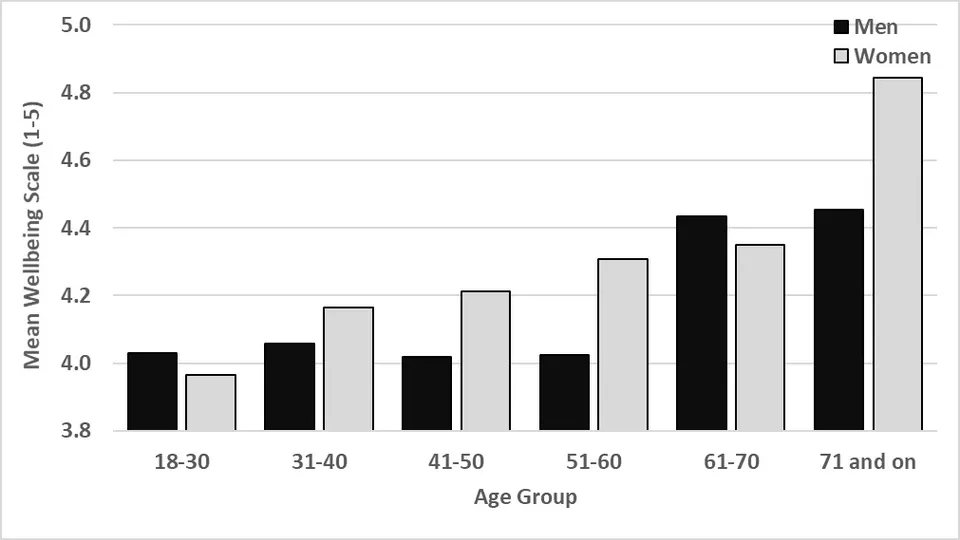
Finally, the only significant interaction between age group and gender for the wellbeing scores has been significant [F(1334, 5)=2.554, p<0.05, ηp²=.008]. Figure 5 indicates that wellbeing scores have steadily increased with age group although none of the differences between men and women have been significant. A nearly significant simple comparison of the two genders at the "70 and on" age group shows higher wellbeing scores of women (p=0.084).
4. Discussion
In order to examine the question what makes older people cope better than younger ones with the disastrous threats of the COVID-19 pandemic, we have defined coping in terms of lower levels of distress symptoms and sense of danger, and higher levels of wellbeing and resilience. Studies have found that older adults, who have experienced countless positive and negative experiences, have learned what they are capable of surviving, what they need to do to feel content, and the actions necessary to avoid high levels of distress in their daily lives. Their life experience has made them realize that they are capable of coping with most current adversities, much the same as they have overcome previous ones (Rothermund & Brandstadter, 2003; Blanchard-Fields, 2007; Li & Mutchler, 2019). It has further been shown that people with a more limited life expectancy strive to adopt emotion regulation strategies to a greater extent than younger adults (Carstensen, Fung, & Charles, 2003).
The findings of the current study support the socio-emotional theory which posits that the realization that time is limited is accompanied by a more present-focused awareness. Older adults therefore focus on their present lives. A desire to maintain emotional wellbeing motivates them to regulate their emotions to maintain high levels of wellbeing (Carstensen et al., 1999; Charles, 2010; Wang, Di, Ye, & Wei, 2020). The higher resilience of older individuals is not limited solely to coping with challenging conditions; it is most probably characteristic of older age groups in general. Two previous studies have reported that a higher age was associated with higher levels of community and national resilience in relatively peaceful times (Kimhi, Goroshit, & Eshel, 2013; Marciano et al., 2019). It should also be emphasized that the higher vulnerability of the elderly population to the COVID-19 threat has not been manifested in their ratings of distress or perceived danger. Similar results have been reported by Limcaoco, Mateos, Fernandez, and Roncero (2020). It may be surmised that getting older does increase the psychological resilience of people.
In line with previous studies, the present results indicate that men cope better than women with adversity in terms of lower sense of danger and distress symptoms, and higher individual and national resilience. Yet women have shown higher wellbeing and higher community resilience. There are no established data pertaining to possible reasons for this finding. A recent study posits that structural physical differences between men and women are correlated with characteristic brain regions, known to be involved in the prefrontal-limbic system, which is considered critical in stress regulation (e.g., Li et al., 2015). Other researchers claim that these results are consistent with the notion that men and women are socialized to cope with stress in different ways. Ptacek, Smith, and Dodge (1994) as well as Meléndez et al. (2013) have claimed that women tend to seek social support and use emotion-focused coping to a greater extent than men, whereas men tend to use relatively more problem-focused coping than women. This perspective on life-span coping is supported by the present finding of higher community resilience scores of women.
It should though also be considered that gender differences may impact the tendency to report concerns, distress, or decreased levels of resilience when responding to questions that pertain to elements that may be perceived as presenting weaknesses. As has previously been found that men consider it vital to appear 'strong' and are more reluctant than women to show weaknesses (Samulowitz, Gremyr & Hensing, 2018), they may also find it harder to admit to not coping with the COVID-19 threat as compared to women.
It is quite possible that the inconsistent inclines and declines of mean responses over age portray midlife crisis. Results from a number of large surveys have revealed that the lowest points of life satisfaction in the life cycle were among those aged 40 to 60 (Ulloa, Møller, & Sousa-Poza, 2013; Lachman, Teshale, & Agrigoroaei, 2015). However, chronological age may not be the best anchor for identifying what is midlife, which may be affected as well by roles, timing of life events, and life experience (Lachman, 2004). Furthermore, where midlife stands depends on the dimension that is supposed to be affected by it (Staudinger, Bluck, & Herzberg, 2003).