Article Fingerprint
ReserarchID
57F37
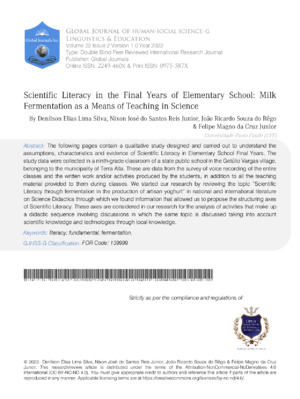
The following pages contain a qualitative study designed and carried out to understand the assumptions, characteristics and evidence of Scientific Literacy in Elementary School Final Years. The study data were collected in a ninth-grade classroom of a state public school in the Getúlio Vargas village, belonging to the municipality of Terra Alta. These are data from the survey of voice recording of the entire classes and the written work and/or activities produced by the students, in addition to all the teaching material provided to them during classes. We started our research by reviewing the topic “Scientific Literacy through fermentation in the production of artisan yoghurt” in national and international literature on Science Didactics through which we found information that allowed us to propose the structuring axes of Scientific Literacy. These axes are considered in our research for the analysis of activities that make up a didactic sequence involving discussions in which the same topic is discussed taking into account scientific knowledge and technologies through local knowledge.
Denílson Elias Lima Silva. 2026. \u201cAlfabetizacao Cientifica Nos Anos Finais Do Ensino Fundamental: Fermentacao Do Leite Como Meio De Ensino Em Ciências\u201d. Global Journal of Human-Social Science - G: Linguistics & Education GJHSS-G Volume 22 (GJHSS Volume 22 Issue G2): .
Crossref Journal DOI 10.17406/GJHSS
Print ISSN 0975-587X
e-ISSN 2249-460X
Explore published articles in an immersive Augmented Reality environment. Our platform converts research papers into interactive 3D books, allowing readers to view and interact with content using AR and VR compatible devices.
Your published article is automatically converted into a realistic 3D book. Flip through pages and read research papers in a more engaging and interactive format.
Total Score: 105
Country: Brazil
Subject: Global Journal of Human-Social Science - G: Linguistics & Education
Authors: Denílson Elias Lima Silva, Nixon José do Santos Reis Junior, João Ricardo Souza do Rêgo, Felipe Magno da Cruz Junior, Jurandyr da Costa Lima (PhD/Dr. count: 0)
View Count (all-time): 170
Total Views (Real + Logic): 1937

Total Downloads (simulated): 45

Publish Date: 2026 01, Fri
Monthly Totals (Real + Logic):
This paper attempted to assess the attitudes of students in
Advances in technology have created the potential for a new
Inclusion has become a priority on the global educational agenda,
The following pages contain a qualitative study designed and carried out to understand the assumptions, characteristics and evidence of Scientific Literacy in Elementary School Final Years. The study data were collected in a ninth-grade classroom of a state public school in the Getúlio Vargas village, belonging to the municipality of Terra Alta. These are data from the survey of voice recording of the entire classes and the written work and/or activities produced by the students, in addition to all the teaching material provided to them during classes. We started our research by reviewing the topic “Scientific Literacy through fermentation in the production of artisan yoghurt” in national and international literature on Science Didactics through which we found information that allowed us to propose the structuring axes of Scientific Literacy. These axes are considered in our research for the analysis of activities that make up a didactic sequence involving discussions in which the same topic is discussed taking into account scientific knowledge and technologies through local knowledge.
Lorem ipsum dolor sit amet, consectetur adipiscing elit. Ut elit tellus, luctus nec ullamcorper mattis, pulvinar dapibus leo.