## I. INTRODUCTION
The importance of children's movement in their physical and mental development has been of interest to parents and academics alike for over a century. The notion that physical and mental dexterity are linked is part of cultural wisdom and is ingrained as an assumption in Western civilization. The growing burden of disease caused by excessive weight in childhood, associated with increased sedentary lifestyles, can lead to the collapse of many of the world's health systems, as well as cause suffering and expense for those affected (Baird, 2005, cited by Rodriguez et al., 2018, p. 54).
Schools serve as an excellent venue to provide students with the opportunity for daily physical activity, to teach the importance of regular physical activity for health, and to build skills that support active lifestyles.
Unfortunately, most children get little to no regular physical activity while in school (Trost, 2007). Physical inactivity has increased in the last decades, being one of the riskiest causes of the increase of different non-communicable diseases, and it also affects children's school performance, especially the teaching-learning process. Is an important lifestyle factor associated with a wide range of benefits in children's health and development, including the prevention of overweight, obesity, and cardiovascular diseases as well as supporting academic achievement and mental health (Mooses et al., 2021; Kriemler et al., 2010; Ruiz, et al., 2022).
The promotion of physical activity and health has become a universal challenge. The alternative program was launched to increase and promote the physical activity of schoolchildren in order to achieve an improvement in the teaching-learning process of primary school pupils (Gråstén et al., 2015). It is relevant and necessary to work continuously on the intervention of an alternative physical activity program to improve school performance at the different levels of basic education in the Ministry of Public Education.
Studies have proven the benefits and positive effects of the teaching-learning process, in function with physical activation and academic performance in children, this brings as a consequence structural changes in the brain and cognitive functioning (Best, 2010; Donnelly et al., 2016; Chavez et al., 2018; Gunnell et al., 2019; Lamas, 2015; Obregon, 2019; Tomporowski & Pesce, 2019; Toala et al., 2022), it has been confirmed that physical activation contributes to brain oxygenation; the other organ systems, improve school performance for more efficient development and performance of the teaching-learning process.
It is important to highlight that "within educational contexts, there has been a permanent interest in understanding the cognitive and behavioral factors that favor or hinder student performance in their academic work and how this relates to their overall development" (Ornelas et al., 2012, p. 781). For the welfare of the teaching-learning process of students at different levels of education, especially at the primary level, in order to contribute to effective learning.
Maureira et al. (2014) express that "the improvement of academic performance may be related to the increase of blood flow to various areas that could be involved in the cognitive processes necessary in learning" (p. 47). Likewise, in recent years there have been many problems closely related to sedentary lifestyles, lack of physical activity, inadequate diet, cardiovascular diseases, obesity, and hypertension, among many others, therefore, obesity and overweight are real public health problems, and their prevalence is increasing in child populations around the world (Pantoja & Montijano, 2012).
The objective of the research is to determine the effect of an alternative physical activation program to improve school performance.
## II. MATERIALS AND METHODS
The research is based on a quantitative approach, applying a pre-experimental design with a study group to compare the results of the grades of Bimesters II and IV; also, to determine the effect of an alternative physical activation program to improve school performance "Sor Juana Ines de la Cruz". This pre-experimental, approach of this study, (Hernandez et al., 2014; Almutairi, et al., 2020) was consulted. The scope of the research is to provide a background of the need to solve physical inactivity, through an alternative program, as a tool, based on physical activation to improve school performance. The SPSS 25 statistical program was used for the normality tests, and a student's t-test was applied to compare the results of Bimesters II and IV, respectively, with the purpose of verifying the most significant effect of the alternative physical activation program. A confidence level of (95%) was used, with significance $(p < 0.05)$.
### a) Participants
In relation to, the characteristics of the participants are described in table 1, where we can observe that in the pre-experimental, the participants (n=134) participated with an average age of 9.4 years, with an average age $(SD \pm 1.01)$ of the students of the "Sor Juana Ines de la Cruz" elementary school. Of these (n=64), were male, representing $47.76\%$, while the remaining (n=70) corresponded to the female sex with $52.24\%$.
Table 1: Participants and the Average Age
<table><tr><td>Participants</td><td>n</td><td>%</td></tr><tr><td>Average Age</td><td>9.4 ±1.01</td><td>-</td></tr><tr><td>Male</td><td>64</td><td>47.76</td></tr><tr><td>Female</td><td>70</td><td>52.24</td></tr><tr><td>Total</td><td>134</td><td>100</td></tr></table>
### b) Procedures
Among the requirements, the student subjects needed to be enrolled in the 2021 school year at the time the research was conducted. In addition to having the consent of the parents to participate in the physical activation program, prior to the school day, one of the requirements was to have $90\%$ attendance at the scheduled sessions of physical activation. The alternative physical activation program consisted of 40 sessions, with a duration of 45 minutes, and was carried out on Mondays, Wednesdays, and Fridays, during a semester divided into three moments, as described below.
In the first part, linked to the initial part, composed by the orientation of the objectives, the articular warm-up; in the second part, in the medullar part, the planned activities were developed, in correspondence with the objectives, according to the weeks of planning of the program, specifically with reaction exercises based on games, short runs of 20 meters, flexibility exercises. The final part was composed of the recovery and analysis of each class.
### c) Evaluation Criteria
The student's grades were evaluated according to the guidelines of the Ministry of Public Education (SEP), corresponding to the subjects of Mathematics and History and Civic Education in Bimesters II and IV, respectively.
### d) Selection Criteria
In order to participate in the process of the alternative physical activation program to improve school performance in the primary school "Sor Juana Inés de la Cruz", students with attendance problems were excluded; all students agreed to participate with the informed consent of their parents and the SEP management.
## III. RESULTS
Of these participants, 18 students were the age of seven (12.8%), 34 students the age of eight (24.4%), 38 participants the age of nine (31.4%), 30 students the age of (21.4%), and only 14 students in the age of 11 (10%) of the total, as shown in figure 1 below.
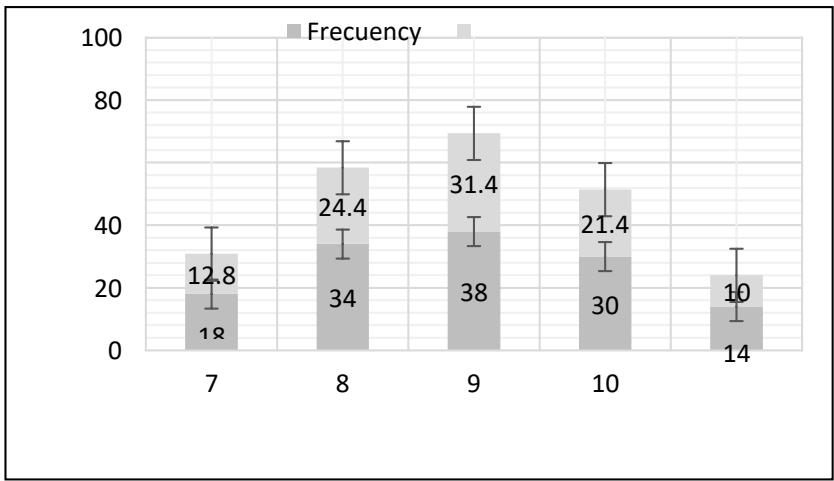 Figure 1: Ages of the Participants
In figure 2, we can observe the school grades of the participants, where 25 students participated in third grade (17.68%), 43 students in fourth grade (30.72%),
39 students in fifth grade $(32.14\%)$, and 27 students in sixth grade $(19.28\%)$.
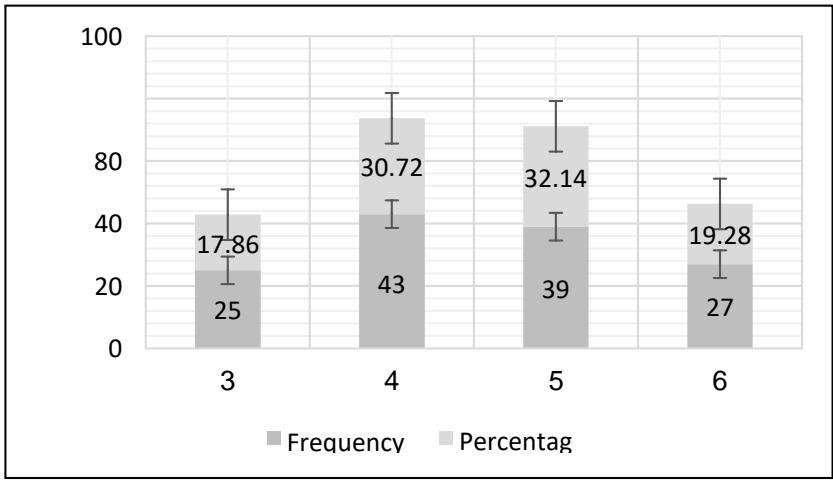 Figure 2: Grade Levels of Students
On the other hand, the most influential variable in this pre-experimental was school performance, in which the results of the grades of the second semester and the grades of the fourth semester were obtained, where it was analyzed whether there were significant changes in the subjects of the basic axis of common formation: History, Mathematics, and Civic Education. These results are shown in figure 1.
While it is true that the most significant subject was Mathematics, which from having a mean of 9.21 with an SD $\pm 0.83$ in the second bimester improved to 9.63, with an SD $\pm 0.38$, which caused a significant change, with a value of $p = 0.000$. On the other hand, in the other subjects, there was no significant change in general, the data will be described below by school grade and by gender of those investigated.
It is necessary to mention that, the results of the grades related to the students of both genders, produced significant change in the grades of the subject of Mathematics from Bimester II to Bimester IV the students had 9.19 in their average grades in Bimester II and then went to 9.60 of grade in Bimester IV; in the same way, the girls went from 9.32 to 9.77 in their school performance in the subject of Mathematics, with a value of $p = 0.000$.
On the other hand, in the other subjects, there were no significant changes in general, but there were some numerical differences from the second to the fourth semester.
Table 2: Results of the Scores before and After the Alternative Physical Activation Program
<table><tr><td>Materials</td><td colspan="3">Qualifications
II Bimester</td><td colspan="3">Qualifications
IV Bimester</td><td>Significance</td></tr><tr><td></td><td>Media</td><td>±</td><td>SD</td><td>Media</td><td>±</td><td>SD</td><td></td></tr><tr><td>Matemáticas</td><td>9.21</td><td>±</td><td>0.83</td><td>9.63</td><td>±</td><td>0.38</td><td>0.000*</td></tr><tr><td>Historia</td><td>9.53</td><td>±</td><td>0.54</td><td>9.42</td><td>±</td><td>0.66</td><td>0.071</td></tr><tr><td>Civic Education</td><td>9.60</td><td>±</td><td>0.56</td><td>9.60</td><td>±</td><td>0.61</td><td>0.276</td></tr></table>
It is necessary to mention that the results were grouped based on the school grade, obtained in the second grade of primary school in general, and based on the sex of the participants, where it was observed that the subject of History was where significant changes were presented, in relation to the grade with a mean of 9.32 with an $\mathrm{SD} \pm 0.68$ in the second bimester to 9.60, in relation to the fourth bimester, with a value of $p = 0.028$, which was significant. The other subjects presented very similar values in both Bimesters, there were no significant changes, for a better analysis check table 3.
Table 3: Results of scores before and after the alternative physical activation program, by gender
<table><tr><td colspan="2">Materials</td><td colspan="3">Qualifications Bimester</td><td colspan="3">Qualifications IV Bimester</td><td>Significance</td></tr><tr><td></td><td></td><td>Media</td><td>±</td><td>SD</td><td>Media</td><td>±</td><td>SD</td><td></td></tr><tr><td rowspan="2">Mathematics</td><td>Female</td><td>9.19</td><td>±</td><td>0.96</td><td>9.67</td><td>±</td><td>0.37</td><td>0.000*</td></tr><tr><td>Male</td><td>9.22</td><td>±</td><td>0.77</td><td>9.71</td><td>±</td><td>0.39</td><td>0.000*</td></tr><tr><td rowspan="2">History</td><td>Female</td><td>9.32</td><td>±</td><td>0.68</td><td>9.60</td><td>±</td><td>0.70</td><td>0.0208</td></tr><tr><td>Male</td><td>9.62</td><td>±</td><td>0.47</td><td>9.49</td><td>±</td><td>0.62</td><td>0.194</td></tr><tr><td rowspan="2">Civic Education</td><td>Female</td><td>9.54</td><td>±</td><td>0.71</td><td>9.53</td><td>±</td><td>0.66</td><td>0.925</td></tr><tr><td>Male</td><td>9.77</td><td>±</td><td>0.40</td><td>9.66</td><td>±</td><td>0.57</td><td>0.172</td></tr></table>
Table 4: Mean Scores Before and After the Alternative Physical Activation Program for Third-Year Students
<table><tr><td>Materials</td><td colspan="3">Qualifications
II Bimester</td><td colspan="3">Qualifications
IV Bimester</td><td>Significance</td></tr><tr><td></td><td>Media</td><td>±</td><td>SD</td><td>Media</td><td>±</td><td>SD</td><td></td></tr><tr><td>Mathematics</td><td>9.79</td><td>±</td><td>0.24</td><td>9.85</td><td>±</td><td>0.23</td><td>0.352</td></tr><tr><td>History</td><td>9.32</td><td>±</td><td>0.68</td><td>9.60</td><td>±</td><td>0.49</td><td>0.028*</td></tr><tr><td>Civic Education</td><td>9.78</td><td>±</td><td>0.31</td><td>9.80</td><td>±</td><td>0.34</td><td>0.739</td></tr></table>
Table 5 shows the results of the fourth-grade students, which showed two significant differences, the first in the subject of History with a significance of (0.042) and the other in the subject of Mathematics with (0.000), in the subject of Civic Education, we can see that we have a numerical difference of 9.53 to 9.71.
Table 5: Results of Scores Before and After the Alternative Physical Activation Program for Fourth-Grade Students
<table><tr><td>Materials</td><td colspan="3">Qualifications
II Bimester</td><td colspan="3">Qualifications
IV Bimester</td><td>Significance</td></tr><tr><td></td><td>Media</td><td>±</td><td>SD</td><td>Media</td><td>±</td><td>SD</td><td></td></tr><tr><td>Mathematics</td><td>9.06</td><td>±</td><td>0.74</td><td>9.75</td><td>±</td><td>0.32</td><td>0.000*</td></tr><tr><td>History</td><td>9.54</td><td>±</td><td>0.58</td><td>9.32</td><td>±</td><td>0.69</td><td>0.042*</td></tr><tr><td>Civic Education</td><td>9.53</td><td>±</td><td>0.46</td><td>9.71</td><td>±</td><td>0.43</td><td>0.072</td></tr></table>
The grades in the fifth grade of elementary school did not show significant changes from the second bimester to the fourth bimester. In mathematics, there was a slight numerical change in the mean scores of the grades, going from 9.53 in the second bimester to
9.60, according to the fourth bimester. On the other hand, the subjects of History and Civics presented non-significant numerical decreases, because the grades were lowered, as illustrated in table 6.
Table 6: Results of Grades Before and After the Alternative Physical Activation Program for Fifth-Grade Students
<table><tr><td>Materials</td><td colspan="3">Qualifications
II Bimester</td><td colspan="3">Qualifications
IV Bimester</td><td>Significance</td></tr><tr><td></td><td>Media</td><td>±</td><td>SD</td><td>Media</td><td>±</td><td>SD</td><td></td></tr><tr><td>Mathematics</td><td>9.53</td><td>±</td><td>0.43</td><td>9.60</td><td>±</td><td>0.41</td><td>0.278</td></tr><tr><td>History</td><td>9.73</td><td>±</td><td>0.33</td><td>9.46</td><td>±</td><td>0.80</td><td>0.356</td></tr><tr><td>Civic Education</td><td>9.78</td><td>±</td><td>0.39</td><td>9.58</td><td>±</td><td>0.74</td><td>0.071</td></tr></table>
The sixth-grade grades showed three aspects; the first; was a significant improvement in the subject of mathematics, where its mean value of 8.32 with a relatively high standard deviation of $\pm 1.10$ improved to a grade of 9.49 in the fourth Bimester and with a decrease in its standard deviation to $\pm 0.40$; the second subject behaved without changes in its grades, the mean values remained the same only with slight changes in their standard deviations, this in the subject of History; Finally, in Civic Formation, there was a numerical decrease, this indicates that it was not significant, for a better understanding see table 7.
Table 7: Results of Grades before and After the Alternative Physical Activation Program for Sixth-Grade Students
<table><tr><td>Materials</td><td colspan="3">Qualifications
II Bimester</td><td colspan="3">Qualifications
IV Bimester</td><td>Significance</td></tr><tr><td></td><td>Media</td><td>±</td><td>SD</td><td>Media</td><td>±</td><td>SD</td><td></td></tr><tr><td>Mathematics</td><td>8.32</td><td>±</td><td>1.10</td><td>9.49</td><td>±</td><td>0.40</td><td>0.000*</td></tr><tr><td>History</td><td>9.38</td><td>±</td><td>0.53</td><td>9.38</td><td>±</td><td>0.46</td><td>1.000</td></tr><tr><td>Civic Education</td><td>9.59</td><td>±</td><td>0.92</td><td>9.32</td><td>±</td><td>0.73</td><td>0.104</td></tr></table>
## IV. DISCUSSION
With respect to the results, it means that these results are still not enough, so we must continue working to improve the problems that affect children in Mexico, due to the lack of systematic physical activity, which influences school performance, as well as electronic media, which limit the school performance of students. According to the main findings, there is a significant relationship in mathematics, but not in History and Civic Education, with respect to the number of days of physical activity per week and the time of practice.
The same was the case in our pre-experimental, where 134 participants, but at the primary level, found that significant changes were also observed in the subject of mathematics from the second bimester, with respect to the fourth bimester in the subject of History, which could be associated with the subject of Civic Education, there were no significant changes. The sample consisted of 847 students (422 girls, 425 boys) from 12 to 14 years of age from 2 school districts. The experimental school $(N = 208)$ and 4 control schools $(N = 639)$ were selected in northeastern and central Finland through direct contact with the school principals (Gråstén et al., 2015, p.127). The pre-experimental that was carried out on physical activation had a duration of 45 minutes prior to the school day, and significant changes were found in some subjects, in that sense, some research has observed a positive relationship between one hour of physical activity with the improvement of school grades and thus an increase in school performance (Dwyer et al., 2001).
In relation to this, the SIM program targets basic schools (grades 1-9, ages 7-16). The group of schools participating in the program is diverse in size and location, ranging from rural schools with 15 students to urban schools with more than 1300 students (Mooses et al., 2021, p.2). Likewise, Kriemler et al. (2010). In their studies, they state that 498 children completed the baseline and follow-up assessments (mean age 6.9 (SD 0.3) years for first grade, 11.1 (0.5) years for fifth grade). After adjustment for the grade, sex, baseline values, and clustering within classes, children in the intervention arm compared with controls showed more negative changes in the z score of the sum of four skin folds (-0.12, 95% confidence interval -0.21 to -0.03; $p = 0.009$ ). In relation to other studies, from a humanistic approach, academic performance is "the product given by students in educational institutions and usually expressed through school grades" (Martinez, 2007). In other research, no significant differences were located in the gender of the participants, as in the work done by (Oropeza, Avalos & Ferreyra, 2017), where they found significant differences between academic performance and people who performed physical activity, but not so between participants. In accordance with (Avila et al., 2021; Maureira et al., 2014; Ruiz, et al., 2022), sought to determine the influence of the practice of physical activity on academic performance in the subjects of mathematics, Language History, and Science, where they evaluated 73 high school students.
The effect on primary school students of a physical activity program during school breaks through pre-sports games, these studies were applied to 54 primary school students, aged 9 to 11 years, physical activity programs performed during school breaks with a duration of 45 minutes for three days a week, produces improvements in the values of Body Mass Index and physical condition of those who practice it (Pumar, Navarro, & Basanta, 2015).
## V. CONCLUSIONS
By way of conclusion, it was found that during the research process, several approaches were carried out with the directors of the school "Sor Juana Ines de la Cruz", until it was approved by the Secretary of Public Education and parents, for the implementation of an alternative program of physical activation to improve school performance, based on recreational activities and races. With a time of 45 minutes, 40 sessions, before entering class shifts, according to their teaching schedules, this program was carried out on Mondays, Wednesdays, and Fridays, during a semester, fulfilling the objective of the research and the schedule of planned activities.
Besides verifying the impact, it had on the participants and their school performance, which was not entirely sufficient, it made a significant contribution to the subject of Mathematics, specifically, according to the results shown. We can also affirm that the study influenced the learning of the subjects of Civic Education and History in the students of the "Sor Juana Inés de la Cruz" elementary school. The main theoretical and methodological limitations of this study are limited by time and its application for a longer period of time, so we recommend the school administrators continue working with the purpose of encouraging the school community to systematically practice physical activity for the well-being of health and the quality of the teaching-learning process.
### ACKNOWLEDGMENTS
We are grateful to all those who unconditionally collaborated with the research. We are grateful to the Departments of Sports Science and Physical Activity of the University of Sonora, Mexico, and to the University "Marta Abreu" of Villa Clara, Cuba.
Declaration of authorship and contributions
We declare that all authors have contributed to the intellectual collaboration of the research process culminating in the submission of this article.
Declarations
The authors declare that they have no conflicts of interest.
Ethical Approval
The present study was approved by the Ethics Committee of the Secretary of Public Education (SEP) and by the Ethics Committee of the Universidad de Sonora (UNISON), in addition to having the informed consent of the parents regarding the participation of the students.
Financing With support from CONACyT
To access the availability of data and materials, please contact the authors through the following. email:
[email protected]