Amniotic Fluid Volume Disorders: Causes and Effects

Article ID

FW3EN

High-quality research on amniotic fluid volume, pregnancies, and related complications.

Amniotic Fluid Volume Disorders: Causes and Effects

Mst. Tajmira Sultana
Mst. Tajmira Sultana Dhaka Medical College Hospital
Laila A
Laila A
Nasrin UT
Nasrin UT
DOI

Abstract

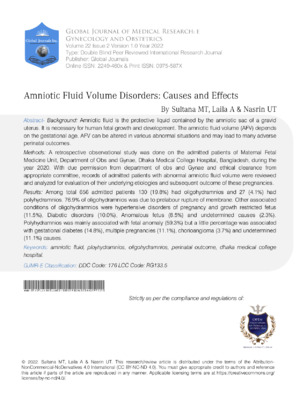
Background: Amniotic fluid is the protective liquid contained by the amniotic sac of a gravid uterus. It is necessary for human fetal growth and development. The amniotic fluid volume (AFV) depends on the gestational age. AFV can be altered in various abnormal situations and may lead to many adverse perinatal outcomes. Methods: A retrospective observational study was done on the admitted patients of Maternal Fetal Medicine Unit, Department of Obs and Gynae, Dhaka Medical College Hospital, Bangladesh, during the year 2020. With due permission from department of Obs and Gynae and ethical clearance from appropriate committee, records of admitted patients with abnormal amniotic fluid volume were reviewed and analyzed for evaluation of their underlying etiologies and subsequent outcome of these pregnancies. Results: Among total 656 admitted patients, 130 (19.8%) had oligohydramnios and 27 (4.1%) had polyhydramnios. 76.9% of oligohydramnios was due to prelabour rupture of membrane. Other associated conditions of oligohydramnios were hypertensive disorders of pregnancy and growth restricted fetus (11.5%), Diabetic disorders (10.0%), Anomalous fetus (8.5%) and undetermined causes (2.3%). Polyhydramnios was mainly associated with fetal anomaly (59.3%) but a little percentage was associated with gestational diabetes (14.8%), multiple pregnancies (11.1%), chorioangioma (3.7%) and undetermined (11.1%) causes. Among 83 deliveries of oligohydramnios cases, 63 (75.9%) babies were born alive and 20(24.1%) were stillbirth. 29 (34.93%) of the live babies needed admission in NICU and 9 (10.84%) of them died during their neonatal period. From 20 delivered polyhydramnios cases 10 (50.00%) babies were born alive and 10 (50.00%) were stillbirth. 5 (25.00%) of the live babies needed admission in NICU and 4 (20.00%) of them died during their neonatal period. Discussion: From the current study and previous studies, results showed that some abnormalities of pregnancies are almost always present with amniotic fluid volume disorders and subsequently lead to a considerable number of adverse perinatal outcomes. Conclusion: It is important to keep an eye on amniotic fluid index for better pregnancy outcome.

Amniotic Fluid Volume Disorders: Causes and Effects

Background: Amniotic fluid is the protective liquid contained by the amniotic sac of a gravid uterus. It is necessary for human fetal growth and development. The amniotic fluid volume (AFV) depends on the gestational age. AFV can be altered in various abnormal situations and may lead to many adverse perinatal outcomes. Methods: A retrospective observational study was done on the admitted patients of Maternal Fetal Medicine Unit, Department of Obs and Gynae, Dhaka Medical College Hospital, Bangladesh, during the year 2020. With due permission from department of Obs and Gynae and ethical clearance from appropriate committee, records of admitted patients with abnormal amniotic fluid volume were reviewed and analyzed for evaluation of their underlying etiologies and subsequent outcome of these pregnancies. Results: Among total 656 admitted patients, 130 (19.8%) had oligohydramnios and 27 (4.1%) had polyhydramnios. 76.9% of oligohydramnios was due to prelabour rupture of membrane. Other associated conditions of oligohydramnios were hypertensive disorders of pregnancy and growth restricted fetus (11.5%), Diabetic disorders (10.0%), Anomalous fetus (8.5%) and undetermined causes (2.3%). Polyhydramnios was mainly associated with fetal anomaly (59.3%) but a little percentage was associated with gestational diabetes (14.8%), multiple pregnancies (11.1%), chorioangioma (3.7%) and undetermined (11.1%) causes. Among 83 deliveries of oligohydramnios cases, 63 (75.9%) babies were born alive and 20(24.1%) were stillbirth. 29 (34.93%) of the live babies needed admission in NICU and 9 (10.84%) of them died during their neonatal period. From 20 delivered polyhydramnios cases 10 (50.00%) babies were born alive and 10 (50.00%) were stillbirth. 5 (25.00%) of the live babies needed admission in NICU and 4 (20.00%) of them died during their neonatal period. Discussion: From the current study and previous studies, results showed that some abnormalities of pregnancies are almost always present with amniotic fluid volume disorders and subsequently lead to a considerable number of adverse perinatal outcomes. Conclusion: It is important to keep an eye on amniotic fluid index for better pregnancy outcome.

Mst. Tajmira Sultana
Mst. Tajmira Sultana Dhaka Medical College Hospital
Laila A
Laila A
Nasrin UT
Nasrin UT

No Figures found in article.

Mst. Tajmira Sultana. 2026. “. Global Journal of Medical Research – E: Gynecology & Obstetrics GJMR-E Volume 22 (GJMR Volume 22 Issue E2): .

Download Citation

Journal Specifications

Crossref Journal DOI 10.17406/gjmra

Print ISSN 0975-5888

e-ISSN 2249-4618

Classification
GJMR-E Classification: DDC Code: 176 LCC Code: RG133.5
Keywords
Article Matrices
Total Views: 1516
Total Downloads: 26
2026 Trends
Research Identity (RIN)
Related Research
Our website is actively being updated, and changes may occur frequently. Please clear your browser cache if needed. For feedback or error reporting, please email [email protected]

Request Access

Please fill out the form below to request access to this research paper. Your request will be reviewed by the editorial or author team.
X

Quote and Order Details

Contact Person

Invoice Address

Notes or Comments

This is the heading

Lorem ipsum dolor sit amet, consectetur adipiscing elit. Ut elit tellus, luctus nec ullamcorper mattis, pulvinar dapibus leo.


High-quality academic research articles on global topics and journals.

Amniotic Fluid Volume Disorders: Causes and Effects

Mst. Tajmira Sultana
Mst. Tajmira Sultana Dhaka Medical College Hospital
Laila A
Laila A
Nasrin UT
Nasrin UT

Research Journals