The Strife of Love in a Dream (Hypnerotomachia Poliphili, 1499) is a story of unrequited love. It is widely believed that its author–Francesco Colonna–was a monk; however, there has been no interest in studying the impact of Medieval Christianity and monasticism in the novel. The present investigation exposes the survival of the physiological-cognitive perspective (Galen’s and Avicenna’s legacy) in regard to amorous feelings and their literary representation (through the doctrine of pneuma and to demonstrate the relevance of said knowledge in service to Christian moralizing and monastic training.) To such purpose, a selection of passages from the book alongside with visual resources (illustrations, diagrams, and map) are presented to facilitate general access to the story and so that the understanding of the processes occurring within the inner man be emphasized.
## I. INTRODUCTION
We will give ourselves license to start this exposition regarding amorous feeling in The Strife of Love in a Dream novel by Francesco Colonna, with a thought originating from several centuries after the period that brings us here. In fact, in the Age of Enlightenment, an Italian Jesuit comments:
It has not been found, and it will never be found, a microscope, with the power to observe the medium through which the soul is governed in its functions, being, as it is, an invisible spirit. And despite how we play at the potential material Fantasy, situated in the brain, not even there will ever our eyes be able to penetrate in order to discover those we call ideas or ghosts.[^1]
The words have the value of illustrating how literary fantasy can provide us with said impossible microscope, and at the same time, to make evident the constancy of certain unsolved concerns regarding the invisibles processes within the inner man: the origin of his thoughts and of the phantoms in his mind, and their relationship with the attachments of his soul. It so happens that *The Strife of Love in a Dream* by Francesco Colonna already had offered a microscopic view to that interior world that so seemed to disquiet this Jesuit thinker. Three centuries earlier, in a liminal moment between the Early Middle Ages and Early Renaissance, through literature a watchtower was built from the impossibility to represent fantasy; a vantage point from which a fantastic character could be observed. The Strife of Love in a Dream shows an often-disregarded progressive side of medieval thinking in regards to the conceptions of the modern secularized man. Its author, a Venetian monk, must have spent many years of his life in the crafting of the manuscript to achieve such feat.
## II. THE STATE OF THE MATTERS REGARDING FRANCESCO COLONNA'S NOVEL
The Strife of Love in a Dream (Hypnerotomachia Poliphili) by Francesco Colonna is a novel printed by Aldus Manutius in Venice in 1499. Although it is deemed that the manuscript might have been finished as early as 1467, the first edition would only be concretized in the dawning of the 16th century. The novel deals during a dream with the experiences related to the pitiful love Poliphilus feels towards Polia. The work is constituted by two books: the first and longest is constructed from the exhaustive and fragmented description of architectonic monuments, precious objects and lustful temptations that afflict the protagonist in a world of queens, goddesses, and nymphs. The second offers a chronological telling of Poliphilus' attempts to set alight passion within Polia's glacial heart. The mystery of the book is suggested through a dream within a dream, accompanied of images that are intrinsically complicit with the diagramming of its texts. The fundamental motive of the work is centered in how unrequited sensual inclinations affect the protagonist. The core theme is less evident, due to the fact that it is built around age-old theories about cognition and memory that, once inspected through a Christian perspective (monastic), are presented through literary means in the novel. As we will see, Colonna projects his own psycho and physiopathological condition onto the protagonist of his dream world, a place where the missing loved one presents herself as phantasmagorical.
Colonna's book has been the object of multiple interpretations that have adopted the Greek, Roman and neopagan legacy as their recurrent perspectives. During the past years, the community of research revolving around his work has accepted the theory affirming that the book's author was a monk of unorthodox behavior. However, despite this acceptance, the impact of
Christian thought and its medieval literary referents have not been given due attention.[^7][^6] In regard to this situation, we must mention that the study of amorous sentiment in the novel was undertaken by Ian Culianu.[^2]2 The knowledge that supports his study is the theory of erotic syndrome, also known as hereos love. Culianu relates the effects of amorous feelings to cognitive and memory processes. Furthermore, we do not ignore the comments regarding *The Strife of Love in a Dream* that do include certain details of Christian nature. Authors like Emanuela Kretzulesco-Quaranta3 and the essay by N. Temple4 are good examples of this. However, neither study has Christian thoughts and beliefs or monasticism as the main focus, and therefore neither is exhaustive regarding this topic.
Independently from the studies around the novel itself, the medieval conception regarding the somatic nature of the processes of memory has been undertaken by authors such as Frances Yates, $^{5}$ Mary Carruthers, $^{6}$ and Lina Bolzoni. $^{7}$ Medieval physiological-cognitive theory exists, mainly, due to the synthesis and the contributions developed by Avicenna in his treatise known as Canon de Avicenna (Avicenna's Medicine), Liber de Anima $^{8}$ in book IV. To this date, there does not exist any study devoted to the search of connections between these theories of physiological origin and The Strife of Love in a Dream in particular.
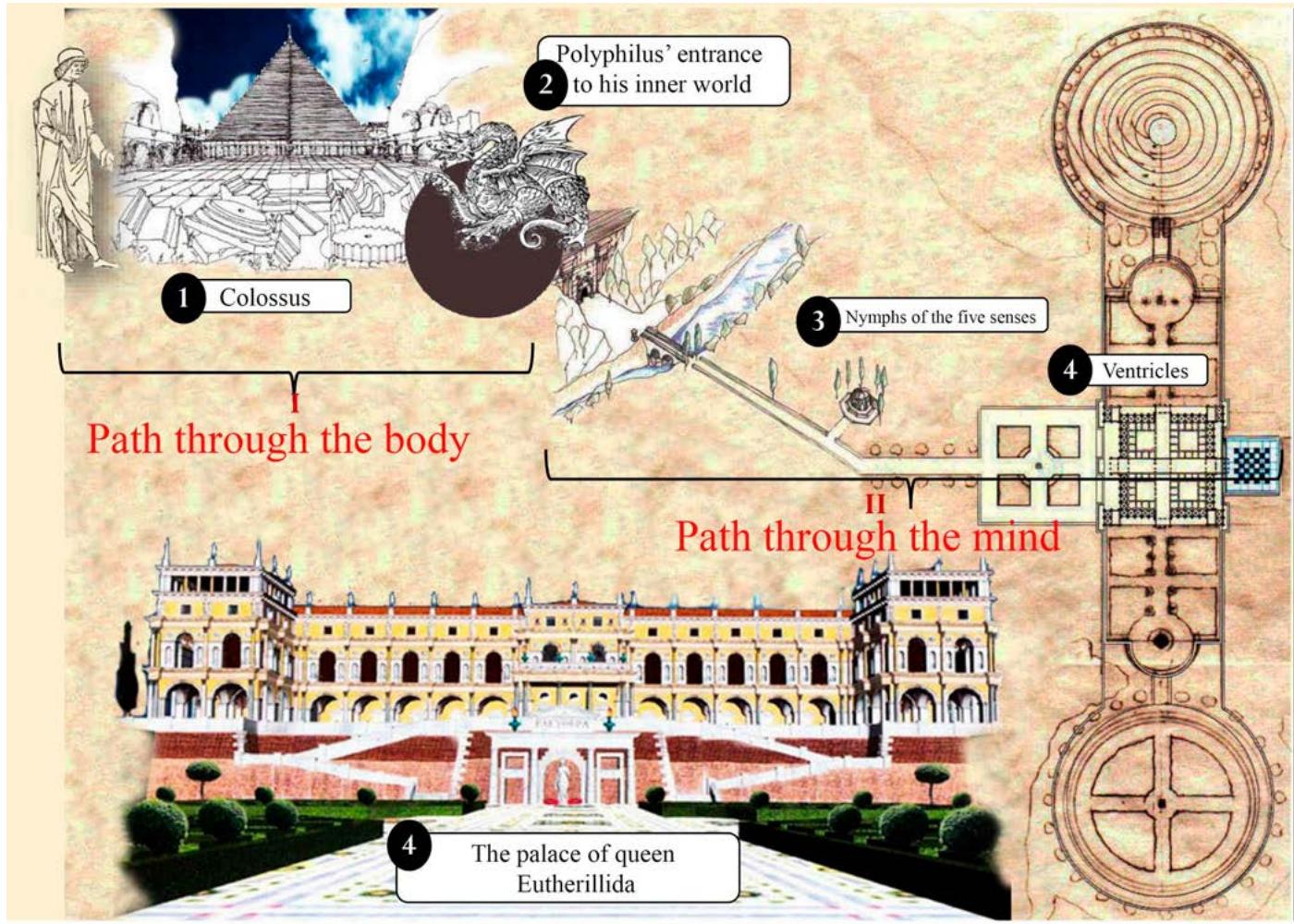
For those who possess knowledge of this book, the lack of any mention in the present investigation to its iconographic nature might seem strange. This omission is due to, first of all, our desire to flank the traditional lines of investigation that position Colonna's novel as facing the Renaissance: we opted to find its medieval roots. And secondly, we chose to omit it because we have the certainty that the nature of the engravings of Aldus Manutius' original 1499 edition does not fulfill a properly illustrative function, as occurs--certainly--with the images in the French edition by Kerver[^9] and the virtual contemporary reconstructions by Esteban Alejandro de la Cruz,[^10] which are based on the highly technical descriptions that Colonna unfolds in his work. However, we will make use of these images (by Kerver and by Cruz) and not the woodcuts in the original Venetian print, to illustrate any such passage in the story about which the reader must be informed about quickly and efficiently. In consequence, the present study does make use of supplementary visual resources such as process diagrams (one, regarding the process of the phantasmatic love in Poliphilus' cerebral architecture and the other, regarding the journey of pneumatic-Poliphilus in the allegoric cerebral architecture), and a map that synthesizes the main milestones of his treacherous and turbulent pilgrimage, in the far away land of visions he dreams about.
## III. STUDY'S OBJECTIVES
Given the aforementioned considerations, the following investigation presents as its objective to prove the survival of the doctrine of pneuma in regard to matters of the heart, particularly in relation to amorous feelings and their representation in The Strife of Love in a Dream, by identifying links between the novel and the physiological-cognitive theory by Avicenna (with Galenic roots). We will analyze passages from chapter fourth, seventh and eighth (Elizabethan version 1527), which mainly address the description of a recumbent colossus and queen Eutherillida's palace. For this the main ideas that are born from Avicenna's legacy regarding the feeling of love and its connection to cognitive processes--in relationship to the functions of the heart and brain--will be our interpretative tool.
The passages chosen depict Colonna's interest and knowledge about the functioning of the inner organs positioned in the three main zones of the body according to medieval understanding: venter, pectus, and caput, following the contributions by Le Goff & Truong.11 However, the author keeps completely silent regarding the organ nested in the colossus' uppermost cavity: the brain. In this respect, we must add that Avicenna was responsible for synthesizing the Platonic and Aristotelian tradition during the Middle Ages, positing the brain as the headquarters of the mental faculties (five inward senses), and locating its energetic center in the heart.12 Then, if the novel really is in affiliation with the aforementioned theory, how can the omission of the brain be explained without diminishing the strength of the affiliation with Avicenna's thought? In order to answer, let us consider this; which would be Colonna's reasons to present a fallen colossus instead of a standing one? From our point of view, medieval cognitive theory, as well as consideration of the cardinal sin of akedia, offers some answers. Christian symbolism can be discerned from the colossus' description and the architecture of queen Eutherillida's palace. We will observe that Poliphilus's journey within the colossus' body is resolved in a literary inventory of organs and aches, themselves a reflection of a negligent monk's soul. Because we must always remember that Poliphilus as protagonist is author-Poliphilus, a literary creature that manifests the writer's own concerns regarding monastic life, particularly the life of a Dominican monk. For this reason, in its deep structure the novel consists of a cleansing of author-Poliphilus's spirit (spiritus o pneuma), a purification which occurs by directing the gaze to the ineffable spaces of the inner man: his soul.
## IV. MEDIEVAL MICROSCOPY REGARDING THE
### RAVAGES OF LOVE IN THE SOUL: PNEUMA AND ITS DOCTRINES
We have decided to present this novel as a medieval microscopy of the inner spaces of man. Amorous feelings in The Strife of Love in a Dream are posited as a pathological emotional state, consequence of an extreme experience of the soul. We are interested in bringing forward the problem the representation of the ravages of love, caused by the phantom of the loved one (Polia), in the body, mind and soul of the lover (Poliphilus). The survival and representation of cognitive physiology in The Strife of Love in a Dream involves the understanding of medieval love as a phantasmatic process that is sustained--in turn--by the pneuma doctrine, just as Giorgio Agamben affirms.[^13] The survival of the idea of cerebral ventricles is in line with the thinking of other medieval authorities such as Saint Agustin in "De genesi ad litteram",[^14] Alberto Magno[^15] and Saint Thomas Aquinas.[^16] In relation to fantasy, phantoms (fantasmas) and the ideas present in the comment by the Jesuit Muratori that we introduced at the very beginning of this work, correspond to the ventricular system where the faculties of Poliphilus' soul-altered by the painful love--are manifested.
## V. DOCTRINE OF PNEUMA
In general terms, pneuma was considered to be a partly physic current of nature that emanated from blood. The term pneuma comes from Greek and "it means in certain occasions «wind», the verbal form pneō, means «to blow» and the resonances remain."17
The word is derived from the Hebrew ruach, which is translated as wind, breeze or vital breath. In Latin its terminology was multiplied as spiritus, mens, animus/animal, intellectus/ratio. $^{18}$ Pneumatic flux travelled throughout the whole body and participated in the main bodily functions, that is to say, those pertaining to the heart and brain. Through its existence, it was thought possible to posit solutions to certain pathologies, and/or to understand the configuration of thought and memory.
The oldest antecedents regarding this subject date from de 6th century before Christ, with Alcmaeon of Croton.[^19] From then, its history is loaded with nuances and is far away from forming a uniform doctrine.[^20] In the hypocratic legacy (460-370 a.C.) cultivated by the School of Alexandria, the brain was considered to be the creator of pneuma and the one responsible for cognition. Meanwhile the teachings by Empedocles (495-430 a.C.) perpetuated by the School of Sicily--assigned to the heart the power of rational speculation and centered this organ as the place from where sickness originated. The doctrinal dichotomy regarding these matters between both schools of medicine was a product of Classical Greek thought. On the one hand, there were those who followed Plato, who situated the heart at the center of knowledge and memory in his "Timeo"[^21] and on the other, those who followed Aristotle, who maintained that the brain was the organ of cognition.[^22]
We can observe the survival and permanence of Empedocles' idea (pneuma as a subtle outpour of the blood stored in the heart) in The Strife of Love in a Dream: Colonna presents pilgrim-Poliphilus through a pneumatic configuration. We can observe it, for example, in the key role that the heart plays in the description of the recumbent colossus' interior, which we will further examine later. We know that Empedocles' ideas persisted thanks to the Galenic tradition. In fact, the Medical School of Rome--also known as the "pneumatic school" (1st century), to which Galen belonged (130-210)--was the one to find harmony between the physiological perspective (Alexandrian and Sicilian, as well as the aforementioned Platonic and Aristotelian postulates) with stoic philosophical thought; ordering and systematizing everything then known regarding the human body and soul. In *The Strife of Love in a Dream*, we can find vestiges of Classical and Hellenic medical tradition; Galenic anthropology of the
3rd century in particular provides us with the necessary elements to understand Avicenna's idea (11th century) concerning the five inward senses, which emanates from his study of Aristotle's treatise De anima. According to Galen, there were two vital centers to the body (brain and heart) and three pneuma classes, as we can observe in table 1:
Table 1: Pneuma classification according to Galen23
<table><tr><td>Psychic Rational soul</td><td>Brain - Heart Refrigerating function</td><td>Upper Pneuma. First instrument of the soul.</td></tr><tr><td>Natural Concupiscible soul</td><td>Liver - abdomen</td><td>Vegetative functions Runs through arteries.</td></tr><tr><td>Vital Irascible soul</td><td>Heart -thorax Produces vital heat.</td><td>Lower or impure pneuma Produced by the air that is breathed and the blood outpour in the heart.</td></tr></table>
Nemesius -a 3rd-century philosopher who became *Emesa's* archbishop--validated Galenic doctrine, transmitting it to Christian thought in his writing,[^24] which then became widely used in the 8th century.[^25] For Nemesius, psyquic *pneuma* depended on the soul's voluntary movements, while the natural and vital *pneuma* were completely out of our rational control. The truth is that for Galen vital *pneuma* was a flux exhaled by and alongside blood, travelling through the body in its entirety. Only when reaching the brain was this flux purified.[^26] This purifying phenomenon caught Nemesius's interest (and the interest of those members of the church who studied his treatise), because it implied a *pneuma* controlled by our consciousness and, in consequence, one that became a part of our ethics. Furthermore, the exercise of free will in connection to *pneuma* also interested Saint Agustin in "De libero et arbitrio".[^27] In other words, the ethical aspect that the word adopted during the Middle Ages was an effect of classical, but above all, of Christian theology. The process of refining and purifying *pneuma* was interpreted--in monastic terms--as a spiritual progression, an ascension of the spiritual steps toward perfection. In the same manner proposed by Guigo II, the Carthusian,[^28] or the Benedictine Smaragdus of Saint
Mihiel $^{29}$ (c.760-840), Poliphilus--as a pneumatic entity--is subjected to a cleansing, a process in which the five outward senses (sensitive and sensorial, characteristic of his corporal nature) are completely involved, and therefore, they are represented in the novel.
In synthesis, pneuma was under the scrutiny of physiologists, philosophers and even theologists. We must warn that the present study is centered only in the pneuma doctrine itself and that, just as we showed, said doctrine was a product of several disciplines. However, we must emphasize that it was Avicenna who finished the endeavor of connecting the soul's processes with the brain's anatomy and that Alberto Magno would continue working on these ideas, but from a Christian perspective.
Considering all these theories, *The Strike of Love in a Dream* becomes, then, a literary work that contains as an implicit message the representation of the spiritual question that love's pains and woes bring with them. The medieval psychophysiological code in the novel allows us to elucidate that:
1. Poliphilus in an allegory of pneumatic flux (we will inspect two of the three states defined by Galen).
2. The story gives and account of the journey of said flux in the interior of the protagonist himself, at the levels of the body and brain, both separate from each other,
In order to understand how this novel represents a spiritual question, it is necessary first to revise, briefly, what infatuation is under the pneuma doctrine, specifically from Avicenna's perspective. In the hands of this Arabic philosopher, we will discover how the amorous state disrupts the cognitive activities of the one afflicted to great extent. In this sense, the love phantom in the novel-- Polia--is an obsessive image in the lover's mind--Poliphilus-- and as an amorous phantom she is an image incredibly resistant to oblivion and almost impossible to forget.
## VI. THE BUILDING OF HUMAN THOUGHT: THE FORMATION OF FANTASIES AND IN THE STRIFE OF LOVE IN A DREAM
### a) Love's phantasmatic process in The Strife of Love in a Dream
A phantasmatic process is the formation of inner images through which the mind can think (reason) and the soul intelligize (superior knowledge). In the 3rd century, Nemesius classified the three brain cavities. The central space was for him imagination, while the frontal cavity corresponded to fantasy or common sense. The conjecturing power was a kind of reason or cogitation.[^30] Avicenna, in his Libro sobre el alma, distinguishes five inward senses[^31] which, however, appear reduced to three circumferences in many medieval diagrams, as the ones that can be found in some of Alberto Magno's manuscripts. (see fig. 1) As has already been said, he has very similar ideas, particularly in book III of the treatise De Anima.
As can be observed in fig.1, which depicts "the phantasmatic process of Poliphilus' love", circle 1 corresponds to what Avicenna calls in Avicennae arabum medicorum principis opera ex gerardi cremonensis versione, venetii $^{32}$, as:
The first of the virtues of phantasy or common sense, which is a force organized in the first cavity in the brain that receives by itself all the shapes that are impressed upon the five senses and are transmitted to her. After that there is the imagination, which is the force organized in the extremity of the head preceding the brain, which keeps what common sense receives from the senses, which stay in her even after the suppression of the physical objects.[^33]
The beginning of the formation of the amorous images in the brain (fig.1) can be applied to Colonna's novel in the instant that Polia's image enters in contact with Poliphilus's soul as a "subtle spirit" $^{34}$ through the eyes, just as Lucretio (epicurean philosopher) explains. $^{35}$ Common sense or fantasy (sensus communis) receives information from all sensorial organs. It is a zone of incoherent recollection of sensorial vestiges. $^{36}$ Because of this, Polia's "espiritus sutil" (subtle spirit) is a sensorial image. It appears in conjunction to odoriferous experiences, $^{37}$ gustatory (passionate kisses), $^{38}$ and tactile; these "espiritus sutiles" (subtle spirits) are tactile simulacra, because they penetrate Poliphilus's eyes "lamiendo la pupila" (licking the pupil) in Lucretio's words $^{39}$.
Furthermore, the heat from passion was thought to stir the production of pneuma in the heart. Pneuma's circulation as warm outpourings through the body affected each organ in a different way. Due to the effect of the extremely warm pneumatic breath (as dry air), the brain, considered a receptive organ, had its impression surfaces hardened. In consequence, the imprinting of the image in the mind (generating an image for a thought and after that, a memory) became extremely difficult, but also it became almost impossible to delete it (to produce the forgetting of a memory). In fact, in line with all these theories, in more than one occasion Poliphilus suffers the embarrassment of his lustful impulses; an effect of pneuma which, when being produced in higher quantities, made the virile member swollen, just as affirmed by Aristotle $^{40}$ and Galen. $^{41}$ We can see this very situation in one of the woodcuts in Manutius's edition, where Poliphilus's gesture is more than evident. $^{42}$
Let us return now to the diagram (fig.1) and turn our attention towards circle 2, which according to Avicenna represents:
[...] the force called imaginative, this is organized in the medium cavity of the brain and it composes according to its will the shapes that are in the imagination with others. After that there is the estimative or conjecturing force, organized in the summit of the medium cavity, which apprehends the non-sensorial intentions that are found in singular objects.[^43]
The amorous phantom is in the ventricle of imaginative force. Alberto Magno calls it vis imaginativea or imaginative power, the one "[...] which retains the sensorial forms of particular things that are not present but does not abstract [itself] from its natural appendixes".44 In this ventricle, the sensitive images that are collected by common sense--incoherently--are organized in a single composition, a single image. There, the mental images necessary for thought are generated: phantoms. It is here that the soul manifests its power to compose. The disruption of love prevents the performance of the intellectual functions and then, the lover presents mental attitudes of senseless curiosity and extreme distraction (disorderly thoughts) as symptoms. Due to the malfunctioning of common sense, Poliphilus only shows interest for knowledge of the particular (the loved things: architecture and Polia) and not the universal (superior ideas that favor moral conscience and the approximation to God, pious thoughts from which Poliphilus is very far away).
In fact, for Avicenna, virtus aestimativa "[...] is what the soul apprehends from the sensory object [...] it is what the hidden faculties apprehend without the senses [and that] it is properly given in this place the name of intention".45 In this sense, intention is the capacity of capturing meaning after a mental image, be it a fantasy (that originates directly from common sense) or a phantom (from imagination). Afterwards, for Alberto Magno in De anima, imagination and estimative power define a single force (phantasy): "[...] a power that composes images with intentions and intentions with images and images with images and intentions with intentions [...]".46 Different from the mental production by common sense (fantasies), phantoms are thoughts whose complexities are higher in their level of abstraction. With time, Avicenna's basic ventricular system acquired higher specificity. Saint Thomas Aquinas, Alberto Magno's disciple, keeps the fractioning of the central cavity with the estimative, but names it ratio particularis;47 that is to say, a rational or discerning faculty of the first order, in relation to the vis cogitativa.48 Saint Thomas keeps the aestimativa with the imaginative force, but it is in the latter where he diversifies the quality in the elaboration of thoughts, as a necessity to establish three classes of reasoning: the most basic one or instinctive (estimative), middle reason or particular ideas (imaginative power), and the most elevated range of the universals, for which he had to add the vis cogitativa.49 The relevance of his contribution resides in that Saint Thomas was convinced that "[...] universal reason morally perfects the reason of sensitivity [...]".50 An affirmation which, when applied to The Strife of Love in a Dream, means that the ratio or reason of the aestimativa (Avicenna's intentions or conjecturing) were involved in the judgement of fantasies of phantoms, including during dreaming. This situation will appear in the book through allegory, as we will see in a few pages. Finally, in respect to the third cavity (circle 3), Avicenna tells us that "[...] the memorial and reminiscent strength [...] is the one ordered in the posterior cavity of the brain and that keeps what the estimative one apprehends of the non-sensorial intentions of singular objects."51
Furthermore, for Alberto Magno the three cerebral cavities that the psychic pneuma traverses have retentive skills similar to memory.[^52] The vis imaginativa (common sense) retains sensitive shapes but not intentions. The aestimativa only captures intentions (pre-reason judgements based on absent sensitive shapes). And imagination or phantasia shares with memory the ability to retain abstractions or complex thoughts, but unlike the latter, it can constantly construct mental representations. Memory fulfills a temporal activity as it is responsible for the actions of reminiscence and recollection. This means that, in Aristotelian terms, if we wish to remember something, said mental action implies a concatenation of images.[^53]
It is through the use of ekphrasein,-copious and thorough architectonic descriptions-that the author, through allegory, presents us with the inscrutable spaces of the inner man. Throughout the story, pneumatic Poliphilus will be subjected to the process of cleansing from this flux born from the heart as vital pneuma, and that is transformed afterwards in psyquic pneuma, when it reaches the brain. Furthermore, the successive communication sent by the pneumatic flux to the soul, allows the manifestation of the latter through the realization of its different functions (such as reasoning, sense, will or breath of life, among others). That is why Isidore of Seville explains that:
Because of this, 'mind' (mens) is not the word we use for the soul, but for that which is the superior part in the soul [pneuma], as if the mind were its head or its eye [...]. Different terms have been allotted to the soul according to the effects of its causes [different functions]. Indeed, memory is mind, whence forgetful people are called mindless. Therefore it is soul when it enlivens the body, will when it wills, mind when it knows [intelligence], memory (memoria) when it recollects, reason (ratio) when it judges correctly, spirit [pneuma] when it breathes forth, sense (sensus) when it senses something. Will is said to be sense (sensus) with regard to what it senses (sentire) [...].[^54] In *The Strife of Love in a Dream* the author-protagonist's soul will be manifested in the same functions or powers enumerated by Saint Isidore. Colonna's literary proposal is, exactly, the scrutinizing of inner spaces (in consequence, invisible) through figures, images and allegories representing the soul in its diverse functions.
Saint Agustin identified memory with forgetting because the Christian is aware that he has forgotten God.[^55] Paradoxically, oblivion keeps an elemental memory of that which it has forgotten; a fact that for Saint Agustin meant the possibility of recovering said memory and thus, revitalizing the faulty condition of the forgetful soul. If for the treatise writers of medieval culture Saint Agustin was an auctoritas, then it is easy to understand the spreading of this theory about forgetting and its core idea: to forget is to sin, but the gradual recovery of memory makes such state reversible. Author-Poliphilus has forgotten Polia, of whom only lamentation remains, a situation that can be extrapolated to what Saint Agustin claims about God. After all, if our mind forgets God, it remains idle and at the mercy of all kind of pernicious thoughts, and this is exactly what occurs to Poliphilus. Although he reiterates his love for Polia through the novel, it does not prevent him from "curiosear", snooping around full of curiosity,[^56] his surroundings, even knowing that she accompanies him in his journey. His distractions flux between the aesthetic beauties and delights which the buildings offer with their gardens, and the furtive pleasure that leads him to the excessive admiration of the nymphs' bodily architecture.
In the same vein, from oblivion, one of the most serious sins is born: idolatry. Tertullian is interested in particular in the idolatry that cannot be seen just by looking[^57] and which consists in the mind's (and thus, the soul's) disposition to the cult of certain thoughts or ideas that are not centered in the true God. This means that creativity can be condemned as an expression of hybris, as it happens to be the case of an author with such a fertile imagination as Colonna. The same can be said about author-Poliphilus, whose lustful and idolatrous thoughts for Polia fall under the same category. In this sense, the process of formation of amorous thoughts--which present Polia as an emanation of "cuerpos sutiles"/"subtle bodies" directed towards Poliphilus's external five senses--is transformed into an invasion by "unclean spirits"[^58] from the point of view of Christian thought. This connotation of physiological pneuma, leads us to determine that Polia--the literary creation of a sinner monk--represents the unhealthy thoughts that occupy God's place in the negligent soul of author-Poliphilus.
## VII. CARTOGRAPHY OF THE DOCTRINE OF PNEUMA IN FRANCESCO COLONNA'S NOVEL
For brevity's sake, we prepared a visual (cartographic) panoramic of some of the events of *The Strife of Love in a Dream* that are necessary to keep in mind. The map in fig.2, uses the engravings in Kerver's 1546 French edition and the sketches and digital illustrations are from the 2006 *architectonic* reconstruction project by Esteban Alejandro Cruz. In both cases, the illustrative nature is of great quality; the accuracy of these images is determined by their fidelity to the mathematical and naturalist descriptions described by Francesco Colonna. Finally, it is important to note that the map distinguishes two types of paths: the first one (I) through the body, and the second one (II) through the mind.
### I- Path through the body
Stage: Pyramid with an obelisk and atrium in ruins
Monumental landmark: Recumbent colossus
Since to this date, this passage lacks an illustration, we will cite a selection in which it is described as a bronze sighing automaton.
Let us remember that the novel describes the dream of Poliphilus within a dream. The protagonist falls asleep under the shadow of a holm oak and awakens in a mysterious place reminiscent of Egyptian aesthetics (see fig.3). After stopping to observe the ruins of the complex and inspecting a few monuments, a terrible lament shatters the silence of the desert scenery. Although horrified, Poliphilus is pushed by his curiosity to look for the source of the sound, and he moves away from the atrium of an enormous pyramid in front of which he was situated, to describe to us his encounter with a mechanic and whimpering mind, the recumbent colossus:
Thus willingly going forward, I came to a vast and wonderful large Colose, the feete thereof bare, and their soles hollowe, and the legges as if their flesh had been wasted, consumed and fallen way. From thence with horror I came to looke upon the head, where did coniecture and imagine that the ayre and winde getting in and comming forth of his wide open mouth and the hollow pipes of his throat, by a diuine invention did cause this moderated noise and timed groanes: it lay with the face vpward all of molten metal, like a man of middle age, and his head lifted vp as with a pillowe, with a resemblance of one that were sicke, breathing out at his mouth, sighes and groanes gaping, his length was three score paces. By the haires of his beard you might mount vp to his breast, and by the rent and torne peeces of the same to his stil lamenting mouth, which groningly remained wide open and empty, by the which, prouoked by the spurre of curious desire, I went downe by divers degrees into his throat, from thence to his stomacke, and so forth by secret ways, and by little and little to all the severall partes of his inward bowelles [...] 59
Poliphilus starts the path through the interior of this pierced colossus and observes that all the organs of the body are represented, each one labeled in three languages, and indicating their respective illnesses and their causes, as well as their cure and remedies. But it is the heart which captivates most of the protagonist's descriptive attention:
When I came to the heart, / did see and reade how Loue at his first entrance begetteth sorow, and in continuaunce sendeth out sighes, and where Loue doth most greuously offend: wherewithall/was mooued to renew my passion, sending out from the botome of my heart deepe set and groaning sighs inocating and calling out vpon Polia, in such sort as that the whole Colose and Machine of brasse did resound, striking me into a horrible feare: an exquisite
Arte beyond all capacity, for a man to frame his like not being an Anotomy indeede.60 In this point, we must point that Poliphilus' entrance through the colossus' wailing mouth (mugiente in its translation to Spanish), allows us to identify this character as the literary incarnation of the vital pneuma (see table 1). Through the mouth it inhales and exhales: Poliphilus in his entrance through said orifice is transformed into an aerial entity, as the vital breath expelled by this machine of sighs. For Galen, breathing and lungs were directly involved with the functions of the heart and the production of pneuma[^61]. This was product of the exhalations of the blood, which, according to the ancient medical tradition, had their center at the heart. And it is exactly the heart the place where Poliphilus comes to a stop.
Furthermore, we must also note the state of decay of the colossus, similar in every way to the protagonist's: in its condition of emotional, physical, and above all moral precariousness (both have fallen). The colossus' feet have been perforated, so he can no longer stand tall or walk; it is the symbol of hopelessness and lack of faith, both worries which would have been particularly relevant to a monk such as Colonna. In fact, San Isidore of Seville claims that:
Hope (spes) is so called because it is a foot for someone going forward, as if it were est pes ("there is a foot"). Desperation (desperatio) is its contrary, for in that term the 'foot is lacking' (deest... pes), and there is no ability to go forward, because as long as someone loves sin, he does not hope for future glory.[^62]
Poliphilus' desperation is evident from the novel's very first scene, where he describes himself as insomniac and prostrated in his bed, desperate for Polia's love; Polia who--for reasons that are unknown to us as readers--is not by his side. To give oneself to love's desperation is a sin--as Saint Isidore wants to tell us--and therefore, he who is faithless cannot expect salvation. Therefore, we deduce a tremendous warning in Colonna's work: "be careful of falling" is the same as "be careful of giving up hope". One must always move forward, progress, with the grace of faith... but also with caution: this is recurrent in the motto present throughout the novel, festina lente (make haste slowly).
We must also note as crucial that Poliphilus interest for this monumental fallen or lying image is no more than the representation of himself and his own sufferings. Said curiosity is in fact an idolatrous gesture in Tertullian's terms. This idea can also be supported with Ariani and Gabriele's interpretation in their key critical work regarding the Hypnerotomachia, where they insert this colossus within Tityos'63 allegorical tradition as an exemplum of guilty libido.64 Once more, we can prove that the vital pneuma--heated by passion--is exactly what Poliphilus incarnates in his journey through the insides of this giant.
After the scene we just described, Poliphilus exits towards the exterior of the bronze machine, but without understanding what the colossus means. Thus, he returns--without remedy--to his state of sinful ignorance and excessive curiosity. He visits the belly of an enormous elephant with an obelisk and later, accesses the interior of a mega pyramidal structure. The map in fig.2 summarizes the terrifying trajectory of the protagonist as vital pneuma, from the surprise encounter with a dragon (see point 2 in the map) in the portal at the pyramid's entrance, to his hasty entry to the basement of the same building, submerged in darkness, and to the miraculous way in which he is able to exit the mega structure's opposite side. Just as a passage would, the structure has led him to a different world; a place of beautiful fields, forests and gardens (to our judgement, a deeper dreamscape, equivalent to a third dream within the initial dream.) Poliphilus crosses a bridge full of warnings regarding the moderation and restraint that life should have; it is there where the motto semper festina lente and the meaning of its emblem, patientia est ornamentum custodia et protectio vitae, appear.[^65] He keeps moving forward until he has an encounter with five nymphs (fig. 2, point 3 in the map). At this point Poliphilus' vital pneumatic nature is just about to change.
#### II- Path through the mind
Stage: Eutherillida's kingdom. Encounter with five nymphs
Monumental landmark: The chambers of Queen Eutherillida's palace
Now it is the time for us to visualize how vital-pneumatic Poliphilus reaches his own brain, the only place that Colonna does not mention when describing the colossus' interior. We suppose it is a deliberate choice from the author, who would have projected the representation of Poliphilus as psychic pneuma through an architectonic space, more adequate to contain the manifestation of the powers of the soul in the different cerebral cavities. In respect to the architectonic (fig. 2, point 4 in the map: front and floor of the palace) as place of residence for the psychic pneuma, Synesius of Cyrene (370-413) tells us that it:
"[...] is hidden in the interiority and governs the living being as if from a citadel. Nature has built it all around the factory of the head [...] it is a perfect sense [...] without intermediaries, it is the closest to the soul [...]."66
This psychic pneuma, as a spiritual mediator [espiritu fantástico]67 moves in its action of hiding in the interior spaces of the head, which is conceived, by this Christian philosopher, as an architectonic space, a citadel, a building in which governing is exercised, as it occurs in the novel with Queen Eutherillida's palace (fig.2, point 4 in the map).
When the encounter between the nymphs and Poliphilus occurs, at the beginning he is reticent and feels ashamed in front of them, because his clothes are torn, and he is dirty and unkempt. Let us observe now fig. 4, and let us note how the illustrator shows us Poliphilus hiding behind a tree. One of the nymphs appeases him and extends her hand towards him as she says:
Therefore quyet, comfort, and settle thy heart to rest. For nowe thou art come as thou mayest evidently perceiuè, and plainly see, into a place of pleasure and delight, abandoning strife and discontent. For our vniformed ages: the seate vnchaungeable, the time not stealing away, the good opportunitie, the gratious and solitable familiaritie, inticingly dooth allure vs therevnto, and graunteth vnto vs a continuall leysure. And this also thou must understand, that if one of vs be merrie and delightsome, the other sheweth her herself the more glad and pleasaint, and our delectable and participated friendship, is with an attentive consideration perpetually vnyted and knitte together. One of vs increasing an others content, to the highest degree of delight, and moste conuenyentsolace.[^68]
These five nymphs are allegoric representations of the five senses to which, physiologically, the vital pneuma must connect in order to ascend to the cerebral cavities. The sensorial experience allegorized by them is an integral whole, which is the reason why they remain together, increasing the effects of one of them on the body through the aid of the remaining ones. The nymphs know this, which is why Aphea is the nymph who offers the first gesture of contact (contact through her touch) with pneumatic Poliphilus. "One pleasant Nymphe spake thus merrily vnto mee saying, giue mee thy hand, thou art verie welcome [...]".[^69] She is the nymph in charge of bridging contact through touch between Poliphilus with all others:
Thou seest at this present here, that we These nimphs are fiue companions and I am called Aphea, were his fiue sences an s e \* at carnetn the boxes and white cloathes
Offressia. This other with the shining Glasse (our delighttes) her name is Orassia. Shee that carrieth the sounding Harpe is called Achioe, and shee that beareth the casting bottle of pretious Lyquor, is called Genshra. And we are all now going together to these temperate bathes to refresh and delight our selues[...]70 In summary, the hand is Aphea's attribute (touch), the anointed canvases are Ofressia's (smell), the mirror is Orassia's (sight), the lyre is Achioe's (haring) and the vase with liquor is Genshra's (taste). But even when witnessing such beauty, Poliphilus does not seem satisfied:
With pleasurable actions, maydenly gestures, swasious behaviours, girlish sportes, wanton regards, and with sweet words they lede mee on thither, beeing wel content with euerie present action, but that Polid was not there to the supplement of my felicitie, and to haue been the sixt person in the making vp of a perfect number.[^71]
Polia is the sixth nymph missing, but why would six be the perfect number, if there are five senses? Immersed as Colonna is in the physiological-pneumatic theory, we understand then, that Poliphilus is referring to common sense or sensus communis, the first inward sense which Avicenna calls fantasy or imagination. Polia must be absent because she is fantasy: the sixth sense located in the border between the physical and the intangibility of the mental processes of the soul and, simultaneously, the first inner sense[^72], organ that collects all the sensorial vestiges transmitted by the five nymphs or five outward senses.
But the true transformation (cleansing) of Poliphilus as psychic pneuma occurs during his visit to Queen Eutherillida's palace, a queen about whom the nymphs comment the following:
[the] most excellent Queene of large bountie and exceeding liberalitie: called Euterilyda of great pittie and meruelous clemencie, ruling with great wisdom, and with kingly gournement, with great pompe, in an accumulated heape of all felicitie, and shee wll bee greatly delighted, when we shall present thee vnto hir sacred presence, and maiestical sight. And therefore cast away, shake of, and forget all afflicting sorrow, and frame thy selfe and thy affrighted spyrits to intertaine of our comforts, solace and pleasure.[^73]
Eutherillida being governor of liberality and receiving the epithets of "clement" and "wise" has given Ariani and Gabriele freedom to interpret this character as the incarnation of free will.[^74] Due to the fact that liberality is the exercise of prudence, and the latter in itself implies the happy medium and the balance in the decisions taken in life. $^{75}$ For us, Eutherillida allegorizes the progress and evolution (of the soul) achieved through the exercise of modest and humble wisdom. Our interpretation is in line with the worries of a religious man such as Colonna. In fact, Saint Benedict establishes ten degrees of humility that every monk must practice to achieve gradual dominion over his will. $^{76}$ It must be noted as well that, in regards to this same topic, Saint Agustin observes that through the exercise of will in the right direction, human beings are able to "defeat ignorance and hardships." $^{77}$ Fight and combat are established by him as stimuli for the soul's perfection, $^{78}$ a perspective which clarifies the motives that inspired Colonna in the titling of his novel $^{79}$. Eutherillida, then, can be understood as Christian code and, in the same process, be related to the pneumatic doctrine of the medics. Eutherillida as well as her palace create a monumental allegory of the journey of the psychic pneuma (transfigured Poliphilus) through the cerebral cavities: a path throughout the inward senses.
Let us go back to fig.4 and pay close attention to the representation of the soul in Eutherillida's palace. The Queen's throne room is separated from the entry chambers, which, in turn are subdivided by rich and elaborate curtains (observe the small rectangular segments). The nymphs prepare Poliphilus to cross the rooms, each one protected by a guardian, before he can reach the throne room of the Queen of free will:
And there my sportfull, faire, and pleasant companions, euerie one putting their right handes to mine, willing to haue me in, sayde, Poliphilus this is the vsall waye, by [109] the which you must come into the presence of our Gracious and moste excellent Queene. But you cannot haue leaue to enter in here through this Curtain, before you bee received of a vigilant and innocent Damosel that is the keeper of this doore, and she is called Cinosia. Who hearing vs comming, did forthwith present her selle, and faourably held vp the cloth, and wee entered in. There was a roome hung about and diuided by another Curtaine of excellent Arras full of Imagerie, as signs, shapes, plants, and beasts, singularly well done. In this place at our comming, another curious woman came towards vs, called Indalomena, and she putting by the Curtaine, wee entered in. And there was another suche like roome, from the second for quantitie, with discourses and reason marueilously wouen, with infinite knottes, bucklinges, tyings, and old-fashioned harping Irons, or Hookes, as if they had been fastened and knit toither. In which place without any staying, the third woman came and receiuied vs very gratiously, her name was Mnemosina, and shee calling vs, gaue vs free leaue to go in. Where lastly my companions did present mee before the sacred majestie of the Queene Eleuterillida. 80
This path is represented in fig.4 in analogy to the cerebral cavities explained in fig.1. The symbolic description of each door guard (with her curtain) gives account of Avicenna's theory regarding the five inward senses, relative to the five cerebral cavities. In the following table, we present the comparison and equivalence between the guardians, the palace itself and the corresponding cerebral cavity.
As can be observed in table 2, Cinosia and Indalomena's curtains divide the same space within the palace. It is only Mnemosyna's curtain that leads to an independent hall, whose magnificence can be appreciated in the illustrations present in fig.5.
Colonna was aware of the changes and developments in the doctrine of pneuma through time. In fact, at the time it was common to fuse the aestimativa and the imagination power, following Alberto Magno's writings regarding the topic. He interpreted them as a single cavity and power, mainly due to the fact that both powers fulfilled functions of judgement and discernment (both appear in table 2 under Polia's "custody"). It was Saint Thomas Aquinas who felt necessary to add to Avicenna's theory regarding vis cogitative in order to distinguish its mental product with a higher degree of abstraction (universal judgements) and discernment to the aestimativa (which emits pre-rational judgements) or the imagination power (rational judgements tied to the particular).[^81]

<table><tr><td rowspan="7">Poliphilus as psychic pneuma/Soul (Anima)</td><td colspan="5">Table 2
ANALOGY BETWEEN POLIPHILUS' PATH THROUGH EUTHERILLIDA'S KINGDOM AND CEREBRAL CAVITIES
(Ventricles) (Inward senses for Avicenna)</td></tr><tr><td>CURTAINS
Description of the
fabric</td><td>GUARDIAN
Meaning of the
name
(Pilar Pedraza)</td><td>RESPECTIVE
CEREBRAL
CAVITY & POWER
(Avicenna)</td><td>THE PLACE OF THE
REIGN /
PLACE OF THE PALACE
OF QUEEN
EUTHERILLIDA</td><td>POWER OF THE SOUL BEING
MANIFESTED
(Function according to
Saint Isidore)</td></tr><tr><td></td><td>POLIA
Front</td><td>Sensus communis
(communication with
external senses
Imagining sense
or picturing power
images/phantasia</td><td>Countryside in the
palace's outskirts</td><td>Sense (sensus)
when it feels.
Mental images
elaborated from
sensorial vestiges</td></tr><tr><td>1.- Gold and silk
threads
Symbols of labor
and
contemplation</td><td>CINOSIA
"movement"
Middle</td><td>Estimation
Intentions
"ratio particularis"
(Saint Thomas)</td><td rowspan="2">Main
complex with courtyards
& porticoes</td><td>Reason (ratio) When
the soul judges what is
right</td></tr><tr><td>2.- Tinctured
threads. Symbols
of the sensorial
world.</td><td>INDALOMENA
"aparition"</td><td>Imagination power
Phantoms,
Thoughts</td><td>Mind (mens) When the
soul as a mind knows</td></tr><tr><td>3.- Knotted
threads. Symbols
I retention
(Carruthers)</td><td>MNEMOSYNA
"memory"
Back</td><td>Memory
Power
of memory</td><td>Courtyard of the Queen's
throne</td><td>Memory
When the soul
remembers</td></tr><tr><td colspan="5">EUTHERILLIDA = WILL = LIBERO ARBITRIO/FREE WILL Animus (intent)
Divine grace granted to humanity as a whole to make the right decisions When the soul manifests itself as intelligence</td></tr></table>
Table 2 also synthesizes an important idea that can be deduced from this passage: the intrinsic relationship of the souls (anima) of both Poliphilus and Eutherillida. Because as Saint Isidore tells us "In like manner some people say that the will (animus)and the soul (anima)are the same, even though soul is characteristic of life, while will is characteristic of intention [intent].[^81] Libero arbitrio's Queen is the allegory of Poliphilus' own will, the primordial manifestation of his soul as animus or intelligence. Meanwhile, Poliphilus is the psychic pneuma, the manifestation of the existence of his soul within his own body.
Thus, from the selection of passages shown, two paths can be distinguished in Francesco Colonna's novel, both a reflection of the concerns' central to the author's life. One is corporeal. The other ventures through the ineffable spaces of the inner man and brings us as close as possible to the lodgings where the soul manifests itself with greater splendor: the citadel or watchtower of the head, not before attempting--however fruitlessly--to discover the secrets hidden in Poliphilus' heart. Comparing both trajectories in parallel (as shown in table 2) allows us to understand that the sins of concupiscence and pride, products of idolatry and forgetting God, can only produce errors in discernment in human beings; and there lies the biggest hazard of getting carried away by love. Furthermore, the loss of moderation and restraint as well as excess are both worries characteristic of a monk: the author of the novel. We synthesize these conclusions in Table 3.
Tabla 3: The Ineffable Spaces of the Inner Man in the Strife of Love in a Dream
<table><tr><td>I. Path through the body</td><td>II. Path through the soul</td></tr><tr><td>Interior of the fallen colossus</td><td>Interior of Queen Eutherillida's palace</td></tr><tr><td>Vital Pneuma</td><td>Psychic Pneuma</td></tr><tr><td>RAVAGES OF LOVE: PHYSICAL</td><td>RAVAGES OF LOVE: PSYCHIC</td></tr><tr><td>• Loss of moral values
• Sins of concupiscence and pride</td><td>• Judgement errors</td></tr></table>
## VIII. FINAL THOUGHTS
If in fact, the symbol of the colossus is projected from the Christian tradition onto the whole of The Strife of Love in a Dream, its dormant state represents the somatization of the soul's sins. In this line of thought, the contemplation of the questions posed at the beginning allows us to conclude that:
First, the descriptive omission of the brain or its functions as part of the bronze automaton is due to the fact that the representation of the cognitive processes (of invisible nature) are exteriorized in the story itself, that is to say, in its narrative function (which would explain its peculiarities).
Second, the visibility of the colossus' heart is related to physical matters, specifically to the emphasis of the physical dimension of the novel: in other words, its condition as an object, a book. This determines the importance of the material base of the novel--the physical book--in itself a metaphor of Poliphilus' heart, open to its readers; a place where his fantasies, thoughts and memories can be seen by all. The survival of medieval cognitive theory in this early Renaissance novel favors this interpretation. Because we must take into account that the images of the prints of the heart--according to the doctrine of pneuma--are materialized not only in the technique of woodcutting that gives life visually to the whole novel, but also in the use of a technology new to that time: the printer. After all, *The Strife* of Love in a Dream, from Aldus Manutius' press in Venice, is the last of the incunables of the history of the printed book.
Finally, whether the metallic giant of pierced legs can be considered key to the understanding of The Strife of Love in a Dream is still open to interpretation. However, from our perspective, the colossus is the keyhole that opens the doors towards a Christian interpretation of Colonna's work, based on the importance that the interiority of man and his conscience in relation to virtue and moral conduct had for monasticism.
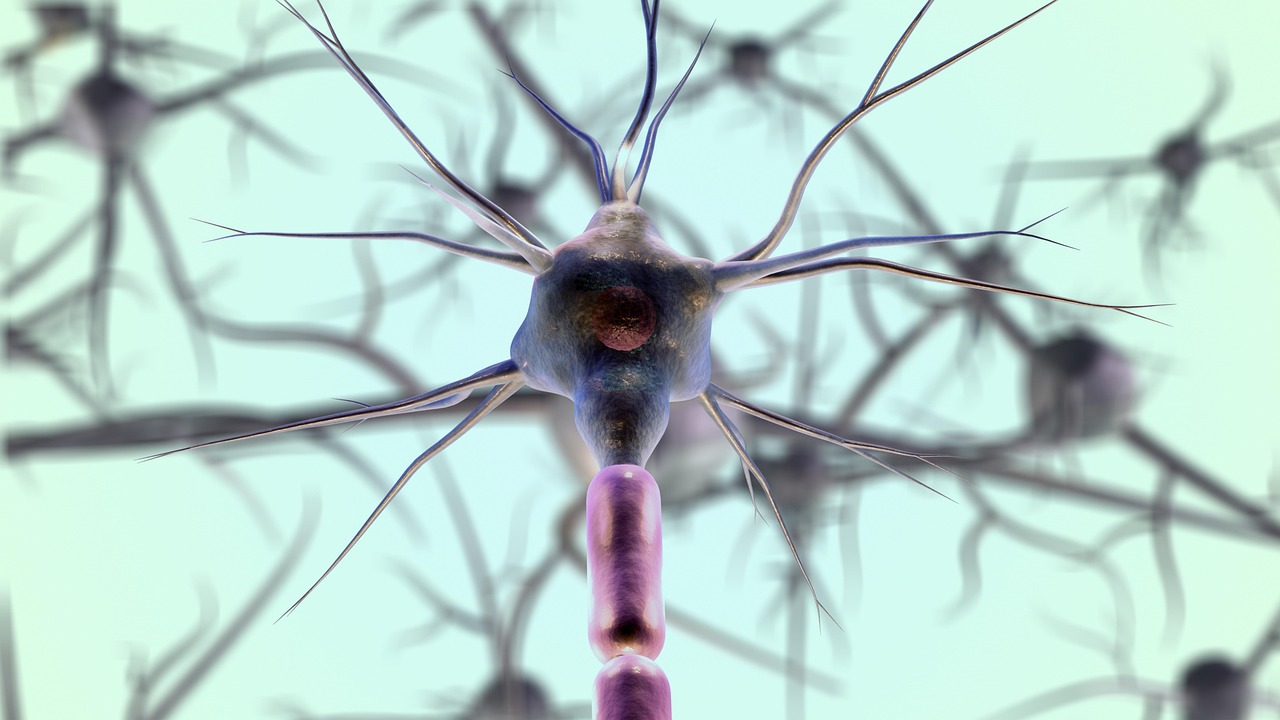
It has been said that what is written with imagination must be read with imagination. In this sense, Poliphilus' amorous Dream presents to us-- through literary means--an imagination that imagines itself or a mind that thinks itself. Aristotle himself had already commented upon such phenomenon, saying that such: "[...] intellect is able to intelligize itself".[^81] Even now, the exploration of the inner spaces of the human mind continues, and to this day images remain being central to the processes of scientific cognition; the contemporary face of the old medieval study of the human spirit and the higher faculties of the soul (see fig.6).
1. Grandishcionario enciclopédico de imagenés y@simbolos de la Biblia, ed. T. Longman III, J.C.Wihoit, L.Ryken and trans. Rubén Gómez Pons (Barcelona, 2015).
[^1]: Luis Antonio Muratori, Fuerza de la humana fantasía (Madrid, 1777), p.xiv. _(p.1)_
[^9]: Francesco Colonna, Hypnérotomachie, ou discourse du sogne de Poliphile 3, ed. Kerver and trans. Jean Martin & Jacques Gohorny (Paris, 1546). _(p.2)_
[^10]: Esteban Alejandro de la Cruz, Hypnerotomachia Poliphili: Re-Discovering Antiquity through the Dreams of Poliphilus (Victoria, 2006). _(p.2)_
[^13]: Giorgio Agamben, Estancias. _(p.3)_
[^14]: Saint Agustin, Obras Completas de San Agustín, XV, trans. Fr. Balbino Martín (Madrid, 1957). _(p.3)_
[^15]: Alberto Magno, De anima II-III, trans, Jorg Alejandro Tellkamp (Pamplona, 2012). _(p.3)_
[^16]: Saint Thomas Aquinas, Summa theologiae I-II (Madrid, 1990). Specifically, "Tratado de las pasiones del alma" (Q27), "Tratado de los habitos en general" (Q50), "Tratado de las virtudes en general" (Q57), "Tratado de los dones del Espíritu Santo" (Q68) and "Tratado de los vicios y el pecado" (Q77). _(p.3)_
[^19]: in G. Verveke, L'Evolution de la doctrine du pneuma, p.208; and from Quod Animi mores Corporis Temperatura Sequantur in Agamben, Estanciaias, p.162. _(p.4)_
[^20]: G. Verbeke, L'Evolution de la doctrine du pneuma. Du stoicism a Agustin. Étude philosophique (Paris, 1945). _(p.3)_
[^21]: Plato, "Timeo", trans. Francisco Lisi (Madrid, 2011), pp. 855-859. Specifically in verses 69e-73a. _(p.3)_
[^22]: Bolzoni, The Gallery of Memory, p.132. _(p.3)_
[^24]: Nemesius, On the Nature of Man 26, trans. R.W.Sharples & P.J.van der Eijk (Liverpool, 2008). _(p.4)_
[^25]: Kimberly Rivers, Preaching Memories of Virtue and Vice. Memory, Images, and Preaching in the Late Middle Ages (Belgium, 2010), pp.132-3. _(p.4)_
[^26]: Agamben, Estanciaes, p.170. _(p.4)_
[^27]: Saint Agustin, Obras Completas de San Agustin, III, trans. Fr. Balbino Martin (Madrid, 1963). _(p.4)_
[^28]: Guigo II, Scala Claustralium, Tratado sobre los发展模式 de orar a partir de la palabra de Dios. _(p.4)_
[^30]: Nemesius, On the Nature, chapters 6, 8, 13, 55-56, 63 and 69. _(p.5)_
[^31]: This is the work cited and translated by Agamben in his book. The translation to which we have had access is a compendium, reason why these passages do not appear in the text. However, sections fourth to seventh are the parts of the compendium where these same ideas are summarized. _(p.5)_
[^33]: As quoted in Agamben, Estanciais, p.141. _(p.5)_
[^43]: Avicena, in Agamben, Estancias, pp.141-142. _(p.6)_
[^52]: J.AlejandroTellkamp p.45. _(p.6)_
[^53]: Aristotle, De Memoria et Reminiscentia, trans. Jorge A. Serrano (Madrid, 1993), pp.73-78. Specifically in verses 2.451b-452b. _(p.6)_
[^54]: Isidore of Seville, The Etymologies of Isidore of Seville. Etimologiae 11.1.12-13, trans. Stephen A.Barney, W.J.Lewis, J.A.Beach & Oliver Berghof. With the collaborations of Muriel Hall (Cambridge, 2006). p.231-232. Bold emphasis ours. _(p.7)_
[^55]: Saint Agustin, Confesiones 10, trans. Angel Custodio Vega (Madrid, 1979). _(p.7)_
[^56]: For medieval monastic culture, the distraction born form error was curiositas. John Cassian exhorts: "do not cede against the allure of curiosity. Do not start keeping track of what happens in the world." In *Instituciones* 10.7 (2012, Buenos Aires), p.276. This is what the fight between prayer an affliction during reading is. _(p.7)_
[^57]: Tertullian, On Idolatry 2. _(p.7)_
[^58]: 58Tertullian, On Idolatry 1. _(p.7)_
[^61]: $^{61}$ Galen, De usu Partium Corporis Humani 6, trans. Mercedes López Salva (Madrid, 2010). _(p.8)_
[^62]: Isidore of Seville, Etimologiae 8.2.5, p.173-174. Bold emphasis ours. _(p.8)_
[^65]: Francesco Colonna. Suen de Polfilo 2.7. First woodcut. _(p.9)_
[^68]: Francesco Colonna, The Strife of Love in a Dream 1.8. Emphasis ours. _(p.9)_
[^69]: Francesco Colonna, The Strife of Love in a Dream 1. _(p.9)_
[^71]: Francesco Colonna, The Strife of Love in a Dream 1.8. Emphasis ours. _(p.10)_
[^72]: Imagination, aestimativa and memory are also inward senses. _(p.10)_
[^73]: Francesco Colonna, The Strife of Love in a Dream 1.8. Emphasis ours. _(p.10)_
[^74]: $^{74}$ Ariani & Gabriele, Hypnerotomachia Poliphili, p.674. _(p.10)_
[^81]: Summers, El juicio de la Sensibilitidad, p.306 _(p.11)_
[^3]: Emanuela Kretzulesco-Quaranta, Los jardines de ensuño, trans. Miguel Mingarro (Madrid, 1996). _(p.2)_
[^4]: N. Temple, "The Hypnerotomachia Poliphilli as a possible model for topographical interpretations of Rome in the early 16th century," Word & Image 14.1 _(p.2)_
[^5]: Frances Yates, The Art of Memory. (London, 1966). _(p.2)_
[^6]: Mary Carruthers, The Craft of Thought: Meditation, Rhetoric, and the Making of Images, 400-1200 (Cambridge, 1998). The Book of Memory: a Study of Memory in Medieval Culture (Cambridge, 2008). The Medieval Craft of Memory. An anthology of Texts and Pictures (Philadelphia, 2004). _(p.2)_
[^7]: Lina Bolzoni, The Gallery of Memory. Literary and Iconographic Models in the Age of the Printing Press (Toronto, 2001). _(p.2)_
[^8]: Emphasis ours. _(p.9)_
[^12]: Avicenna, A Compendium on the Soul, Section 7.3 p.64. _(p.2)_
[^23]: From De usu partium Corporis Humani 6 _(p.4)_
[^29]: Smaragdus of Saint Mihiel, Diadema Monachorum, trans. David Barry (Minnesota, 2013). _(p.4)_
[^32]: Section seven of the Compendium works with the inward senses, and just as warned in the previous note, the translation is different from the one offered by Agamben. However, there is a passage in the compendium that synthesizes all the ideas we will develop regarding Avicenna. Note that the frontal cavity fulfills two roles; to recollect (common sense) and to paint mental pictures (imagining or picturing sense): _(p.5)_
[^35]: Lucretio, De rerum natura 4. _(p.5)_
[^36]: Carruthers, The Book of Memory, pp. 67-68; The Craft of Thought, p.120. _(p.5)_
[^37]: Francesco Colonna, Sueno de Polifilo 2.8. _(p.5)_
[^38]: Francesco Colonna, Sueno de Polfilo 2.29 and 31. _(p.5)_
[^39]: Lucretio, De rerum natura 4, p.247. In verses 240 _(p.5)_
[^41]: Agamben, Estanciaias, p. 188. _(p.6)_
[^44]: Alberto Magno, De anima 2.3.4 and 3.1.1. _(p.6)_
[^46]: Alberto Magno, De anima 3.1. _(p.6)_
[^47]: Saint Thomas Aquinas, Summa Theologia Q78 article 4, as cited in Carruthers, The Book of Memory, p.62. _(p.6)_
[^49]: Carruthers, The Book of Memory, p.62. _(p.6)_
[^51]: In Agamben, Estanciais, p.142. _(p.6)_
[^59]: Francesco Colonna, The Strife of Love in a Dream 1.4. _(p.8)_
[^60]: Francesco Colonna, The Strife of Love in a Dream 1.4. _(p.8)_
[^66]: Synesius of Cyrene, Oneirocritica 5, trans. Francisco Antonio Garcia Romero (Madrid, 1993), p262. Verse 136a. Emphasis ours. _(p.9)_
[^67]: Synesius, Oneirocrítica, 5. In verse 135a. _(p.9)_
[^70]: Francesco Colonna, The Strife of Love in a Dream 1. _(p.10)_
[^75]: Ariani & Gabriele, Hypnerotomachia Poliphili, p.675. _(p.10)_
[^76]: $^{76}$ Saint Benedict, Regula 7, trans. Iñaqui Aranguren (Madrid, 2000). _(p.10)_
[^78]: Saint Agustin, "De libero et arbitrio" 3.20.57, pp.384-385. _(p.10)_
[^79]: Hypnerotomachia Poliphili = hypnos + eros + machia = Strife of Love in a Dream. _(p.10)_
[^80]: Francesco Colonna, The Strife of Love in a Dream 1.8. Emphasis ours. _(p.11)_
[^82]: Isidore of Seville, Etimologiae 11.1.11, p.231. _(p.13)_
[^83]: Aristotle, De Anima 3.4. In verse 429a. _(p.13)_
[^250]: Emphasis ours: _(p.5)_
Generating HTML Viewer...
References
59 Cites in Article
Saint Thomas,Aquinas Unknown Title.
Alejandro Jorg,Tellkamp (2012). his introduction to Alberto Magno.
Mary Carruthers (2008). The Book of Memory.
David Summers (1993). El juicio de la Sensibilidad. Renacimiento, naturalismo y emergencia de la estética.
Estancias Agamben Unknown Title.
(2011). 45.
Aristotle (1993). Notes to De Memoria et Reminiscentia.
J Barkhuizen (1993). SYNESIUS OF CYRENE, HYMN 8: A PERSPECTIVE ON HIS POETIC ART.
Francesco Colonna (2000). Francesco Colonna:.
Francesco Colonna (2000). Francesco Colonna:.
Francesco Colonna (1890). Francesco Colonna:.
(2008). Book I: De ecclesiastics officiis. St. Isidore of Seville.
Aristotle (1961). Aristotle: De Anima.
Raphaëlle Beauregard (1546). The Strife of Love in a Dream (1592) /Le Songe de Poliphile (1546) : du texte à l’image.
Giorgio Agamben (1995). Estancias: la palabra y el fantasma en la cultura occidental.
Alberto Magno (2012). Sobre el alma (De anima), trans.
Luiz Alberto Machado Cabral (1999). A Biblioteca do Pseudo Apolodoro e o estatuto da mitografia.
Saint Aquinas,Thomas (1990). Unknown Title.
Aristotle De la memoria y de la reminiscencia.
Jorge Serrano (1993). Unknown Title.
Acerca del alma" (De anima). Aristóteles I. Protréptico. Metafísica. Acerca del alma.
Tomás Calvo,Martínez (2003). Unknown Title.
José Sánchez-Cánovas (2004). RESEÑA de: Barberá, Ester; Martínez Benlloch, Isabel. Psicología y Género. Madrid: Pearson, Prentice-Hall, 2004.
Marco Ariani,Mino Gabriele (2015). Francesco Colona.
Avicenna (1906). A Compendium on the Soul (Liber de Anima).
Lina Bolzoni (2001). The Gallery of Memory.
Claudio Acuña,Patricia Chenlo,Julia Ariagno,Susana Curi,Herberto Repetto,Lucas Salinas,Mariano Cohen,Gabriela Mendeluk (2012). A Sociological Approach to Vasectomized Patient’s Trajectories at the Buenos Aires University Clinical Hospital “José de San Martín”.
Claudio Acuña,Patricia Chenlo,Julia Ariagno,Susana Curi,Herberto Repetto,Lucas Salinas,Mariano Cohen,Gabriela Mendeluk (2012). A Sociological Approach to Vasectomized Patient’s Trajectories at the Buenos Aires University Clinical Hospital “José de San Martín”.
Mary Carruthers (2008). The Book of Memory.
Leo Carruthers (1998). MARY CARRUTHERS. — The Craft of Thought: Meditation, Rhetoric, and the Making of Images, 400-1200. (Cambridge: Cambridge UP, 1998, xvii + 399 pp., £ 37.50, $ 59.95.).
Charles Briggs (2004). Carruthers, Mary and Jan M. Ziolkowski, eds. The Medieval Craft of Memory: An Anthology of Texts and Pictures.
Cruz De La,Alejandro Esteban (2006). Hypnerotomachia Poliphili: Re-Discovering Antiquity through the Dreams of Poliphilus.
Ian Culianu (1999). Eros y magia en el Renacimiento, trans. Neus Clavera and Hélené Rufat.
Galen (2008). Las facultades del alma siguen los temperamentos del cuerpo (Quod animi mores corporis temperatura sequantur), trans. Juana Zaragoza Gras.
(2010). De usu partium corporls humani lib. XIV.
I Guigo,Carthusian (2012). La palabra de los testigos.
Emanuela Kretzulesco-Quaranta (1996). Los Jardines del Sueño. Polífilo y la Mística del Renacimiento,trans.
Le Goff,Jacques,Nicolas Truong (2003). Una historia del cuerpo en la Edad Media, trans.
Lucretio (1984). De la naturaleza de las cosas de Marx.
Luis Muratori,Antonio (1777). Fuerza de la humana fantasía.
Nemesius (2008). Nemesius.
Plato (2011). Timeo" in Dialogos 2, trad.
Kimberly Rivers (2010). Preaching the Memory of Virtue and Vice.
Agustin Saint (1979). Las confesiones.
Guadalupe Márquez Domínguez (1963). Nota crítica sobre el libre albedrío en De Libero Arbitrio, Liber II de San Agustín. Critical Note on Free Will In De Libero Arbitrio, Liber II of Saint Augustine.
(null). Investigaciones acerca del primer censo en Colombia..
Saint Benedict (2000). La Regla de San Benito (Regula).
Jacques Elfassi (2019). Isidore of Seville and the Etymologies.
Stephen Barney,W Lewis,J Beach,Oliver Berghof (2006). The Etymologies of Isidore of Seville.
(2013). Appendix B.
Cyrene Synesius (1993). Sobre los Sueños" (Oneiroctitica), Himnos-Tratados.
Víctor Stoichita (1997). Breve historia de la sombra, trans. Anna María Cordech.
David Summers (1993). El juicio de la Sensibilidad. Renacimiento, naturalismo y emergencia de la estética.
Christian Schütz (1991). Introducción a la pneumatología, trans.
N Temple (2012). The<i>Hypnerotomachia Poliphili</i>as a possible model for topographical interpretations of Rome in the early sixteenth century.
Tertullian (2016). Salvador Vicastillo.
G Verbeke (1945). Evolution de la doctrine du pneuma. Du stoicism a Agustin.
Frances Yates (2010). 1 Frances Yates, from The Art of Memory (1966).
G Aranda Pérez (2015). Diccionario Enciclopédico de la Biblia, publicado bajo la Dirección del Centro «Informática y Biblia», Abadía de Maredsous. Traducción castellana de Miguel Gallart, revisada por Isidro Arias, Ed. Herder, Barcelona 1993, 1682 pp., 16,5 x 24,5..
No ethics committee approval was required for this article type.
Data Availability
Not applicable for this article.
How to Cite This Article
Liza N. Piña-Rubio. 2026. \u201cAmorous Feelings in the Strife of Love in a Dream Survival and Representation of Medieval Cognitive Physiology through Monastic Code\u201d. Global Journal of Human-Social Science - G: Linguistics & Education GJHSS-G Volume 23 (GJHSS Volume 23 Issue G7): .
Explore published articles in an immersive Augmented Reality environment. Our platform converts research papers into interactive 3D books, allowing readers to view and interact with content using AR and VR compatible devices.
Your published article is automatically converted into a realistic 3D book. Flip through pages and read research papers in a more engaging and interactive format.
The Strife of Love in a Dream (Hypnerotomachia Poliphili, 1499) is a story of unrequited love. It is widely believed that its author–Francesco Colonna–was a monk; however, there has been no interest in studying the impact of Medieval Christianity and monasticism in the novel. The present investigation exposes the survival of the physiological-cognitive perspective (Galen’s and Avicenna’s legacy) in regard to amorous feelings and their literary representation (through the doctrine of pneuma and to demonstrate the relevance of said knowledge in service to Christian moralizing and monastic training.) To such purpose, a selection of passages from the book alongside with visual resources (illustrations, diagrams, and map) are presented to facilitate general access to the story and so that the understanding of the processes occurring within the inner man be emphasized.
Our website is actively being updated, and changes may occur frequently. Please clear your browser cache if needed. For feedback or error reporting, please email [email protected]
Thank you for connecting with us. We will respond to you shortly.