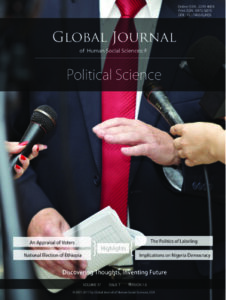
An Appraisal of Voters Turn out During the 2010 National Election of Ethiopia:The Case of Toke Kutaye Woreda

α
Mebratu Chalchisa
Mebratu Chalchisa
α Ambo University

Send Message

To: Author

An Appraisal of Voters Turn out During the 2010 National Election of Ethiopia:The Case of Toke Kutaye Woreda

Article Fingerprint

ReserarchID

A7KC8

An Appraisal of Voters Turn out During the 2010 National Election of Ethiopia:The Case of Toke Kutaye Woreda Banner

AI TAKEAWAY

Connecting with the Eternal Ground
  • English
  • Afrikaans
  • Albanian
  • Amharic
  • Arabic
  • Armenian
  • Azerbaijani
  • Basque
  • Belarusian
  • Bengali
  • Bosnian
  • Bulgarian
  • Catalan
  • Cebuano
  • Chichewa
  • Chinese (Simplified)
  • Chinese (Traditional)
  • Corsican
  • Croatian
  • Czech
  • Danish
  • Dutch
  • Esperanto
  • Estonian
  • Filipino
  • Finnish
  • French
  • Frisian
  • Galician
  • Georgian
  • German
  • Greek
  • Gujarati
  • Haitian Creole
  • Hausa
  • Hawaiian
  • Hebrew
  • Hindi
  • Hmong
  • Hungarian
  • Icelandic
  • Igbo
  • Indonesian
  • Irish
  • Italian
  • Japanese
  • Javanese
  • Kannada
  • Kazakh
  • Khmer
  • Korean
  • Kurdish (Kurmanji)
  • Kyrgyz
  • Lao
  • Latin
  • Latvian
  • Lithuanian
  • Luxembourgish
  • Macedonian
  • Malagasy
  • Malay
  • Malayalam
  • Maltese
  • Maori
  • Marathi
  • Mongolian
  • Myanmar (Burmese)
  • Nepali
  • Norwegian
  • Pashto
  • Persian
  • Polish
  • Portuguese
  • Punjabi
  • Romanian
  • Russian
  • Samoan
  • Scots Gaelic
  • Serbian
  • Sesotho
  • Shona
  • Sindhi
  • Sinhala
  • Slovak
  • Slovenian
  • Somali
  • Spanish
  • Sundanese
  • Swahili
  • Swedish
  • Tajik
  • Tamil
  • Telugu
  • Thai
  • Turkish
  • Ukrainian
  • Urdu
  • Uzbek
  • Vietnamese
  • Welsh
  • Xhosa
  • Yiddish
  • Yoruba
  • Zulu

Abstract

Election is always controversial in Ethiopia. This part of controversies also part of Toke Kutaye woreda of west shewa zone of Oromia regional state. Public political participation particularly during election looks like a tragedy in the woreda because the end result always comes with a dilemma. The ways through which people mobilized for political participation mainly for election by the ethnic parties of the same ethnic group to solve the claim of the people also a headache and strike full in this woreda. In contrast, the people of the woreda were less likely aware of the program and policy of political parties. The election administrative body makes a baised decision in favor of the ruling regime. The methodological approach used was both qualitative and quantitative approach to clearly identify the core problem of electoral practice in the woreda.

References

52 Cites in Article
  1. Agner Fog (2004). The Supposed Impact of Media on the Quality of Democracy.
  2. Alain Gagnon (2007). Democratic multinational federalism under scrutiny: scrutiny Healthy tensions and unresolved issues in Canada1 a part in Multi national federation simultaneously published in the USA and Canada by Rout ledge.
  3. Alan Gerber,Gregory Huber,David Doherty,Conor Dowling (2012). Why People Vote: Estimating the Social Returns to Voting.
  4. I Almami,Cyllah (2010). Democracy and election in Africa, Regional Director for Africa.
  5. Amanda Hoffaman (2005). Political parties, electoral systems and democracy: A cross‐national analysis.
  6. Belay Getye,Gebrehiwot Gebreslassie,Tsegaye Issay Tedla,Getachew Adam Workneh (2009). Magnetically Recyclable Activated Carbon Prepared from Brewer’s Spent Grain and Its Chromium (VI) Adsorption Study.
  7. Andargachew Tiruneh (1993). The Ethiopian revolution: A Transformation from an aristocratic to a Totalitarian Autocracy.
  8. André Blais,Louis Massicotte,Agnieszka Dobrzynska (2003). Direct presidential elections: a world summary.
  9. Alexandra Samuel (2004). Hacktivism and the Future of Political Participation.
  10. Anne Twomey,Glenn Withers (2007). Australian federal future, Federalist paper 1, Australian and newzealand school of government.
  11. Aregawi Berhe (2008). A Political History of the Tigray People's liberation front (1975-1991): Revolt, Ideology and Mobilization in Ethiopia.
  12. Arend Lijphart (1997). Unequal Participation: Democracy's Unresolved Dilemma Presidential Address, American Political Science Association, 1996.
  13. Asafa Jalata (2008). Chapter Five: Theorizing Oromummaa.
  14. Asafa Jallata (2006). Gada (Oromo Democracy): An Example of Classical African civilization.
  15. (2012). The Ethiopian Quest for Democracy in a Dominant Party State: A Case Study on Democratization in Ethiopia since the Implementation of Ethnic Federalism in 1995.
  16. Carole Pet,Man (1971). Political culture, political structure and political change.
  17. Carter Center (2006). Atlantic Coast Regional Election (March 2006).
  18. (2009). Energy conservation in existing office buildings. Final report.
  19. Ioana Bulău-Olaru,Ana Ranta,Viorel Stănică (2009). Citizens’ Free Access to Information. The Case of Local Institutions from Rural Areas of the North-Western Region from Romania.
  20. Celine Teney,Laurie Hanquinet (2012). High political participation, high social capital? A relational analysis of youth social capital and political participation.
  21. (2007). Engagement with Civil society in Ethiopia: perspectives of Ethiopian CSOs, A working paper.
  22. Clemence Vergne (2009). Democracy, elections and allocation of public expenditures in developing countries.
  23. D Ruedin (2007). Contemporary issues and social science.
  24. Danial Elazar (1995). Federalism: An overview.
  25. Daniel Tefera (2011). Dandi: Yenegaso menged, the Amharic version.
  26. David Palentz,Daniel Lipinski (1994). Political culture and Political communication, working paper 92.
  27. Dessalegn Rahmato,Akalewold Bantirgu,Yoseph Endeshaw (2008). NGOs and ‘civil society’.
  28. Abrham Gebre,Seare Tekie,Yisihak Gebre (2006). GFRP COMPOSITES: A MATERIAL TO STRENGTHEN REINFORCED CONCRETE BEAMS WITH WEB OPENINGS FOR SHEAR.
  29. Dima Noggo (2009). Contested Legitimacy: Coercion and the State in Ethiopia.
  30. Edmond Keller (2002). Ethnic Federalism, Fiscal reform, Development and Democracy in Ethiopia.
  31. Eueom (2005). Home Office has its hands full as a General Election approaches.
  32. Eueom (2010). Preliminary Statement: High turnout on a peaceful and orderly Election Day marred by a narrowing of political space and an uneven playing field.
  33. Efduf (medrek (2011). Evaluation on the party performance on the 2010 election of Ethiopia.
  34. Eprdf (2011). some fact about EPRDF.
  35. Haile Abebe,Teshome Alemteshay (2010). Determinants of Dietary Diversity Consumption and Nutritional Status of Pregnant Women Attending Armed Forces Comprehensive Specialized Hospital, Addis Ababa, Ethiopia.
  36. Gerard Newman (1989). Electoral system.
  37. Abebe M. Aga,Demise Mulugeta,Atsbeha Gebreegziabxier,Jemal Mohammed,Anberber Alemu,Yewenshet Tesera,Frehiwot Mulugeta,Bedasa Gidisa,Jaleta Bulti,Gemechu Tadesse,Dereje Nigussei (2012). The Impact of Vaccination on RT-PCR Cycle Threshold Values for COVID-19: Insights for Future Pandemic Preparedness.
  38. G Harold,Marcus (1994). A History of Ethiopia.
  39. Henok Bogale (2012). Designing an electoral system for sustainable multi-party democracy of the Ethiopian multi-ethnic-federation.
  40. (2009). Human right league of the horn of Africa.
  41. Paul Wilder (2002). The international IDEA handbook of electoral system design.
  42. Anders Kjellberg (2004). Sweden.
  43. Idea (2005). Electoral system design hand book.
  44. (2009). Ethiopia: Ethnic federalism and its discontents, working paper.
  45. (2010). Pakistan on United States Watch List for Violations of Religious Freedom.
  46. Ishac Diwan (2009). The World bank's role in good Governance written on democracy and social question: some contribution to a dialogue in Ethiopia .Falcon printing enter price.
  47. J Johari (2005). Principles of modern political science.
  48. Célia Belim,Rodrigues (2010). Press Freedom and Informed Public Opinion: Measures of the Quality of Democracy? -The case of Southern Europe Countries, conference cepaper.
  49. Jennifer Ostini,Y Anthony,Fung (2002). Beyond the Four Theories of the Press:A New Model of National Media Systems written on Mass communication and Society, School of Journalism and Communication, the Chinese University of Hong Kong.
  50. Margaret Wachira,Charles Gachoki (2005). Econometric evaluation of Economic freedom and Health outcomes in East African community.
  51. Jimy Martin (2006). Mixed Electoral Systems: MMM vs. MMP: Unique Systems or Two Sides of the Same Coin.
  52. Joakim Ekman,Erik Amna (2009). Political participation and civic engagement: Towards A New Typology.

Funding

No external funding was declared for this work.

Conflict of Interest

The authors declare no conflict of interest.

Ethical Approval

No ethics committee approval was required for this article type.

Data Availability

Not applicable for this article.

How to Cite This Article

Mebratu Chalchisa. 2017. \u201cAn Appraisal of Voters Turn out During the 2010 National Election of Ethiopia:The Case of Toke Kutaye Woreda\u201d. Global Journal of Human-Social Science - F: Political Science GJHSS-F Volume 17 (GJHSS Volume 17 Issue F1): .

Download Citation

Issue Cover
GJHSS Volume 17 Issue F1
Pg. 27- 40
Journal Specifications

Crossref Journal DOI 10.17406/GJHSS

Print ISSN 0975-587X

e-ISSN 2249-460X

Keywords
Classification
GJHSS-F Classification: FOR Code: 360199p
Version of record

v1.2

Issue date

June 2, 2017

Language
en
Experiance in AR

Explore published articles in an immersive Augmented Reality environment. Our platform converts research papers into interactive 3D books, allowing readers to view and interact with content using AR and VR compatible devices.

Read in 3D

Your published article is automatically converted into a realistic 3D book. Flip through pages and read research papers in a more engaging and interactive format.

Article Matrices
Total Views: 3497
Total Downloads: 1613
2026 Trends
Related Research

Published Article

Election is always controversial in Ethiopia. This part of controversies also part of Toke Kutaye woreda of west shewa zone of Oromia regional state. Public political participation particularly during election looks like a tragedy in the woreda because the end result always comes with a dilemma. The ways through which people mobilized for political participation mainly for election by the ethnic parties of the same ethnic group to solve the claim of the people also a headache and strike full in this woreda. In contrast, the people of the woreda were less likely aware of the program and policy of political parties. The election administrative body makes a baised decision in favor of the ruling regime. The methodological approach used was both qualitative and quantitative approach to clearly identify the core problem of electoral practice in the woreda.

Our website is actively being updated, and changes may occur frequently. Please clear your browser cache if needed. For feedback or error reporting, please email [email protected]

Request Access

Please fill out the form below to request access to this research paper. Your request will be reviewed by the editorial or author team.
X

Quote and Order Details

Contact Person

Invoice Address

Notes or Comments

This is the heading

Lorem ipsum dolor sit amet, consectetur adipiscing elit. Ut elit tellus, luctus nec ullamcorper mattis, pulvinar dapibus leo.

High-quality academic research articles on global topics and journals.

An Appraisal of Voters Turn out During the 2010 National Election of Ethiopia:The Case of Toke Kutaye Woreda

Mebratu Chalchisa
Mebratu Chalchisa Ambo University

Research Journals