I. INTRODUCTION
Nowadays, there were continually decreasing in birth and mortality rate, developing children and adolescence to high potential was essential to the future of the country. Even as a group of juvenile offenders (The people are under 18-year-old who committed criminal assault, murder, rape, burglary, drug trafficking, etc.), the government must invest their potentials and not let them be left behind. When someone had committed a criminal crime and was prosecuted to a court trial and a prison sentence was issued. In that case, children and young adults will be sentenced to detention in Juvenile Vocational Training Center (JVTC). Under the Beijing Law [15] and the Convention of the Rights of the Child, the Vocational Center was organizing youth rehabilitation therapy, with the expectation that uncontrolled youths can grow into good Samaritans and helpful citizens of the country.
Following the law and international principle, Thailand Juvenile Vocational Training Center (JVTC), Department of Juvenile Observation and Protection (DJOP), Ministry of Justice, also must address treatment needs, develop skills, and rehabilitate juveniles that the court has ordered probation to protect the welfare and to improve the quality of life. Juvenile offenders were characterized by a high risk of recidivism, poverty-stricken, and low investment in potential development, so they were often unsuccessful in life and got set back because they were not well educated [12] and were not interested in studying, and often had to drop out of school [8]. Carter [2] explained that childhood laborers with a history of violent behavior and a previous offense were less successful in their lives than the youth without a history. Lower average incomes and the high unemployment rate are the results of improper nurturing, and growing up in an unsuitable environment. Therefore, the JVTC's juvenile rehabilitation therapy had divided the training activities into 3 modules: 1) the provision of compulsory education and professional training, 2) the adjustment of attitudes and cognitive behavior, and 3) the rehabilitation of physical health and lifestyle hygiene.
According to the Department of Juvenile Observation and Protection report [4], since 2015, they have received more than 32: $1) from the government, an increase of approximately 2.4% per year. Except in the year 2019, there had been allocated a reduced budget. The number of juvenile offenders continued to decline by an average of 5%. About 34% of that budget was for JVTC, which had 21 locations spread across the country. Each center had different sizes to accommodate the youths. There were approximately 4,000-6,000 juvenile offenders in JVTC, from a total of 30,000 juvenile offenders, accounting for 0.9% of the total number of juveniles each year. The risk and the necessity of misdemeanor survey data [11] found that half of the youths were drug offenses. Most of them were abusive, violent, had improper parenting, and did not receive a good education.
Therefore, JVTC, a government facility, should have the mission of remediation and rehabilitation for juvenile offenders. They had behaviors and attitudes that affected social order and were difficult to correct. Child potential development required adequate and appropriate resources. However, the cost of the center was disproportionate to the youth when compared to the centers. Small centers with less than 100 youths had a cost that was equivalent to the large centers. The situation affected different qualities of youth rehabilitation therapy [8].
As mentioned, JVTC evidently receives additional government funding, but the number of youths receiving treatment and rehabilitation decreased. There were also criminal behaviors and attitudes, and there was a cost difference between the centers and the youths. However, JVTC had a limited budget, so the arrangement of the center must be efficient. Knowing the efficient cost per unit and center size will help the manager of the Inspection Department to formulate appropriate sizes and cost per unit policies, providing JVTC with adequate and appropriate resources. The objective of the study was to analyze the performance of JVTC by using the concept of cost per unit, and Economies of Scale analysis.
II. LITERATURE REVIEW
This paper analyzed the efficiency of JVTC in a remedial treatment of juvenile offenders by using a cost per unit, and Economies of scale analysis. A literature review of the relevant theory and research was as follows:
Efficiency theory explained the ability to use rare resources of the manufacturer considering the relationship among the factors, the process, and the output. The production was efficient when the manufacturer used the least factor but produced a high quantity. The efficiency consisted of Technical Efficiency (TE), and Allocation Efficiency (AE). Therefore, the TE of the production factor was positively correlated with the output.
Allocation Efficiency described an operator's ability to select a combination of input factors or combinations of input . When there was no change in the production technique, but the maximum yield by the combination . Subsequently, a mix of set input was used. Set to be less than n , but the yield was equal to , which was greater than . Therefore, ingredient utilization of input to have AE.
When the production achieved TE and AE. Therefore, Cost Efficiency (CE) at effective production volumes had the lowest cost per unit. CE was related to the price of the input factors. The production of output Y used input X, and the price of the factors was w. The cost of factors was calculated from the n combinations of input factors that represented the lowest possible cost per unit of production. was shown the relationship between the cost and the outputs. The factors of production and productivity gave the cost function . When the cost function was divided by the number of outputs, the average cost (AC) was obtained as . AC line creature with U-curve gave the lowest value. The minimum AC intersected with the marginal cost (MC) line or the supply line was drawn from the left to the right.
According to the Economics analysis of public service arrangements, the goal of utilizing factors of production was to provide people in society with the highest social welfare. Therefore, efficiency refers to the ability to make the most of resources for the people in society . Economics analysis considered the benefits of the society from public services that were arising. Economics Analysis was distinctive from the private sector. Economics analysis in the justice system relied on the approach to analysis.
The review of theories and analysis for the efficiency of the work in the justice system was classified into 2 ways: 1) a minimum cost or a value of socio-economic losses, and 2) Economies of Scale analysis. The details were as follows:
The analysis of costs or the value of economic and social losses. The judicial policy can be classified into two categories: (1) Social welfare lost value analysis and research estimated the impact of severe narcotics policy based on the demand and supply curve of narcotics. The results of the study explained that the anti-drug policy was ineffective because the demand-supply did not decrease, but the price increased, resulting in high social welfare losses [1]. This guiding analysis also applied to cigarette tax policies, the study concluded that tax incremental policies were ineffective [17]. (2) Cost per unit analysis. The Washington State Institute for Public Policy [16] found that in 2003, the community-based program of community-based remedial juvenile offenders was effective and cost an average of $1,900-31,200. The study by Fowles, Byrnes, and Hickert [6] estimated the accounting costs of JVTC in Utah found 40% more recidivist rehabilitation costs than first-time offenders.
For Economies of Scale Analysis in the judicial process, Livingston, Stewart, Allard, and Ogilvie [9] analyzed economies of scale for police stations in Canada. Estimated cost and arrest data for criminals between 2001-2012, the mean cost equations of urban and rural police stations, together with demographic, economic, and social factors, it was found that urban police stations were economies of scale, but local police stations did not result in economies of scale. Hennebel, Simperet, and Verschelde [8] analyzed the scale of prisons in England and Wales, finding economies of scale of prisons should have a capacity of 554-1,187 people, with an annual cost of around £23-37 million per site. However, the researcher recommended that prisons focus on quality improvement and environmental management as prisons had a large number of inmates. The average cost was reduced, which affected the quality of remediation. Turner, Toor, Hollingsworth, and Anderson [14] used Economies of Scale analysis of community health counseling centers. The results explained that the consulting center did not generate economies of scale because the consulting mission was more than one mission.
According to theory and literature review, the paper analyzed the efficiency by analyzing cost per unit and economies of scale from cost function determined by youth numbers of all centers, small and large cost functions. Thus, the average cost (AC) function was used to analyze the cost per unit and economies of scale for both small and large sizes.
III. METHODS
The study was quantitative research, using data from 17 JVTCs out of 21, accounting for 81% monthly between December 2016 and December 2019, and classified as 10 JVTCs and 7 special JVTCs, compiling 629 months of secondary data, a total number of 16,000 children and youth. Costs were classified as follows: (1) fixed costs, (2) variable costs, (3) direct costs, and (4) indirect costs. Accounting expense data of JVTC were classified into 2 groups as follows: (1) capital factors and (2) labor factors.
AC and MC equations were estimated by the cost function. AC curves were drawn to analyze cost per unit and Economies of Scale.
IV. RESULTS
This paper analyzed the efficiency of the JVTC, DJOP, Ministry of Justice by analyzing cost per unit and Economies of Scale. The findings included the cost situation, cost function, cost per unit, and economies of scale. The details were as follows:
- It was found that since 2017 the total cost was monthly 1.3 million, and in 2019 was 5.5 million.
The labor cost was 10.4 million consisted of food, personnel, and materials for training activities. Indirect costs were $0.5 million, consisting of personnel welfare, youth personnel, external miscellaneous expenses, and personnel meeting and training expenses. Fixed costs accounted for 53% and variable costs accounted for 46%. Labor costs accounted for about half of the total cost, according to the regulations of the Department of Observation, which defined the structure, the position and number of personnel in the center of approximately 56 people and was included as civil servants, government employees, and permanent employees, resulting in most personnel expenses.
While considering the cost according to the size of the center, it was found that there were small centers which included approximately children and youth of 1,520 people with a total cost of approximately 0.6 million. Small centers average a total cost of 0.1 million. The proportion of costs by the expenses comparing small to large centers were found to be no distinctive. Smaller centers with a small number of children in the center, their consumption costs (F) accounted for 33% and personnel costs (L) accounted for 37%. [Figure. 1]
- The cost equation analysis was divided into 3 cases: cost equations of all centers (TC), small centers (TC ), and large centers (TC ). It was found that the cost equations were estimated to have AIC from the quartic polynomial function of 19,660, which was the least and had the relative coefficient ( ) of 0.17. From the total cost equation estimated to be equal to . It was found that the fixed cost was 0.1 million. [Table 2]
The small cost equation was found that the AIC from the cubic polynomial equation was the lowest at 13,480.9, the was 0.112, and the total cost equation was . The fixed capital was 1,755.
(a) small JVTC's group Table 1: JVTC Cost Classified, Unit: $Million (%)
| Types of costs | 2017 | 2018 | 2019 | |||
| Monthly | Annual | Monthly | Annual | Monthly | Annual | |
| 1) Capital | 0.8(58.9) | 11.3(54.5) | 0.7(54.1) | 10.2(50.4) | 0.5(55.3) | 5.5(50.7) |
| 2) Labor | 0.6(41.0) | 9.4(45.4) | 0.6(45.8) | 10.0(49.5) | 0.4(44.6) | 5.3(49.2) |
| 3) Direct costs | 1.3(94.4) | 19.7(94.6) | 1.3(95.2) | 19.3(95.3) | 0.8(94.8) | 10.4(95.6) |
| 4) Indirect costs | 0.1(5.5) | 1.1(5.3) | 0.1(4.7) | 0.9(4.6) | 0.0(5.1) | 0.5(4.3) |
| 5) Fixed cost | 0.4(30.1) | 9.2(44.0) | 0.5(35.6) | 10.2(50.3) | 0.3(35.3) | 5.8(53.2) |
| 6) Variable cost | 1.0(69.8) | 11.6(55.9) | 0.9(64.3) | 10.0(49.6) | 0.5(64.6) | 5.1(46.7) |
| Total | 1.4(100) | 20.8(100) | 1.3(100) | 20.3(100) | 0.8(100) | 10.8(100) |
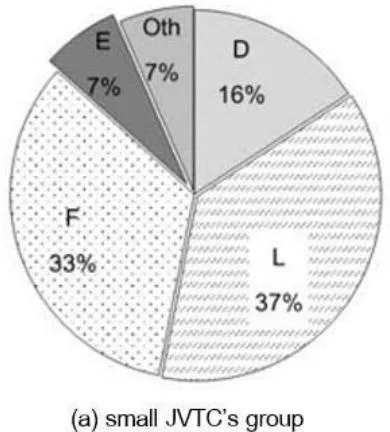
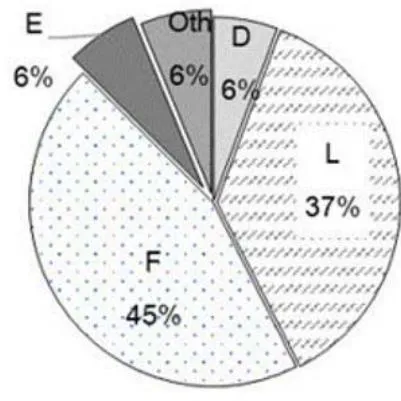
Note: The personnel expenses (Labor wages and labor benefits: L), depreciation (D), the consumption and training activities (F), Utilities (E), and other expenses (O).
It was found that the optimal large cost equation was a linear regression equation. The lowest AIC was 6,103. The was 0.2. The total cost equation of the large center was approximately equal to . Even there was only one additional youth, a large center would cost $69.
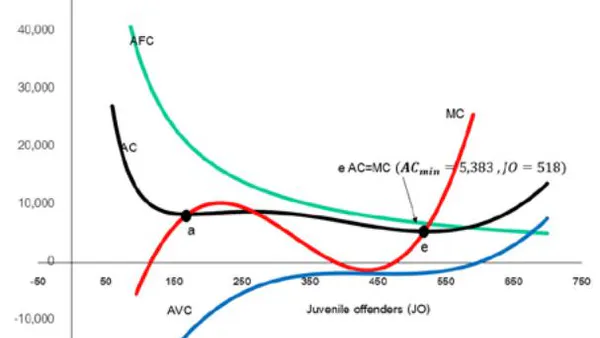
The cost per unit analysis was analyzed from the total cost equations used to estimate Average Cost equations, Average Fixed Cost (AFC), Average Variable Cost (AVC), and Marginal Cost (MC). It was found that the AC line was U-curved with point e being the lowest AC point with 518 children in the center [Figure 2]. The cost per unit was 2,018). At point e, it was the point where the incremental cost line crosses the mean cost curve and was the point of efficiency correction of juvenile rehabilitation.
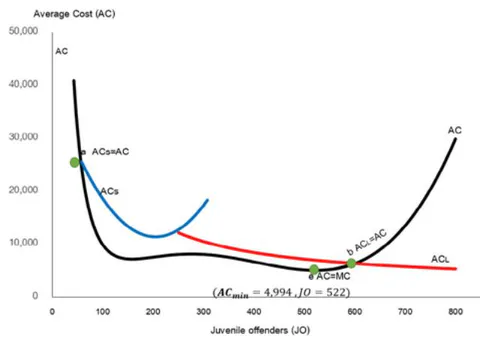
Economics Size analysis was based on AC curve of AC, , and . In the case of the AC curve of a large center, all cost lines were straight-line equations, the additional cost per unit equal to AVC equally to AC_LAC_S168. It was found that the operations of small and large centers did not have Economies of Scale analysis.
| Independent variable | TC (quartic eq.) | (cubic eq.) | (Linear eq.) | ||||||
| Estimate | p-value | Estimate | p-value | Estimate | p-value | ||||
| Constant | 3,515,000 | 0.00 | *** | 3,952,000 | 0.00 | *** | 2,490,545 | 0.00 | *** |
| JO | -48,980 | 0.00 | *** | -56,850 | 0.04 | ** | 2,205 | 0.09 | * |
| 326.6 | 0.00 | *** | 334.3 | 0.05 | * | ||||
| -0.75 | 0.00 | *** | -0.53 | 0.10 | * | ||||
| 0.0006 | 0.00 | *** | |||||||
| JO Density | 261,100 | 0.07 | * | 253,400 | 0.17 | 416,291 | 0.04 | ** | |
| No. Men | 1,959 | 0.80 | 16,160 | 0.19 | 54,040 | 0.87 | |||
| No. Female | 27,460 | 0.07 | * | 46,440 | 0.04 | ** | 67,527 | 0.84 | |
| No. Recidivism | -3,525 | 0.71 | -11,200 | 0.39 | -6,776 | 0.58 | |||
| No. Mudder | -7,931 | 0.37 | -19,720 | 0.14 | 6,066 | 0.53 | |||
| No. Drug | 5,701 | 0.16 | -1,437 | 0.81 | 13,941 | 0.00 | *** | ||
| Punishment level | 13,830 | 0.33 | 40,680 | 0.04 | ** | -37,331 | 0.03 | ** | |
| Low risk | 453.6 | 0.95 | 1,291 | 0.88 | -19,049 | 0.95 | |||
| Under risk AVG | -1,691 | 0.74 | -2,111 | 0.73 | -66,460 | 0.84 | |||
| Upper riskAVG | 3,313 | 0.71 | 6,925 | 0.51 | -70,717 | 0.83 | |||
| Under need AVG | 1,664 | 0.75 | 2,021 | 0.75 | 11,006 | 0.45 | |||
| Upper need AVG | -3,671 | 0.85 | -16,390 | 0.49 | 127,136 | 0.01 | ** | ||
| Poor | -10,270 | 0.19 | -22,390 | 0.07 | * | -15,363 | 0.09 | * | |
| AIC | 19,660.27 | 13,480.9 | 6,102.92 | ||||||
| 0.168 | 0.112 | 0.20 | |||||||
| 0.145 | 0.08 | 0.14 | |||||||
| F value | 7.29 | (0.00) | 3.26 | (0.00) | 3.34 | (0.00) | |||
| d.f. | 614 | 413 | 187 | ||||||
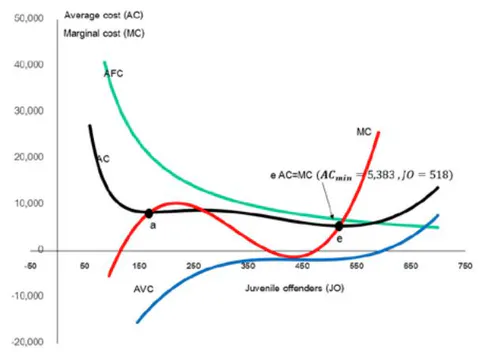
The results concluded that the costs of the centers with DJOP regulations were personnel structure determination, food tariff, and government procurement and procurement regulations. Most of the cost of JVTC being fixed costs incurred by the capital and labor factors as a part of the fixed cost. The cost per unit analysis showed that the size of the center with 518 youths was the lowest number of costs per unit, which was $168, which was higher than the cost per unit of a large center. The cost per unit of a small center was higher than the mentioned cost per unit, thus this reduces economies of scale for small and large centers.
V. DISCUSSION
The study was the Economics Analysis of Juvenile Rehabilitation of JVTC, DJOP, the Ministry of Justice, whose mission was to correct, cure, and rehabilitate criminal juvenile offenders with two parts: cost per unit, and Economies of Scale analysis:
a) Cost per unit of Juvenile Rehabilitation Treatment
The cost per unit analysis of juvenile rehabilitation as part of the economics analysis cost, considering the relationship between AC curves and the cost per unit. According to the theory, the cost line properties were positively correlated with the number of youths and optimal input factors mixtures that provided the lowest cost while maintaining or increasing yields [8]. The results of the AC analysis revealed that the U-curve [8] and the additional MC curves had an N-curve characteristic. The minimum AC curve was pointed out at 518 youths and 187 per month [10], and the cost of raising children was $292 monthly [3]. These costs were higher than the juvenile cost per unit. As a result, the quality of life of the youth in the center did not meet the standard level [15]. In the future, the juveniles who have lower human capital than the others will tend to commit reoffending [2].
b) Economies of Scale analysis
An analysis of economies of scale by Hennebel, Simperet, and Verschelde [8] presented a scale-out of the size of the prison: about 500 prisoners. On the other hand, JVTC has set the capacity of having juveniles in each center differently in Thailand. Some centers can take up to 697 youths, and in some centers, they can hold a maximum of only 34 youths. Therefore, three centers always had overcrowded people problems, and the others had juveniles less than what they were capable of. The study divided the centers into two sizes - small and large. ACS, ACL, and AC of all caseshave analyzed the economies of scale. It was found that the operation of these two sizes did not have economies of scale. The result was distinctive from others; Livingston, Stewart, Allard and Ogilivie [9] and Hennebel, Simperet and Verschelde [8]. The two sizes had no economies of scale as a result of a poor arrangement. There was no guideline for an average cost to arrange the resources for centers, and each center was assigned the same number of employees which is 56 even though they are distinctive in size. Besides, a small center had an average cost of about 1.6 a day was less than the average standard living cost.
VI. CONCLUSION
The study analyzed the cost per unit and Economies of Scale. It was found that the center had corrective and rehabilitative arrangements, not to Economies of Scale which had the lowest cost per unit of 187 [10]. The life quality of youths was therefore not up to universal principles [15]. The executive of DJOP, the Ministry of Justice should do as follows: (1) increase the budget for the center for the youth to have a better life quality. The cost per unit should be between $187 and 292, which was consistent with the cost of child care and higher than the standard level of living. It also made the youth's life in line with international standards. (2) promote and support center administrators to improve the quality and provide a center environment that was conducive to remediation, therapy, and rehabilitation by supporting adequate and appropriate resources.
ACKNOWLEDGEMENT
This article is in partial fulfillment of the requirements of the Doctor of Philosophy Program in Economics, Srinakharinwirot University. The research was granted a scholarship from the Royal Golden Jubilee Program, The Thailand Research Fund (TRF), at present known as Thailand Science Research and Innovation (TSRI), with the kindness of the advisor including personnel and staff of DJOP, who provided beneficial advice to the author. On this occasion, the author would like to express the deepest gratitude to all of them. This article had licensed human research ethics number's SWUEC-G-060/2562 by Srinakharinwirot University ethics board.