An Empirical Assessment of the Economic Model of the Exchange Rate

§ Kazakh-American University

Send Message

To: Author

An Empirical Assessment of the Economic Model of the Exchange Rate

Article Fingerprint

ReserarchID

MBR7996V

An Empirical Assessment of the Economic Model of the Exchange Rate Banner

Key Research Insights

Synthesized scholarly intelligence & interactive research assistant
  • English
  • Afrikaans
  • Albanian
  • Amharic
  • Arabic
  • Armenian
  • Azerbaijani
  • Basque
  • Belarusian
  • Bengali
  • Bosnian
  • Bulgarian
  • Catalan
  • Cebuano
  • Chichewa
  • Chinese (Simplified)
  • Chinese (Traditional)
  • Corsican
  • Croatian
  • Czech
  • Danish
  • Dutch
  • Esperanto
  • Estonian
  • Filipino
  • Finnish
  • French
  • Frisian
  • Galician
  • Georgian
  • German
  • Greek
  • Gujarati
  • Haitian Creole
  • Hausa
  • Hawaiian
  • Hebrew
  • Hindi
  • Hmong
  • Hungarian
  • Icelandic
  • Igbo
  • Indonesian
  • Irish
  • Italian
  • Japanese
  • Javanese
  • Kannada
  • Kazakh
  • Khmer
  • Korean
  • Kurdish (Kurmanji)
  • Kyrgyz
  • Lao
  • Latin
  • Latvian
  • Lithuanian
  • Luxembourgish
  • Macedonian
  • Malagasy
  • Malay
  • Malayalam
  • Maltese
  • Maori
  • Marathi
  • Mongolian
  • Myanmar (Burmese)
  • Nepali
  • Norwegian
  • Pashto
  • Persian
  • Polish
  • Portuguese
  • Punjabi
  • Romanian
  • Russian
  • Samoan
  • Scots Gaelic
  • Serbian
  • Sesotho
  • Shona
  • Sindhi
  • Sinhala
  • Slovak
  • Slovenian
  • Somali
  • Spanish
  • Sundanese
  • Swahili
  • Swedish
  • Tajik
  • Tamil
  • Telugu
  • Thai
  • Turkish
  • Ukrainian
  • Urdu
  • Uzbek
  • Vietnamese
  • Welsh
  • Xhosa
  • Yiddish
  • Yoruba
  • Zulu
Reading Preferences
Font Size
Line Spacing
Background
This converted HTML version may contain rendering inconsistencies. Please refer to the PDF for the authoritative version, or click here to provide feedback.

Abstract

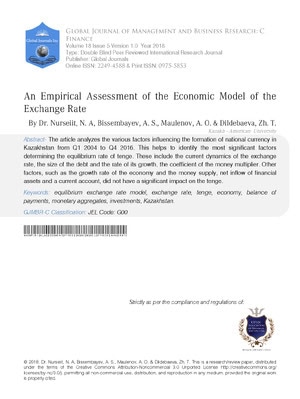
The article analyzes the various factors influencing the formation of national currency in Kazakhstan from Q1 2004 to Q4 2016. This helps to identify the most significant factors determining the equilibrium rate of tenge. These include the current dynamics of the exchange rate, the size of the debt and the rate of its growth, the coefficient of the money multiplier. Other factors, such as the growth rate of the economy and the money supply, net inflow of financial assets and a current account, did not have a significant impact on the tenge.

References

12 Cites in Article
  1. Manuel Arellano,Stephen Bond (1991). Some Tests of Specification for Panel Data: Monte Carlo Evidence and an Application to Employment Equations.
  2. K Arystanbekov (2015). Is there a connection between the early elections and the tenge rate?.
  3. Bela Balassa (1964). The Purchasing Power Parity Doctrine: A Reappraisal.
  4. Kase (2000). Annual results of Kazakhstan's transition to free floating tenge-National Bank.
  5. Liter (2018). Liter Per Liter.
  6. M Gordeyeva,D Solovyov (2015). Kazakhstan floats tenge, currency tumbles.
  7. K Rogoff (1996). The Purchasing Power Parity Puzzle.
  8. Paul Samuelson (1964). Theoretical Notes on Trade Problems.
  9. J Tica,I Druzic (2006). The Harrod-Balassa Samuelson Effect: A Survey of Empirical Evidence.
  10. H Montiel,J Peter (1999). Exchange rate misalignment: Concepts and measurement for developing countries.
  11. P Neary (1988). Determinants of the Equilibrium Real Exchange Rate.
  12. N Nurseiit (2004). Ensuring the stability of the national currency: Theory and practice of monetary policy.

Funding

No external funding was declared for this work.

Conflict of Interest

The authors declare no conflict of interest.

Ethical Approval

No ethics committee approval was required for this article type.

Data Availability

Not applicable for this article.

How to Cite This Article

Dr. Nurseiit, N.A, Bissembayev, A. S., Maulenov, A.O, Dildebaeva, Zh.T.. 2018. "An Empirical Assessment of the Economic Model of the Exchange Rate". Global Journal of Management and Business Research - C: Finance GJMBR-C Volume 18 (GJMBR Volume 18 Issue C5).

Download Citation

Journal Specifications

Crossref Journal DOI 10.17406/GJMBR

Print ISSN 0975-5853

e-ISSN 2249-4588

Keywords
Classification
GJMBR-C Classification JEL Code: G00
Version of record

v1.2

Issue date
August 6, 2018

Language
English
Order Article Reprint
Experiance in AR

Explore published articles in an immersive Augmented Reality environment. Our platform converts research papers into interactive 3D books, allowing readers to view and interact with content using AR and VR compatible devices.

Read in 3D

Your published article is automatically converted into a realistic 3D book. Flip through pages and read research papers in a more engaging and interactive format.

Article Matrices
Total Views: 1.4K
Total Downloads: 122
All Trends

Request Access

Please fill out the form below to request access to this research paper. Your request will be reviewed by the editorial or author team.
X

This is the heading

Lorem ipsum dolor sit amet, consectetur adipiscing elit. Ut elit tellus, luctus nec ullamcorper mattis, pulvinar dapibus leo.

High-quality academic research articles on global topics and journals.

An Empirical Assessment of the Economic Model of the Exchange Rate

Dr. N.A
Dr. N.A Kazakh-American University
Bissembayev, S.
Bissembayev, S.
Maulenov, A.O
Maulenov, A.O
Dildebaeva, Zh.T.
Dildebaeva, Zh.T.