
I. INTRODUCTION
According to Onodugo, Ifeanyi (2015) before the emergence of Information technology financial transaction was carried out manually, this manual method involves the use of ledger cards, also the counting of money and posting of figures manually. This method is not 100 percent accurate and is therefore prone to human error which makes the transactions inefficient and effective as errors in form of miscalculation, wrong posting and displacement of document are prone to exist. This short comings of the manual method lead to the adoption of Information technology as a model to limits the challenges of the manual method. Information technology according to (Safeena & Date 2010; Uduji, 2013) refers to the use of software, hardware, services, and the supporting infrastructures to manage and deliver information via a voice, data, and video. The introduction of IT have changed the entire business process in an unprecedented manner (Uduji, 2013). This reflect in all sectors of the economy including the banking sector, with the introduction of Electronic-banking. Prakash and Malik (2008) defined electronic banking as "the use of technology to communicate instructions and receive information from a financial institution where an account is held". They went further to explain electronic banking services include the arrangement that allows hank customers access accounts, carry out business transactions, and receive information on financial products and services online.
E-banking aims at innovating, developing, and strengthening the competition in the banking industry (Oluwatolani, Joshua, & Philip, 2011). The adoption of electronic banking have driven numerous changes in the banking industry starting from the distribution channels as evidenced with the introduction of automated teller machine (ATM), point of sale (POS), internet banking, mobile-banking, telephone-banking, PC-banking, etc.(Galiup, 2008). These technologies have replaced the manual based process and reduce the use of paper based payment instruments. Omotayo (2007) defines electronic banking as a system in which funds are moved between different accounts using computerized on line/real time systems without the use of written cheque. According to Edet, (2008) in international Journal of investment and finance, electronic banking is defined as a system by which transactions are settled electronically with the use of electronic gadgets such as ATMs, POS terminals, GSM phones, and V-cards e.t.c. handled by e-holders, bank customers, and stake holders. The link between financial sector and economic growth has been debated in financial and economic literatures. Growth theorists posit that a well-developed financial sector facilitates economic growth (Hicks, in Balago, 2014). while later theories Levine and Zervos (1996) argue that financial systems do not enhance economic growth rather respond economic growth. Theories however, posits that bank development of effective payment can enhance bank performance and in turn encourage economic growth. Studies by Cobb (2004) posit that electronic payments can also enhance improve financial transparency, government efficiency, encourage higher consumption and facilitating economic growth. As observed by Farrel and Saloner (1985) ebanking can reduce the operational cost of the bank as a result of speed associated with the use of information technology to bring about low value added transaction such as bill payment and balance inquiries process through online network.
Currently, almost commercial banks in country have customized payment platform like debit and credit cards as well as operation of ATM switch networking systems (Oyewole et al. 2013). This evolution which commenced in the early 2000s was characterized with the prevalent adoption of electronic banking by almost all the banks in Nigeria in view of the cashless policy of the Central Bank of Nigeria and the emergence of technological innovations in the banking industry. Today, Nigeria banking industry has been characterized by the deployment of ATMs, internet, phones and Point of Sale (POS) as electronic payment tools (Okoro, 2014).
Innovations and investments in high tech IT applications and business models have no doubt improved banking service greatly and also provided for efficiency and safety in payment systems through innovative payment solutions such as web pay channels, Point of sale terminals, ATM etc. Babatunde and Salawudeen (2017) opines that Nigerian banks have no doubt invested much on technology; and have widely adopted electronic and telecommunication networks for delivering a wide range of value added products and services. They have in the last few years transformed from HE manual to automated systems. Unlike before when ledge cards were used, today banking has been connected to information technology networks, thereby facilitating the practice of interbanking and inter branch banking transactions. Like it is all over the world, the banking sector plays a vital role in the entire financial system in Nigeria. This study therefore seek to understand the relation between the economic growth and e-banking.in Nigeria.
II. LITERATURE REVIEW
a) Empirical review
Amos, Umar, Busari, Ekpe, and Kolawale (2020) examined the effect of electronic banking on bank performance in Nigeria. The study utilized secondary data derived from the audited annual financial statement of the deposit money bank quoted on the Nigeria stock exchange from 2008 to 2017. The study also made use of journals, textbooks, Nigeria stock exchange fact books, the Central Bank of Nigeria (CBN) Bullion and other published materials using the multiple regression analysis techniques, the finding reveal that c-banking measured by return on equity (ROE), return on asset (ROA), and earning per share (EPS) has no significant impact on the performance of deposit money banks in Nigeria. The study recommended that for effectiveness of electronic banking, there should be rigorous campaign and awareness for clients to patronize the facilities.
Amu, Nathaniel, and Nwezeaku (2016) studied the relationship between electronic banking and the performance of Nigerian commercial banks. Electronic proxied by customers' deposits. Engle-Granger co-integration model was used to analyse data for the sample period January 2009 to December 2013. The results show that POS is not co-integrated with both the savings and time deposits but are co-integrated with demand deposits. It is recommended that the monetary authorities and commercial banks should embark on an all inclusive enlightenment campaign for the banking public on the benefits, convenience and importance of adopting ebanking channels in completing their transactions.
Ogbeide, Nwamaka, and Ishiuwu (n.d.) examined the impact of electronic banking on economic growth in Nigeria. It further determined if there exists a long-run relationship between c-banking and economic growth in Nigeria employing the Auto-regressive Distributed Lag (ARDL) bond testing technique. Economic growth (RGDP) was regressed on some measures of e-banking (Automated Teller machine, Mobile banking, Web banking and Point on Sales Terminal) for the period 2009 to 2014 quarterly data. The Pairwise Granger Causality test was also adopted to determine the direction of causality. The results of the study showed that c-banking had significant impact on economic growth. ATMs and MB were found to have a positive impact on economic growth while POS and WB showed a negative impact. One naira increase in the use of ATM and MB leads to 4.2489 and 19.8707 increases in RGDP respectively while one naira increase in POS and WB leads to 15.262 and 53.757 naira fall in RGDP. The result of the study further showed that there is a long-run relationship between ebanking and economic growth and that c-banking Granger causes economic growth in Nigeria. The study thus recommended the improvement of the technological base of the country and policy measures to encourage the efficient performance of the banking sector as well as a regulation and control of the banking activities.
Ozsoz, and Helvacioglu (2008) studied the impact of internet banking on the performance of commercial banks in Turkey from 1996 to 2000. A sample of 14 was adopted for this study. Commercial banks profitability measures include return on assets (ROA), Margin of Interest, return on equity (ROE) which served as the dependent variables. Findings revealed that in the first year of adopting internet banking, there was no positive performance between internet banking and profitability of commercial banks. While in the second and subsequent years. Some improvements in performance were seen such that return on equity (ROE) had a positive and significant relationship with internet banking. However, return on assets (ROA) had a positive but insignificant relationship with internet banking.
Francesca, and Peter (2008), conducted a comparative analysis of the effect of electronic banking on performance in four European countries namely UK, Spain, Finland and Italy. The study adopted panel data method from 1995 to 2004 using 46 banks. The dependent variables were return on assets (ROA) and return on equity (ROE). Findings revealed that banks involved in only on line banking services and those involved in mixed internet,banking services do not have any clear differences. However, the study showed that internet banking has a significant impact on European countries
Enoruwa, Ezuem, and Nwani (2019) examined the relationship between electronic banking and bank performance in Nigeria adopting data sourced from the Central Bank of Nigeria (CBN) bulletin for the period 2009 to 2017. Regression Analysis was used to test the strength and nature of relationship between the dependent and independent variable. The performance of the Nigerian banking sector was proxied by Total Bank Deposit while transaction values of Automated Teller Machine (ATM Debit Cards), Mobile Banking, Point of Sales (POS) and Web Pay was used as proxy for electronic banking. The correlation results show that electronic channel products (ATM, POS, Web pay, Mobile Pay) are positively and significantly related to bank performance. The regression result also showed that all the predictors are highly correlated to each other.
Abaenewe, Ogbulu, and Ndugbu (2013) this study investigated the profitability performance of Nigerian banks following the full adoption of electronic banking system. The study became necessary as a result of increased penetration of electronic banking which has redefined the banking operations in Nigeria and around the world. Judgmental sampling method was adopted by utilizingdata collected from four Nigerian banks. These four banks are the only banks in Nigeria that have consistently retained their brand names and remain quoted in the Nigerian Stock Exchange since 1997.
The profitability performance of these banks as measured in terms of returns on equity (ROE) and returns on assets (ROA). With the data collected, we tested the pre- and post-adoption of ebanking performance difference between means using a standard statistical technique for independent sample at 5 percent level of significance for performance factors such as ROE and ROA. The study revealed that the adoption of electronic banking has positively and significantly improved the returns on equity (ROE) of Nigerian banks. On the other hand and on the contrary, it also revealed that e-banking has not significantly improved the returns on assets (ROA) of Nigerian banks.. The findings of this study have motivated new recommendations for bank customers, bank management and shareholders with regard to electronic banking adoption for banking operations.
III. METHODOLOGY
The study adopted an ex-post facto design since it dealt with data that had already been compiled. Also, since the study is focused on the cause-effect relationship among variables and investigates variables that cannot be observed experimentally, such as those studies in this work. Descriptive Research design complimented the ex-post facto design given that the study is quantitative in nature.
The data used for the study was secondary data. The datasets were sourced from the central bank of Nigeria statistical bulletin for various years, the World Bank database and from other relevant websites. In addition, the datasets were annualized time series.
The model for this study was structured to empirically reveal the impact of electronic banking on economic growth in Nigeria. The variables used include Mobile Banking, Internet Banking, Automated Banking and economic growth proxied by Gross Domestic Product (GDP). The model follows the classical linear regression equation adapted from Books (2014) thus:
To capture the impact of electronic banking on economic growth in Nigeria, the essential variables are fitted into the classical linear regression model (CLRM) as shown thru (Electronic Banking System) To capture the various sectors, GDP is unbundled into Mobile Banking, Internet Banking,
Automated Banking and Economic Growth to reflect the GDP hypotheses.
The model were presented as follows thus:
Model:
Where:
GDP = Gross Domestic Product proxy for Economic Growth
MB = Mobile Banking
IB = Internet Banking
AB = Automated Banking e = Error Term
Constant, Coefficient of the independent variables.
Apriori expectation and
IV. RESULT AND DISCUSSION
a) Data Presentation
Table 4.1: The various variables used in our analyses are firstly presented in table below:
| YEARS | ATM-N- | ATM-TRANS - ON- | GDPQ | INRERNET | MOBILEBAN KING-N- |
| 2010Q1 | 20.86 | 2587623. | 12583478 | 1.12 | 0.29 |
| 2010Q2 | 26.91 | 3730691. | 12934531 | 1.42 | 0.46 |
| 2010Q3 | 38.30 | 6149955. | 14304438 | 3.31 | 0.61 |
| 2010Q4 | 47.17 | 7576268. | 14789817 | 2.49 | 0.86 |
| 2011Q1 | 111.17 | 26537335 | 14501448 | 8.04 | 1.11 |
| 201 1Q2 | 121.56 | 28381017 | 15054961 | 7.34 | 1.24 |
| 2011Q3 | 129.16 | 29179176 | 16163642 | 2.12 | 1.67 |
| 2011Q4 | 158.69 | 31759139 | 17260346 | 2.37 | 2.31 |
| 2012Q1 | 151.60 | 28896601 | 16450360 | 2.12 | 0.36 |
| 2012Q2 | 161.08 | 30600815 | 17743633 | 2.31 | 1.64 |
| 2012Q3 | 166.57 | 31665063 | 18521601 | 2.51 | 2.42 |
| 2012Q4 | 182.30 | 34000106 | 18998342 | 3.57 | 6.08 |
| 2013Q1 | 203.75 | 21606314 | 18295632 | 3,79 | 7.63 |
| 2013Q2 | 225.03 | 23948024 | 19931016 | 3.12 | 9.64 |
| 2013Q3 | 243.08 | 25567503 | 20464396 | 4.10 | 11.31 |
| 2013Q4 | 271.12 | 27309139 | 21401520 | 4.76 | 19.03 |
| 2014Q1 | 261.35 | 27601100 | 20169778 | 5.53 | 22.12 |
| 2014Q2 | 284.12 | 30901210 | 21734830 | 4.71 | 24.72 |
| 2014Q3 | 342.64 | 37398440 | 22933144 | 6.31 | 28.83 |
| 2014Q4 | 338.52 | 37466751 | 24205863 | 8.12 | 39.83 |
| 2015Q1 | 312.65 | 33957223 | 21041701 | 7.59 | 30.54 |
| 2015Q2 | 320.81 | 34911205 | 22859153 | 5.68 | 33.48 |
| 2015Q3 | 337.16 | 36704113 | 24313637 | 7.46 | 36.44 |
| 2015Q4 | 352.79 | 38956667 | 25930469 | 9.79 | 47.00 |
| 2016Q1 | 356.66 | 41596729 | 22235315 | 10.56 | 45.08 |
| 2016Q2 | 378.16 | 45463562 | 23547467 | 8.76 | 56.09 |
| 2016Q3 | 415.60 | 51055678 | 26537651 | 10.25 | 74.35 |
| 2016Q4 | 512.28 | 58630343 | 29169059 | 14.54 | 76.77 |
| 2017Q1 | 500.68 | 59654903 | 26028356 | 15.53 | 86.86 |
| 2017Q2 | 514.74 | 62601810 | 27030250 | 12.36 | 98.41 |
| 2017Q3 | 519.58 | 64695576 | 29377674 | 15.19 | 79.78 |
| 2017Q4 | 610.85 | 79897410 | 31275354 | 18.45 | 102.27 |
| 2018Q1 | 522.98 | 70790284 | 28438604 | 20.25 | 109.71 |
| 2018Q2 | 534.51 | 72472654 | 30699567 | 17.75 | 136.86 |
| 2018Q3 | 530.34 | 73423457 | 33368049 | 70.40 | 165.88 |
| 2018Q4 | 572.32 | 75153374 | 35230608 | 73.84 | 197.65 |
| 2019Q1 | 513.09 | 67653224 | 31824350 | 35.88 | 33.56 |
| 2019Q2 | 566.39 | 73886648 | 34944152 | 38.75 | 385.21 |
| 2019Q3 | 540.98 | 70942146 | 37806924 | 40.19 | 476.04 |
Table 4.2: Basic Descriptive Statistics of the Variables under Study
| Options | GDPQ | NO | ATM | INTERNET | NG |
| Mean | 230.79 | 41.819 | 323.6 | 13.92 | 75.41 |
| Median | 22.23 | 35.80. | 328.9 | 7.52 | 32.01 |
| Std. Dev. | 671.16 | 21.76 | 20.86 | 1.12 | 0.29 |
| Skewness | 0.376 | 0.148 | 178.94 | 17.45 | 126.36 |
| Kurtosis | 2.242 | 2.031 | 0.058877 | 2.172 | 2.647 |
| Jarque-Bera | 1.852 | 1.711 | 1.750 | 7.16 | 9.486 |
| Observations | 40 | 40 | 40 | 40 | 40 |
Table 4.2 shows descriptive statistics of the variables. Descriptive statistics used to measure the impacts of electronic banking on economic growth in Nigeria. The aggregate mean of GDPQ (230.79), NO (41.819), ATM (323.6), INTERNET (13.92) and NG (75.41) respectively. Median option discuss like GDOQ (22.79), NO (35.80), ATM (328.9), INTERNET (7.52) and
NG (32.01). Standard Deviation GDPQ (671.16), NO (21.76), ATM (20.86), INTERENT (1.12) and NG (0.29). The Skewness which measure symmetry or departure from symmetry and Kurtosis which is a measure of peakedness or flatness of the distribution or series are also shown. The Jarque -Berastatistics generally suggests there is no normality.
b) Correlation Matrix
Table 4.3: Correlation Analysis Result
| VARIABLE | GDPGR | CLAIMS | DD | INCOME | LADY | MCAP |
| GSPQ | - | - | - | - | ||
| ATM TRANS | 0.93492016.025860.0000 | - | - | - | ||
| ATM NO | 0.96085321.095340.0000 | 0.95 764820.230200.0000 | - | - | ||
| INTERNET | 0.7787317.5504550.0000 | 0.7275106.4499240.0000 | 0.6747405.5609390.0000 | - | ||
| MOBILEBANKING | 0.7895877.8268690.0000 | 0.6896175.7924970.0000 | 0.6674765.452500.0000 | 0.6930845.8484110.0000 | - | - |
From the results all the series share bivariate and significant correlation one with another. This is evidenced by the fact that their respective correlation coefficients are positive or negative and the probability values of the associated t-statistics are respectively significant by all being less than 0.05.
c) Graphical Presentation
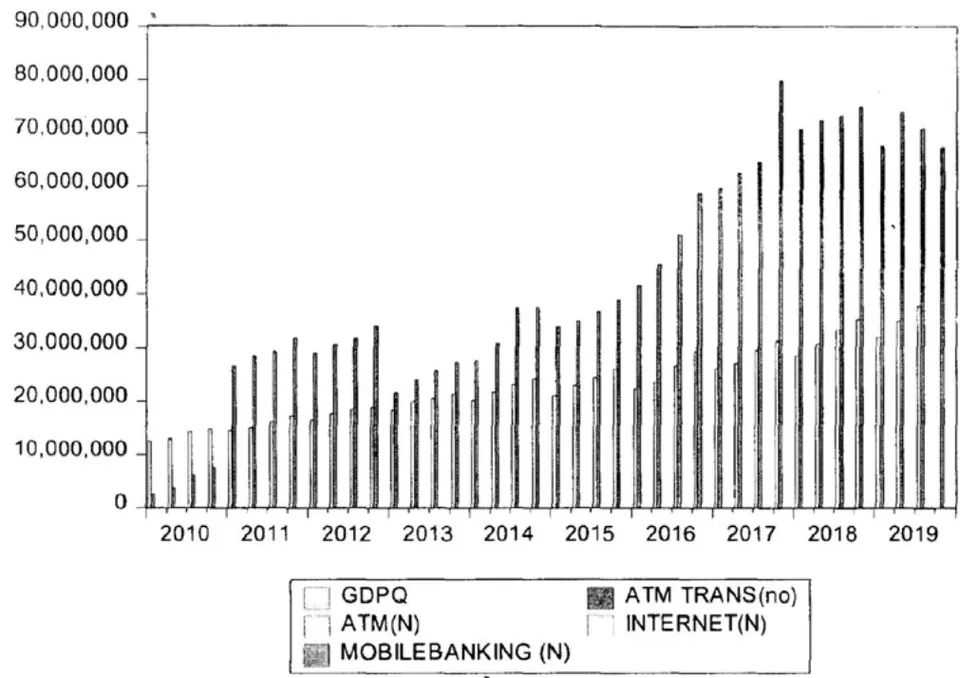
The graphical representation can be used to understand the trend of the various macroeconomic variables from 2010 to 2019. According to the graph in figure 4.1, it shows that all the independent variables from 2010 showed staggered movement.
The ARDL test results for hypothesis one are presented in box 4.5.1 below:
| LOG (MB) Coeff = 0.173552 | |
| t = (0.048175) | |
| Se = [-3.602538] | |
| PVALUE = 0.002<0.05 |
Source: Extract from ARDL Regression Model Estimation Results.
As revealed, Mobile banking showed significant impact to the growth rate of the Nigeria economy (coefficient of Mobile banking = 0.1735, t-value 0.048175). This indicates that increase in GDPGR in Nigeria is due to increase in Mobile banking, The probability value of confirms the significance of the result. Given the t-statistics of mobile banking (-3.6025) and the probability of t-statistics 0.00 being significant, we reject the null hypothesis and conclude that mobile banking had significant impact on the growth rate of the Nigeria economy.
The ARUL test results for hypothesis two are presented in box 4.5.2 below:
| LOG (MB) Coeff = 0.823344 |
| t = (0.159879) |
| Se = [0.15989] |
| PVALUE = 0.001<0.05 |
Source: Extract from ARDL Regression Model Estimation Results.
ATM showed significant impact on the growth rate of the Nigeria economy (coefficient of ATM = 0.823344, t-value = 0.159879). This indicates that a one percent increase in GDPGR output in Nigeria is due to increase in ATM, The probability value of confirms the significance of the result.
Given the t-statistics of ATM (-3.6025) and the probability of t-statistics being significant, we reject the null hypothesis and conclude that ATM had significant impact on the growth rate of the Nigeria economy.
The ARDL test results for hypothesis three are presented in box 4.5.3 below:
| LOG (MB) Coeff = 0.2499 T = (7.158155) Se = [0.034916] PVALUE = 0.0000<0.05 |
Source: Extract from ARDL Regression Mode! Estimation Results.
Internet banking showed significant impact on the growth rate of the Nigeria economy (coefficient of INTB 0.2499, t-value = 7.158155). This indicates that a growth in internet banking in Nigeria causes a increase in the growth rate of the economy. The probability value of confirms the significance of the result. Given the t-statistics of Internet banking (0.034916) and the probability oft-statistics being significant, we reject the null hypothesis and conclude that Internet banking had significant Impact to the growth rate of the Nigeria economy.
V. CONCLUSION AND RECOMMENDATION
The internet banking in economic growth in Nigeria should recommend the improvement of technological base of the country and policy measure to encourage the efficient performance of the banking sector as well as regulation and control of the banking activities.
E-banking is playing a major role that it's improving the service quality and strengthen the banking sector because of the electronic payment, there is an increase in customer satisfaction level, increase in productivity, reduction in cost of banking operations, settlement faster and in large volume.