
An Esthetic-Oriented Evaluation Paradigm: Review and Practice of Educational Connoisseurship and Educational Criticism Theory

1
Lu Zizhen
Lu Zizhen
1 Nanjing Normal University

Send Message

To: Author

GJHSS Volume 22 Issue G3

Article Fingerprint

ReserarchID

2F6BF

An Esthetic-Oriented Evaluation Paradigm: Review and Practice of Educational Connoisseurship and Educational Criticism Theory Banner
  • English
  • Afrikaans
  • Albanian
  • Amharic
  • Arabic
  • Armenian
  • Azerbaijani
  • Basque
  • Belarusian
  • Bengali
  • Bosnian
  • Bulgarian
  • Catalan
  • Cebuano
  • Chichewa
  • Chinese (Simplified)
  • Chinese (Traditional)
  • Corsican
  • Croatian
  • Czech
  • Danish
  • Dutch
  • Esperanto
  • Estonian
  • Filipino
  • Finnish
  • French
  • Frisian
  • Galician
  • Georgian
  • German
  • Greek
  • Gujarati
  • Haitian Creole
  • Hausa
  • Hawaiian
  • Hebrew
  • Hindi
  • Hmong
  • Hungarian
  • Icelandic
  • Igbo
  • Indonesian
  • Irish
  • Italian
  • Japanese
  • Javanese
  • Kannada
  • Kazakh
  • Khmer
  • Korean
  • Kurdish (Kurmanji)
  • Kyrgyz
  • Lao
  • Latin
  • Latvian
  • Lithuanian
  • Luxembourgish
  • Macedonian
  • Malagasy
  • Malay
  • Malayalam
  • Maltese
  • Maori
  • Marathi
  • Mongolian
  • Myanmar (Burmese)
  • Nepali
  • Norwegian
  • Pashto
  • Persian
  • Polish
  • Portuguese
  • Punjabi
  • Romanian
  • Russian
  • Samoan
  • Scots Gaelic
  • Serbian
  • Sesotho
  • Shona
  • Sindhi
  • Sinhala
  • Slovak
  • Slovenian
  • Somali
  • Spanish
  • Sundanese
  • Swahili
  • Swedish
  • Tajik
  • Tamil
  • Telugu
  • Thai
  • Turkish
  • Ukrainian
  • Urdu
  • Uzbek
  • Vietnamese
  • Welsh
  • Xhosa
  • Yiddish
  • Yoruba
  • Zulu

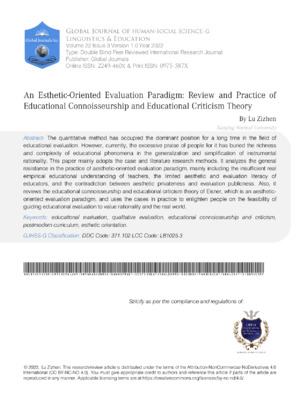
The quantitative method has occupied the dominant position for a long time in the field of educational evaluation. However, currently, the excessive praise of people for it has buried the richness and complexity of educational phenomena in the generalization and simplification of instrumental rationality. This paper mainly adopts the case and literature research methods. It analyzes the general resistance in the practice of aesthetic-oriented evaluation paradigm, mainly including the insufficient real empirical educational understanding of teachers, the limited aesthetic and evaluation literacy of educators, and the contradiction between aesthetic privateness and evaluation publicness. Also, it reviews the educational connoisseurship and educational criticism theory of Eisner, which is an aestheticoriented evaluation paradigm, and uses the cases in practice to enlighten people on the feasibility of guiding educational evaluation to value rationality and the real world.

Funding

No external funding was declared for this work.

Conflict of Interest

The authors declare no conflict of interest.

Ethical Approval

No ethics committee approval was required for this article type.

Data Availability

Not applicable for this article.

Lu Zizhen. 2026. \u201cAn Esthetic-Oriented Evaluation Paradigm: Review and Practice of Educational Connoisseurship and Educational Criticism Theory\u201d. Global Journal of Human-Social Science - G: Linguistics & Education GJHSS-G Volume 22 (GJHSS Volume 22 Issue G3): .

Download Citation

Comprehensive review of educational evaluation paradigms and practices.
Issue Cover
GJHSS Volume 22 Issue G3
Pg. 23- 27
Journal Specifications

Crossref Journal DOI 10.17406/GJHSS

Print ISSN 0975-587X

e-ISSN 2249-460X

Keywords
Classification
GJHSS-G Classification: DDC Code: 371.102 LCC Code: LB1025.3
Version of record

v1.2

Issue date

April 29, 2022

Language

English

Experiance in AR

The methods for personal identification and authentication are no exception.

Read in 3D

The methods for personal identification and authentication are no exception.

Article Matrices
Total Views: 1726
Total Downloads: 21
2026 Trends
Research Identity (RIN)
Related Research

Published Article

The quantitative method has occupied the dominant position for a long time in the field of educational evaluation. However, currently, the excessive praise of people for it has buried the richness and complexity of educational phenomena in the generalization and simplification of instrumental rationality. This paper mainly adopts the case and literature research methods. It analyzes the general resistance in the practice of aesthetic-oriented evaluation paradigm, mainly including the insufficient real empirical educational understanding of teachers, the limited aesthetic and evaluation literacy of educators, and the contradiction between aesthetic privateness and evaluation publicness. Also, it reviews the educational connoisseurship and educational criticism theory of Eisner, which is an aestheticoriented evaluation paradigm, and uses the cases in practice to enlighten people on the feasibility of guiding educational evaluation to value rationality and the real world.

Our website is actively being updated, and changes may occur frequently. Please clear your browser cache if needed. For feedback or error reporting, please email [email protected]
×

This Page is Under Development

We are currently updating this article page for a better experience.

Request Access

Please fill out the form below to request access to this research paper. Your request will be reviewed by the editorial or author team.
X

Quote and Order Details

Contact Person

Invoice Address

Notes or Comments

This is the heading

Lorem ipsum dolor sit amet, consectetur adipiscing elit. Ut elit tellus, luctus nec ullamcorper mattis, pulvinar dapibus leo.


High-quality academic research articles on global topics and journals.

An Esthetic-Oriented Evaluation Paradigm: Review and Practice of Educational Connoisseurship and Educational Criticism Theory

Lu Zizhen
Lu Zizhen Nanjing Normal University

Research Journals





























































